Quality Control Checklist for Bicycles From Bangladesh
A numbered QC checklist for bicycles from Bangladesh: frame and fork alignment, wheel trueness, brake stop tests, gear indexing, torque checks, reflectors and packing for complete bikes and CKD kits, with fixes for common failures.
Short answer
Use this bicycles quality control checklist to check frame and fork alignment, wheel trueness and spoke tension, brake stopping and pad alignment, headset and stem torque, gear indexing under load, saddle and reflector fit, and packing for complete bikes or CKD kits from Bangladesh before shipment. Agree tolerances, test methods and acceptance numbers in the purchase order.

On this page
Key takeaways
Agree the sample, geometry chart, torque table, test methods and acceptance numbers before inspection, and draw the sample randomly across models, colors and cartons.
Check safety in motion, not only on the bench: brake stop tests, gear indexing under load, wheel trueness and headset play catch the faults a carton check misses.
Treat frame, fork and brake failures as safety failures to segregate and escalate, separate from cosmetic faults such as paint chips.
Record numbers, not only pass marks: tire pressure, lever reach, torque values and serial numbers settle later disputes from evidence.
If you buy bicycles from Bangladesh, this bicycles quality control checklist gives you a practical way to check a shipment before it leaves the factory. A bicycle is judged in motion: a brake that pulls to one side, a wheel that runs out of true, or a gear that skips under load shows as soon as the bike is ridden. Use this checklist on assembled bikes and on knocked-down kits.
ISO 4210-2:2023 sets safety and performance requirements for the design, assembly and testing of city and trekking, young adult, mountain and racing bicycles.1 It requires at least two independently actuated braking systems, front and rear, and a smooth, safe stop without excessive juddering, front wheel locking, overturning, loss of control or excessive side-skid.1
Why this checklist matters
Bicycles concentrate risk in moving parts: frame alignment decides whether the bike tracks straight, brake setup decides whether it stops straight, and gear indexing decides whether the chain stays on. A fault hidden inside a carton, such as a loose headset or a bent derailleur hanger, becomes a warranty claim at the destination.
A written checklist removes interpretation: each point is checked against the approved sample and purchase order, and recorded as pass, fail or not applicable. Safety failures, such as a cracked frame or a brake that cannot stop the bike, are kept separate from cosmetic faults.
Before you start
Do not begin until the references are complete: an approved sample per model and color, the purchase order, the geometry chart, the component list, the torque table, and the packing specification for complete bikes or completely knocked down (CKD) kits. Agree the sampling plan in advance, and draw the sample randomly across models, colors and cartons.
ISO 2859-1 specifies an acceptance sampling system for inspection by attributes, indexed by acceptance quality limit (AQL), for lot-by-lot inspection.2 See the AQL acceptance quality limit explainer, and read the pre-shipment inspection guide before the inspection day.
For the United States, confirm which market rules apply to the model. Under the US bicycle rule, a bicycle with only handbrakes must stop within 4.57 m (15 ft), and caliper brake pads must be replaceable and adjustable so they engage the braking surface without contacting the tire or spokes.3 For the EU and UK, confirm the ISO 4210 edition named in the purchase order.
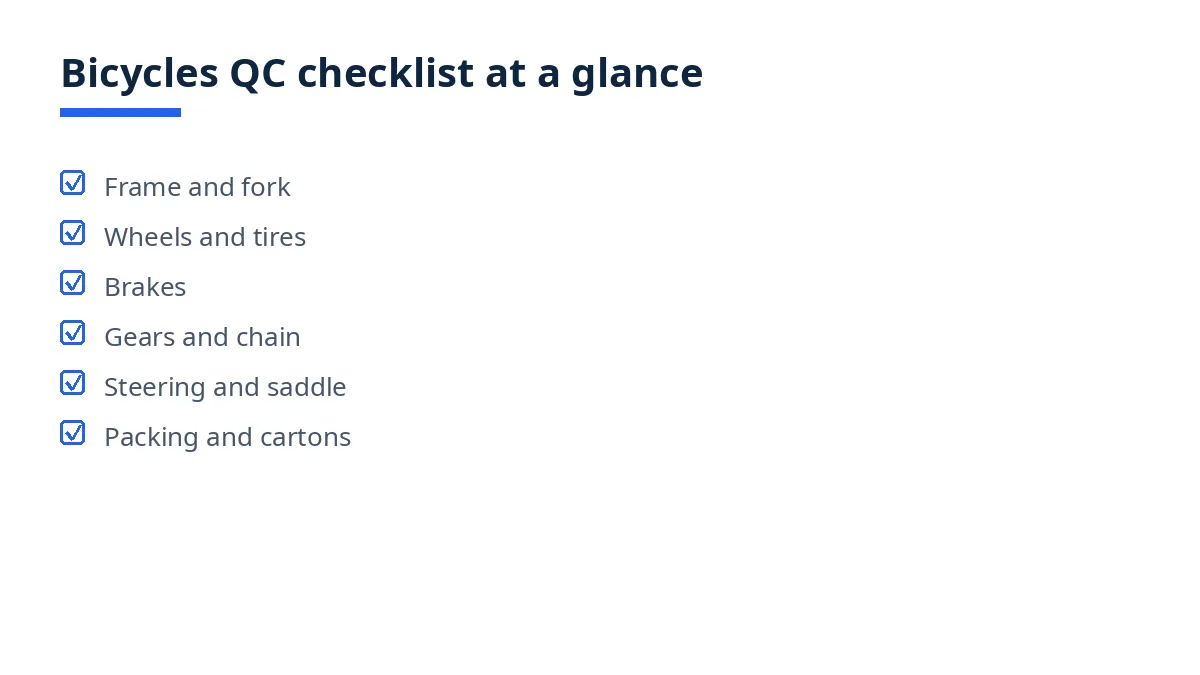
The full checklist (numbered, printable)
Frame, fork and paint
Check the frame and fork for cracks, dents, bends and weld defects, especially at the head tube, bottom bracket and dropouts.
Check frame alignment: both wheels sit centered, and the bike tracks straight.
Check the fork for bent blades, twisted legs and damaged dropouts, and confirm the model and steerer type.
Check paint and decals for runs, chips, blistering, rust spots and misaligned logos against the approved sample.
Check threaded parts for crossed or stripped threads and missing bolts, and confirm fastener types match the list.
Wheels, tires and spokes
Spin each wheel and check trueness laterally and radially, recording any wobble touching a pad or the frame as a failure.
Check spoke tension by hand for loose, broken or missing spokes, and confirm no spoke protrudes through the tape.
Check hubs for play and rough bearings, and confirm quick releases or thru-axles are tightened correctly.
Check tires for cuts, bulges, exposed casing and tread defects, and confirm size, tread pattern and rotation direction match the specification.
Inflate each tire to the sidewall range, check the bead seats evenly, and confirm the valve cap is present.
Check rim condition on rim-brake wheels, including wear indicators, and check disc rotors for bends, contamination and rub.
Brakes
Check that both brakes are present and independently actuated, front and rear, as ISO 4210-2:2023 requires.1
Check brake lever position and reach in the normal riding position. Under the US rule, grip dimension must not exceed 89 mm between pivot point and lever midpoint, and 76 mm for sidewalk bicycles.3
Check pads: they meet the braking surface squarely, do not touch the tire or spokes, and retain material above the wear limit.
Check cable condition: no fraying, kinking, cutting at the anchor bolt or abrasion over fixed parts, and cable ends capped.
Test each brake separately on a short ride: the bike stops smoothly in a straight line without juddering, wheel locking or loss of control.1
For foot brakes, check independent operation from gear position. Under the US rule, footbrake force must reach at least 178 N for a 310 N pedal force.3
Steering, headset, handlebar and stem
Check the headset for play and binding: rock the bike with the front brake on, then turn the bars and feel for notches.
Check handlebar and stem alignment: the bar sits centered and square to the front wheel, and the stem sits within its height marks.
Check every stem, handlebar and headset bolt against the torque value printed on the part, using a calibrated torque wrench.4
Check grips and bar ends: grips are secure and seated, bar plugs are fitted, and no sharp bar end is exposed.
Drivetrain, gears and chain
Check the chain for stiff links, correct length and lubrication, and measure elongation where the purchase order requires it.
Check chainrings, cassette and jockey wheels for hooked, bent or missing teeth, and confirm gear ratios match the specification.
Check derailleur hanger alignment, since a bent hanger causes skipping that cable adjustment cannot fix.
Shift through every gear under load: each shift engages cleanly, the chain does not skip or drop, and limit screws prevent overshift.4
Check the bottom bracket for play and rough rotation, and check crank arms and pedals for tightness and correct left and right fitting.5
Saddle, seatpost and accessories
Check the saddle for level position, secure clamping and torn covering, and confirm the saddle model matches the specification.
Check the seatpost minimum-insertion mark: the mark stays inside the frame, and the clamp holds the post without slipping.
Check reflectors and lights for the destination market. Under the US rule, a bicycle must carry a colorless front reflector, colorless or amber pedal reflectors, a red rear reflector, and side reflectors or retroreflective tire sidewalls.6
Check fitted accessories named in the specification, such as fenders, racks, kickstands, bells and lights, for secure fitting and working function.5
Measurements to record
Record frame size, wheel size and tire size for each sampled bike, and compare them with the geometry chart.
Record tire pressure, brake lever reach and torque values checked, rather than pass marks alone.
Record the serial number or batch code for each sampled bike, and confirm the frame marking matches the packing list.
Packing and cartons
For complete bikes, check that each bike is protected at the frame, fork, wheels and derailleur, and that the carton is sealed.
For CKD kits, check that every kit-list part is present, small parts are bagged and labeled, and the assembly manual is inside the carton.
Weigh and measure sample cartons, check markings and count against the packing list, and confirm the manual and warranty card are included.
Common failures and how to fix them
The most frequent failure is a brake that stops poorly or pulls to one side, usually because pads are misaligned, a cable is stretched, or a rotor is bent. Stop, check pad alignment and cable tension on a sampled bike, and test each brake separately. Next is a gear that skips under load, which traces most often to a bent derailleur hanger or a worn chain: check hanger alignment before adjusting cables.
Wheels out of true usually start at uneven spoke tension or transit damage: re-true a sampled wheel and check the batch for the same pattern. Loose headsets point to incorrect preload: reset preload and re-check the batch. Paint chips cluster where cartons lack protection: add frame protection and re-inspect the affected cartons.
Above the agreed acceptance level, options are re-inspection after sorting or rework, documented partial acceptance, or rejection. Safety failures, such as a cracked frame or a brake that cannot stop the bike, are not reworked on the inspection table: segregate those bikes and escalate them.
Downloadable template / summary table
Copy the checklist into your inspection sheet, add the geometry chart, torque table and acceptance numbers, and record a result per bike.
Section | Checks | Evidence |
|---|---|---|
Frame and fork | Cracks, alignment, paint | Visual check, roll test |
Wheels and tires | Trueness, spokes, pressure | Spin check, gauge reading |
Brakes | Pads, cables, stop test | Ride test, lever check |
Steering | Headset, stem, bar | Play check, torque values |
Drivetrain | Chain, gears, bottom bracket | Shift test under load |
Saddle and accessories | Seatpost, reflectors, lights | Fit check, function test |
Packing | Complete bike or CKD kit | Carton check, packing list |
How Exportain helps
Exportain is a B2B marketplace connecting buyers with Bangladeshi suppliers of bicycles and light engineering goods, so specifications behind this checklist can be agreed at the enquiry stage. Browse suppliers, plan the check with inspection services, and read the pre-shipment inspection guide before the inspection day. Supplier profiles show which document and photo checks have been recorded, not factory inspections. Exportain is not a party to the goods contract.
FAQs
When should this checklist be used?
Use it at final inspection, when bikes are finished, assembled and largely packed. For larger and first orders, also use it in production, while brake setup, gear indexing and wheel trueness can still be corrected.
Who should complete it?
The buyer, a local agent or an independent inspector can complete it, using the approved sample, geometry chart, torque table and a randomly drawn sample. Safety checks need a person who can ride the bike and judge the result.
What are the most common failures?
Brake misalignment, gears skipping under load, wheels out of true, loose headsets, paint damage and missing CKD kit parts are the failures buyers find most often.
Can a third party do it?
Yes, if you share the approved references, torque values and acceptance levels first, and name which market rule applies.
Next steps on Exportain
Before production starts, agree your geometry chart, component list, torque table and packing specification, then read the AQL acceptance quality limit explainer and the pre-shipment inspection guide, and plan the check with inspection services. You can also post a free RFQ via RFQs and compare quotes from Bangladeshi suppliers.
Sources
- ISO 4210-2:2023 - City, Trekking, Mountain & Racing Bicycles. ANSI, (accessed )
- ISO 2859-1:1999 - Sampling procedures for inspection by attributes — Part 1: Sampling schemes indexed by acceptance quality limit (AQL) for lot-by-lot inspection. International Organization for Standardization (accessed )
- 16 CFR § 1512.5 - Requirements for braking system. Cornell Law Institute (accessed )
- Bike Tune-Up Checklist: 3 Tiers for Shops. BIKE.co (accessed )
- Checklist; Bike ready-to-deliver. Cycleurope (accessed )
- 16 CFR § 1512.16 - Requirements for reflectors. Cornell Law Institute (accessed )
- pre-shipment inspection
- quality control
- Bangladesh exports
- aql inspection
- Light engineering Bangladesh
- Bicycles
About the author
Sourcing from Bangladesh?
Post a request for quotation and suppliers on Exportain can send you their quotes directly.
Post an RFQ