How to Import Potatoes From Bangladesh in 2026: Complete Buyer Guide
A step-by-step guide to importing fresh potatoes from Bangladesh: varieties, harvest seasons, phytosanitary rules, grading and packing, cold-chain shipping, documents and landed cost.
Short answer
To import potatoes from Bangladesh, confirm your country accepts Bangladeshi ware potatoes, then agree the variety, size band, pack, quantity, price and Incoterm in writing. Buy during the January to March harvest when possible, get a phytosanitary certificate from the Plant Quarantine Wing within 24 hours of shipment, ship table potatoes at about 7.5 degrees Celsius in a reefer container, and inspect the load before paying the balance.
On this page
Key takeaways
Bangladesh harvested a record 11.57 million tonnes of potatoes in 2024-25, but exported only about 62,000 tonnes.
The main harvest runs from mid-January to March; cold storage extends supply through the year.
The phytosanitary certificate is valid for 24 hours for perishable goods, so book inspection close to loading.
Ship table potatoes at about 7.5 degrees Celsius and processing potatoes at about 10 degrees Celsius.
Bangladesh is not on the EU list of origins for ware potatoes, so check your destination's plant-health rules first.
Fresh potatoes from Bangladesh suit buyers who need large volumes of table or processing potatoes at a low price, and who can manage a short harvest window and a strict cold chain. This guide covers the full process, from choosing a variety to clearing the shipment at your port.
Why buy potatoes from Bangladesh?
Bangladesh produced 11.57 million tonnes of potatoes in the 2024-25 financial year, the highest harvest on record, grown on 4.92 lakh hectares of land.1 Domestic demand is just over 9 million tonnes a year, including about 1 million tonnes kept for seed.1 Exports are still small next to production: just over 62,000 tonnes left Bangladesh in 2024-25, up from about 12,300 tonnes the year before.1
Exporters were procuring potatoes at around USD 0.05 to 0.16 per kg in the 2024-25 season, down from about USD 0.25 per kg the year before, and some exporters reported shipping at approximately USD 300 per tonne.2 The main destinations in recent seasons have been Malaysia, Singapore, Saudi Arabia, Nepal, the United Arab Emirates, Qatar, Bahrain, Kuwait, Sri Lanka, Oman, Canada and the Maldives.3
Which potato varieties should you buy?
Potatoes are traded by end use: table (ware), processing and seed. A table potato is bought on variety, shape, skin and flesh colour, uniformity and freedom from greening, sprouts, soil and damage. A processing potato is also bought on storage history, because tubers held too cold build up sugars that darken in the fryer.4
| Variety | Main end use | | Diamond | Table, storage | | Granola | Table, export | | Asterix | Processing, frying | | Lady Rosetta | Processing, crisps | | Santana | Processing, French fries | | Sunshine | Table, retail packs |
The varieties Bangladesh exports include Diamond, Granola, Asterix, Lady Rosetta, Santana, Courage and Sunshine.2 Seed potatoes fall under HS 0701.10 and ware potatoes under HS 0701.90; see our HS code guide for potatoes. Name the variety and the end use in your order, because a supplier who quotes "potatoes" without a variety has not given you a specification you can inspect against.
When is the best time to buy potatoes from Bangladesh?
The main harvest starts in mid-January and runs until March each year, with early varieties reaching the market from December.1 The buying window for fresh-harvest tubers is roughly December to March, and prices are usually lowest during the harvest.
Cold storage stretches the season. About 2.9 million tonnes of potatoes were held in cold storage in Bangladesh in August 2025, months after the harvest ended.1 Stored tubers can ship through the year, but ask how long the lot has been stored and at what temperature, because storage history changes frying quality and sprouting risk.4
What does the import process look like, step by step?
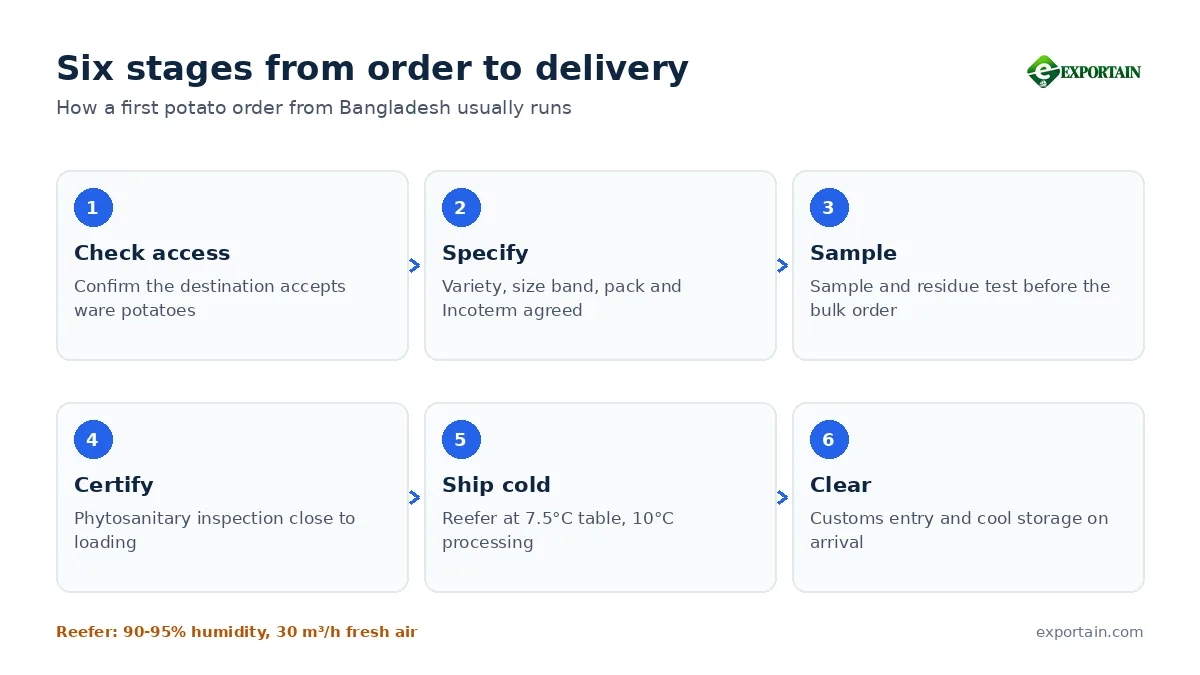
Importing fresh potatoes from Bangladesh follows seven stages. The phytosanitary certificate and the cold chain are the two stages that most often delay a first shipment.
Confirm that your country accepts ware potatoes from Bangladesh and note its plant-health conditions.
Agree the variety, size band, pack, quantity, price and Incoterm in writing, with a named inspection point.
Ask for a pre-shipment sample and a residue test result.
Book the phytosanitary inspection close to the loading date.
Load at the agreed pulp temperature and check the reefer settings.
Ship with the documents sent to your customs broker.
Clear customs on arrival and move the potatoes to cool storage without delay.
What does the phytosanitary process require?
A phytosanitary certificate is the official document, issued by the exporting country's national plant protection organization, confirming that a consignment was inspected or tested and meets the importing country's plant-health requirements. The international standard for these certificates is ISPM 12, issued under the International Plant Protection Convention.5 The certificate must match the commercial invoice, packing list and bill of lading on consignee, quantity, description and botanical name, and any hand-written correction after issue makes it invalid.5
In Bangladesh, the certificate is issued by the Plant Quarantine Wing of the Department of Agricultural Extension. The exporter applies at least one day before shipment for perishable goods, and the certificate is valid for 24 hours for perishable goods.6 That short validity is the main timing risk in the whole process: the inspection must happen close to loading, and a delayed vessel can leave you with an expired certificate.
Check your destination's rules before you order, because they differ sharply by market. Under the EU plant-health regulation, Implementing Regulation (EU) 2019/2072, ware potatoes may enter the EU from non-EU countries only from a short list of origins, and only with an official statement that they come from areas where brown rot is known not to occur. Bangladesh is not on that list, so Bangladeshi ware potatoes sell mainly in Asia and the Middle East.4 Some buyers also ask for residue results for chlorpropham (CIPC), a sprout suppressant whose EU approval was not renewed in 2020.4 Wood packaging is covered by the ISPM 15 treatment mark, not by the phytosanitary certificate, so use marked pallets or plastic pallets.5
How are potatoes graded and packed for export?
Grading decides whether the load survives the voyage in saleable condition. A good fresh-market tuber is turgid, well shaped and uniform, with no adhering soil, damage, greening, sprouts or disease.7 After harvest, tubers are cured for 10 to 14 days at 12 to 16 degrees Celsius and 85 to 95 percent relative humidity, which heals wounds and toughens the skin before packing.4
Write the grade into the contract as a size band in millimetres and a defect limit for greening, sprouting, cuts, bruising, soil and rot, not as a general phrase such as "good quality". Our potato quality control checklist lists the checks to put in the contract.
Packing for export is usually 25 kg jute or leno mesh bags, or 10 kg ventilated cartons.4 Mesh bags ventilate the tubers and let inspectors see the contents, which matters for a perishable load. Mark each bag or carton with the variety, size band, lot number, net weight and country of origin, so a problem at destination can be traced to one lot. Never mix varieties or lots in one bag.
How should potatoes be shipped?
Potatoes are perishable, and the cold chain is what protects their value. Table potatoes travel at about 7.5 degrees Celsius and processing potatoes at about 10 degrees Celsius, at 90 to 95 percent relative humidity, with about 30 cubic metres per hour of fresh air in a reefer container.7 Ventilated or open-sided containers are an alternative for short sea routes, but a reefer gives the most control on a longer voyage.7
The temperature band is narrow. Below about 3 degrees Celsius tubers turn sweet, above 6 to 7 degrees they begin to sprout as dormancy ends, and they freeze at minus 2 to minus 3 degrees Celsius.4 Storage at 0 to 2 degrees increases the risk of freezing or chilling injury.7 Put the set temperature, the ventilation rate and the maximum pulp temperature at loading in the contract, and ask the supplier to record the pulp temperature of several tubers at loading.
One hazard catches first-time buyers out. If a cold cargo is discharged into a warm, humid atmosphere, condensation can follow, then a lack of oxygen in the load, then bacterial soft rot. Warm the cargo gradually before arrival so its temperature sits above the expected dew point at the discharge port.7 Tell your forwarder the discharge port climate and agree the warming plan before the vessel sails, and move the potatoes into cool storage as soon as customs releases them. Sea freight is the normal route; air freight is not practical for a low-value, heavy tuber.
What documents do you need?
Every document must agree on the product, quantity, consignee and marks. A mismatch between the phytosanitary certificate and the bill of lading is one of the most common reasons a perishable shipment is held at the border.5
| Document | Who issues it | What to check | | Commercial invoice | Supplier | Variety, quantity, unit price and Incoterm match the contract | | Packing list | Supplier | Bag count, net and gross weight, marks and lot numbers | | Phytosanitary certificate | Plant Quarantine Wing, DAE | Issued within 24 hours of shipment for perishables6 | | Certificate of origin | Chamber of commerce | Needed for preferential duty | | Bill of lading | Shipping line | Consignee, port, container number and seal match the packing list | | Residue test report | Accredited laboratory | Results against your destination's limits |
Your supplier's agro-products exporter licence, issued by the Department of Agricultural Marketing and valid for one year, is part of the supplier's own compliance.6 If you pay by letter of credit, the document list in the credit must match this list exactly, or the bank will refuse payment on a document mismatch. Our letter of credit guide explains how the document check works.
How much does it cost to land potatoes?
Freight, insurance, duty and local handling decide the landed cost per tonne, and duty depends on your country's tariff for HS 0701.90. Our landed cost guide explains the full calculation.
The table below works through one container. Example figures: these numbers are illustrative, not a quotation.
| Cost item | Example figures | | 25 tonnes of table potatoes, FOB, at USD 300 per tonne | USD 7,500 | | Sea freight, reefer container to a Gulf port | USD 1,800 | | Marine insurance at 0.5 percent of goods plus freight | USD 47 | | CIF value | USD 9,347 | | Import duty at 5 percent of CIF value | USD 467 | | Port handling, customs broker and local transport | USD 350 | | Total landed cost | USD 10,164 | | Landed cost per tonne | USD 407 |
In this example, freight, duty and handling add about USD 107 per tonne to the FOB price. A longer route or a higher duty rate moves the total up. Ask for the quotation on the same Incoterm from every supplier so the prices compare like with like. Under FOB the supplier's price stops at the vessel, while under CIF the supplier also pays freight and insurance to your port.
How do you check quality before you pay?
Do not pay the full balance before an inspection. Agree in the contract that a third-party inspector checks the load at the packing point or at loading, and that the balance is paid only after the inspection report is issued. The inspector should check the size band, defect share, sprouting, greening, pulp temperature and packing against the contract. Our pre-shipment inspection guide explains how to set the inspection up and what the report should contain.
What mistakes do first-time potato buyers make?
Ordering without naming the variety and end use, then receiving a processing potato when they needed a table potato.
Assuming EU market access. Bangladesh is not on the EU list of origins for ware potatoes, so check your destination's plant-health rules first.4
Booking the phytosanitary inspection too early. The certificate is valid for 24 hours for perishable goods, so a delayed vessel can leave it expired.6
Shipping too cold. Tubers held below about 3 degrees Celsius turn sweet, and processing potatoes stored too cold darken when fried.4
Accepting a vague grade. "Good quality" cannot be inspected; a size band and a defect limit can.
Paying in full before inspection. The balance should follow the inspection report, not precede it.
Next steps on Exportain
Start by comparing suppliers and prices on Exportain suppliers, then post a request for quotation with the variety, size band, pack and shipment month at post an RFQ. Read how to buy on Exportain before you place your first order.
Sources
- Potato output hits historic high, raises concerns of surplus. The Daily Star, (accessed )
- Bangladesh potato exports hit a three-year peak. FreshPlaza (accessed )
- Potato exports rising as prices drop locally. The Daily Star, (accessed )
- Fresh Potatoes: Ware and Processing Supplier - HS 0701.90. Commbril (accessed )
- Phytosanitary Certificate for Export: What It Is, When You Need One, ePhyto and Common Mistakes. Triplicate, (accessed )
- Import Export Hub | Bangladesh Customs and VAT. Import Export Hub (Bangladesh Customs and VAT), (accessed )
- Potatoes. Cargo Handbook (accessed )
About the author
Sourcing from Bangladesh?
Post a request for quotation and suppliers on Exportain can send you their quotes directly.
Post an RFQ