

Quality Control Checklist for Potatoes From Bangladesh
Product-specific QC checklist for potatoes: size and grade, skin and sprouting, greening, rot and internal checks, dry matter and specific gravity, bagging, ventilation and loading checks before shipment.
Short answer
This potatoes quality control checklist covers variety, size band, shape, firmness, skin, greening, sprouting, surface disease, cut internal checks, dry matter, specific gravity, bagging, ventilation, labels, and loading, with a numbered checklist, failure fixes, a summary table, and a published-table sampling example for buyers ordering from Bangladesh.

On this page
A potato lot can look sound in the bag and fail at the destination. The skin hides most faults that matter: a soft spot under an unbroken surface, rot starting at an eye, greening under soil, or sprouting that began in storage. A buyer who checks only the outside of the bag is checking the packing, not the potato.
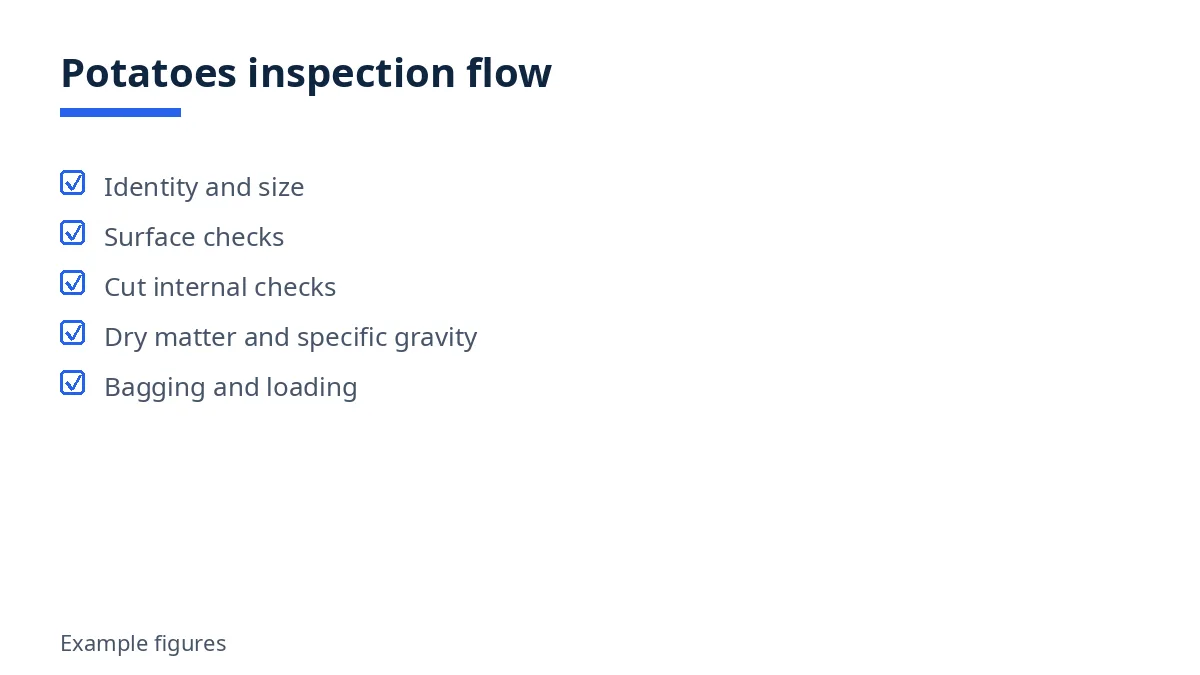
This guide checks potatoes in inspection order: identity and size first, then the outside of the tuber, then a cut look inside, then buyer-specified laboratory items, and finally bagging, ventilation, and marking. Every laboratory item names its method, and the result is recorded against the order value. No item here carries a universal pass mark. AQL, defined in ISO 2859-1, sets how many units to sample and how many defective units can be found before rejection.1 A pre-shipment inspection samples finished, mostly packed goods, not every piece, and is not a guarantee.2
Why this checklist matters
Potatoes change after harvest, fastest when warm, damp, or exposed to light. Sprouting in storage is one reason potatoes held for export stop being suitable for shipment, and a cold chain that breaks after cold storage leaves grading and packing time at ordinary temperature to do further damage.3 The inspection date, storage history, and condition at loading therefore belong in the report.
A second risk is mixing. One shipment can carry more than one variety, size band, or intended use, and table and processing potatoes are not interchangeable. A buyer who receives the wrong variety or size band has the wrong product even when every tuber is sound, so variety, size band, and intended use must be checked bag by bag.
The third risk is the cut. Bruising, internal discoloration, hollow heart, and early rot cannot be judged from the surface alone. An inspection that never cuts tubers will pass lots that a destination check will reject, after freight has been paid.
Before you start
Freeze the reference set before inspection: one sealed approved sample of the ordered variety, the purchase order, the potato specification, the size bands ordered, the defect list by class, the sampling plan, and the bagging, ventilation, and marking specifications. Keep the approved sample sealed and separate. Published processing grades start from similar varietal characteristics, firmness, and shape, and from freedom from freezing injury, blackheart, late blight tuber rot, bacterial rots, insects, soft rot, wet breakdown, and loose sprouts, dirt, and foreign material.4
Agree six things in writing in the purchase order: the variety and intended use; the size bands, with the measuring method; the defect list and each defect class, with reference photographs; the sampling plan, including standard, level, and acceptance and rejection numbers per class; each buyer-specified test, named with method and result; and the bag, ventilation, pallet, and marking specification. Pass the storage history to the inspector as well, including time out of cold storage and exposure to light.
The full checklist (numbered, printable)
Tick each item Pass, Fail, or Not applicable. Record bag and pallet numbers, and photograph every failed item.
Approved sample. One sealed approved sample per variety and intended use.
Variety against the order. Variety checked bag by bag against the order and the approved sample, with no mixed variety in one bag unless allowed.
Intended use per bag. Each bag identified for its ordered use, table or processing.
Size band, buyer-spec item. Size measured by the ordered method, diameter or weight, result recorded against the ordered band only.
Size uniformity within the bag. Tubers in one bag checked for a spread that would make the bag read as mixed.
Shape. Shape checked against the variety and approved sample, noting misshapen, knobby, and second-growth tubers.
Firmness. Firmness checked by hand, noting soft, spongy, shriveled, and flabby tubers.
Skin set and finish. Skin checked for set, scuffing, and peeling, noting loose skin and badly scuffed tubers.
Soil, dirt, and foreign material. Sampled tubers and bags checked for adhering soil, stones, stems, and other foreign material.4
Cuts and mechanical damage. Cuts, bruising, and handling damage checked across the surface.
Greening. Green coloration checked across the surface and at the eyes, noting that greening follows light exposure in the field, in storage, and on display.5
Sprouting. Sprouts checked for presence, length, and condition, noting broken, flabby, and dried sprouts still attached to the tuber.
Eyes and eye depth. Eyes checked for depth, damage, and sprout attachment.
Growth cracks. Growth cracks checked along the tuber.
Second growth. Second-growth tubers and knobs checked.
Scab and surface disease signs. Surface scab, silver scurf, rhizoctonia, and other surface marks checked across the tuber surface, with the affected area described.
Insect and pest damage. Insect, worm, and grub damage checked on the surface and in cut tubers.
Cut inspection, internal discoloration. Cut tubers checked for internal black spot, blackheart, and other internal discoloration, cut face photographed.
Hollow heart and internal cavities. Cut tubers checked for hollow heart and internal cavities.
Rot, buyer-spec item. Soft rot, wet breakdown, dry rot, and late blight tuber rot checked in whole and cut tubers, any wet, soft, or foul-smelling tuber held and photographed. Processing grades require freedom from soft rot and wet breakdown.4
Freezing injury. Freezing injury checked in whole and cut tubers, noting water-soaked tissue and darkening after thawing.
Dry matter, buyer-spec item. Dry-matter method, oven-dry or hydrometer as the order states, and result recorded against the order value only. Specific gravity is found by weighing in air and in water.6
Specific gravity, buyer-spec item. Specific-gravity method, weight in air and in water, result recorded against the order value only.
Reducing sugar, buyer-spec item, processing lots only. Reducing-sugar method and result recorded against the order value only, where ordered for frying or chip color.
Fry or cook check, buyer-spec item, processing lots only. Fry or cook method, slice thickness, and color result recorded against the order value only, where ordered.
Bag weight and count. Bag weight and count per bag checked against the packing list.
Bag type and ventilation. Bag material, mesh, and ventilation checked against the order, noting bags that trap moisture or block airflow.
Labels on each bag. Each label shows variety, size band, net weight, bag number, and lot identification.
Quantity and assortment. Bags per pallet and per shipment counted against the packing list, no mixed variety or size band in one pallet unless allowed.
Pallet and loading condition. Pallets checked for stability, damp, and damage, and loading checked for ventilation, condensation, and exposure to light and heat.
Sampling decision on the finished, packed lot. As a published-table example only, a lot of 26 to 50 potato bags at General Inspection Level III gives code letter E and a sample of 13 bags.1 With buyer-specified AQL 2.5 for major and AQL 6.5 for minor defects, the published table gives 1 and 2 for major defects and 2 and 3 for minor defects.1 Those are buyer-agreed order values, not standard-mandated values for potatoes.2
Common failures and how to fix them
Greening across the lot. Hold the lot, check light history from field to loading, and re-sort under cover.
Sprouting after storage. Hold the lot, separate sprouted bags, and check storage history before accepting a re-sort.
Soft or rotting tubers in sampled bags. Hold the affected bags, cut a wider set of tubers, and check whether rot is isolated or spreading.
Mixed variety or size band. Hold the pallet and re-sort bag by bag against the approved sample.
Bruised and cut tubers. Hold the lot, check handling from harvest to bagging, then re-grade with a fresh sample.
Internal discoloration found on cutting. Hold the lot and cut tubers from more bags, since a surface check cannot show how far the fault runs.
Damp bags and condensation at loading. Hold the shipment, separate damp bags, and check ventilation and time out of cold storage.
Wrong bag or missing label. Hold the pallet and re-bag or re-label against the packing list.
Downloadable template / summary table
The table below is the template.
Group | What to record | Result |
|---|---|---|
Reference and identity | Approved sample, variety, intended use, bag numbers | Pass/fail |
Size and shape | Size band, method, uniformity, shape, second growth | Pass/fail |
Surface condition | Firmness, skin, soil, cuts, bruising, greening, sprouting | Pass/fail |
Surface disease and pests | Scab, silver scurf, rhizoctonia, insect and grub damage | Pass/fail |
Internal condition | Cut face, black spot, blackheart, hollow heart, rot, freezing injury | Pass/fail |
Laboratory items | Dry matter, specific gravity, reducing sugar, fry or cook check, methods | Pass/fail |
Bagging and loading | Bag weight, bag type, ventilation, labels, quantity, pallets, loading | Pass/fail |
Sampling decision | Lot, level, code, sample, Ac/Re | Pass/fail |
Copy the table into the inspection report with lot number, date, and inspector name, and attach photographs of failures. Published potato inspection guidance lists common defects by damage and serious damage, including bruising, greening, growth cracks, surface scab, silver scurf, internal black spot, and insect damage.5
How Exportain helps
Exportain does not inspect goods itself. A buyer can use this checklist to write the inspection into the purchase order, book an independent inspector, and compare the report with the order value for each item. Inspection providers can be found through Exportain, but the inspection contract is between the buyer and the provider.
FAQs
When should this checklist be used?
Use it at final inspection, when grading and bagging are complete and bags are mostly palletized, and again after any rework, with a fresh sample. Check a sealed bag, an opened bag, and cut tubers from across the lot.
Who should complete it?
The buyer's inspector, a third-party inspector, or the supplier quality team can each complete it, but roles must stay separate. Whoever books the inspection receives the report.2
What are the most common failures?
The failures that recur here are greening, sprouting after storage, soft or rotting tubers, mixed variety or size band, bruised and cut tubers, internal discoloration found on cutting, damp bags at loading, and wrong or missing bag labels.
Can a third party do it?
Yes. A pre-shipment inspection is usually arranged through an independent third-party firm, and the buyer sends that firm the purchase order, specification, approved sample details, and bagging requirements.2 Agree who pays for re-inspection first.
Next steps on Exportain
Read the AQL acceptance quality limit guide before fixing the sampling plan. Then read the pre-shipment inspection guide for booking and re-inspection.
Sources
- AQL Calculator | Sample Size and ISO 2859-1 Tool. AQMBD (accessed )
- Pre-Shipment Inspection (PSI). Exportain (accessed )
- Higher exports bring no relief to potato farmers. The Daily Star (accessed )
- Potatoes for Processing Grades and Standards. USDA (accessed )
- Potatoes | International Produce Training. International Produce Training (accessed )
- Specific Gravity and Tuber Dry Matter Characteristics of Taewa and Modern Potatoes in Response to Irrigation and Nitrogen. Annals of Plant Sciences (accessed )
About the author
Sourcing from Bangladesh?
Post a request for quotation and suppliers on Exportain can send you their quotes directly.
Post an RFQ


