HS Code for Potatoes: Classification Guide for Importers
Fresh or chilled potatoes point indicatively to heading 0701, but frozen, dried, milled, and starch potato products fall under different headings. This guide works through the deciding factors and how to confirm the full national code.
Short answer
The indicative heading for fresh or chilled potatoes is 0701, with seed potatoes at 070110 and other fresh or chilled potatoes at 070190. Frozen potatoes point to 071010, dried cut or sliced potatoes to 0712, potato flour and flakes to 1105, and potato starch to 110813. Every heading here is indicative: verify the full national code in the destination tariff for the entry date before filing.
On this page
If you import potatoes, the hs code for potatoes is not one settled number for every potato product. It changes with the state of the goods: fresh or chilled, frozen, dried, or turned into flour, flakes, or starch. The Harmonized System is a multipurpose international product nomenclature developed by the World Customs Organization (WCO), with more than 5,000 commodity groups, each identified by a six-digit code, arranged in a legal and logical structure with well-defined rules for uniform classification.1
Quick answer: indicative HS heading
The indicative heading for fresh or chilled potatoes is 0701. The United Nations Statistics Division classification shows heading 0701 as potatoes, fresh or chilled, with subheading 070110 for seed potatoes and subheading 070190 for potatoes other than seed.2 Treat 0701 as indicative only: it does not cover frozen potatoes, dried potatoes in every form, potato flour or flakes, or potato starch.
Product state | Indicative heading | Six-digit subheading | Verify note |
|---|---|---|---|
Fresh or chilled, for sowing as seed | 0701 | 070110 | Verify seed certification for the destination |
Fresh or chilled, other than seed | 0701 | 070190 | Verify national line |
Frozen, uncooked or cooked by steaming or boiling | 0710 | 071010 | Verify no frying or further preparation |
Dried, cut or sliced, not further prepared, not flour or flake form | 0712 | 071290 | Verify current edition |
Flour, meal, powder, flakes, granules or pellets of potatoes | 1105 | Verify subheading | Verify form |
Potato starch | 1108 | 110813 | Verify starch, not flour or meal |
Every national line here must be confirmed on the entry date.
How HS codes are structured
The HS comprises commodity groups identified by a six-digit code, used by more than 200 countries and economies as a basis for their customs tariffs and trade statistics.1 Only the first six digits are shared internationally.
Level | Digits | For potatoes |
|---|---|---|
Chapter | 2 digits (07) | Edible vegetables and certain roots and tubers |
Heading | 4 digits (0701, 0710, 0712, 1105, 1108) | The product group, such as potatoes, fresh or chilled |
Subheading | 6 digits (070110, 070190, 071010, 110813) | International detail, such as seed potatoes or potato starch |
National extension | 8 to 10 digits | Set by the importing country |
Chapter 07 covers edible vegetables and certain roots and tubers; Chapter 11 covers milling products, malt, starches, inulin, and wheat gluten, so potato flour and starch leave Chapter 07. Read the heading text and chapter notes before the subheading.
The rest belong to the importing country and the tariff edition in force on the entry date.
Factors that decide the code for potatoes
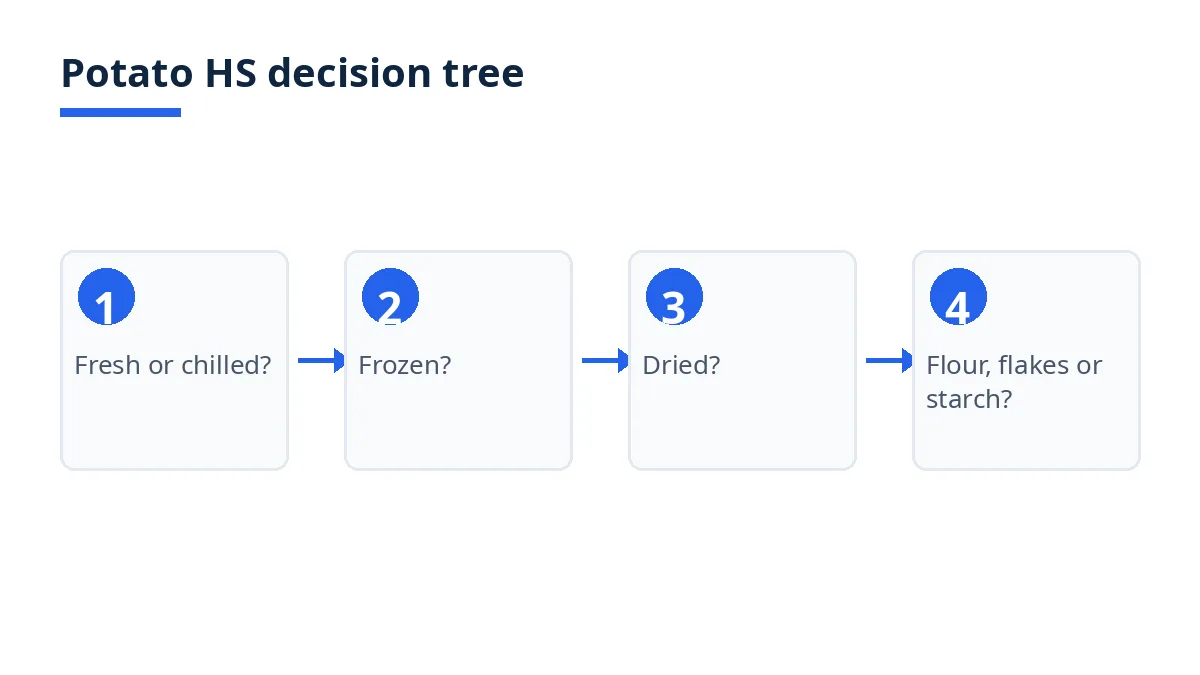
Classification follows the heading wording and chapter notes, not the seller's product name. Check state first: fresh or chilled points to 0701, frozen to 0710, dried to 0712 or, for flour and flake forms, to 1105. Then check form, processing, and, where required, intended use. Chapter 7 note 3 states that heading 0712 covers dried vegetables of the kinds in headings 0701 to 0711, other than flour, meal, powder, flakes, granules and pellets of potatoes, which fall in heading 1105.3
Seed potatoes for sowing: are these seed potatoes, or table potatoes?
Deciding factor: certified seed status for sowing, with official marking and import for use as seed. Indicative subheading 070110.2 In the United States tariff, seed in subheading 0701.10 covers only potatoes certified by a foreign government officer or agency, grown and approved especially for use as seed, in containers marked with official seed potato tags and imported for use as seed.3
Fresh table potatoes: are these fresh or chilled potatoes other than seed?
Deciding factor: fresh or chilled state, and other-than-seed status. Indicative subheading 070190.2 The United Kingdom tariff splits this line nationally, including a starch-manufacture line and new-potato lines by date period, each to confirm on the entry date.4 Do not copy a national split into another country's declaration.
Frozen chips or fries: were these potatoes frozen uncooked, or cooked only by steaming or boiling in water?
Deciding factor: cooking and preparation before freezing. Indicative subheading 071010, for potatoes, uncooked or cooked by steaming or boiling in water, frozen.5 The United States tariff carries the same line as 0710.10.00.3 If the product was fried, coated, or otherwise prepared beyond heading 0710, check the prepared-product headings before filing. State the cooking method in writing; a photograph cannot show it.
Dried potato flakes: are these dried potatoes, or flour, meal, powder, flakes, granules or pellets of potatoes?
Deciding factor: form after drying. Dried potatoes, whether or not cut or sliced but not further prepared, point to heading 0712; the Combined Nomenclature text opened for this guide shows line 0712 90 05 for such potatoes.6 Dried potato flakes, granules, and pellets point the other way, because chapter note 3 excludes them from heading 0712 and places them in heading 1105.3 Heading 1105 covers flour, meal, powder, flakes, granules and pellets of potatoes.7
Potato starch: is this starch, or flour or meal?
Deciding factor: whether starch was extracted, rather than the potato being milled into flour or meal. Indicative subheading 110813, for potato starch, under heading 1108 for starches and inulin.8 Potato flour, meal, and powder stay in heading 1105.7 Keep the production description with the file.
National codes: US HTS, EU CN/TARIC, UK commodity code
Only the first six digits are harmonized; each line below must be confirmed on the entry date.
United States: HTS, ten digits. The United States International Trade Commission tariff shows 0701.10.00 for seed potatoes, 0701.90 for other fresh or chilled potatoes, and 0710.10.00 for frozen potatoes, with further national splits.3 Never copy a ten-digit code from a supplier invoice without checking the current HTS revision.
European Union: CN at eight digits, TARIC for the import code and measures. The Combined Nomenclature text opened for this guide shows 0701 10 00 for seed potatoes, 0701 90 10 for starch-manufacture potatoes, 0710 10 00 for frozen potatoes, and 0712 90 05 for dried potatoes, whether or not cut or sliced but not further prepared.6 Use those CN lines as the starting point, then check the full import code and measures for the entry date in TARIC.
United Kingdom: commodity code. The United Kingdom tariff shows heading 0701 for potatoes, fresh or chilled, with seed at 0701 1000 00, starch-manufacture potatoes at 0701 9010 00, and new potatoes split by date period under 0701 9050 00 and 0701 9090.4 It also shows heading 0710 for vegetables, uncooked or cooked by steaming or boiling in water, frozen, with potatoes at 0710 1000 00.9 Confirm the full code and measures for the origin and import date, rather than reusing an EU or United States code.
How to confirm the code officially
Use this sequence for each distinct product.
Write a precise product description: state on arrival, form and cut, cooking or drying method, flour or starch method where relevant, and seed certification and marking where relevant.
Start from the official tariff for the destination: the United States International Trade Commission HTS, the Combined Nomenclature and TARIC for the European Union, and the United Kingdom Trade Tariff. Read the heading text and chapter notes, not only the search result line. Under the General Rules for Interpretation in the United Kingdom tariff, classification follows the heading terms and any relative notes, and subheading classification compares only subheadings at the same level.4
Check published rulings for similar goods; another trader's ruling is not a decision about your goods.
For a borderline product, apply for a binding decision before you ship. In the United Kingdom, an Advance Tariff Ruling must be applied for before all customs procedures have been completed, with a separate application for each type of goods, and the customs authority replies in 30 to 120 days.10 A legally binding decision is generally valid for 3 years, and helps calculate duties, licensing requirements, quotas, or other restrictions in advance.11 For Northern Ireland or the European Union, apply for a Binding Tariff Information decision instead.11
Give your broker the full description and confirmed code, and use the same code on the commercial invoice, packing list, and import declaration.
Common classification mistakes
Using 0701 for every potato product. State decides the heading; frozen, dried, milled, and starch products each leave 0701.
Calling dried potato flakes a 0712 product. Chapter note 3 excludes flour, meal, powder, flakes, granules, and pellets of potatoes from heading 0712, placing them in heading 1105.3
Calling potato starch potato flour. Starch is heading 1108, subheading 110813.8 Flour, meal, and powder of potatoes are heading 1105.7 Production method decides.
Copying a code from another product or country. A six-digit match does not mean the national code also matches.
Treating intended use as seed status. Seed potatoes need the destination's certification and marking conditions, not only an intention to plant.3 4
Confusing potatoes with sweet potatoes. Sweet potatoes are a different tuber, treated separately in the United Kingdom tariff notes.4 Check the tuber named in the heading.
Leaving the description vague. An invoice that says only potatoes forces a broker to guess state, form, and cooking method.
Treating the code as permanent. Tariffs are revised, and a binding decision can cease to be valid when the nomenclature changes.
Related duties and documents
This guide states no duty rate for any potato product. The code decides which duty line and measures customs applies, but rates, preferences, and additional measures depend on the destination, origin, tariff edition, and entry date, and they change. Read the rate and measures beside the confirmed code in the official tariff for your entry date, and check what proof of origin any preferential treatment requires.
Keep the same code on the commercial invoice, packing list, and any origin declaration, with the tariff printout or ruling reference and the supplier specification. If any fact changes, recheck the code before the next shipment.
FAQs
What is the HS code for potatoes?
There is no single HS code for all potato products. Fresh or chilled potatoes point indicatively to heading 0701, seed potatoes to 070110 and other fresh or chilled potatoes to 070190.2 Frozen potatoes point indicatively to 071010, dried cut or sliced potatoes to heading 0712, potato flour and flakes to heading 1105, and potato starch to 110813.5 6 7 8 Verify each heading for your exact product and destination.
Is the HS code the same in every country?
The first six digits are shared internationally, because the HS is used by more than 200 countries and economies as a basis for their customs tariffs.1 The full code is not the same everywhere, because each country adds its own digits. Confirm the full code in the destination tariff.
How do I confirm the correct code?
Write a precise description covering state, form, cooking or drying method, and seed certification where relevant. Read the heading text and chapter notes in the destination tariff, check rulings for similar goods, and for a borderline product apply for a binding decision before you ship.10 11 Give your broker the full description and confirmed code.
What happens if I use the wrong code?
Customs may reclassify the goods and apply the duty line and measures for the correct code, which can delay clearance and change the amount payable. A correct code also matters for licenses and quotas, which is why a legally binding decision helps calculate duties, licensing requirements, quotas, or other restrictions in advance.11
Next steps on Exportain
Start with the general system: read the HS code explainer for the structure of the code, then how to classify your product for the method. When ready to source, browse suppliers and ask each supplier for the written specification this guide lists.
Sources
- What is the Harmonized System (HS)?. World Customs Organization (accessed )
- Classification Detail: HS 2012, Code 0701. United Nations Statistics Division (accessed )
- Harmonized Tariff Schedule of the United States Revision 8 (2026), Chapter 7. U.S. International Trade Commission (accessed )
- Potatoes, fresh or chilled - UK Integrated Online Tariff. GOV.UK, HM Revenue and Customs (accessed )
- Classification Detail: HS 2012, Code 071010. United Nations Statistics Division (accessed )
- Commission Implementing Regulation (EU) 2016/1821, Annex I, Chapter 7. European Commission (accessed )
- Classification Detail: HS 2017, Code 11. United Nations Statistics Division (accessed )
- Classification Detail: HS 2012, Code 1108. United Nations Statistics Division (accessed )
- Vegetables (uncooked or cooked by steaming or boiling in water), frozen - UK Integrated Online Tariff. GOV.UK, HM Revenue and Customs (accessed )
- Apply for an Advance Tariff Ruling. HM Revenue & Customs (GOV.UK), (accessed )
- Check what you'll need to get a legally binding decision on a commodity code. GOV.UK, HM Revenue and Customs (accessed )
About the author
Sourcing from Bangladesh?
Post a request for quotation and suppliers on Exportain can send you their quotes directly.
Post an RFQ