Typical MOQ for Jute Geotextiles in Bangladesh (and How to Negotiate It Down)
Jute geotextile MOQs from Bangladesh vary widely by variant: Bangladeshi listings show 1,000 kg to 20,000 yards for woven soil saver, 5,000 sq m for 292 gsm mesh, and 1,000 pieces for non-woven felt. This guide explains why mills set minimums and the levers that bring them down.
Short answer
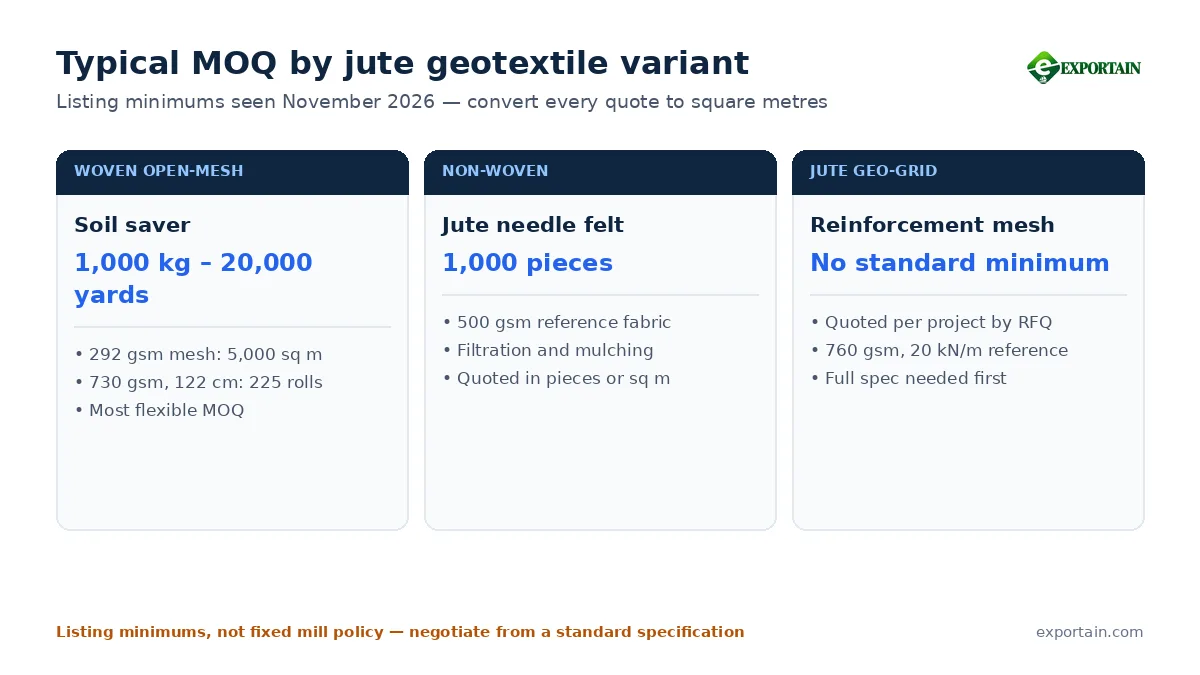
Jute geotextiles from Bangladesh have no single standard MOQ. Current listings show woven open-mesh soil saver at 1,000 kg to 20,000 yards, 292 gsm mesh at 5,000 square metres, 730 gsm mesh at 225 rolls, and non-woven jute felt at 1,000 pieces, while jute geo-grid is quoted per project. Accepting a standard 500 gsm weight and width, offering a longer lead time, and committing to repeat orders are the strongest ways to negotiate the minimum down.
On this page
Key takeaways
Bangladeshi listings show woven soil saver MOQs from 1,000 kg to 20,000 yards, so convert every quote to square metres before comparing.
Mills set MOQs to cover loom set-up, per-control-unit testing and fibre lots, not to block small buyers.
A standard 500 gsm weight at a standard width is the strongest negotiation lever.
Jute geo-grid has no standard listing minimum and is quoted per project by RFQ.
If you are buying jute geotextiles from Bangladesh for an erosion-control or slope project, the minimum order quantity (MOQ) is usually the first number a mill quotes back, and it is often larger than the project needs. This guide sets out the typical minimums by variant, explains why mills set them, and shows the levers that bring them down. If you are still learning the basics of minimum orders, start with our MOQ explainer.
What is the typical MOQ for jute geotextiles from Bangladesh?
There is no single published MOQ for jute geotextiles from Bangladesh. Mills quote by variant, weight and width, and the minimums buyers actually see come from mill listings and quotations rather than a fixed schedule. The table below pulls together the minimums shown on current listings for Bangladeshi and comparable jute geotextile products, checked in November 2026.
| Variant | Typical listing minimum | Quoted in | What the listing shows | | Woven open-mesh soil saver, 292 to 730 g/m² | 1,000 kg to 20,000 yards | kg or yards | A Bangladeshi seller lists 1,000 kg as its minimum, while another Bangladeshi mill lists 20,000 yards for woven soil-saver fabric1 2 | | Woven soil saver, 292 gsm | 5,000 sq m | Square metres | A 292 gsm woven soil-saver listing sets its minimum at 5,000 square metres1 | | Woven soil saver, 730 gsm, 122 cm wide | 225 rolls | Rolls | A Bangladeshi seller lists 225 rolls as the minimum for 730 gsm mesh at 122 cm width1 | | Non-woven jute needle felt | 1,000 pieces | Pieces | A jute needle-felt listing for grow mats and mulch use sets its minimum at 1,000 pieces1 | | Jute geo-grid and reinforcement mesh | No standard listing minimum found | Not listed | No Bangladeshi listing states a standard minimum for jute geo-grid, so mills quote it per project by RFQ |
Two patterns stand out. First, the unit changes with the product: woven soil saver is quoted in kilograms or yards, while felt and mat products are quoted in square metres or pieces, so always convert before comparing two quotes. Second, the spread is wide: the smallest Bangladeshi listing minimum is 1,000 kg, while another asks for 20,000 yards, roughly 22,300 square metres at a 122 cm roll width.
Why do mills set a minimum order for jute geotextiles?
A jute geotextile is not cut from stock cloth. Each order starts with a loom set-up: the warp is threaded for a specific width, yarn count and weave, and that set-up takes time whether the run is 1,000 metres or 20,000 metres. A mill recovers that set-up time only by spreading it across a long run, which is why a short run costs more per square metre and why mills prefer a minimum length.
Testing adds a second fixed cost. Under the Indian standard IS 14715 for jute geotextiles, which covers woven and non-woven types, a control unit is the entire quantity of one type manufactured under similar conditions in a single day from the same raw material, and each consignment of certified material carries a test certificate with its control-unit number and test results3. The tests are run per control unit, not per metre, so a small order carries the same testing cost as a large one.
Raw jute supply adds a third reason. Jute is an agricultural fibre, and mills buy and store fibre in lots. A small, unusual order can force a mill to open a new fibre lot for a few hundred kilograms, which it would rather avoid. Standard weights and widths let the mill run your order from fibre it already holds.
How does the variant change the MOQ?
The three main forms of jute geotextile behave differently on the loom, and their minimums follow from that.### Woven open-mesh soil saver
This is the most common form, an open weave laid over bare soil to break rainfall, trap sediment and hold moisture while vegetation establishes, then biodegrading over one to two seasons4. Common weights run from about 292 to 730 g/m², made to the buyer's project specification4. Standard reference weights are 500 gsm for open mesh and 760 gsm for heavier woven fabric, with the woven form reaching 20 kN/m tensile strength in both directions5. Because the open mesh is woven on a standard loom set-up, its MOQ is the most flexible of the three forms, and it is the form where accepting a standard weight brings the minimum down fastest.
Non-woven jute geotextile
Non-woven jute geotextile is made by needle-punching jute fibre into a felt rather than weaving it. A standard non-woven reference fabric is 500 gsm with tensile strength of 4 by 5 kN/m, used for filtration, mulching and weed suppression5. Non-woven runs are set by the weight of fibre fed into the line, so the minimum is usually quoted in pieces or square metres rather than in yarn length. The felt form suits buyers who need coverage rather than strength.
Jute geo-grid and reinforcement mesh
Jute geo-grid is the least standardised of the three. The IS 14715 standard covers woven and non-woven jute geotextiles for strengthening road sub-grades and controlling bank erosion in rivers and waterways, with separate specifications for each use3. Heavier woven fabric at 760 gsm and 20 kN/m is the usual reference point where strength matters, and jute geotextiles are described as tailor-made products, with stronger and wider fabric produced to site-specific requirements5.
Because a geo-grid order is almost always tied to a project design, mills treat it as a made-to-order product and quote the minimum only after seeing the specification. Expect a higher minimum here than for open-mesh soil saver, and expect the mill to ask for the full engineering specification before it names a number.
What does a typical MOQ weigh, in practice?
The MOQ matters most when you translate it into kilograms and rolls, because freight and storage are priced on weight and volume. The worked example below shows how that translation works.
Example figures: a buyer orders 25,000 square metres of 500 gsm open-mesh soil saver for a slope project. At 500 grams per square metre, the order weighs 12,500 kg. Against a 1,000 kg listing minimum, that order is more than twelve times the minimum. Against a 20,000-yard listing minimum, assuming a 122 cm roll width, the minimum covers about 22,300 square metres, so the same 25,000 square metre order is only just above one minimum run. The same quantity looks large against one quote and small against another, which is why the unit on the quote matters as much as the number. Ask the mill to state the roll length, roll weight and number of rolls on the quotation, and confirm those figures before you agree the order size.
How can you negotiate the MOQ down?
Mills move on MOQ when the order becomes easier or safer for them to run. These levers work in that order.
Accept the mill's standard weight and width. A 500 gsm open mesh at a standard width is a run the mill can set up quickly, while a custom weight or width needs a new set-up. Standard reference weights for open-mesh soil saver start at 500 gsm5, and Bangladeshi mills commonly offer 292 to 730 gsm to specification4.
Consolidate two needs into one run. If two sites need the same weight, combine them into one order with split delivery.
Offer a longer lead time. A mill that can fit your run into a gap between larger orders will often accept a smaller quantity. Ask what the minimum would be with eight weeks instead of four.
Commit to a repeat order in writing. A first order of 1,000 kg followed by a written commitment for the same quantity each quarter is worth more to a mill than a one-off order of the same size.
Pay faster. A larger advance or a confirmed letter of credit reduces the mill's risk on a small run. Offer the payment term as part of the MOQ discussion, not after it.
Split the delivery, not the production. Accept the full MOQ run, but ask for delivery in two shipments.
Ask for a priced trial run. Some mills will run a small trial at a higher unit price, then credit part of that premium against the full order. This works when the trial uses the same weight and width as the full order.
Use the levers together. A standard weight plus a longer lead time plus a repeat commitment will move a mill further than any single concession.
What should you put in your RFQ so the MOQ comes back lower?
The RFQ is where the MOQ is decided. A vague RFQ gets a defensive minimum; a precise one gets a workable number. Include the fabric weight in gsm, the roll width, the roll length, the tensile strength you need, and the test standard that applies, such as IS 14715 Part 1 for road sub-grade work or Part 2 for bank erosion3. State the quantity in both square metres and kilograms, the delivery schedule, the destination port and the payment terms you can offer. Our guide to writing an RFQ covers the full format. If you are comparing mills, our guide to jute geotextile manufacturers in Bangladesh explains how to check a mill before you send the RFQ.
Common mistakes when ordering below the MOQ
Asking for a custom width on a small order. A non-standard width needs its own warp set-up, which is exactly the cost the MOQ exists to cover. If your project can take a standard width, take it.
Comparing MOQs in different units. A 1,000 kg minimum and a 20,000-yard minimum are not comparable until both are converted to square metres at the same roll width. Convert every quote to square metres and kilograms before you compare. Our jute geotextile QC checklist lists the tests to ask for on any order.
Skipping the test certificate on a small order. Each consignment of certified jute geotextile should carry a test certificate with its control-unit number and results3. Ask for it even on a trial order, and check the results against the specification before you pay the balance.
Treating a listing minimum as final. A listing minimum is a starting position. Mills that list 20,000 yards will often accept less for a standard specification with a longer lead time, and mills that list 1,000 kg may hold firm on a custom one. Negotiate from the specification, not from the number alone.
Why more mills are quoting jute geotextiles now
Demand for jute is rising. Export Promotion Bureau figures reported in November 2026 show jute and jute goods earnings of 346.37 million US dollars in July to October of fiscal year 2026-27, up 24.88 percent on the same period a year earlier6. The government's five-year jute sector strategy aims to raise annual export earnings from jute and jute goods to 1.64 billion US dollars by 2031, and it names the expansion of geotextiles, technical textiles and other value-added jute products as a central part of that plan6. More mills entering geotextile production means more quotations to compare, and a buyer who asks three mills for the same standard specification will usually find a workable MOQ.
Next steps on Exportain
Check the mill before you order with our guide to jute geotextile manufacturers in Bangladesh, confirm the classification in our HS code notes for jute geotextiles, then post an RFQ with your weight, width, quantity in square metres and kilograms, and the lead time you can offer.
Sources
- Jute Mesh Soil Saver: Erosion Control & Sustainable Landscaping. Accio (accessed )
- Jute Geotextile Slope Stabilization. Accio (accessed )
- Product Manual for Jute Geotextiles Part 1: Strengthening of Sub-Grade in Roads — Specification as per IS 14715 (Part 1):2016. Bureau of Indian Standards, (accessed )
- Jute Geotextiles — Erosion Control Soil Saver, Mill-Direct. Wahab Jute Mills Ltd (accessed )
- Application of Jute Geotextile in Civil Engineering, Agrihorticulture and Forestry. Sahapedia (accessed )
- Jute export earnings rise by 25% in Jul-Oct'FY27. Dhaka Tribune, (accessed )
- minimum order quantity
- Bangladesh sourcing
- Jute geotextiles
- erosion control
- MOQ Bangladesh
- jute soil saver
About the author
Sourcing from Bangladesh?
Post a request for quotation and suppliers on Exportain can send you their quotes directly.
Post an RFQ