

Quality Control Checklist for Jute Geotextiles From Bangladesh
Product-specific QC checklist for jute geotextiles: roll identity, construction, dimensions, laboratory tests, opening size, permeability, ultraviolet resistance, labels, and packing, with a numbered checklist, failure fixes, and a summary table.
Short answer
This jute geotextiles quality control checklist covers the reference set, roll identity, construction and dimensions, mass, thickness, tensile, tear and puncture tests, opening size, permeability, ultraviolet resistance, labels, and packing, with a numbered checklist, failure fixes, a summary table, and a published-table sampling example for buyers ordering from Bangladesh.
On this page
A jute geotextile is checked before it disappears under soil, stone, and water. Once a roll is laid on a slope, under a road layer, or along a bank, a fault in the fabric cannot be seen or corrected without reopening the work. The buyer is judging whether a layer that will carry load, pass water, and hold soil will do that job for the period the project expects.
This guide checks the geotextile in site order: reference set, roll identity, construction and dimensions, laboratory properties, handling, labels, and packing. Every laboratory item names its method, and the result is recorded against the order value. No item here carries a universal pass mark. AQL, defined in ISO 2859-1, sets how many units to sample and how many defective units can be found before the lot is rejected.1 A pre-shipment inspection is a sampling inspection of finished, mostly packed goods, not a check of every piece and not a guarantee.2
Why this checklist matters
A geotextile fails out of sight. A roll with a torn section or an opening size that does not match the soil it must filter can look acceptable while wrapped. The failure shows later as soil washing through, water ponding, or a road layer losing support. By then the cost is excavation and replacement.
Jute adds a second risk. It is a natural fiber that absorbs moisture, and its condition changes with damp storage, crushing, and exposure. A roll left uncovered or stored on wet ground can arrive in a different condition from the roll that left the mill.
The third risk is mixing. Woven, nonwoven, and open-weave types serve different functions, and one project can order more than one type. A roll of the wrong construction, packed under the right label, will be laid as if it were the right product.
Before you start
Freeze the reference set before inspection: one sealed approved sample or approved roll section, the purchase order, the geotextile specification, the project function for each type ordered, the defect list by class, the sampling plan, and the packing and labeling specifications. Keep the approved sample sealed and separate from the lot. Jute geotextiles are used for road construction, river bank protection, hill slope management, and slope protection beside roadways and railway tracks.3
Agree five things in writing in the purchase order: the construction and type for each item; the defect list and each defect class, with reference photographs; the sampling plan, including standard, level, and acceptance and rejection numbers per class; each buyer-specified test, named with method and result; and the roll, wrapping, and pallet specification. Pass the site conditions to the inspector as well, including the soil to be filtered and any treatment specified.
The full checklist (numbered, printable)
Tick each item Pass, Fail, or Not applicable. Record roll and pallet numbers, and photograph every failed item with its roll number visible.
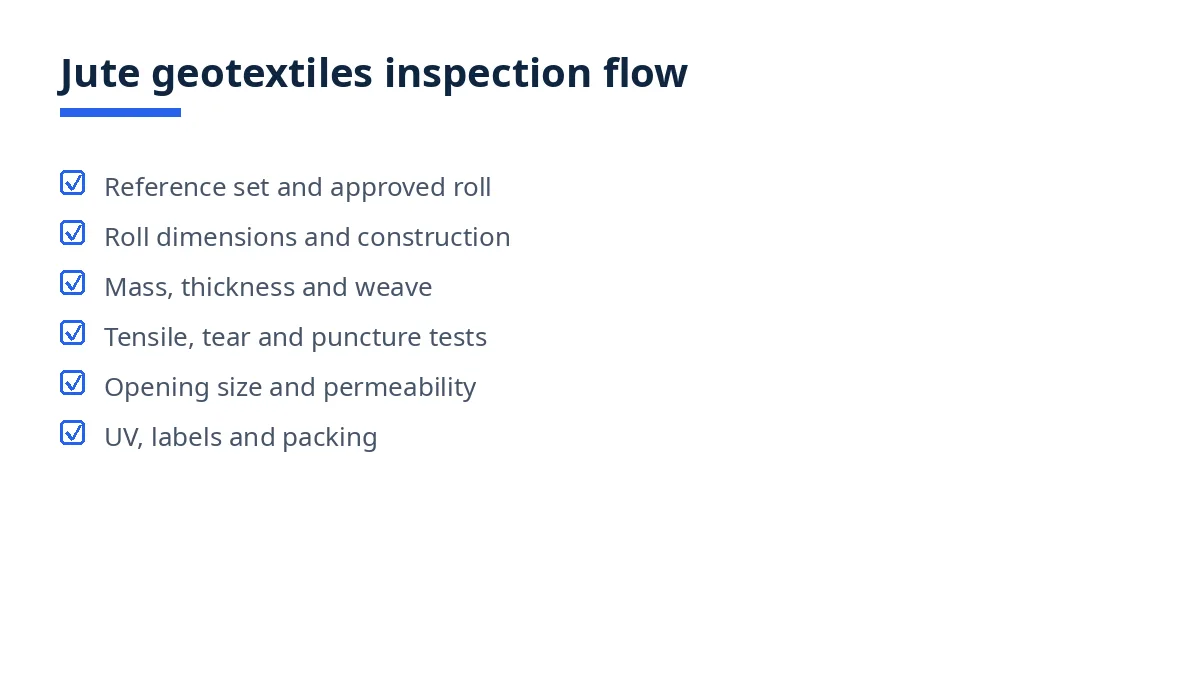
Approved sample. One sealed approved sample per construction and type, matched to the stated project function.
Construction against the order. Woven, nonwoven, or open-weave construction checked against the order for each roll.
Project function per roll. Each roll identified for the function the order states for it.
Roll length. Length measured flat, without stretching, against the order and the approved sample.
Roll width. Width measured across the full width against the order, noting narrowing or uneven edges.
Edges and selvage. Both edges checked for fraying, cuts, missing yarns, and strapping damage.
Weave and mesh evenness. Weave or mesh checked across the width and along the roll for missing yarns, holes, and thin patches.
Open area, buyer-spec item. Open-area method and result recorded against the order value only, where open weave is ordered.
Mass per unit area, buyer-spec item. Method and result recorded against the order value only, from specimens across the roll width. Mass per unit area is found by weighing specimens of known dimensions.4
Thickness, buyer-spec item. Method, pressure, and result recorded against the order value only. Thickness is measured at a stated pressure between a reference plate and a presser foot.4
Tensile strength, buyer-spec item. Wide-width tensile method and result in both directions recorded against the order value only. Wide-width tensile testing is one of the most common mechanical tests for a geotextile.4
Elongation at break, buyer-spec item. Elongation method and result in both directions recorded against the order value only.
Tear resistance, buyer-spec item. Tear method and result recorded against the order value only, where specified.
Puncture resistance, buyer-spec item. Puncture method and result recorded against the order value only. A static puncture test pushes a flat-ended plunger through fabric held between rings, simulating stone pressed onto the layer.4
Seams and joins where specified. Seam type, stitching, and continuity checked against the order.
Apparent opening size, buyer-spec item. Opening-size method and result recorded against the order value only. The characteristic opening size governs filtration and separation performance.5
Pore-size consistency. Opening-size result reported with its method, since results from different sieving methods do not always compare.
Permeability and permittivity, buyer-spec item. Water-flow method and result recorded against the order value only, noting velocity index or permittivity. Permeability is one of the essential hydraulic properties of a geotextile, alongside opening size.5
Water-flow method stated. Laboratory report states the head and method used, so a constant-head result is not read as a falling-head result.
Treatment where specified. Treatment type checked against the order, with uneven treatment, untreated patches, and flaking noted.
Ultraviolet and weathering resistance, buyer-spec item. Ultraviolet exposure method and result recorded against the order value only. Deterioration from ultraviolet light and water is tested with an exposure apparatus method.6
Damp, mold, and odor. Sampled rolls checked for damp patches, mold spots, staining, oil marks, and odors untypical of jute.
Roll condition. Rolls checked for crushing, telescoping, a damaged core, strapping cuts, and water damage, with enough unrolled to see the fabric.
Labels on each roll. Each label shows product, type, dimensions, roll number, and lot identification against the packing list. Geotextile labels are expected to identify the manufacturer name, style name, and roll number.6
Quantity and assortment. Rolls per pallet and per shipment counted against the packing list, with no mixed type in one pallet unless allowed.
Wrapping and pallet packing. Rolls wrapped against shipment damage, water, sunlight, and contaminants, with pallets stable and marked. During storage, rolls are to be kept off the ground and covered against precipitation, extended ultraviolet radiation, strong chemicals, flames, and excess heat.6
Sampling decision on the finished, packed lot. As a published-table example only, a lot of 281 to 500 geotextile rolls at General Inspection Level II gives code letter H and a sample of 50 rolls.1 With buyer-specified AQL 2.5 for major and AQL 4.0 for minor defects, the published table gives 3 and 4 for major defects and 5 and 6 for minor defects.1 Those are buyer-agreed order values, not standard-mandated values for jute geotextiles.2
Common failures and how to fix them
Wrong construction in the lot. Hold the pallet and check construction roll by roll against the approved sample.
Uneven mass or thickness. Hold the lot and test fresh specimens from across the width.
Torn or holed sections. Hold the roll and unroll a longer section to find whether the fault repeats.
Opening size that does not match the order. Hold the lot and ask the laboratory to restate method and result together.
Water flow that does not match the order. Hold the lot and check treatment and weave before accepting a retest.
Brittle or faded rolls. Hold the affected rolls and check storage history for ultraviolet or weather exposure.
Damp or moldy rolls. Hold the lot, separate damp rolls, and do not pack damp rolls with dry rolls.
Mixed pallets. Hold the pallet and re-sort by label, construction, and roll number before shipment.
Downloadable template / summary table
No file download is offered with this article. The table below is the template.
Group | What to record | Result |
|---|---|---|
Reference and identity | Approved sample, construction, function, roll numbers | Pass/fail |
Dimensions and weave | Length, width, edges, weave, open area | Pass/fail |
Laboratory properties | Mass, thickness, tensile, elongation, tear, puncture | Pass/fail |
Hydraulic properties | Opening size, method, permeability, method | Pass/fail |
Durability and condition | Treatment, ultraviolet result, damp, mold, roll damage | Pass/fail |
Labels and packing | Roll labels, quantity, wrapping, pallet, marks | Pass/fail |
Sampling decision | Lot, level, code, sample, Ac/Re | Pass/fail |
Copy the table into the inspection report with lot number, date, and inspector name, and attach photographs of every failed item. Published jute geotextile specifications list construction, weight, width, yarn count, thickness, tensile strength, elongation, puncture resistance, burst strength, permittivity, and opening size.3
How Exportain helps
Exportain does not inspect goods itself. A buyer can use this checklist to write the inspection into the purchase order, book an independent inspector, and compare the report with the order value for each property. Inspection providers can be found through Exportain, but the inspection contract is between the buyer and the provider. Exportain's own supplier checks are document and photo reviews, not a factory inspection.
FAQs
When should this checklist be used?
Use it at final inspection, when production is complete and rolls are mostly packed, and again after any rework, with a fresh sample. Check the wrapped roll and an unrolled section.
Who should complete it?
The buyer's inspector, a third-party inspector, or the supplier quality team can each complete it, but roles must stay separate. Whoever books the inspection receives the report, and the inspector works to the buyer's checklist and order values.2
What are the most common failures?
The failures that recur here are wrong construction in the lot, uneven mass or thickness, torn or holed sections, an opening size that does not match the order, water flow that does not match the order, brittle or faded rolls, damp or moldy rolls, and mixed pallets. A check that looks only at the outer wrap will miss most of them.
Can a third party do it?
Yes. A pre-shipment inspection is usually arranged through an independent third-party firm, and the buyer sends that firm the purchase order, specification, approved sample details, and packing requirements.2 Agree who pays for re-inspection before booking.
Next steps on Exportain
Read the AQL acceptance quality limit guide before fixing the sampling plan. Then read the pre-shipment inspection guide for booking and re-inspection.
Sources
- AQL Calculator | Sample Size and ISO 2859-1 Tool. AQMBD (accessed )
- Pre-Shipment Inspection (PSI). Exportain (accessed )
- Jute Geotextiles. Jute Corporation of India (accessed )
- TS002- Test methods of Geotextiles. TextileSphere (accessed )
- ISO 12956 Geotextiles and Geotextile Related Products - Determination of Characteristic Opening Size. Eurolab (accessed )
- Specification for Geotextile Used in Soil Stabilization and Layer Separation. Docest (accessed )
About the author
Sourcing from Bangladesh?
Post a request for quotation and suppliers on Exportain can send you their quotes directly.
Post an RFQ


