Jute Geotextiles Manufacturers in Bangladesh: How to Find and Verify
A practical guide to finding jute geotextile manufacturers in Bangladesh: write a specification, shortlist mills that weave in-house, check capability against IS 14715, ISO 10319 and ASTM D4595, sample through an independent laboratory, and audit the factory before ordering.
Short answer
Find jute geotextile manufacturers in Bangladesh by writing a specification first — application, standard, weight, aperture and total area — then shortlisting mills through Exportain listings, trade associations and trade fairs. Check that the mill weaves in-house, ask for test reports against IS 14715, ISO 10319 or ASTM D4595, sample through an independent laboratory, and audit the factory before ordering. No list of named suppliers replaces these checks.
On this page
Key takeaways
Write the specification first: application, standard, weight, aperture, area and finish.
A real geotextile maker weaves in-house and can show looms, capacity and an in-house lab.
Ask for test reports against IS 14715, ISO 10319 or ASTM D4595, with numbers, lot and laboratory named.
Sample through an independent laboratory and audit the factory before a first order.
Exportain trust badges are document and photo reviews, not factory inspections.
Buying jute geotextiles from Bangladesh is a technical purchase. The fabric must hold soil on a slope or a riverbank for a set period, then break down once vegetation takes over, so the manufacturer matters as much as the price. This guide shows how to find manufacturers that actually weave geotextiles, check their capability, ask for the right standards and tests, and run sampling and a factory audit before a first order. It names no preferred supplier: apply the same checks to every candidate.
What is a jute geotextile, and which type does your project need?
A jute geotextile is an open-weave fabric of coarse jute yarn, made for ground engineering rather than packaging.1 Its deliberate gaps, called apertures, let vegetation grow through while the fabric holds the soil surface.1 It is a fully natural material that biodegrades into the soil once plants have established, leaving no plastic behind.1
The mesh shields soil from rain impact, slows runoff, absorbs water to keep the seedbed moist, and adds organic matter as it breaks down.1 Untreated fabric usually performs for around one to three years, and a rot-retardant treatment extends that window.1 Typical weights run from about 290 to 1,000 grams per square metre, with apertures from a few millimetres up to about 15 millimetres or more.1 Research records treated jute fabric holding a riverbank slope for more than a decade, with soil strength gaining as the fabric degraded.2 That is no promise about any single mill today: your written specification decides whether a delivery performs.
| Type | Suited for | Confirm first | | Woven open-mesh | Slopes, embankments, re-vegetation | Weight, aperture, tensile strength | | Woven open-mesh, treated | Longer service life needed | Treatment and service life | | Woven, road grade | Separation under pavements | Tensile strength 25 kN/m | | Non-woven | Concealed drains, roadside drainage | Mass, permittivity, opening size |
For road use, the Indian standard sets a minimum weight of 724 grams per square metre and tensile strength of 25 kN/m in both directions for woven fabric, with an apparent opening size of 150 to 400 microns.3 Its non-woven grade differs: 500 grams per square metre, and tensile strength of 4 kN/m machine direction and 5 kN/m cross-machine direction.3
Where do Bangladesh jute geotextile manufacturers fit in the market?
Bangladesh ranks second in the world for jute production, and aims to double jute sector earnings to 2 billion dollars by 2031.4 Jute and jute goods earned 883.7 million dollars in fiscal year 2025-26, up 7.75 percent on the year before, after 820.16 million dollars in 2024-25.4 5 Jute yarn and twine earned the most, at 461.83 million dollars in fiscal year 2024-25; raw jute earned 148.48 million dollars and sacks and bags 125.96 million dollars.5
Geotextiles are a small, higher-value line inside that trade, not a bulk commodity like sacking. A mill running large sacking volumes may not weave geotextile grades at all. India also imposed anti-dumping duties on Bangladeshi jute products in 2017, which still affects trade with that market.5 If your project is in India, confirm the duty position with your customs broker first.
How do you find manufacturers that actually weave geotextiles?
Start with a written brief before you contact anyone: the application, the standard, the weight and aperture, the total area, the roll width, the finish, the destination port and the Incoterm. A brief this specific filters out sellers who cannot meet it.
Use several channels at once. Search Exportain's supplier listings and post a request for quotation stating your specification in full. Ask the Bangladesh Jute Goods Exporters Association and the Bangladesh Jute Mills Association for member mills that produce geotextiles. Check trade fair exhibitor lists, and ask your freight forwarder or inspection firm which mills they have visited for similar goods. Our jute products sourcing guide explains how to structure a first supplier search in Bangladesh.
When a candidate replies, ask five questions before you discuss price. Does the mill weave geotextiles in-house, or buy fabric from another mill. Which looms produce the fabric, and what is the monthly output for your grade. Which standards has it supplied against, and can it share independent laboratory test reports. What is the minimum order quantity. Can it send a sample cut from production stock. A manufacturer answers directly. A trader hedges, delays, or sends a catalogue covering every jute product at once.
What capability checks separate a maker from a trader?
Capability is what a mill can prove on its own floor. Ask for a live video walkthrough from the production area, not a meeting room, and watch the path from raw fibre storage through spinning, weaving and packing without cuts. Ask how many looms run geotextile grades, the monthly capacity for your weight, and how the mill handles a rush order without sending work outside. If claimed capacity far exceeds what its looms can produce, that gap is a warning. Also check raw material control, in-house testing and past shipments of the same grade, with documents to match.
Ask for the documents behind the claims: a trade licence, an export registration certificate and tax registration are the basic papers for a Bangladeshi exporter.6 Cross-check the address on each document against the video walkthrough. A certificate in a different company name, or at a different address, needs an explanation first.
Which standards and tests should you ask for?
Name the standard in your brief, and ask the mill to quote against it. For road sub-grade work, IS 14715 Part 1 covers woven and non-woven jute geotextiles, and sets the weight, tensile strength, elongation, permittivity and apparent opening size.3 For riverbank work, IS 14715 Part 2 covers woven jute geotextiles for control of bank erosion in rivers and waterways.7 The two parts address different jobs: a test report against one does not prove performance under the other.
For tensile strength, two test methods dominate. ISO 10319 describes a wide-width tensile test for geosynthetics, including woven and non-woven geotextiles, measuring maximum load per unit width and strain at maximum load.8 ASTM D4595 is the equivalent wide-width method in many project specifications, usable for acceptance testing of commercial shipments, although the standard advises comparative tests when buyer and seller laboratories disagree.9 Ask which method the laboratory used, and insist the report states the method, specimen width and direction tested.
Request test reports before you approve a sample, and read them. Check that the report names the mill, the grade, the lot or roll number and the test date, and that its numbers meet the standard you named. A report that only states the fabric passed, with no numbers, proves nothing. If a report looks altered or the laboratory cannot confirm it, treat that as a failed check. Our jute geotextiles quality control checklist lists the inspection points for a ready shipment.
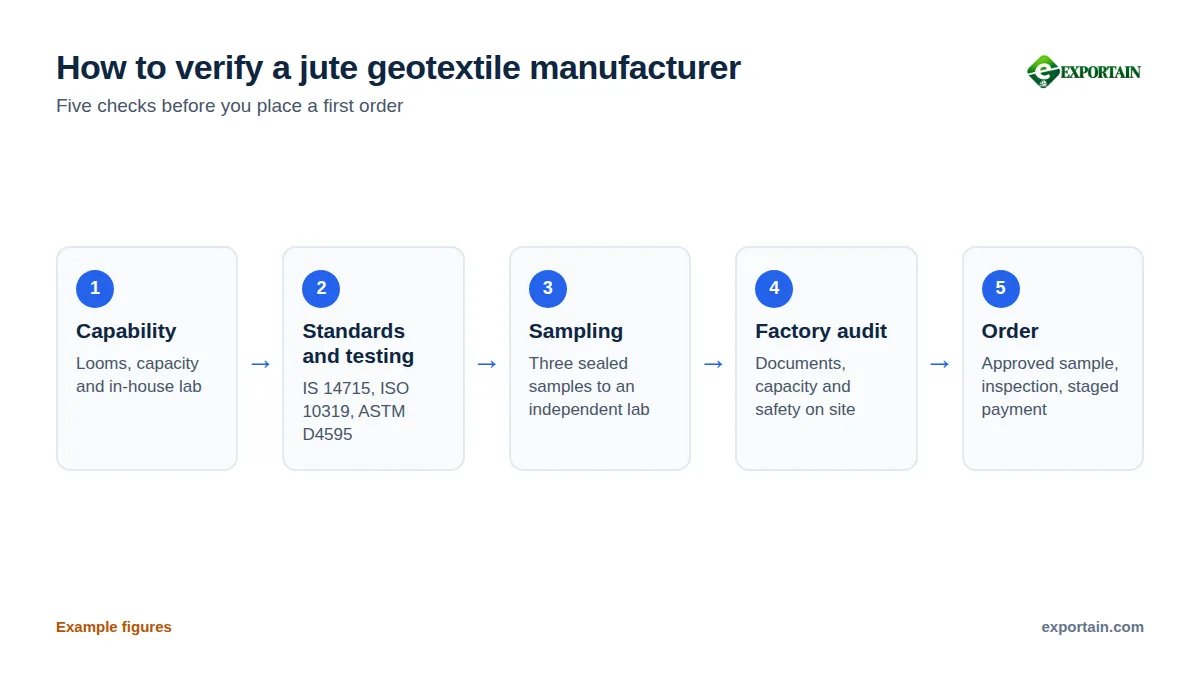
The checks below run in order. Capability comes first: a mill that cannot weave your grade fails every later test. Standards and sampling prove the fabric, the audit proves the factory, and only then does an order make sense.
How do you run sampling and a factory audit?
Sampling is where most first orders go wrong: the sample a mill sends is often not representative of bulk production. Ask in writing for three sealed samples cut from production stock, each labelled with the grade, roll number and date. Ask an independent party to draw, seal and submit the samples to an accredited laboratory such as SGS, Intertek or Bureau Veritas, or one your project nominates.6 The chain of custody is what makes the result trustworthy: the factory never chooses which pieces are tested.6
A factory audit is a structured review of premises, documents, capacity, working conditions and fire and building safety, done with verification before the first order for a new supplier.6 A verification visit confirms the factory exists at the address given, checks trade licences and export registration against the originals, compares lines, machines and bookings with your quantity and lead time, and reviews fire, electrical and structural safety.6 It also tests sub-contracting risk: if the order cannot fit in-house, it is likely to pass to units you have not approved.6
If you cannot visit, commission a third-party audit and ask for timestamped photographs of the premises, machines and lines, plus a written report naming the auditor, the date and the documents checked. Do not accept a video call as a substitute for an audit. On Exportain, trust badges come from a review of documents and photos, not a factory inspection, and membership never grants a badge.10 Treat the badge as a starting point, then run your own checks.
Agree the inspection plan before you pay a deposit: who inspects, at which stages, and what happens if the goods fail. A during-production inspection catches problems while they can still be fixed, and a pre-shipment inspection checks the finished goods, packing, carton count and container seal. Put acceptance limits in the contract, not in an email thread.
What does a worked example look like?
Example figures: a buyer needs geotextiles for a riverbank project in Southeast Asia. The specification calls for woven fabric at 724 grams per square metre, tensile strength of 25 kN/m in both directions, and an apparent opening size of 150 to 400 microns, matching IS 14715 Part 1 values.3 The buyer needs 10,000 square metres in 1.2-metre rolls, natural finish, FOB Chattogram in 45 days.
The buyer shortlists three mills, sends the same brief to each, and asks for three sealed samples from production stock. Two reply with independent laboratory reports showing weight and tensile strength within specification. The third sends a report with no laboratory name and no lot number, and is dropped. The buyer audits the two remaining mills, confirms looms, capacity and safety, and places a trial order of 2,000 square metres with the mill whose audit report is stronger. A during-production inspection is agreed at 50 percent completion, and a pre-shipment inspection checks the finished rolls against the sample. If the trial passes, the remaining 8,000 square metres follow on the same terms.
Which red flags should stop a deal?
Stop when a supplier refuses a live video walkthrough from the production floor, or when the address on its documents does not match the factory shown. Stop when test reports carry no laboratory name, no lot number and no numbers, or when the laboratory cannot confirm the report. Stop when the price is far below every other quote for the same specification: the saving usually comes from lighter fabric, weaker yarn or a different grade. Stop when the supplier asks for full payment before production, or asks you to pay a personal account or an unrelated company. Stop when the mill cannot name the standard it supplies against, or claims a certificate belonging to a different company. Any one of these is enough to pause the deal. Two together end it.
What mistakes do first-time buyers make?
The most common mistake is ordering by weight alone. Two fabrics can weigh the same yet differ in tensile strength, aperture and finish, so a weight-only order invites a weaker delivery that still passes a scale check. The second mistake is accepting a sample without a written specification to compare it with. A sample proves nothing unless the approved weight, aperture and test values are recorded first. The third mistake is skipping the audit on a first order to save time. One audit costs far less than a container of the wrong fabric. The fourth mistake is paying in full before inspection. Staged payment, tied to an approved sample and a passed pre-shipment inspection, protects both sides. For classification and duty, confirm the code with our HS code guide for jute geotextiles before you ship, and read our guide to finding suppliers in Bangladesh for a wider shortlist.
Next steps on Exportain
Start with a written specification, then search Exportain suppliers for jute makers and post a request for quotation stating your standard, weight and aperture. Read the HS code guide for jute geotextiles and the jute geotextiles quality control checklist before agreeing terms, and check how seller verification works on Exportain so you know what a badge does and does not prove.
Sources
- Jute Geotextiles (JGT): The Complete Guide to Erosion Control. Wahab Jute Mills, (accessed )
- A Review on Jute Geotextile Part 1. International Journal of Research in Engineering and Technology (accessed )
- IS 14715 (Part 1): 2016 — Jute Geotextiles, Part 1: Strengthening of Sub-Grade in Roads — Specification. Bureau of Indian Standards (accessed )
- Bangladesh's jute exports to India nearly double, garment earnings decline. bdnews24.com, (accessed )
- Exports of jute and jute goods keep falling. The Financial Express, (accessed )
- Supplier Verification and Factory Audit in Bangladesh. BPO Bangladesh (accessed )
- IS 14715 (Part 2): 2016 — Jute Geotextiles, Part 2: Control of Bank Erosion in Rivers and Waterways — Specification. Bureau of Indian Standards (accessed )
- ISO 10319:2015 — Geosynthetics: Wide-Width Tensile Test. International Organization for Standardization, (accessed )
- D4595/D4595M Standard Test Method for Tensile Properties of Geotextiles by the Wide-Width Method. ASTM International (accessed )
- Supplier verification: Earn trust badges buyers can see. Exportain (accessed )
- Bangladesh
- supplier verification
- quality control
- sourcing from Bangladesh
- factory verification
- Jute geotextiles
- Jute
About the author
Sourcing from Bangladesh?
Post a request for quotation and suppliers on Exportain can send you their quotes directly.
Post an RFQ