Jute Shopping Bags Exporters: Verified Supplier Checklist
A five-stage checklist for buyers sourcing jute shopping bags from Bangladesh: documents, export track record, compliance, sampling, and payment, with an AQL inspection table and a worked scoring example.
Short answer
To find a reliable jute shopping bag exporter in Bangladesh, check the export documents first: a current ERC from CCI&E, trade licence, e-TIN, BIN, and an authorised dealer bank account. Then confirm past shipments of shopping bags, buyer references, in-scope certificates, an approved pre-production sample, and a pre-shipment inspection plan under AQL Level II. Pay by irrevocable letter of credit that names the inspection certificate.
On this page
Key takeaways
Check the ERC, trade licence, e-TIN, BIN, and authorised dealer bank account first, and make sure the same legal name appears on every document.
Past shipments of shopping bags and reachable buyer references matter more than a long client list.
Use General Inspection Level II with AQL 0 for critical, 2.5 for major, and 4.0 for minor defects, and name the inspection certificate in the letter of credit.
Score every shortlisted exporter on documents, track record, compliance, sampling, and payment terms before paying an advance.
A jute shopping bag order is easy to place and hard to undo. This checklist helps a buyer confirm, before paying, that the exporter in Bangladesh is a real export business and has shipped this product before.
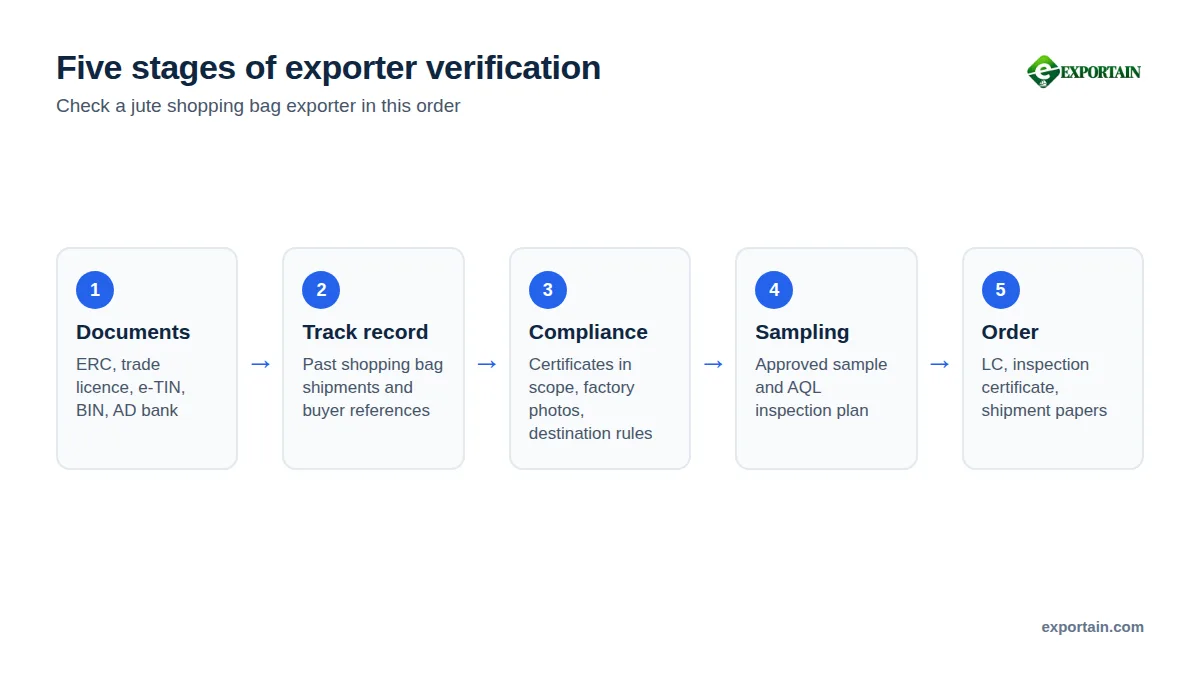
The five stages: documents, track record, compliance, sampling, then the order.
Why do jute shopping bag exporters need a checklist
Demand for reusable bags keeps growing as plastic carrier bags face limits. In the European Union, Directive (EU) 2015/720 targets lightweight plastic carrier bags below 50 microns thick, and member states were to cut consumption to no more than 40 per person per year by 31 December 2025.1 That shift supports demand for natural fibre alternatives such as jute shopping bags.
Bangladesh is a natural source for those bags. The country earned 883.7 million dollars from jute and jute goods in fiscal year 2025-26, up 7.75 per cent on the year before, and the government aims to double sector earnings to 2 billion dollars by 2031.2 Jute sacks and bags rose 5.03 per cent to 132.3 million dollars in the same year, after earning 125.96 million dollars the year before, up 18.51 per cent.2 3
What is the difference between an exporter and a manufacturer
An exporter holds the export registration, signs the contract, files the export declaration, and receives the payment. A manufacturer makes the bags. The two are often the same company, but a trading exporter may buy finished bags from several small makers and ship them under its own name. The risk is a seller who claims to be a manufacturer but is really a broker with no control over production, or an exporter who cannot name the factory that will make the order. Ask directly who makes the bags, where the factory sits, and whether the exporter owns it or buys from it. For background on how shopping bag makers work, see our guide to jute shopping bags manufacturers in Bangladesh.
How do you check an exporter's documents
The Export Policy 2024-27 names the Export Registration Certificate (ERC) from the Office of the Chief Controller of Imports and Exports (CCI&E) as the first step in the export process.4 Ask for a copy and check that the name and address match the trade licence, and that the certificate is still in force.
Check:
Trade licence: from the city corporation, municipality, or union parishad for the business address, current for this year.
E-TIN certificate: income tax registration with the NBR.
BIN certificate: VAT registration with the NBR. Customs lists the ERC and BIN among the general export documents.4
Bank account with an authorised dealer (AD) bank: the bank that handles the EXP forms, export bills, and incoming money.
Chamber or association membership certificate.
Certificate of incorporation for a limited company, or the partnership deed for a partnership.
Check that the same legal name appears on every document: a different name on the invoice, the bank account, and the ERC is a common source of payment delays. Photocopies are a start, not proof: ask to see the originals on a video call, and note the expiry date of each document.
How do you check an exporter's track record
Documents show that a business may export. History shows that it has. Ask for evidence of past shipments of jute shopping bags, not just of jute goods in general.
Ask how many shipments of jute shopping bags the exporter sent in the last two years, and to which countries; what the highest-volume single order was; and which buyers can give a reference.
A reference that answers promptly is worth more than a long client list with no contacts. Jute and jute goods earned 820.16 million dollars in fiscal year 2024-25, down from 855.23 million dollars the year before.3
What compliance checks belong on the list
Ask which certificates the exporter holds and for which scope. The export policy encourages ISO 9000, ISO 14000, and ISO 22000 certification, but read what a certificate covers: one for yarn spinning does not cover bag stitching and printing.4
Before you approve a factory, check that the certificate names the exporter or the factory, covers the activity you are buying, and is in date. Ask for dated photos of the production and packing areas and the store for finished bags, which must be clean and dry because jute absorbs moisture. For the destination, check labelling, fibre content, and chemical limits for printed bags in the European Union, and labelling and state rules in the United States. India has applied anti-dumping duty on Bangladeshi jute products since 2017.3
An Exportain badge is not a substitute for these checks: badges reflect reviews of documents and photos, not factory inspections or guarantees.
How do you check the bag itself before ordering
Agree the specification in writing before the sample is made, then check the sample against it point by point.
Confirm the classification as well. Heading 6305 of the Harmonized System covers sacks and bags of a kind used for the packing of goods, and subheading 6305.10 covers those of jute or of other textile bast fibres.5 Shopping bags with handles are often classified under a different heading from packing sacks, so confirm the code with your customs broker. Our guide to classifying jute shopping bags under the HS code explains how the headings differ.
Put these points in the specification sheet: fabric weight in grams per square metre (GSM), weave, and lamination; length, width, and gusset in centimetres, with a tolerance of plus or minus 1 centimetre; print colours, method, and position; handle material, length, and stitching; stitch density and seam type; and bags per carton, carton markings, and gross weight per carton.
Order a pre-production sample made from the bulk fabric, not a showroom piece. Load it, carry it by the handles, and check the print after handling. Approve it in writing, and state that bulk production must match it.
What should the inspection plan say
A pre-shipment inspection is the last chance to catch a bad lot before it leaves Bangladesh. The plan should name the inspection level, the acceptance quality limit (AQL) for each defect class, who inspects, and what happens if the lot fails. Most buyers sample at General Inspection Level II and accept a lot when it has no critical defects, no more than 2.5 major defects per hundred units, and no more than 4.0 minor defects per hundred.6 Under ISO 2859-1, the lot size and the inspection level give a code letter, which gives the sample size and the accept and reject numbers.6
| Lot size in pieces | Code letter | Sample size | Major AQL 2.5 accept and reject | Minor AQL 4.0 accept and reject | | 281 to 500 | H | 50 | 3 and 4 | 5 and 6 | | 501 to 1,200 | J | 80 | 5 and 6 | 7 and 8 | | 1,201 to 3,200 | K | 125 | 7 and 8 | 10 and 11 | | 3,201 to 10,000 | L | 200 | 10 and 11 | 14 and 15 |
A single critical defect rejects the lot under the AQL 0 convention, so define what counts as critical before inspection day: a broken handle, a hole in the fabric, a wrong fibre content on the label, or a print that names the wrong brand. Agree the defect list in writing and attach it to the purchase order. For a fuller defect list, see our quality control checklist for jute shopping bags. Book the inspection for the day the order is packed and ready, with the sample drawn at random from several cartons.
How do you pay safely and check the shipment papers
For a first order with a new exporter, an irrevocable letter of credit (LC) is the usual choice. An LC is a bank's written promise to pay the seller, on one condition: the seller must present the documents the LC asks for, within the dates it sets, and the documents must match its terms.7 Under the ICC rules most LCs follow, known as UCP 600, an LC cannot be changed or cancelled without the agreement of the seller, the issuing bank, and any bank that has added its own promise.7 Ask for confirmation if the issuing bank or the buyer's country carries risk you do not want to take: a confirming bank adds its own promise to pay on top of the issuing bank's.7 Banks deal in documents, not goods, so an LC protects the buyer only as far as the documents go. If you want proof of quality, ask for it in the LC, for example an inspection certificate from a named company.7
The exporter's paperwork clock also matters. The exporter files the EXP form through its AD bank before customs formalities, and must give the bank the signed EXP copy, the certified bill of export, and the shipping documents within 14 days of shipment.4 Full export proceeds must normally reach Bangladesh within four months of shipment, although raw jute and jute goods can get up to 360 days under an irrevocable confirmed LC or qualifying open-account terms.4 For a first order, a common structure is 30 per cent advance and 70 per cent by irrevocable LC at sight, with the LC naming the inspection certificate. Never pay 100 per cent in advance to an exporter you have not checked.
Worked example: scoring three exporters
Score each exporter from 0 to 2 on each stage: 0 means no evidence, 1 means partial evidence, and 2 means full evidence on file. The example below compares three exporters for one order of 5,000 laminated jute shopping bags. Example figures.
| Check | Exporter A | Exporter B | Exporter C | | Documents complete and in date | 2 | 2 | 1 | | Track record with shopping bags | 2 | 1 | 0 | | Compliance certificates in scope | 1 | 2 | 1 | | Sample matches specification | 2 | 2 | 1 | | Payment terms and inspection agreed | 2 | 1 | 1 | | Total score out of 10 | 9 | 8 | 4 |
Exporter A quoted 1.55 dollars per bag, an order value of 7,750 dollars; B quoted 1.72 dollars, or 8,600 dollars; C quoted 1.95 dollars, or 9,750 dollars. A 30 per cent advance would be 2,325 dollars, 2,580 dollars, and 2,925 dollars in the same order. Example figures.
Exporter A scores highest and costs least, so it is the natural choice, subject to a pre-shipment inspection under the AQL plan above. Exporter B is a fair second choice if A cannot meet the delivery date. Exporter C costs the most and scores lowest.
What red flags should stop the order
Some findings are reasons to walk away until the exporter fixes them. The ERC, trade licence, or BIN is expired, or the names on the documents do not match. The exporter will not name the factory or give its address. The exporter asks for full payment in advance and refuses an LC. The exporter changes its bank account details by email with no second-channel confirmation. No pre-production sample from bulk fabric is offered. The price is far below every other quote with no explanation. For context on normal pricing, see our jute shopping bags price breakdown. The exporter refuses a pre-shipment inspection. References cannot be reached.
One red flag can sometimes be explained. Two or more together mean the order should wait. A buyer who places the order anyway should at least cut the advance and name the inspection certificate in the LC. The most common mistake is to check the price and skip the rest: a low FOB price means little if the bags arrive with weak handles, wrong print, or damp fabric. Start with a trial order, and check the MOQ guidance for jute shopping bags before negotiating the quantity.
Next steps on Exportain
Run the checklist on your shortlist, starting with the documents and the track record, and keep the evidence for each exporter in one file. Then compare exporters on the Exportain suppliers directory, post your requirement as a new request for quotation, and read how to buy on Exportain before you agree payment terms.
Sources
- Plastic bags. European Commission, (accessed )
- Jute exports rise 37 per cent as Bangladesh plans to double earnings by 2031. The Financial Express, (accessed )
- Exports of jute and jute goods keep falling. The Financial Express, (accessed )
- Start an Export Business in Bangladesh (2026 Guide). Entrepreneurs.bd (accessed )
- HS, 2012 - Code 6305 Classification Detail. United Nations Statistics Division (accessed )
- Textile Quality Control: AQL Sampling And Inspection Guide. TextileTuts (accessed )
- A bank's promise. Open Trade Bangladesh (accessed )
- supplier verification
- bangladesh exporters
- Bangladesh sourcing
- Jute shopping bags
- exporter checklist
- jute bags export
About the author
Sourcing from Bangladesh?
Post a request for quotation and suppliers on Exportain can send you their quotes directly.
Post an RFQ