Jute Shopping Bags MOQ in Bangladesh: How to Negotiate It Down
A Bangladeshi maker quotes 5,000 printed jute shoppers when you need 2,400. This guide works through the published MOQ bands by print and customisation level, the setup costs behind them, and a seven-lever negotiation that cuts the first order without breaking the relationship.
Short answer
A typical MOQ for a printed jute shopping bag in Bangladesh runs from 100 units for stock bags to 2,000 units for bespoke bags, with semi-custom printed bags in between. The number is set by loom setup, dye lots and print screens, and it falls when you change the run behind it: standard fabric and size, one print colour, a blanket order with split shipments, or a setup fee and a higher unit price.
On this page
Key takeaways
A shopping-bag MOQ is counted per variant, not per order: one size, one colour and one print can each carry its own minimum.
Published MOQ bands run from 100 units for stock bags to 2,000 units for bespoke bags, with semi-custom printed bags in between.
Loom setup, dye lots and print screens set the floor, so the negotiation starts by asking which one binds.
Seven levers lower the number: standard fabric and size, one print colour, a different print method, a shared run, a blanket order, a setup fee with a higher price, and a smaller maker or consolidator.
Example figures cut a 5,000-bag ask at $2.20 to a 2,400-bag first order at $2.55 plus a $150 setup fee, costing $990 across the full programme.
A buyer for a farm-shop chain in the north of England needs 2,400 laminated jute shoppers for a Christmas launch: one size, a two-colour print, padded cotton handles. The Dhaka maker replies with a minimum order quantity (MOQ) of 5,000 bags. The buyer needs less than half that number.
The gap is negotiable, but only when the buyer negotiates the production run behind the number rather than the number itself. This guide covers the published MOQ bands, the setup costs behind them, and seven levers that bring a first order down.
What a shopping-bag MOQ counts
A shopping-bag MOQ is almost always counted in pieces per variant, not per order total. A variant is one combination of size, fabric, colour and print: change any one of them and the maker counts a fresh minimum. A quote of 1,000 pieces may mean 1,000 of one size, one colour and one print, so two sizes in two colours is four minimums.
The published bands show how far the number moves with customisation. One jute-bag maker lists stock bags at a minimum of 100 units, whatever printing is needed, and anything it must customise or make bespoke at 2,000 units.1 A second supplier publishes a three-step ladder: plain or in-stock bags from 50 to 100 units, semi-custom bags in standard sizes with a logo print from 250 to 500 units, and fully custom dimensions with dyed fabric and laminated linings at 1,000 units or more.2 A third puts custom printed jute totes at 100 to 250 units, with the exact figure set by the printing method,3 while a fourth sets its minimum for custom jute bags at 1,000 bags.4
Why the maker sets the number where it does
Setup work for custom bags includes making printing screens, calibrating machines, sourcing materials and preparing designs, and those costs are fixed whether the order is 100 bags or 10,000.5
Five setup costs set the floor. The first is the loom run: the cloth is woven to a grade and width, and a new grade means a new setting. Mills commonly require 50 to 100 kg of fabric per colour, roughly 150 to 300 T-shirts in apparel.6 The second is the dye lot: a dyed cloth in your brand shade means a dedicated dye bath, and a dye-lot run is commonly around 500 yards of fabric per colour batch.7 The third is the print: each colour needs its own screen, prepared before the run starts, so a single-colour logo carries one screen charge and a four-colour design carries four. Screen printing suits one to three spot colours at high volume; heat transfer and digital suit smaller runs and photo-quality work.3 The fourth is lamination and handles. Packing and freight set the last floor: a part-filled carton still pays for the carton, and a small order pays far more freight per bag than a full load.
Ask what binds before you ask for less
Most buyers open by asking for a lower number, and the maker answers no, because the question gives it nothing to work with. The better question is, "What is driving the MOQ: the loom setup, the dye lot, the print screens, or something else?"
If the answer is the dye lot, a natural shade or a shade already on the maker's card removes the constraint. If the answer is the print screens, one colour instead of two removes a screen and its setup charge. If the answer is the loom run, a fabric weight the maker already weaves removes the setting. If the maker uses pre-dyed stock fabric, its setup constraint may be only around 50 units for a screen-printing line changeover.7 Ask for the breakdown in writing: MOQ per size, colour and print, fabric GSM, print method, and setup fees as separate lines.
Seven levers that lower a shopping-bag MOQ
The number falls when the run behind it changes, so put each agreed point in writing.
1. Take the maker's standard fabric and standard size
Start with the fabric the maker already runs and the size it already cuts. A standard size uses the maker's existing cutting pattern and carton plan.
2. Cut the print to one colour on one side
One colour on one side needs one screen; two colours on both sides need four. Single-colour screen printing is the cheapest setup a supplier can offer.2 For fine detail, ask for a Juco panel: its smoother surface takes fine print better than coarse jute.
3. Switch the print method for a small run
Screen printing is priced for volume. For a run under 500 bags, ask for a heat-transfer or digital-print quote beside the screen-print quote. Heat transfer and digital printing both carry a higher unit price and a lower minimum than screen printing.3 Test the alternative on a folded sample first.
4. Join a fabric run the maker already has scheduled
Ask what the maker is weaving next. Some makers run combined production for several clients, so adding your bags to a run already scheduled costs them very little.6 The same logic covers stock: a maker holding pre-stitched natural bags can print your logo on them at a minimum of 100 units, where a bespoke bag needs 2,000.1
5. Commit the volume, collect it in stages
Agree a bigger total in writing and collect it in stages. Under a blanket purchase order you commit to 500 units over 12 months with quarterly releases of 125: the maker gets its guaranteed volume, and you avoid holding a year of stock.7 For shopping bags, commit 5,000 over twelve months and ship 2,400 now.
6. Pay the setup fee and a higher unit price, with a bigger advance
Offer to pay the fixed setup costs directly rather than through volume. Paying the setup fee on a smaller batch lets the maker keep its margin while your total outlay falls.7 A maker that sees a 50 per cent deposit instead of 30 per cent, a written repeat commitment, or a higher unit price has a reason to run a smaller first order.6
7. Try a smaller maker, or a trader that consolidates
Trading companies generally offer lower starting MOQs because they consolidate orders across several clients and hold stock.7 In Bangladesh, the Jute Diversification Promotion Centre, founded in 2002, counts 1,100 registered entrepreneurs making 282 kinds of diversified jute goods, supported by six service centres around the country.8
What a lower MOQ costs per bag
The figures below are example figures.
What changes | At the full MOQ | At the negotiated MOQ |
|---|---|---|
Unit price | The standard price | A premium of 10 to 20 per cent |
Setup fee | Folded into the unit price | A separate line, often $100 to $200 |
Advance | The standard 30 per cent | Often 50 per cent |
Cash committed now | The full order value | The first drop only |
Risk if the bag does not sell | The full order sits in stock | The first drop sits in stock |
Worked example: 2,400 laminated shoppers for a farm-shop chain
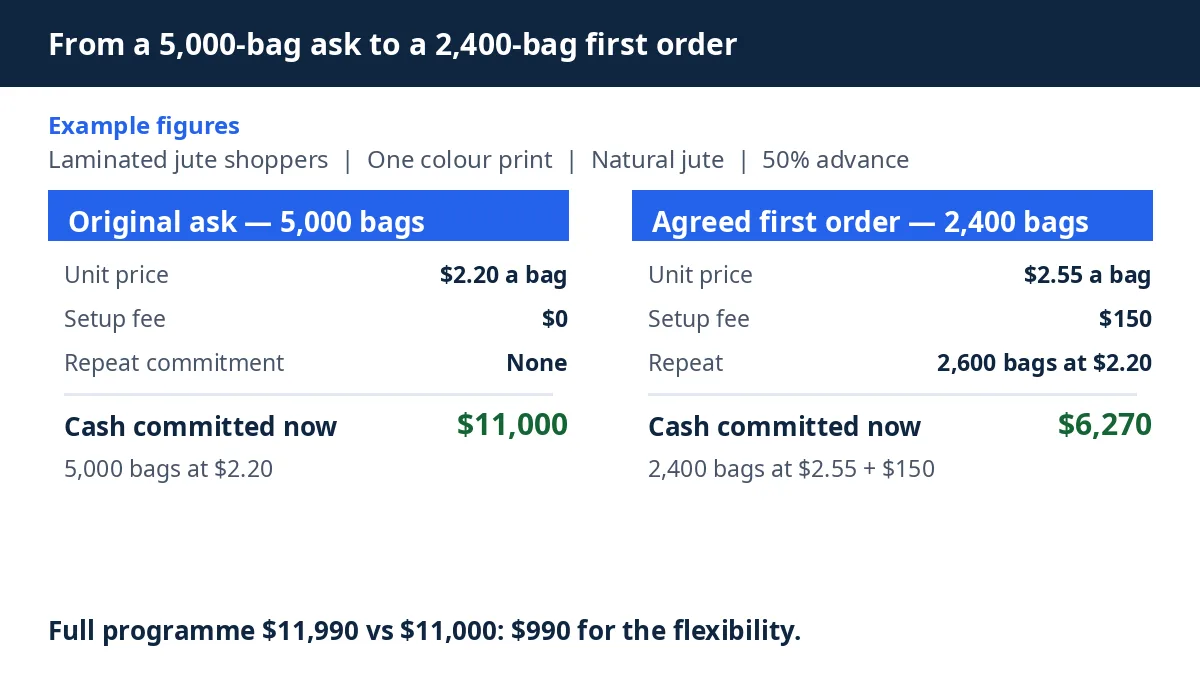
Example figures. A farm-shop chain in the north of England orders laminated jute shoppers, one size, padded cotton handles, a two-colour print. The Dhaka maker quotes a MOQ of 5,000 bags at $2.20 a bag. The buyer needs 2,400 bags.
The maker says the floor comes from a fresh loom run for the dyed fabric and two print screens. The buyer drops the dyed fabric, cuts the print to one colour, and commits in writing to 5,000 bags over twelve months. The maker agrees to ship 2,400 bags now at $2.55 a bag, plus a $150 setup fee, with a 50 per cent advance.
Line | Original ask | Agreed first order |
|---|---|---|
Quantity | 5,000 bags | 2,400 bags now, 2,600 later |
Unit price | $2.20 a bag | Trial $2.55, repeat $2.20 |
Setup fee | $0, folded into the price | $150, charged separately |
Goods value | $11,000 | $6,120 for the first drop |
Cash committed now | $11,000 | $6,270 |
Repeat | None | 2,600 bags in 12 months at $2.20 |
The first order is 2,400 bags at $2.55, or $6,120, plus the $150 setup fee: $6,270. The premium is $0.35 a bag, about 16 per cent above $2.20; the cash not committed now is $4,730. The repeat is 2,600 bags at $2.20, or $5,720, so the full programme costs $11,990 against $11,000 for the original ask: $990 for the flexibility.
Those terms go into the proforma invoice, with a 50 per cent advance and the repeat confirmed within 30 days of the launch. Custom jute-bag orders can take up to 120 days from design approval to delivery.4
What to put in the RFQ
A strong RFQ turns the MOQ into a number with a breakdown behind it. Send the same enquiry to three or more makers, and ask each for:
The minimum in pieces for each size, colour and print, and whether each figure is per variant or for the whole order.
Fabric GSM and grade, and whether the cloth comes from a standard run or a custom one.
Print method, and how the MOQ changes with one colour instead of two.
Setup fees as separate lines: screens, loom setup and sample charge.
Tiered prices at 1,000, 2,400 and 5,000 units.
Timing from pre-production sample approval to dispatch, plus sea-freight time to your port. Allow 2 to 5 weeks for most custom-printed wholesale orders, and longer for fully bespoke bags.3
Packing: bags per carton and cartons per container.
Payment terms, and whether a letter of credit is required.
Mistakes that push the minimum back up
Opening with a quantity and no specification is the first mistake. A maker given no GSM, size or print has nothing to price from, so it names a cautious figure, and the cautious figure is high. The second is splitting one order across variants: two sizes in two colours with two prints multiplies one minimum into eight, because every variant carries its own floor.
Treating the lowest MOQ as the right offer is the third. Treat a very low minimum with suspicion: 200 pieces for a heavily printed bag can mean a digital print, thin cloth, or a maker new to export. Paying in full before the sample is approved is the fourth: approve the printed sample first, then release the bulk deposit. The fifth is promising volume you cannot deliver: put the repeat in writing only when you mean it.6
Questions buyers ask about shopping-bag MOQs
Is there a standard MOQ for jute shopping bags in Bangladesh?
No. There is no published standard minimum: each maker sets its own floor per size, colour and print. Published figures run from 100 units for stock bags to 2,000 units for bespoke bags.1 2
Can I order fewer bags if I pay more per bag?
Often yes. Paying more per bag lets the maker cover the same fixed setup across fewer bags, and a packaged offer beats a bare request for fewer bags. Offer the setup fee, a bigger advance, or a written repeat commitment.6 7
Does a low MOQ mean a weaker bag?
Not on its own, but check. A low minimum can mean a digital or heat-transfer print instead of screen print, a lighter fabric, or a smaller maker with less export experience. Ask for the GSM, the print method and a sample in the final fabric.
Next steps on Exportain
Start with our jute shopping-bag makers guide to shortlist makers that finish bags for retail use, then read our general jute-bags MOQ guide for the counting rules across bag types. When the specification is set, search Bangladeshi suppliers or post an RFQ stating the bag type, fabric weight and print colours, and read how to buy for what happens after you order.
Sources
- FAQs. GoJute International (accessed )
- The Jute Bag Maker: Bulk Jute Bags in Hyderabad Guide. The Jute Bag Maker (accessed )
- Wholesale Jute Bags UK | 100% Ethical Manufacturer. Supreme Creations (accessed )
- Custom Jute Bags. Envi Reusable Bags (accessed )
- Understanding Minimum Order Quantities for Custom Reusable Bags. Envi Reusable Bags, (accessed )
- How to Negotiate Minimum Order Quantities with Suppliers. Grey and Black (accessed )
- How do buying teams successfully negotiate minimum order quantities (MOQs) with suppliers without blowing up unit economics or damaging vendor relationships. SupplyBatch, (accessed )
- Jute Diversification Promotion Centre weaves success for 1,100 entrepreneurs. Daily Sun, (accessed )
About the author
Sourcing from Bangladesh?
Post a request for quotation and suppliers on Exportain can send you their quotes directly.
Post an RFQ