Custom Jute Shopping Bags Manufacturer in Bangladesh: OEM Process From Tech Pack to Bulk
This guide follows the OEM process for a custom jute shopping bag in Bangladesh, from the tech pack through sampling, costing, bulk production, AQL inspection and shipment, with the shopping-bag specifications that decide whether bulk matches the approved sample.
Short answer
A custom jute shopping bag moves from tech pack to bulk in six stages: specification and costing, proto sample, pre-production sample sign-off, bulk production, final AQL inspection, and packing and shipment. The tech pack fixes dimensions, GSM, weave, lamination, handles, print artwork and stitching. The PP sample, made with final materials, is the binding reference for bulk. Standard minimums start at 1,000 to 2,500 pieces per design.
On this page
Key takeaways
The PP sample, made with final materials, is the binding reference for bulk production.
Retail shoppers commonly use 300 to 380 GSM cloth in a 13 by 13 or 14 by 14 weave, with handles tested above 15 kilograms-force.
Standard minimums for custom-dyed and branded jute shopping bags start at 1,000 to 2,500 pieces per design.
Final inspection usually runs at AQL 2.5 for major defects and AQL 4.0 for minor defects under ISO 2859-1.
A custom jute shopping bag is not ordered off a shelf. You send a specification, the factory builds samples against it, you approve a pre-production sample, and only then does bulk production start. Each stage has a written approval, so a mistake found early costs a sample and a mistake found late costs a container.
Bangladesh is a practical place to run this process. Jute and jute goods earned 883.7 million dollars in fiscal year 2025-26, up 7.75 per cent on the year before, and sacks and bags earned 132.3 million dollars, up 5.03 per cent.1 Earnings reached 346.37 million dollars in the first four months of fiscal year 2026-27, up 24.88 per cent year on year,2 Jute fibre is 100 per cent biodegradable and recyclable, and a hectare of jute plants consumes about 15 tonnes of carbon dioxide and releases 11 tonnes of oxygen.3
What the OEM process looks like
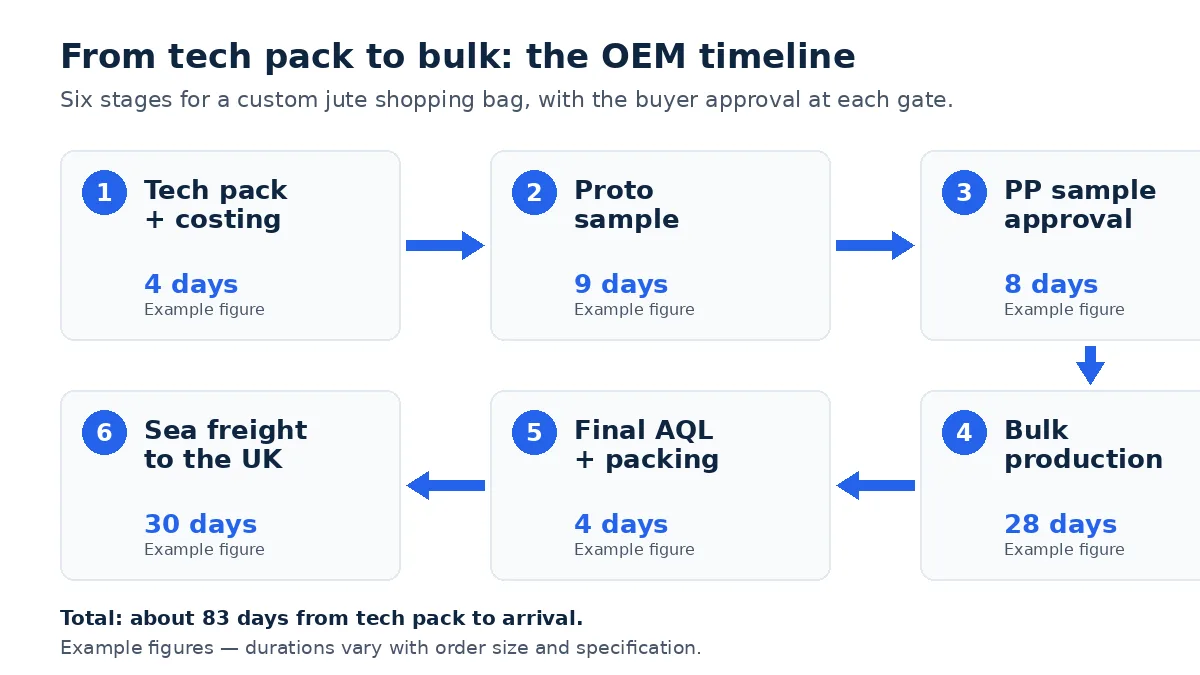
Original equipment manufacturing, or OEM, means the factory makes your design to your specification and puts your branding on it. The process has six stages, and you sign off at three of them: the tech pack, the proto sample, and the pre-production sample.
Stage | What happens | Your approval |
|---|---|---|
1. Tech pack and costing | You send the specification; the factory quotes against it | Agree the specification and price basis |
2. Proto sample | The factory builds a first physical bag | Comment on construction, size and print |
3. Pre-production sample | A bag made with final materials and methods | Written sign-off before bulk starts |
4. Bulk production | Cutting, printing, stitching and finishing | First-piece check and in-line reports |
5. Final inspection | Random sampling of packed goods | Accept or reject the lot |
6. Packing and shipment | Cartons, marks and export documents | Confirm marks and documents before dispatch |
Qualified factories generally need 7 to 10 days to turn around a pre-production sample for sign-off, and bespoke printed jute bags generally take 20 to 35 days in production.4
Heading 6305 covers sacks and bags of a kind used for the packing of goods, and subheading 6305.10 covers those of jute or other textile bast fibres.5 The Northern Ireland tariff lists jute bags under 6305 10, with a 4.00 per cent third-country duty on new jute bags.6
What goes in a shopping-bag tech pack
A tech pack is the single source of truth for your design. It turns sketches, measurements, fabrics and construction notes into instructions a production team can follow without guessing.7 For a shopping bag, the pack has seven parts.
Tech pack part | What to specify for a shopping bag |
|---|---|
Flat sketches | Front, back, side and inside views, with gusset shape, handle position and print area marked |
Dimensions | Width, height and gusset in centimetres, measured flat, with a tolerance such as plus or minus 1 cm |
Fabric and lamination | Fibre content, weave, weight in GSM, and lamination type and side |
Handles | Material, width, length, attachment method and stitching pattern |
Print artwork | Vector files, colours by Pantone reference, print method, size and position on each face |
Stitching and finishing | Stitch type, stitches per inch, seam finish, edge binding, lining and closure |
Labels and packing | Fibre-content label, care label, hangtag, fold, polybag and carton quantity |
The bill of materials sits inside the tech pack and lists every physical component: main fabric, lamination film, handles, thread, lining, labels and packing materials.7 A specification sheet must also define points of measure, so the factory knows where to measure, what value to hit, and how much variation is allowed.7 For a bag, the points of measure are the width, the height, the gusset depth, the handle length and the handle drop, each with its own tolerance.
How fabric, lamination and handles are chosen
Shopping bags for retail use are commonly made from a 13 by 13 or 14 by 14 weave at 300 to 380 GSM, where GSM is grams per square metre of cloth.4 Heavier cloth costs more and makes a stronger bag, so the GSM follows the load: a light promotional tote can sit near 300 GSM, while a grocery shopper that carries several kilograms needs the upper end of the range.
Three cloth choices cover most orders. Natural unlaminated hessian gives a rustic look and full biodegradability, but it has an open weave and little resistance to moisture. Laminated jute carries a thin polypropylene or LDPE film on the inside, which gives the bag structure, resists water, and lets the inside be wiped clean. Juco, a blend of 75 per cent jute and 25 per cent cotton, has a smoother surface that takes fine print better than coarse hessian.4
Handles decide how the bag is carried and where it fails. Cotton webbing handles are the usual choice for retail shoppers, cane handles suit gift and bottle bags, and padded handles help with heavier loads.4 Retail shopping bags are commonly tested to a handle pull strength above 15 kilograms-force.4
How sampling works, and what each sample approves
Sampling runs in rounds, and each round has one purpose. A good tech pack reduces the number of rounds, but a first sample is rarely right in every detail.7
The proto sample is the first physical interpretation of your tech pack. It checks the construction, the proportions, the handle placement and the print position. Send one consolidated revision list after each round.8
The pre-production sample, often called the PP sample, is the gate that matters most. It is an exact replica of bulk production, made with the correct bulk fabrics and trims, and bulk production must match it exactly.7 Before you sign it off, check the cloth weight, the lamination, the handle stitching, the print colours against the Pantone references, the label positions and the finished measurements.7
What drives cost and minimum order quantity
Cost follows the specification line by line. The cloth is the heaviest cost line, because it is most of the bag, and moving from 300 GSM to 380 GSM adds fibre to every bag. Print adds screens and set-up time, so each extra colour costs more than the last.
Minimum order quantity follows the same drivers. Standard factory minimums for custom-dyed and branded jute shopping bags typically start at 1,000 to 2,500 pieces per design.4 A plain bag in a stock cloth can sit at the low end, while a custom-dyed cloth, a special weave or a multi-colour print pushes the minimum up, because the mill and the print shop have their own set-up minimums.7 If your quantity is below the factory minimum, ask what changes: a stock colour instead of a custom dye, a standard handle instead of a woven one, or one print colour instead of three can bring the order inside the minimum without changing the bag shape. Our MOQ guide for jute shopping bags explains how buyers bring the minimum down.
How bulk production runs, from cutting to finishing
Bulk production starts only after the PP sample is signed off. The first control is fabric inspection before cutting: rolls are checked for width, weight, shade and defects, and grouped into shade bands so one bag never mixes cloth from two bands.8
Cutting follows the pattern, and printing usually happens on the cut panels, before stitching.
Stitching is where the bag takes its strength. The body seams are sewn, the gusset is set, the top edge is bound or hemmed, and the handles are attached with their reinforcing stitch. The first-piece approval is the key control here: the first finished bag off the line is checked against the PP sample before the line continues, so a wrong stitch setting is caught on one bag rather than repeated across thousands.8 9
How quality is checked: in-line, final AQL and lab tests
Quality control runs at five stages: incoming fabric and trims, in-line checks during sewing, end-of-line inspection, the factory pre-final check, and the final random inspection.9
Most buyers set the final inspection to AQL 2.5 for major defects and AQL 4.0 for minor defects, with zero tolerance for critical defects, under ISO 2859-1 at General Inspection Level II.9 AQL is the worst tolerable process average, not a promise that a set percentage of the goods will be faulty.
Lot size in pieces | Sample size | Major defects, AQL 2.5 | Minor defects, AQL 4.0 |
|---|---|---|---|
501 to 1,200 | 80 | Accept 5, reject 6 | Accept 7, reject 8 |
1,201 to 3,200 | 125 | Accept 7, reject 8 | Accept 10, reject 11 |
3,201 to 10,000 | 200 | Accept 10, reject 11 | Accept 14, reject 15 |
A lot of 3,000 bags, for example, is inspected on a sample of 125 pieces: 7 or fewer major defects passes the lot on majors, and 8 or more fails it.9 The inspection checklist for these bags lists the checks to put in that purchase order.
Lab tests sit beside the visual inspection. The standard commercial moisture regain for jute goods is 14 to 16 per cent, and exceeding 17 per cent during ocean transit can cause condensation and fungal growth inside the container.4 For the European market, dyes must not release any of the 22 listed aromatic amines above 30 milligrams per kilogram under REACH Annex XVII, Entry 43, and the formaldehyde limit for textiles in direct skin contact is typically 75 milligrams per kilogram.10
How packing, documents and shipment work
Packing protects the bags and tells the receiver what is inside. Shopping bags are usually folded, packed in polybags, and placed in multi-wall master cartons with a set count per carton. Carton marks carry the buyer name, the style number, the colour, the quantity and the carton number.
A handled retail tote can fall under a different heading from a packing sack, such as 4202.92, if customs treats it as a handbag rather than a packing bag, so confirm the classification with the material, the construction and the intended use stated on the documents.5 For the United Kingdom, qualifying diversified jute goods from Bangladesh enter at 0 per cent under the Developing Countries Trading Scheme, provided compliant proof of origin is presented.4
The document set for a sea shipment is the commercial invoice, the packing list, the bill of lading, and the certificate of origin, with the HS code and the delivery term stated consistently across all four.4 Ocean shipping from Chattogram to United Kingdom ports takes about 26 to 35 days, giving an overall door-to-door timeline of 8 to 11 weeks from the end of production.4
Common mistakes that stall a shopping-bag order
The most expensive mistake is approving a PP sample made with substitute materials. The second is sending the tech pack in pieces. Send one versioned tech pack and treat every change as a new version.7
A worked example: 4,000 laminated shoppers
Example figures. A buyer in Manchester orders 4,000 laminated jute shopping bags, 38 by 34 by 14 centimetres, in 350 GSM laminated jute with a two-colour screen print and cotton webbing handles. The factory quotes in 4 days, builds a proto sample in 9 days, and a PP sample in 8 days after one revision to the handle attachment. Bulk production takes 28 days, final inspection and packing take 4 days, and sea freight to the United Kingdom takes 30 days. The total is about 83 days.
Next steps on Exportain
Start with the specification, not the supplier search: write the tech pack, then compare factories against it. Our guide to finding and checking jute shopping bag manufacturers explains the checks to run before you send the tech pack. When the tech pack is ready, write an RFQ that gets useful quotations and post it on Exportain so factories quote on the same specification.
Sources
- Jute exports rise 37 per cent as Bangladesh plans to double earnings by 2031. The Financial Express, (accessed )
- Jute export earnings rise by 25% in Jul-Oct'FY27. Dhaka Tribune, (accessed )
- Food and Agriculture Organization of UN report on Jute. Food and Agriculture Organization of the United Nations (accessed )
- Complete Guide To Product Sourcing In Bangladesh. Fresh Agri Market (accessed )
- Bag HS Codes Guide: 6305 Breakdown for Importers. FreightAmigo, (accessed )
- Heading 6305: Sacks and bags, of a kind used for the packing of goods. GOV.UK (accessed )
- How to Prepare a Tech Pack for a Clothing Manufacturer. Mostnica Garment (accessed )
- From Tech Pack to Final Shipment: The buyer's Map for Denim Manufacturing Excellence. YS Denim, (accessed )
- Textile Quality Control: AQL Sampling And Inspection Guide. TextileTuts (accessed )
- Can I Sell Textiles in the EU? Labelling & REACH Guide. Komplio (accessed )
About the author
Sourcing from Bangladesh?
Post a request for quotation and suppliers on Exportain can send you their quotes directly.
Post an RFQ