How to Import Jute Sacks From Bangladesh in 2026: Complete Buyer Guide
A step-by-step guide to importing jute sacks from Bangladesh: choosing B-Twill, A-Twill or Hessian sacks, writing the purchase order, checking makers, approving samples and lab tests, agreeing FOB or CIF terms, inspecting under AQL, baling, loading and collecting export documents, with a worked landed-cost example.
Short answer
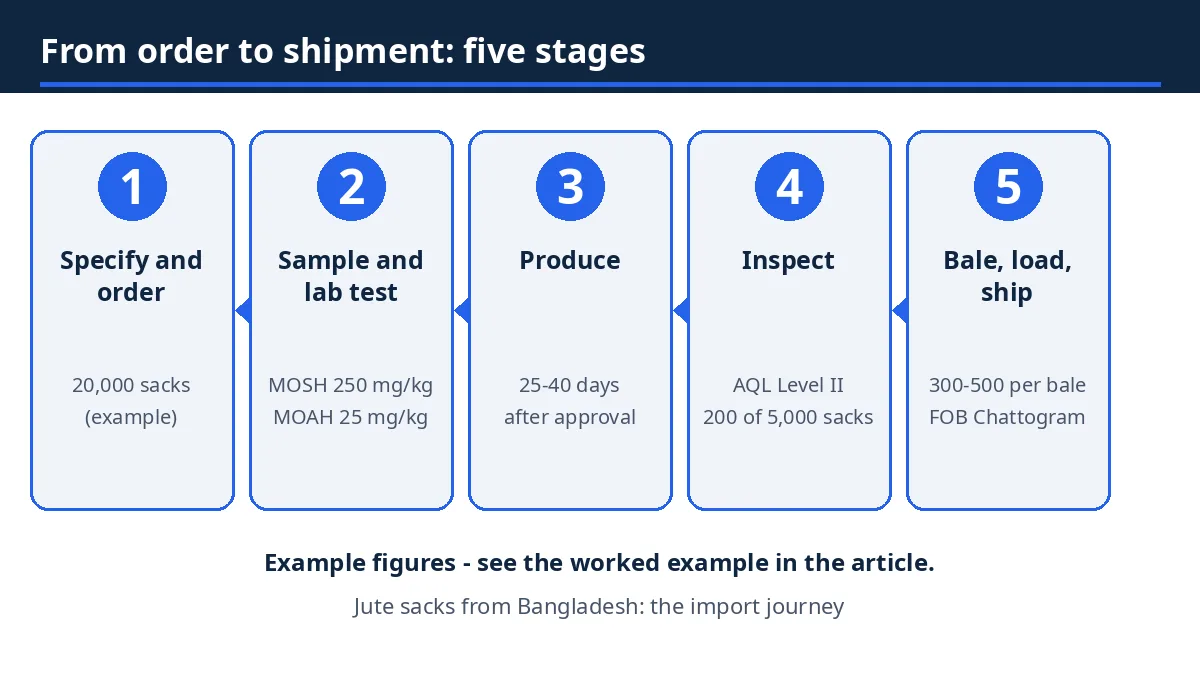
To import jute sacks from Bangladesh, define the sack type, size, weight and treatment in a written specification, check the maker and its export papers, approve a production sample and lab tests, agree FOB or CIF terms and a payment route, inspect the lot under an AQL plan, then pack the sacks in iron-bound bales, load the container at Chattogram and collect the export documents. Production usually takes 25 to 40 days after sample approval.
On this page
Key takeaways
B-Twill 44 x 26.5 in sacks weigh about 1,020 g and hold 80 to 90 kg; A-Twill at the same size holds 100 kg.
Food-grade sacks must use vegetable-oil batching under IJO 98/01, with MOSH capped at 250 mg/kg and MOAH at 25 mg/kg under the June 2026 specification.
A 5,000-sack lot at AQL Level II needs a 200-sack sample: 10 or fewer major defects pass at AQL 2.5.
Risk passes to the buyer on loading under both FOB and CIF; only freight and insurance duties differ.
Importing jute sacks from Bangladesh is a sequence of eight decisions, and each decision locks in the next one.
How the import journey works
A jute sack order normally moves through eight stages: specification, maker selection, sampling, contract terms, production, inspection, packing and loading, and documentation. Exports of jute sacks and bags earned 132.3 million dollars in the 2025-26 fiscal year, up 5.03 per cent, while total jute and jute goods exports reached 883.7 million dollars.1
Step 1: Choose the sack type your cargo needs
Jute sacks divide into two families. Sacking is the heavy twill-weave cloth used for grain and sugar bags, and hessian, also called burlap, is the lighter plain-weave cloth used for coffee and cocoa bags, wrapping and lining.2
Sack type | Standard size | Bag weight | Filling weight |
|---|---|---|---|
B-Twill sacking | 44 x 26.5 in | About 1,020 g | 80 to 90 kg |
A-Twill sacking | 44 x 26.5 in | About 1,190 g | 100 kg |
Binola, or C-Twill | 44 x 26.5 in | About 907 g | Lighter grain loads |
Heavy Cees | 43 x 29 in | About 1,134 g | 100 kg |
Hessian bag | 40 x 28 in | About 464 to 560 g | Coffee, cocoa, seed |
Food cargo needs a separate decision. Conventional jute processing uses mineral petroleum-based batching oil, and food-grade sacks replace it with non-toxic vegetable oil. The standard IJO 98/01 requires bags for coffee, cocoa and shelled nuts to be woven from yarn batched with food-approved vegetable oil, with unsaponifiable matter not above 1,250 mg per kg.2 A June 2026 industry specification sets direct limits of 250 mg per kg for MOSH and 25 mg per kg for MOAH.3
Step 2: Write the specification into the purchase order
The purchase order is the document that decides whether a dispute can be settled. A specification agreed by email and never written into the order is difficult to enforce, so every technical point belongs in the order itself. The order should name the sack type, dimensions, bag weight with tolerance, porter and shot, GSM, stitching, mouth finish, printing and treatment.4
The order should also fix the commercial points that cause most arguments: the quantity, the unit price and currency, the Incoterm and named port, the shipment date, the inspection plan, the payment route and the documents the seller must present. Trade guidance for Bangladesh exports recommends agreeing the specification, price, Incoterm, delivery date, inspection, payment route and documentary requirements in writing before production.5 Jute sacks fall under HS code 6305.10, which covers sacks and bags of jute or other textile bast fibres used for the packing of goods, while hessian cloth sits separately under HS 5310.2 6 Our HS code guide for jute sacks explains how the classification works.
Step 3: Find and check a sack maker
Bangladesh has a deep mill base for this product. The Bangladesh Jute Mills Association has a network of 240 member mills, and the country supplies 282 types of jute goods to 118 countries.7
Our guide to jute sack manufacturers in Bangladesh covers maker checks in detail. Four checks give a first order a sound base. First, ask for the mill name and address, and confirm that the company that signs the contract is the company that owns the looms. Second, ask for the exporter registration papers.8 Third, ask for a mill test report showing bag weight, porter and shot and breaking strength, plus a hydrocarbon-free or IJO 98/01 conformity certificate for food-grade lots.2 Fourth, ask for two recent shipment references for the same sack type and check them.
Step 4: Approve a sample and test it in a laboratory
No bulk order should start without an approved sample. The sample proves the size, weight, weave, stitching, printing and mouth finish in physical form, and it becomes the reference that inspection is judged against.
Order two or three sample sacks made on the production line, measure each one against the order, fill one with the actual cargo and check the seams and the mouth, then send one to a laboratory for the tests the cargo requires.
Food-grade lots need chemical testing. The 2026 industry specification requires batching oils, emulsifiers, lubricants and printing inks to be food grade and non-toxic, and it sets MOSH at a maximum of 250 mg per kg and MOAH at a maximum of 25 mg per kg.3 Its sampling rule takes one bag from each randomly selected bale, with two bales selected for lots up to 100 bales and one more bale for each additional 50 bales, and a lot fails if any sample misses the specification.3
Step 5: Agree payment and delivery terms
Payment and delivery terms decide who carries the risk at each point in the journey, so they should be agreed before production, not after the goods are packed. The common payment routes for a first jute sack order are an irrevocable letter of credit at sight, advance payment by telegraphic transfer, or documentary collection. Trade guidance notes that a letter of credit places the payment promise with the buyer's bank against matching documents, while one document error can delay payment, and that advance payment requires the buyer to trust the seller.8
Most first orders use FOB or CIF, the two sea-freight terms in Incoterms 2020. With FOB, the seller puts the sacks on the vessel at the named loading port, clears them for export, and the buyer books and pays the ocean freight and the insurance.9 With CIF, the seller takes on the freight to the named destination port and buys the minimum insurance the CIF rule requires.9 Either way, the risk moves to the buyer as soon as the sacks are on board at the loading port, not when they reach the destination.9
Step 6: Inspect the lot before it ships
Pre-shipment inspection is the last point where a bad lot can be stopped cheaply. The inspection should run when production is complete and the goods are packed, following a written plan agreed in the purchase order.
The sampling standard used across textile trade is ISO 2859-1, published with ANSI/ASQ Z1.4 as its counterpart, and General Inspection Level II is the default.10 Buyers commonly set three limits: critical defects at zero, major defects at 2.5 and minor defects at 4.0.10 A lot of 5,000 sacks at General Inspection Level II falls in the 3,201 to 10,000 band, which gives code letter L and a sample of 200 sacks.10 At AQL 2.5 for major defects the lot passes with 10 or fewer major defects and fails at 11, and at AQL 4.0 for minor defects it passes with 14 or fewer and fails at 15.10
For jute sacks, the defect list should name holes, broken seams, wrong size or weight, wrong porter and shot, print faults, stains, odour and damp bales. Our quality control checklist for jute sacks gives a full defect list and inspection routine for this stage.
Step 7: Pack, bale and load the container
Jute sacks ship in press-packed, iron-bound bales, and the bale is the unit the warehouse counts. Published mill practice packs 300 to 500 sacks per bale, and a 20-foot container holds about 18,000 to 21,000 standard sacking bags depending on bag weight and bale setup, with a 40-foot container holding around 25,000 to 28,800 pieces.4 The packing list should state the bale count, the pieces per bale and the gross weight of each bale.
Step 8: Collect the export and shipping documents
The document set is what turns a loaded container into a payable shipment. Customs in Bangladesh expects a standard set of export papers: the exporter's registration certificate and VAT number, the sales contract or letter of credit, the EXP declaration, the commercial invoice, the packing list, the transport document and proof of origin.8 The exporter files the EXP declaration with its authorised dealer bank ahead of Customs formalities; Customs then issues the Bill of Export, and the exporter must hand the bank, no later than 14 days after sailing, the signed EXP copy and the certified Bill of Export, together with the shipping papers.8
Document | Who issues it | What to check |
|---|---|---|
Commercial invoice | Seller | Quantity, price, Incoterm, parties match the order |
Packing list | Seller | Bale count, pieces per bale, weights match the load |
Bill of lading | Carrier | Consignee, notify party, ports, seal number |
Certificate of origin | Chamber or EPB scheme | Origin statement matches the preference scheme |
EXP form, Bill of Export | AD bank, Customs | Filed before shipment, certified after |
A single mismatch between the invoice, the packing list and the letter of credit can hold payment, so the buyer should ask for draft documents before the vessel sails and check them against the order line by line.
How long does the whole import take
The table below gives a realistic frame for a first container order, using the published production range and the usual sequence of stages.
Stage | Typical time |
|---|---|
Enquiry, specification, quotation | 1 to 2 weeks |
Sample production and approval | 1 to 3 weeks |
Contract, payment setup, production | 25 to 40 days |
Inspection, packing, loading | 3 to 7 days |
Worked example: the landed cost of one container
The figures below are Example figures. They show how a landed cost is built, not a market price. The order is 20,000 B-Twill sacks, 44 x 26.5 inches, about 1,020 g each shipped FOB Chattogram to a UK port. The sack type and weight follow the published B-Twill standard.2
Cost line | Example figures |
|---|---|
FOB goods, 20,000 sacks at 0.95 dollars each | 19,000 dollars |
Ocean freight, one 20-foot container | 1,600 dollars |
Cargo insurance | 120 dollars |
CIF value | 20,720 dollars |
Destination port and handling charges | 550 dollars |
Import duty, 4 per cent of CIF value | 828.80 dollars |
Inland delivery to the warehouse | 350 dollars |
Total landed cost | 22,448.80 dollars |
Landed cost per sack | 1.12 dollars |
The duty line uses the UK third-country duty rate of 4.00 per cent shown for other jute sacks under HS 6305.10 in the UK tariff, applied here as an example to the CIF value.6
Common mistakes that delay a jute sack import
The first mistake is ordering by price alone. A sack that costs less per piece but weighs 100 g under the specification fails sooner, and the saving disappears when the cargo is repacked at destination. The second mistake is skipping the sample. Production runs 25 to 40 days, and a specification error found at inspection costs a full production cycle to fix.4 The third mistake is naming the wrong food standard. A buyer who asks for food-grade sacks without naming IJO 98/01 or the 2026 industry specification, and without asking for the lab report, has no test to point to when the lot arrives.3
The fourth mistake is agreeing CIF and then assuming the seller carries the transit risk. Risk passes on loading under both FOB and CIF, so the insurance cover and the claim procedure still need checking.9 The fifth mistake is leaving the inspection plan out of the order.
Next steps on Exportain
Start with a written specification and send it as an RFQ, so every maker quotes the same sack. Our guide to jute sack prices explains how FOB quotations are built, and our guide to typical MOQ for jute sacks explains how order size affects the price a maker can offer. You can also read how to import jute bags from Bangladesh if your order covers shopping and retail bags as well as sacks. Post your requirement on Exportain and compare makers on the same specification and landed-cost sheet.
Sources
- Jute exports rise 37 per cent as Bangladesh plans to double earnings by 2031. The Financial Express, (accessed )
- Jute Bags & Hessian Cloth Supplier — HS 6305.10. Commbril (accessed )
- Jute Bags – Jute Yarns for Use in Cocoa and Coffee Supply Chains. European Cocoa Association / European Coffee Federation, (accessed )
- Best Jute Bags Manufacturer & Exporter In Bangladesh. Jute For Good (accessed )
- Bangladesh Export Procedure & Documents. Trade Finance BD (accessed )
- Sacks and bags, of a kind used for the packing of goods. GOV.UK (accessed )
- BYETS and Bangladesh Jute Mills Association Collaborates to Advance Skills in Jute Diversification. Swisscontact, (accessed )
- Start an Export Business in Bangladesh (2026 Guide). Entrepreneurs.bd (accessed )
- FOB vs CIF: What Are the Differences? Which Term Should You Choose?. VICO (accessed )
- Textile Quality Control: AQL Sampling And Inspection Guide. TextileTuts (accessed )
About the author
Sourcing from Bangladesh?
Post a request for quotation and suppliers on Exportain can send you their quotes directly.
Post an RFQ