How to Import Jute Yarn From Bangladesh in 2026: Complete Buyer Guide
A step-by-step guide to importing jute yarn from Bangladesh: choosing the grade and count, confirming the HS code, checking the spinner, approving samples, inspecting the packed lot and working out the landed cost.
Short answer
To import jute yarn from Bangladesh, define the grade, count and ply in a specification sheet, confirm HS code 5307.10 for single yarn or 5307.20 for plied yarn, check the spinner's export papers, agree FOB or CIF terms with a letter of credit at sight, approve a pre-production sample and lab tests, inspect the packed lot under an AQL plan, then ship through Chattogram with the full document set and clear customs at destination.
On this page
Key takeaways
Define grade, count, ply, winding and packing in one specification sheet before asking any mill for a price.
Single yarn is HS 5307.10 and plied yarn is HS 5307.20, and the code must match on every document.
Under both FOB and CIF, risk passes to the buyer when the goods are loaded on board at Chattogram.
Inspect the packed lot under ISO 2859-1 at General Inspection Level II before approving shipment.
Importing jute yarn from Bangladesh is a sequence of small decisions. The grade and count you choose decide which mills can spin the order, the sampling plan decides what quality you can prove, and the delivery term decides who pays for freight and who carries the risk at sea.
How the import journey runs
A jute yarn import usually follows eight stages. Finish each stage before moving to the next.
Define the yarn.
Confirm the HS code and the duty at your destination.
Shortlist spinners and check their export papers.
Agree the delivery term, payment method and purchase order.
Approve a pre-production sample and lab tests.
Monitor production and inspect the packed lot.
Ship the goods and collect the documents.
Clear customs and work out the landed cost.
Bangladesh is a natural place to start. Jute yarn and twine earned USD 461.83 million in fiscal year 2024-25, the largest single earner inside a jute and jute goods sector worth USD 820.16 million that year, according to Export Promotion Bureau data.1 Earnings recovered in fiscal year 2025-26, with jute and jute goods reaching USD 883.7 million, up 7.8 percent.2
Step 1: Define the yarn before you ask for a price
A jute yarn order starts with the grade, which describes fibre quality, and the count, which describes how heavy the yarn is. Count is measured in pounds per spindle, so a higher count means a heavier yarn. Mills in Bangladesh commonly spin counts from 6 lb to 48 lb per spindle, in single or multiple ply.3
Count follows end use: fine yarn of 120 to 224 tex suits carpets and decorative fabrics, while coarse yarn of 483 tex and above suits sacking weft and matting.4
Grade | Usual counts | Common end use |
|---|---|---|
CRP | 6-48 lb | Carpet backing, fine weaving, handicraft yarn |
CRT | 6-48 lb | Carpet yarn, decorative fabrics, twine |
CRX | 6-48 lb | Carpet backing, fabric weaving |
CRM | 6-48 lb | Weaving, twine, general industrial use |
CB | 6-48 lb | Rope, twine, backing, coarse weaving |
Hessian | 10-48 lb | Hessian and burlap fabric |
Sacking | 16-48 lb | Sacking cloth, B-Twill and DW bags |
Write the specification as one sheet before you contact any mill: grade and count, for example CB 8 lb single ply, ply, winding, packing, quantity per shipment and quality tests. Mills offer winding on cops, spools, reels or cheese, and packing on pallets or in truss form.3 Count ranges vary by mill.5
Step 2: Confirm the HS code and your import duty
Jute yarn falls under heading 5307, yarn of jute or of other textile bast fibres. Single yarn takes subheading 5307.10 and multiple, folded or cabled yarn takes subheading 5307.20.6 The first six digits follow the World Customs Organization standard and stay the same in every country.6 Our HS Code for Jute Yarn guide covers the classification.
Give your customs broker the exact product description, material composition and ply, and ask them to confirm the full code for your destination. The code must read the same on the commercial invoice, the packing list, the certificate of origin and the bill of lading.6 Duty rates are set nationally, not by the HS code itself, so check the destination tariff schedule. If you plan to sell the yarn on into India, check whether anti-dumping duty applies, since India has imposed anti-dumping duties on Bangladeshi jute products since 2017.1
Step 3: Find a spinner and check it before you pay
Private spinning mills, represented by the Bangladesh Jute Spinners Association, spin yarn and twine for export. For a yarn order, start with spinning mills, since their frames, counts and grades are set up for yarn. Our Top Jute Yarn Manufacturers in Bangladesh guide explains how to check them.
Ask every shortlisted mill for the same papers: trade licence, Export Registration Certificate, Export Promotion Bureau registration, mill profile and references from recent export shipments. The Export Registration Certificate, issued by the Office of the Chief Controller of Imports and Exports, is the core export registration for a Bangladeshi exporter.7
Check the mill three ways before a bulk order: confirm the papers match the proforma invoice; ask for a video call from the spinning floor; and order a small trial quantity or a paid sample run, tested against the specification sheet from Step 1. Letters of credit at sight are normal for jute yarn shipments from Bangladesh.3
Step 4: Put the deal in writing
The purchase order protects both sides, so write it in full: grade, count and ply, quantity, winding and packing, price and currency, delivery term with named port, payment method, shipment window, inspection plan and lab tests. A letter of credit at sight is the standard choice for a first order.
Which delivery term should you choose
Most shipments move on FOB, CFR or CIF, loading at Chattogram or Mongla.3
Term | Who pays ocean freight | Who arranges insurance | When risk passes to buyer |
|---|---|---|---|
FOB Chattogram | Buyer | Buyer, if wanted | When goods are loaded on board |
CIF destination port | Seller | Seller, minimum cover | When goods are loaded on board |
Under FOB, the seller delivers the goods on board the vessel named by the buyer and completes export clearance, while the buyer arranges and pays for main ocean freight and decides whether to buy cargo insurance.8 Under CIF, the seller also arranges and pays for freight to the named port of destination and buys cargo insurance meeting at least the minimum cover required by the CIF rule.8 Risk still passes to the buyer when the goods are loaded on board at the port of departure under both terms, not when they arrive.8 Choose FOB for control, or CIF for freight and minimum insurance in one price. Import clearance and duties stay with the buyer under both terms.8 Our Incoterms for Shipments From Bangladesh guide explains the rules.
Step 5: Approve samples and lab tests
Never approve bulk production from a photograph. Ask for a pre-production sample in the exact grade, count and ply, wound the way your bulk order will be wound, and test it before you confirm the order. Keep one approved sample sealed as the reference sample, and send a second sealed sample to the mill.
Put count, twist per inch, single-thread breaking strength, quality ratio, moisture content and batching oil type in the purchase order as lab tests. Quality ratio is the single-thread breaking strength in pounds divided by the yarn count in pounds, multiplied by 100. Set the pass limit for each test in the order, with the tolerance, rather than agreeing a vague standard such as good quality.
Check the sample the way your end use will use it: run it on the loom, or weave a trial length. A yarn that passes a lab test can still fail on a fast machine if the twist is uneven or the count drifts, so a short production trial tells you more than a certificate alone.
Step 6: Watch production, inspect and pack
Agree the inspection plan before production starts: an inline check while spinning runs, a pre-shipment inspection when at least 80 percent of the order is packed, and a final document check before the goods leave.9
Sampling follows ISO 2859-1 and ANSI/ASQ Z1.4, with General Inspection Level II as the default and AQL 0 critical, 2.5 major and 4.0 minor as the common convention.9 At Level II, a lot of 501 to 1,200 units takes a sample of 80, accepting 5 and rejecting 6 major defects at AQL 2.5.9
For jute yarn, adapt the unit to the packing: a carton, a bag or a cone can serve as the sampling unit, and the defect classes should be written for yarn, such as wrong count, heavy slubs, oil stains and broken cones. Our Quality Control Checklist for Jute Yarn From Bangladesh covers the defects in full.
Packing deserves the same attention as the yarn. Confirm the winding type, the weight per cone or bag, the number of units per pallet, the strapping and the marking before packing starts. Jute absorbs moisture, so pack it dry and load it into a dry, clean container. Keep the packing list matched to the invoice line by line, since a mismatch is a common cause of delayed payment under a letter of credit.6
Step 7: Ship and clear the documents
Most jute yarn leaves Bangladesh through Chattogram, which handles close to 98 percent of the country's containerised trade.7 Your forwarder books the vessel, and the mill or its clearing agent handles export customs. Make sure the document set is complete and consistent before the vessel sails.
Check each document against the order: the commercial invoice for grade, count, quantity, price, HS code and delivery term; the packing list for weights and unit counts matching the invoice; the bill of lading for ports, container and seal numbers; the certificate of origin for the origin statement; and the inspection certificate for the lot number and test results.
Customs lists the Export Registration Certificate with the exporter's business identification number among the general export documents.7 The EXP form is filed electronically through the exporter's authorised dealer bank before customs formalities, and within 14 days of shipment the exporter gives the bank the signed EXP copy, the certified Bill of Export and the shipping documents.7 Export proceeds must normally reach Bangladesh within four months of shipment, although raw jute and jute goods can have up to 360 days under an irrevocable confirmed letter of credit or qualifying open-account terms.7
Step 8: Work out the landed cost
The landed cost is the full cost of getting the yarn into your warehouse, not the price on the invoice. Build it line by line from the FOB price. The worked example below uses illustrative numbers for a 25 metric ton order to Rotterdam. Example figures.
Cost item | Calculation | Amount in USD |
|---|---|---|
FOB Chattogram | 25 MT at 1,050 per MT | 26,250.00 |
Ocean freight | Chattogram to Rotterdam | 1,900.00 |
Marine insurance | Agreed cover | 160.00 |
CIF value | FOB plus freight plus insurance | 28,310.00 |
Import duty, example rate 4 percent | 4 percent of CIF value | 1,132.40 |
Destination port and clearance | Port charges and broker fee | 620.00 |
Inland transport to warehouse | Truck from port | 430.00 |
Landed cost | Total | 30,492.40 |
Landed cost per metric ton | 30,492.40 divided by 25 | 1,219.70 |
Replace every line with your own quotes before you commit. Freight changes with the season, duty depends on your destination tariff, and port charges vary by terminal. Our Landed Cost for Imports From Bangladesh guide explains each cost line in more detail. Compare quotations on the same basis, so a low FOB price is never mistaken for a low landed cost.
How long the whole import takes
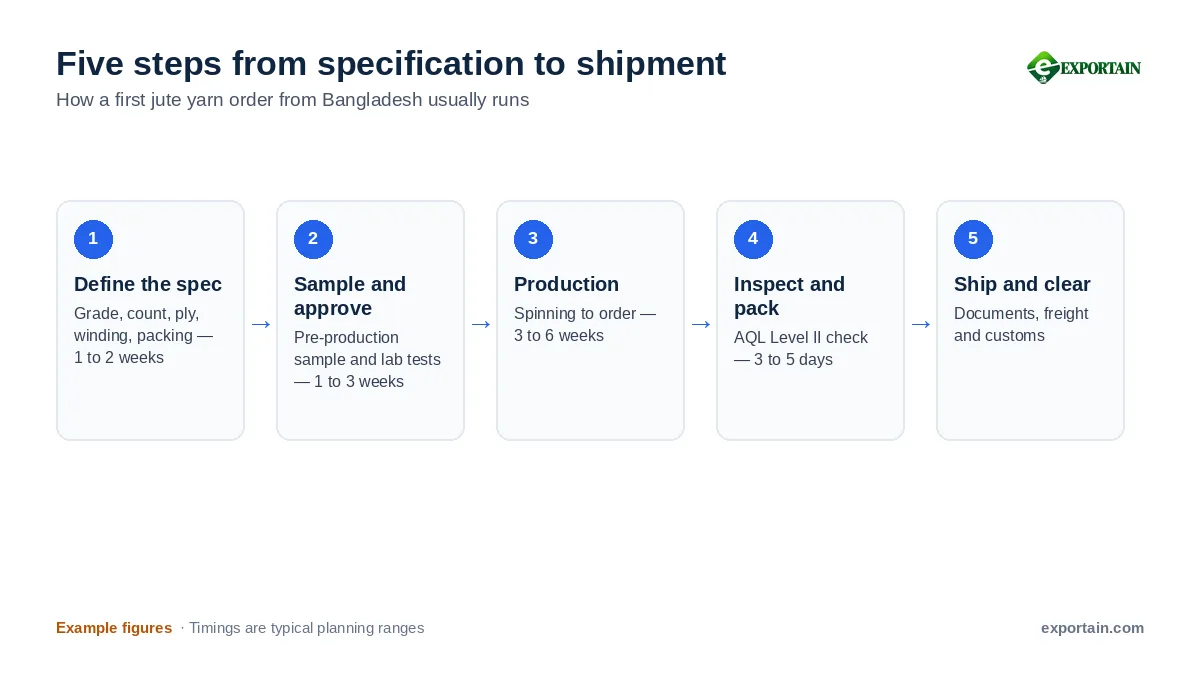
Typical ranges for a first order are 1 to 2 weeks to define the specification and shortlist spinners, 1 to 3 weeks for samples and lab tests, 1 week for the purchase order and production slot, 3 to 6 weeks for production, and 3 to 5 days for inspection and packing. Ocean transit varies by route, so confirm it with your forwarder. Plan backwards from the date you need the yarn, with a buffer week for a failed sample or inspection.
Next steps on Exportain
Start by posting your specification on Exportain: list the grade, count, ply, quantity and destination port in a request for quotation at Post an RFQ, then compare the replies against the specification sheet from Step 1. You can also browse suppliers and read How to Buy. Exportain is a marketplace that connects buyers with Bangladeshi suppliers, and it is not a party to the contract for the goods.
Sources
- Exports of jute and jute goods keep falling. The Financial Express, (accessed )
- Jute export growth offers hope, but innovation will define the next chapter. Textile Today, (accessed )
- Jute Yarn & Twine. Hazrat Shah Chandrapuri Jute Mills (accessed )
- Types of Jute Yarn | Flow-Chart of Jute Processing. Textile Apex, (accessed )
- Jute Yarn & Twine. Al-Amin Jute Mills Ltd. (accessed )
- HS Code 5307.20.00: Jute Yarn & Twine Tariff & Duty. Zenivic (accessed )
- Start an Export Business in Bangladesh (2026 Guide). Entrepreneurs.bd (accessed )
- FOB vs CIF: What Are the Differences? Which Term Should You Choose?. VICO (accessed )
- Textile Quality Control: AQL Sampling And Inspection Guide. TextileTuts (accessed )
About the author
Sourcing from Bangladesh?
Post a request for quotation and suppliers on Exportain can send you their quotes directly.
Post an RFQ