Best Incoterm for Importing Tea, Spices & Rice From Bangladesh
Tea, spices and rice change the Incoterm decision: moisture, fumigation and food-safety certificates matter more than freight price. This guide matches the term to each commodity, explains why CIF minimum cover is a weak fit for food, and works through a container of black tea to Rotterdam with example figures.
Short answer
For bulk rice, FOB Chattogram or FCA gives you control of the vessel, the container and the moisture plan. For bulk black tea and whole spices in containers, FCA fits best, while packed tea and ground spices suit CIP, which brings all-risks Clause A insurance from the seller. CIF is a weak fit for food because its minimum Clause C cover excludes water entering the container. Match the term to the commodity, the packaging and the destination food-safety rules.
On this page
Key takeaways
Bulk rice suits FOB or FCA, bulk tea and whole spices suit FCA, and packed tea and ground spices suit CIP with all-risks Clause A cover.
Under FOB and CIF, risk passes to the buyer on board at Chattogram, so a damp arrival is the buyer's claim either way.
CIF minimum Clause C cover excludes water entering the container, the loss food shipments actually suffer.
Phytosanitary certificates, per-lot certificates of analysis and destination-scoped residue reports must travel with the goods.
Tea, spices and rice are food, and food changes the Incoterm decision. A damp container can turn black tea mouldy, a missed fumigation certificate can hold rice at the border, and a failed pesticide test can send spices back. The term you choose decides who controls the voyage and the insurance, and who carries the risk.
Why tea, spices and rice change the decision
Most Incoterm advice starts with price and freight. For food from Bangladesh, the decision starts with the condition of the cargo. Tea absorbs moisture and odours, ground spices cake and lose aroma when damp, and rice releases moisture through a long voyage.
Incoterms 2020, published by the International Chamber of Commerce (ICC), sets out 11 rules that allocate cost, risk and obligations between seller and buyer, and the edition in force since 1 January 2020 remains the current one.1 The rules decide who pays for carriage, who insures and the exact point where risk passes, but they do not set the price, the payment method or the product specification.1
What moisture does to a food shipment
Container rain is condensation inside a sealed ocean container. Warm, moist air sealed into the box at loading cools against the steel walls and ceiling, condenses into liquid water and drips onto the cargo below, while moisture forming on the cargo surface itself is called cargo sweat.2 The cargo can look sound at loading and still arrive mouldy, caked or discoloured.
Agricultural products are more exposed than most cargo because they contain and release moisture. Grain, oilseeds, pulses, rice and coffee carry a natural moisture content and keep releasing water vapour into the container air through the voyage.2 Tea is hygroscopic in the same way, and ground spices are worse: once damp, they clump, lose volatile oils and can develop mould.
The defences belong in the contract. Calcium chloride desiccants absorb airborne moisture across the voyage, container liners and barrier bags seal bulk cargo away from the walls, floor and ceiling, and kraft paper and dunnage catch drips and keep bagged cargo off cold steel.2 Cargo should be loaded at a checked moisture content, with dry pallets and dry packaging.2 Under a term where the seller books the freight, the seller chooses the container and the desiccant plan. Under a term where the buyer books it, the buyer specifies the container condition and can reject a wet box.
Which documents decide whether the cargo clears
Food import rules turn on documents. Certain plants and plant products entering the European Union must carry a phytosanitary certificate guaranteeing that they are properly inspected, free from quarantine pests and in line with the plant health requirements of Regulation (EU) 2019/2072, and the exporting country's national plant protection authorities issue those certificates.3
A tea shipment needs a per-lot certificate of analysis covering moisture, total ash, dust ratio, water extract and tea polyphenols, plus a pesticide-residue report scoped to the destination maximum residue level, with the invoice, packing list, certificate of origin and phytosanitary certificate.4 The European Union applies Regulation (EC) 396/2005, so a test scoped to a looser market will not satisfy an EU buyer.4
Spices carry a further test. The European Union sets a maximum of 5.0 micrograms per kilogram for aflatoxin B1 and 10.0 micrograms per kilogram for total aflatoxins in chilli, pepper, nutmeg, ginger, turmeric and mixtures containing them, and the same limits apply to maize and rice that are to be sorted or otherwise treated before human consumption.5 Aflatoxins grow where damp grain and spices are stored badly, so a shipment that absorbed water at sea can fail a test it would have passed at loading.
For the United States, the Foreign Supplier Verification Program makes the importer responsible for checking that foreign suppliers produce food to United States safety standards, through an onsite audit, sampling and testing, or a review of the supplier's food safety records.6 No Incoterm transfers that duty to the seller. Ask for the fumigation certificate where the destination requires one before the container is sealed.
In the European Union, the buyer needs the test results before the vessel sails. In the Middle East, halal certification and, for Saudi Arabia, SFDA registration shape the document set.4
The decision table: commodity by Incoterm
The table below gives the recommendation for each commodity form, assuming sea freight from Chattogram.
Commodity | Recommended term | Why it fits | Watch out |
|---|---|---|---|
Bulk rice, loose or in bulk bags | FOB Chattogram, or FCA Chattogram terminal | Buyer books the vessel and controls routing, free time and the moisture plan | Buyer must insure from loading; seller must load at a checked moisture content |
Bagged rice, 25 kg or 50 kg sacks | FCA or FOB Chattogram | Buyer controls the container and desiccant plan | Confirm sacks are food-grade and the liner is specified |
Bulk black tea, woven sacks | FCA Chattogram | Risk passes at handover to the carrier, not at a later on-board moment | Specify PE-lined bags and dry containers |
Packed tea, cartons and retail packs | CIP to destination | Seller arranges all-risks Clause A cover for cartoned goods | Check the policy covers the route to your warehouse |
Whole spices, bulk sacks | FCA Chattogram | Buyer controls routing and can hold shipment until test results arrive | Agree the test scope and destination limit before loading |
Ground spices and spice mixes | CIP to destination | All-risks cover fits a cargo ruined by damp | Require the per-lot certificate of analysis with the documents |
Small trial orders, any commodity | FCA or DAP to destination | Clear handover for low volume; DAP gives a delivered price | Under DAP the buyer still clears import and pays duty |
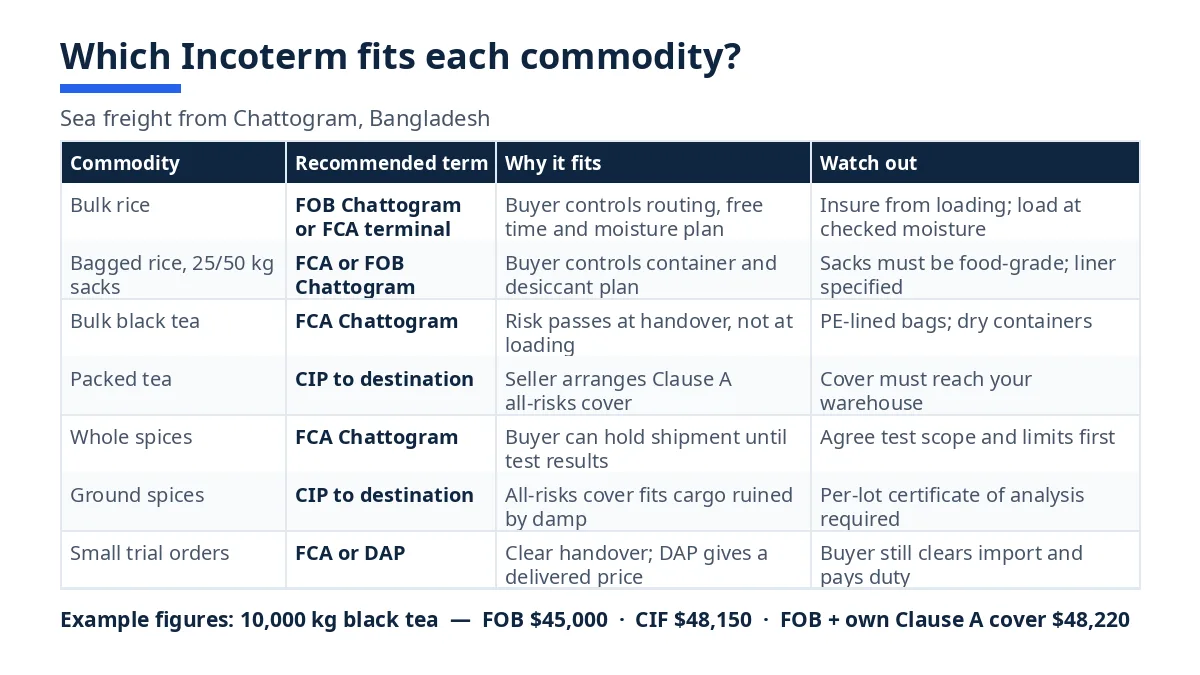
Bulk cargo loaded directly on board suits the sea-only terms, while containerised cargo suits the any-mode terms, because a container is usually handed to the carrier at a terminal well before it is on board the vessel.1
Bulk rice, packed tea and containerised spices term by term
Bulk rice: FOB fits, because the cargo is loaded directly on board and the on-board risk point matches the physical reality.1 The buyer controls routing and insurance, and should specify the loading moisture content and desiccant plan.2
Bagged rice: FCA fits better than FOB, because the sacks move in containers. Under FCA the seller delivers the goods, cleared for export, to a carrier the buyer names, and risk passes at that handover.1
Bulk black tea: FCA is the classic choice. Tea loads of about 10 to 12 metric tonnes fit a 20-foot container and about 18 to 22 metric tonnes fit a 40-foot container, and summer shipments on tropical routes need PE-lined bags and dry containers.4
Packed tea: CIP earns its place. The seller pays carriage to the destination and buys all-risks Clause A insurance.1
Spices: whole spices suit FCA, which gives the buyer control of routing and the right to wait for test results, since the aflatoxin limits leave no room for a border failure.5 Ground spices suit CIP: a damp load is a lost load, and the seller arranges the carriage and the all-risks cover.
Small trial orders: FCA to a named terminal or DAP to the destination gives a clean handover and a clear price. Under DAP the seller delivers to the named destination and bears the risk the whole way, while the buyer unloads and clears import.1
Insurance: why CIF minimum cover is a weak fit for food
Under CIF the seller must arrange and pay insurance to the named destination port, but the minimum required is Institute Cargo Clauses (C), a named-perils cover for major casualties, at a minimum of 110 percent of the contract price.7 Clause C does not cover water entering the container, washing overboard or packages dropped during loading, and it does not cover delay, inherent vice or insufficient packing.7 For tea, spices and rice, water entering the container is the loss that actually happens, so the default CIF policy covers the disaster and misses the everyday risk.
Under Incoterms 2020 the CIP seller must buy cover at the all-risks level of Institute Cargo Clauses (A), also for at least 110 percent of the contract price, unless the parties agree a lower level.7 Clause A covers all risks of loss or damage except those excluded, so theft, rough handling and water damage are covered unless an exclusion applies.7
A buyer who still prefers CIF has three options: accept Clause C and carry the gap, require Clause A cover in the contract at a price, or buy on CFR and insure with a policy the buyer has read.8 Ask for the certificate wording before shipment and confirm that the policy is dated no later than the shipment date.7 Cover under the standard clauses also ends 60 days after discharge at the final port.7
A worked example: one container of black tea to Rotterdam
Example figures. A buyer in Rotterdam orders one 20-foot container of bulk black tea: 10,000 kilograms in PE-lined woven sacks, with a per-lot certificate of analysis and a pesticide-residue report scoped to the European Union limits. The supplier quotes FOB Chattogram at 45,000 dollars, freight is 2,800 dollars, and insurance quotes are 350 dollars for Clause C cover and 420 dollars for Clause A cover. All figures in this example are illustrative.
Quotation basis | Composition | Quoted total |
|---|---|---|
FOB Chattogram | 45,000 dollars goods value | 45,000 dollars |
CIF Rotterdam, Clause C | 45,000 + 2,800 freight + 350 insurance | 48,150 dollars |
FOB plus buyer-arranged cover | 45,000 + 2,800 freight + 420 Clause A insurance | 48,220 dollars |
The CIF quotation is 70 dollars cheaper, but the two policies are not equivalent: the CIF price buys Clause C cover that excludes water entering the container, while the buyer-arranged route buys Clause A cover that includes it.7 Risk is identical under both terms: under FOB and under CIF it passes to the buyer when the goods are on board at the origin port.8 If the tea waits at a Chattogram container terminal before loading, quoting on FCA Chattogram container terminal, or on CIP Rotterdam, moves the risk point to the handover.1
Common mistakes that cost food importers money
Assuming CIF means the seller carries the sea risk. Risk passes at loading under CIF, exactly as under FOB.8
Using FOB or CIF for containers by habit, which mistimes the risk transfer and leaves the seller carrying risk while the box waits at the terminal.1
Accepting a CIF certificate without reading it, then finding that Clause C cover excludes the water damage that actually occurred, or that the cover ends at the port rather than at the warehouse.7
What to write into the contract before you agree a term
Write the term the same way every time: the rule, the named place and the edition, for example "CIP Rotterdam, Incoterms 2020", and put the same wording on the invoice, the proforma invoice and the sales contract.1 Next to it, write the shipment window and who pays origin storage and re-booking if a nominated vessel is late or the cargo is rolled.8 For food, add the moisture limit at loading, the packaging specification and the desiccant plan. Under CIF or CIP, write the insurance clauses, the insured value, the currency and where cover ends.8 Add the document list with deadlines: phytosanitary certificate, certificate of origin, certificate of analysis, pesticide-residue report scoped to the destination limits, and the fumigation certificate where the destination requires one.3 4
Next steps on Exportain
Start with the sourcing detail for this commodity family in our tea, spices and rice sourcing guide, then check the inspection points for your cargo in the black tea quality control checklist, the aromatic rice quality control checklist or the spice mixes quality control checklist. When you are ready to compare suppliers, post a request for quotation with the Incoterm and the document list written into it.
Sources
- Incoterms 2020 Explained: All 11 Rules, Chart & Meaning. Xflowpay (accessed )
- How to Prevent Container Rain, Cargo Sweat, and Mold in Agricultural Exports. Atlantic Pacific Lines (accessed )
- Trade in plants & plant products from non-EU countries. European Commission, (accessed )
- Tea Export Compliance Guide | COA, MRL, Halal & Organic. Smileaf Tea (accessed )
- Commission Regulation (EC) No 1881/2006 of 19 December 2006 setting maximum levels for certain contaminants in foodstuffs. legislation.gov.uk (accessed )
- 21 CFR 1.506 | What foreign supplier verification and related activities must I conduct?. eCFR (accessed )
- Cargo Insurance: Institute Cargo Clauses A, B and C Compared, 110% Cover and CIF vs CIP. TriplicateDocs, (accessed )
- FOB vs CIF, CFR or DAP for Food Shipments. Maqboola (accessed )
About the author
Sourcing from Bangladesh?
Post a request for quotation and suppliers on Exportain can send you their quotes directly.
Post an RFQ