

Quality Control Checklist for Aromatic Rice From Bangladesh
A numbered QC checklist for aromatic rice from Bangladesh: variety and admixture, aroma, grain length, broken rice, chalkiness, milling degree, moisture, cooking elongation, lab evidence, labels and loading, with fixes for common failures.
Short answer
Use this aromatic rice quality control checklist to check variety and admixture, dry and warm-water aroma, grain length and width, chalkiness, broken and head rice, milling degree, moisture, insects, cooking elongation, cooked aroma and texture, laboratory evidence, bag weight, labels, and loading for aromatic rice from Bangladesh before shipment. Agree variety, defect limits, sampling plan, and cooking test method in the purchase order.

On this page
Key takeaways
Put aromatic checks first: variety and admixture, dry and warm-water aroma, and cooking elongation, because they cannot be corrected once the rice is bagged.
Record which head-rice definition the order uses, since ISO 7301 and the Bangladeshi standard count head rice differently, and apply the order limit for every defect class.
Test aroma three ways against the sample: dry, warm-water, and cooked, and treat added fragrance or faded aroma as a failure to investigate before loading.
Agree variety, milling degree, defect limits, sampling plan, and cooking test method in the purchase order, and draw the sample from different bags across the lot.
If you buy aromatic rice from Bangladesh, judge the shipment in the pot as well as in the bag. A lot can look clean in the warehouse and still fail: aroma fades on cooking, grains stay short, or non-aromatic varieties are mixed in. Use this checklist at final inspection, with the sample beside you, recording each point as pass, fail, or not applicable. ISO 7301 gives minimum specifications for husked and milled rice for direct human consumption in international trade.1
Why this checklist matters
Aromatic rice is bought for scent and cooking behaviour, not only for clean grains. The compound 2-acetyl-1-pyrroline (2-AP) is a key aroma compound in aromatic rice, and harvest timing and handling affect aroma and grain quality.2 Aromatic rice usually sells at a premium for its fragrance, so a faded or mixed lot loses value even when grains look acceptable.3
A generic grain checklist may check weight and cleanliness and never test aroma, elongation, or admixture. This checklist puts those aromatic checks first, because they cannot be corrected once the rice is bagged and loaded.
Before you start
Before starting, assemble the sample, the order naming variety, milling degree, and defect limits, and the packing specification. Draw increments from different bags and parts of the lot, not from bags the mill selects. ISO 24333 describes cereal sampling by taking increments throughout a lot, combining them into an aggregate sample, and reducing that sample for the laboratory.4
Agree the sampling and acceptance plan in advance. ISO 2859-1 specifies an acceptance sampling system for inspection by attributes, indexed by the acceptance quality limit (AQL).5 Set the acceptance numbers for each defect class in the order; no figure here substitutes for that agreement. See the AQL acceptance quality limit explainer first.
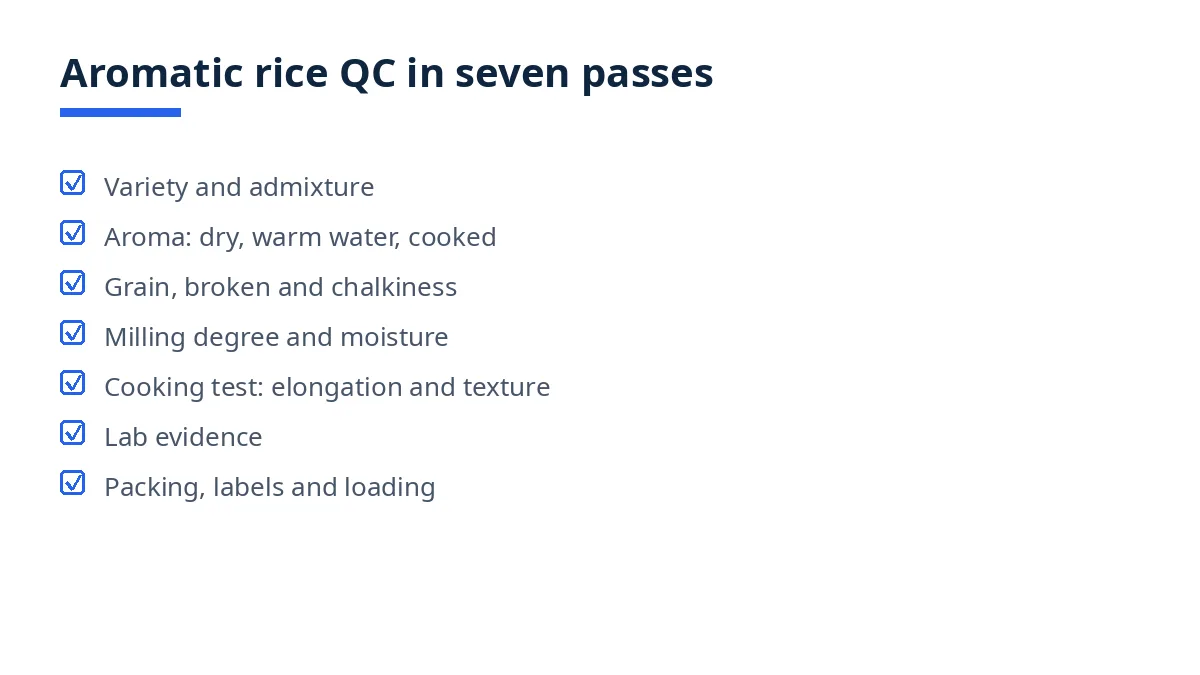
The full checklist (numbered, printable)
Variety, identity and admixture
Confirm lot identity: variety, lot number, mill, and order number match the sample and documents.
Separate foreign varieties and contrasting grains: short, bold, or non-aromatic grains, recording their share against the order limit.
Measure length and width on whole kernels, calculate the length-to-width ratio, and compare with the sample and order description. Also check uniformity: a wide spread points to blending.
Smell the dry rice against the sample: aroma should be present, clean, and characteristic of the variety, with no musty, sour, or chemical note.
Aroma and raw-grain appearance
Warm-water aroma test: cover a small portion with warm water, cover the container, and compare the released aroma with the sample, recording strength, not just a pass mark.
Added fragrance check: an aroma that smells sharp, perfumed, or unlike the sample fails an order requiring natural aroma. The ISO 7301 amendment requires rice aroma to arise naturally, without added substances after harvest.6
Check colour and whiteness: even colour across the lot, with no yellowing, grey patches, or dull areas.
Check chalkiness: separate kernels with an opaque, chalk-white area, recording their share against the order limit. In the Bangladesh study, chalk percentage covers kernels at least half opaque and chalky.3
Check broken and head rice, recording which definition the order uses: ISO 7301 counts head rice as a whole kernel or a part at least three-quarters of the average length,1 while the Bangladeshi standard in the Dhaka study counts it at eight-tenths.3
Sieve out chips and small brokens, recording them separately. ISO 7301 lists chips at 0.1 percent by mass for milled rice; use that only as the attributed reference, and apply the order limit for acceptance.1
Separate damaged, heat-damaged, immature, red-streaked, and chalky kernels, recording each class separately. ISO 7301 lists, for non-parboiled milled rice, damaged at 3 percent, heat-damaged at 2 percent, immature at 2 percent, and chalky at 5 percent by mass; those attributed figures are not a universal rule, and the order limit governs.1
Check paddy and extraneous matter: remaining paddy, husk, stones, sand, dust, and other grains. ISO 7301 lists paddy at 0.3 percent and inorganic extraneous matter at 0.5 percent for milled rice.1
Milling degree and moisture
Check milling degree against the sample and label: semi-milled, well-milled, or highly milled rice should show the bran and germ removal the order names, and the amendment adds milling-degree labelling requirements.6 Also check undermilling and overmilling: bran streaks on one side, excessive breakage on the other.
Measure moisture at more than one point in the lot, recording the values, not only a pass mark. ISO 712-1 specifies a reference method for moisture in cereals, applying to rice in paddy, husked, and milled form.7
Compare each moisture result with the order limit for destination climate and storage time, and hold any lot that exceeds it, rather than averaging a wet result away with dry bags.
Insects, odour and storage condition
Check for live insects, webbing, dead insects, and mould spots in the sample and bag seams; treat live infestation as a failure unless the order states otherwise. Also check for foreign odours from storage or transport, such as chemical, fuel, or damp odours, in the dry rice and warm-water test.
Cooking test
Cook sample and lot rice side by side with the same water ratio, cooking time, and resting time, using the agreed method, recording every result against the sample.
Measure elongation on cooking: measure the same number of raw and cooked grains and calculate the ratio. The Bangladesh study calculates elongation from the cumulative length of raw and cooked grains.2
Check cooked aroma: aroma should survive cooking and match the variety, with no flat, stale, or off note absent from the sample.
Check cooked texture: grains should stay separate or cling as expected, without turning to paste or breaking apart on stirring. Also record cooking time, water uptake, and the share broken after cooking, against the sample.
Laboratory evidence
Review the lab evidence pack: moisture confirmation, defect analysis, and any other test the order names, with the lot number on every report.
Ask for contaminant and pesticide residue evidence against the destination limits where the order requires it, recording which limits were applied.
Use a lab 2-AP test only where the order requires it. For most shipments, sensory comparison with the sample, in the dry, warm-water, and cooking tests, is the working aroma check.
Packing, labels and loading
Weigh sampled bags against the declared net weight and check against the order tolerance, including bag weight where stated.
Check bag condition and seals: tears, holes, weak stitching, moisture damage, and any earlier label that could confuse identity.
Check lot marks on every sampled bag against the packing list, confirming no bag from another lot is mixed in.
Check labels against the order and destination rules: variety, milling degree, net weight, origin, and lot number. For the EU, where a food origin is given and differs from its primary ingredient origin, that origin must also be given or indicated as different.8
Check cartons and pallets where used: counts, stacking, wrapping, and damage that could break bags in transit. Also check the container or vehicle before loading: clean, dry, and free of odour and previous cargo residue, with moisture protection where required.
Retain a sealed sample from the inspected lot, labelled with variety, lot number, and inspection date, for later disputes.
Common failures and how to fix them
Faded aroma is the most frequent failure: the rice smells weak in the warm-water test and weaker after cooking than the sample. Harvest timing affects aroma, with earlier harvesting giving higher 2-AP percentages in the Bangladesh study, while later harvesting can reduce aroma.2 When aroma fails, stop and compare storage time and conditions with the sample lot, because lost aroma does not return.
Mixed varieties are the next failure: short or bold grains appear among long, slender grains, or the spread is wide. Segregate those bags and re-check them as their own group. High broken rice usually traces to milling or handling, and it also rises when harvest timing produces immature or cracked kernels.2 Check mill settings and handling points, and re-test a fresh sample before the rest is milled.
Chalkiness, undermilling, and high moisture each point to a different fix: the grain lot, the mill setting, and drying and storage respectively. Correct the cause and re-test. Above the order acceptance level, the options are re-inspection after sorting, partial acceptance, or rejection.
Downloadable template / summary table
Copy this checklist into your inspection sheet, add the order limits, and record a result per bag or sample.
Section | Checks | Evidence |
|---|---|---|
Variety and aroma | Variety, admixture, aroma tests | Sample comparison |
Grain and defects | Length, chalkiness, broken, damaged, paddy | Separation weights |
Milling and moisture | Milling degree, moisture at several points | Moisture results |
Cooking | Elongation, cooked aroma, texture, time | Cooking record |
Laboratory | Moisture, contaminants, 2-AP if required | Reports per lot |
Packing and labels | Weight, seals, lot marks, labels, loading | Packing list, photos |
How Exportain helps
Exportain is a B2B marketplace connecting buyers with Bangladeshi suppliers of aromatic rice and other food products, so variety, milling degree, defect limits, and the sampling plan can be agreed at the enquiry stage. See the inspection services category when you plan the check, and read the pre-shipment inspection guide. Supplier profiles show which document and photo checks have been recorded, not factory inspections. Exportain is not a party to the goods contract and does not inspect goods.
FAQs
When should this checklist be used?
Use it at final inspection, when the rice is milled, bagged, and ready for loading. For first orders and large lots, also use the aroma, grain, and cooking sections during production, while milling settings can still be corrected.
Who should complete it?
The buyer, a local agent, or an independent inspector can complete it, using the sample, the order limits, and samples from different bags.
What are the most common failures?
Faded aroma, mixed varieties, high broken rice, chalkiness, undermilling, high moisture, poor elongation, and wrong variety or milling degree on the label are the failures found most often.
Can a third party do it?
Yes, if you share the sample, variety and milling degree, defect limits, sampling plan, and cooking test method first, and require lot numbers on lab reports.
Next steps on Exportain
Agree variety, milling degree, defect limits, sampling plan, and cooking test method in the order before production starts, then read the AQL acceptance quality limit explainer and the pre-shipment inspection guide, and plan the check with inspection services.
Sources
- ISO 7301:2011 - Rice - Specification. International Organization for Standardization (accessed )
- Impact of Harvesting Time on Grain Yield, Physicochemical Attributes, and 2-Acetyl-1-pyrroline Biosynthesis in Aromatic Rice. MDPI Agronomy, (accessed )
- Rice quality and its impacts on food security and sustainability in Bangladesh. PLOS ONE, (accessed )
- ISO 24333:2009 - Cereals and cereal products - Sampling. International Organization for Standardization (accessed )
- SIST ISO 2859-1:2003 - Sampling procedures for inspection by attributes, Part 1: Sampling schemes indexed by acceptance quality limit (AQL). International Organization for Standardization, (accessed )
- ISO 7301:2021/Amd 1:2024 - Rice - Specification - Amendment 1. International Organization for Standardization (accessed )
- ISO 712-1:2024 - Cereals and cereal products - Determination of moisture content - Part 1: Reference method. International Organization for Standardization (accessed )
- Origin labelling. European Commission (accessed )
- pre-shipment inspection
- quality control
- importing from Bangladesh
- Bangladesh sourcing
- aql inspection
- Processed food
About the author
Sourcing from Bangladesh?
Post a request for quotation and suppliers on Exportain can send you their quotes directly.
Post an RFQ


