Quality Control Checklist for Spice Mixes From Bangladesh
A numbered QC checklist for spice mixes from Bangladesh: recipe ratios, blend uniformity, colour and flavour balance, moisture migration, multi-spice adulteration screens, allergen cross-contact, contaminant and microbial evidence, blend labelling and packing, with fixes for common failures.
Short answer
Use this spice mixes quality control checklist to check recipe ratios, blend uniformity, colour and flavour balance, moisture migration, multi-spice adulteration screens, allergen cross-contact, contaminant and microbial evidence, blend labelling and packing for spice mixes from Bangladesh before shipment. Agree tolerances, test methods and acceptance numbers in the purchase order.
On this page
Key takeaways
Agree the recipe, tolerances, test methods and acceptance numbers before inspection, and draw the sample randomly across bags and cartons, never from bags the supplier selects.
Check ratio consistency batch by batch against the reference blend, since slow drift passes single checks while moving the blend away from what the buyer approved.
Check allergen cross-contact from line records, not only the recipe, with the previous run, the cleaning step, and the first-batch check recorded before the label is approved.
Check ingredient order against the recipe after every recipe change, with emphasized ingredients and destination allergen declarations handled under the rules the order names.
A spice mix is judged as a recipe, not as a powder. One component ground too coarse, one ratio drifting between batches, or one allergen carried over from the previous run can fail a shipment whose individual spices would each pass alone. Use this checklist at final inspection, with the reference blend beside you, recording each point as pass, fail, or not applicable.
Why this checklist matters
A single-spice check looks for the faults of one ingredient. A blend check must look for the faults between ingredients: a changed ratio, a coarse component separating in transit, moisture moving from a damp component to a dry one, or a label that no longer matches the recipe. Those faults do not show on a test of any one spice, so a blend needs its own checklist.
Risk is shared across the blend: a dye, filler, or contaminant in one component travels into every pack, and an allergen carried over on shared equipment affects the whole batch. Checking the finished recipe, with evidence tied to the blend lot number, stops one component hiding behind the others.
Before you start
Assemble the references before opening any bag: the reference blend, the recipe with shares and tolerances, the purchase order, component specifications, destination contaminant and allergen requirements, test methods, acceptance numbers, and the packing specification. Agree the sampling plan and acceptance numbers, and draw randomly across bags and cartons, not from bags the supplier selects.
For spice sampling, ISO 948 describes taking increments from different positions in the lot, combining them into a bulk sample, and grouping similar containers into separate lots where a consignment is heterogeneous.1 For acceptance decisions, ISO 2859-1 specifies a sampling system for inspection by attributes, indexed by the acceptance quality limit (AQL).2 See the AQL acceptance quality limit explainer before setting numbers.
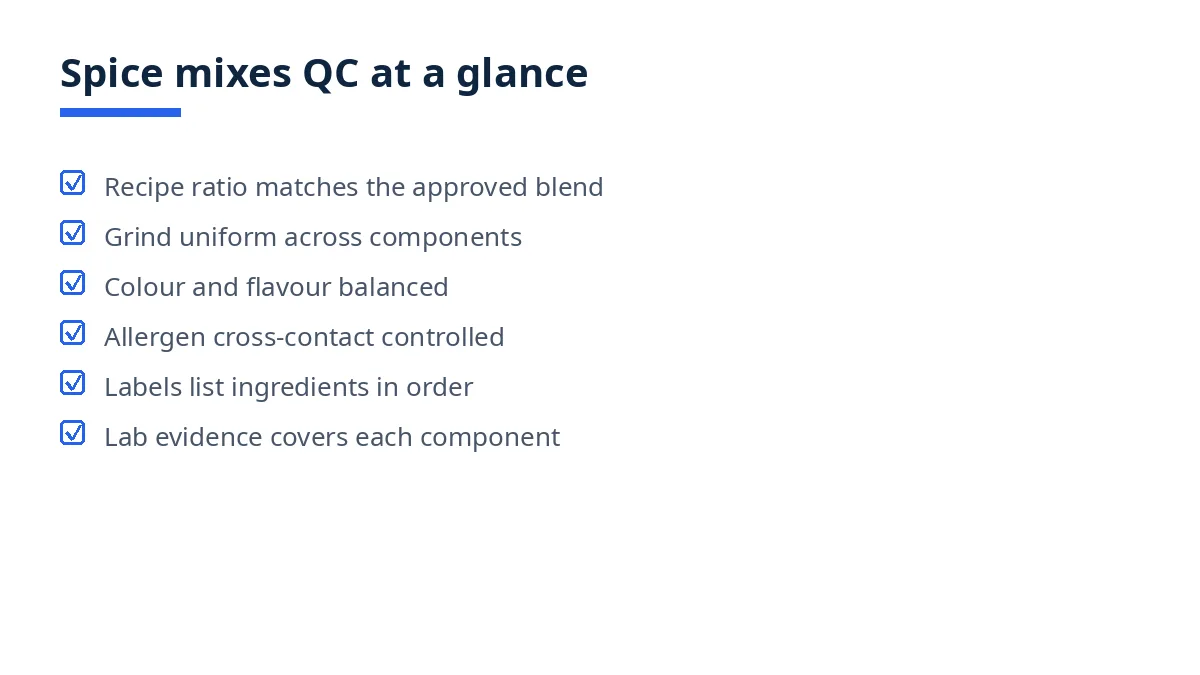
The full checklist (numbered, printable)
Recipe and batch identity
Confirm blend name, recipe version, lot number, and order number match the reference blend and documents; no bag from another blend mixed in.
Check the batch record: components weighed and added in recipe order, signed for this batch, not copied from an earlier one.
Confirm the bag holds the blend ordered, not a neighbouring recipe from the same line; check its distinguishing component against the reference.
Blend uniformity and grinding
Check each component is ground to the recipe's fineness; a coarse component in a fine blend separates during handling.
Spread a thin layer and check for unmixed pockets, streaks, and clusters; a streak or pocket is a mixing failure even if colour looks close.
Where the order requires it, check fineness by the named sieve method, recording the share retained on each sieve against the limit.
Recipe ratio consistency across batches
Compare the batch weigh record with the approved recipe, component by component; any share outside tolerance fails against the recipe.
Compare each batch with the reference blend and the previous batch, not only the specification; slow drift passes single checks.
Where the order names a ratio check by analysis or sensory panel, record method, result, and batch; a claim with no method or batch number does not support acceptance.
Colour, aroma, and flavour balance
Check colour against the reference blend under the same light for every sub-sample: even, characteristic colour, no grey, dull, or patchy areas.
Check aroma and flavour against the reference blend: it should taste and smell like the recipe, no component dominating, no musty, sour, chemical, or fuel note.
Treat unusual brightness as a test trigger, not a pass; a blend far brighter than the reference, with weak flavour for its colour, goes to the screens.
Moisture and moisture migration
Measure moisture at more than one point, recording every value, not only a pass mark. ISO 939:2021 specifies an entrainment method for moisture in spices and condiments.3
Check for moisture migration: a damp component raises whole-blend moisture, and a blend dry at mixing can cake, clump, or lose aroma.
Hold any lot over the order moisture limit instead of averaging a wet result away with dry bags; wet blends cake, lose colour, and invite mould.
Multi-spice adulteration screening
Screen each component for its own adulterants, not only the blend; a dye or filler in one component is diluted by the rest, so a blend-level screen can miss it.
Where the blend contains chili, paprika, or turmeric, require that component's non-permitted dye screens. Any detection is a hold, not a re-grade.
Check ash and acid-insoluble ash against the order limits; high acid-insoluble ash signals filler, so send the lot to microscopy.
Allergen cross-contact
List every allergen in the blend and on the same line before checking labels. The EU Annex II list in Regulation (EU) No 1169/2011 includes celery, mustard, and sesame seeds among 14 entries.4
Check the line records: previous run, cleaning step, and first-batch check after cleaning. A blend made after a mustard or sesame blend on uncleaned equipment carries that allergen whether named in the recipe or not.
Check the allergen declaration against the destination rules the order names. In the United States, sesame became a major food allergen effective January 1, 2023.5 A "may contain" statement, where allowed, must match line records, not substitute for cleaning.
Contaminants and laboratory evidence
For the EU, check aflatoxins against the mixtures entry: Capsicum spp., pepper, nutmeg, turmeric, and mixtures containing them carry aflatoxin B1 at 5 and total aflatoxins at 10 micrograms per kilogram.6 Order limits govern.
For the EU, check ochratoxin A at 15 micrograms per kilogram for dried spices, which the regulation states applies also to mixtures.6 For other destinations, apply and record the order limits.
Review the lab evidence pack before loading, with the blend lot number on each report. For compound foods, ingredient proportions and processing changes count, and food above a maximum level shall not be mixed with compliant food.6
Microbial evidence
Ask for microbial evidence where the order requires it, including Salmonella testing and blend-lot kill-step documentation. The American Spice Trade Association states that all spices need a validated kill step before sale.7 Evidence for one component does not cover the blend.
Blend labelling
Check the ingredient list against the recipe: under Codex general labelling, ingredients are listed in descending order of ingoing weight, and a compound ingredient is declared with its ingredients in brackets in descending proportion.8
Check any ingredient emphasized on the label, or essential to its character: Codex requires its ingoing percentage disclosed, except small-quantity flavouring ingredients.8
For the United States, ingredients are listed by common or usual name in descending order of predominance by weight, with ingredients at 2 percent or less at the end under a quantifying statement.9 A recipe change that reorders components needs a new label check.
Packing and loading
Weigh sampled packs against declared net weight and tolerance, and check seals, liners, and pack interiors for tears, moisture damage, and earlier labels.
Check labels against the order and destination rules: blend name, ingredients, allergen declaration, net weight, lot number, and origin. Check the container before loading: clean, dry, odour-free, with moisture protection. Retain a sealed sample with blend name, lot, and date.
Common failures and how to fix them
The most frequent failure is ratio drift between batches. Compare weigh records with the approved recipe, then each batch with the reference blend; re-blend or remake drifting batches instead of averaging them away.
Next is segregation of a coarse component, shown as colour streaks, unmixed pockets, or bags differing from top to bottom. Re-check grinding fineness per component and re-mix before more blend is packed. Moisture migration shows as caking and clumping in storage: trace the damp component, re-dry and re-test, and check the longest-stored packs first.
Allergen cross-contact has the sharpest consequence because it is invisible in the powder. If the line record shows a mustard, celery, or sesame run before this blend with no recorded cleaning and first-batch check, hold the lot and verify before approving any label. A label whose ingredient order no longer matches the recipe is corrected to the recipe supplied, or the lot is rejected under the order. Above the order acceptance level, the options are re-inspection after sorting or rework, partial acceptance, or rejection.
Downloadable template / summary table
Copy the checklist into your inspection sheet, add the recipe and acceptance numbers, and record a result per batch or sample.
Section | Checks | Evidence |
|---|---|---|
Recipe, uniformity, ratio | Recipe version, weigh records, fineness, drift | Batch records, sieve record |
Colour, flavour, moisture | Colour, aroma, balance, migration, caking | Comparison, lab reports |
Adulteration, contaminants, microbial | Dyes, fillers, ash, aflatoxins, ochratoxin A, kill step | Named screens, reports |
Allergen cross-contact | Line records, cleaning, declaration | Cleaning logs, labels |
Labelling | Ingredient order, emphasized ingredients | Label proof, recipe |
Packing and labels | Weight, seals, origin, lot marks, loading | Packing list, photos |
How Exportain helps
Exportain is a B2B marketplace connecting buyers with Bangladeshi suppliers of spice mixes and other spices, so the recipe, tolerances, allergen controls, and sampling plan can be agreed at the enquiry stage. See inspection services when you plan the check. Supplier profiles show which document and photo checks have been recorded, not factory inspections. Exportain is not a party to the goods contract and does not inspect goods.
FAQs
When should this checklist be used?
Use it at final inspection, when the blend is mixed and largely packed. For first orders and large lots, also use the recipe, uniformity, and moisture sections in production, while settings and ratios can still be corrected.
Who should complete it?
The buyer, a local agent, or an independent inspector can complete it, using the reference blend, recipe, order limits, and samples from different bags.
What are the most common failures?
Ratio drift, segregation, moisture migration and caking, allergen cross-contact from a shared line, and a label whose ingredient order no longer matches the recipe are the failures found most often.
Can a third party do it?
Yes, if you share the reference blend, recipe tolerances, allergen controls, adulteration screens, sampling plan, and destination limits first, and require lot numbers on lab reports.
Next steps on Exportain
Agree the recipe, tolerances, allergen controls, adulteration screens, sampling plan, and destination contaminant limits in the order before production starts, then read the AQL acceptance quality limit explainer and the pre-shipment inspection guide, and plan the check with inspection services.
Sources
- ISO 948:1980 - Spices and condiments — Sampling. International Organization for Standardization (accessed )
- ISO 2859-1:1999 - Sampling procedures for inspection by attributes — Part 1: Sampling schemes indexed by acceptance quality limit (AQL) for lot-by-lot inspection. International Organization for Standardization (accessed )
- ISO 939:2021 - Spices and condiments — Determination of moisture content. International Organization for Standardization (accessed )
- European Union - Food Allergens. Food Allergy Research and Resource Program, University of Nebraska-Lincoln (accessed )
- FDA Reminds Manufacturers of Effective Date for Sesame as a Major Food Allergen. U.S. Food and Drug Administration, (accessed )
- Commission Regulation (EU) 2023/915 on maximum levels for certain contaminants in food. European Union, (accessed )
- Food Safety and Treatment Methods. American Spice Trade Association (accessed )
- General Standard for the Labelling of Prepackaged Foods CXS 1-1985. Codex Alimentarius Commission (accessed )
- 21 CFR 101.4 - Food; designation of ingredients. Legal Information Institute, Cornell Law School (accessed )
- pre-shipment inspection
- quality control
- importing from Bangladesh
- Bangladesh sourcing
- aql inspection
- Processed food
About the author
Sourcing from Bangladesh?
Post a request for quotation and suppliers on Exportain can send you their quotes directly.
Post an RFQ