Quality Control Checklist for Black Tea From Bangladesh
A numbered QC checklist for black tea from Bangladesh: grade and leaf size, CTC vs orthodox, dry leaf and aroma, taster liquor and infused leaf, moisture and lab evidence, labels and packing, with fixes for common failures.
Short answer
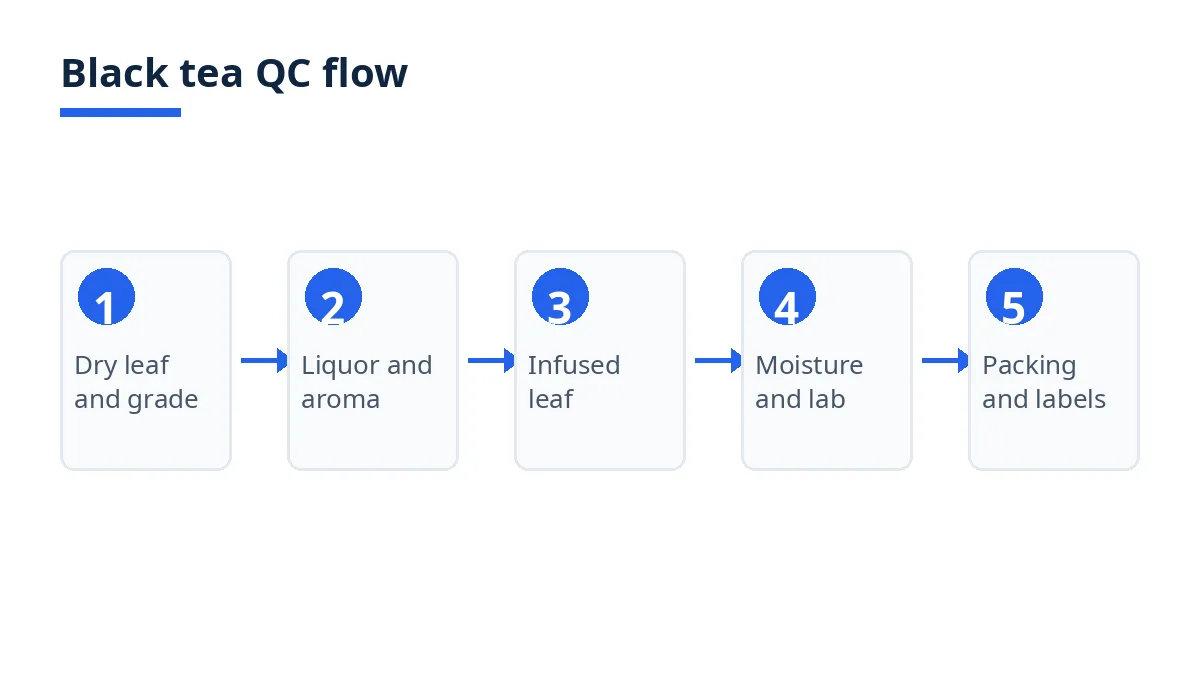
Use this black tea quality control checklist to check grade and leaf size, CTC versus orthodox type, dry leaf aroma and foreign matter, taster liquor color and aroma, infused leaf, moisture by loss in mass, destination lab evidence, labels, and chest and sack packing against the approved sample and purchase order before shipment.
On this page
Key takeaways
Agree the grade, type, sampling plan, moisture limit, and acceptance numbers in the purchase order before inspection, and draw the sample from more than one container and position in the lot.
Judge black tea in the cup: brew sample and bulk the same way and compare liquor color, aroma, strength, and infused leaf against the approved sample.
Grade by leaf size and type, not by name alone: orthodox leaf, broken grades, fannings, dust, and CTC granules each need their own sample comparison.
Do not apply one universal moisture figure: ISO 3720 sets no as-received moisture limit, so record loss in mass at 103 degrees C and judge it against the agreed order limit.
Check destination lab evidence and packing separately: pesticide residue reports for the destination market, plus intact liners, weights, and markings that keep odor and moisture out.
If you buy black tea from Bangladesh, this checklist gives you a practical way to judge a shipment before it leaves the origin. Black tea is judged in the cup, not in the bag: dry leaf that looks even can still brew dull, flat, or tainted, and a grade name alone says nothing about the lot in front of you.
Black tea, under ISO 3720:2011, is tea from tender shoots of Camellia sinensis varieties suitable for beverage use, produced by withering, leaf maceration, aeration and drying.1 Check the lot against that definition, the approved sample, and the purchase order.
Why this checklist matters
Tea is a small, light product that picks up odor fast and loses character when damp, stale, or mixed. Because the faults that matter most show only after brewing, a visual check of the dry leaf is not enough on its own.
Each point is recorded as pass, fail, or not applicable against the approved sample, grade declaration, and packing specification. Acceptance numbers per defect class are set in the purchase order.
Before you start
Do not begin until the references are complete: an approved sample per grade and lot, the purchase order with grade, quantity, and packing details, the label plan, and the lab reports the order requires. Agree the sampling plan in advance. ISO 2859-1 specifies an acceptance sampling system for inspection by attributes, indexed by acceptance quality limit (AQL).2 See the AQL acceptance quality limit explainer.
Draw the sample from more than one container and position in the lot, not from the top chest only. ISO 1839:1980 applies to sampling from containers of all sizes, and covers apparatus, sampling, and packaging, labeling and dispatch of samples, with a sampling report.3 Keep a sealed reference sample from the draw.
The full checklist (numbered, printable)
Identity, grade, and leaf size
Confirm lot identity on every container matches the purchase order: grade, lot or invoice number, net weight, and origin marking.
Confirm the manufacture type named in the order: orthodox whole or broken leaf, or CTC (crushing, tearing, and curling) granular tea. Do not accept one type for the other.
Check the grade declaration against the approved sample, using leaf size as the grading basis. Tea is graded by leaf size, not quality, with leaf tea and broken tea as the two graded categories.4
For orthodox leaf, compare leaf shape, twist, and tip content with the sample: flowery orange pekoe grades carry fine, wiry leaf with tips, while pekoe leaf is shorter and more open.4
For broken grades, compare particle size and evenness with the sample, and check fannings and dust appear only where the grade allows them.
For CTC tea, check granule size and uniformity, and confirm the lot is not mixed with orthodox leaf or oversized particles.
Dry leaf appearance, aroma, and foreign matter
Spread dry leaf on a white tray and check color, evenness, and cleanliness against the sample, lot by lot.
Check for stalk, fiber, and coarse material beyond the sample, and for mixed grades or uneven particles pointing to poor sorting.
Smell the dry leaf before brewing: it must carry the clean aroma of the grade, with no musty, smoky, chemical, or foreign odor.
Check for extraneous matter, dust, and any sign of damp, caking, or mold on the leaf. Under ISO 3720:2011, the tea shall have no taint and shall be reasonably free from extraneous matter.1
Taster evaluation: liquor, aroma, and infused leaf
Brew every sampled lot the same way, so lots can be compared fairly. ISO 3103 specifies a standardized method for preparing liquor for sensory tests, using freshly boiling water in a porcelain or earthenware pot, with liquor poured into a white bowl for examination of infused leaf and liquor.5
Use the same leaf-to-water ratio, water, vessel, and infusion time for sample and bulk, and record the method on the sheet. The commonly described ISO 3103 procedure uses 2 grams of tea per 100 ml of boiling water, infused for six minutes.5
Judge liquor color against the sample and grade: look for a bright, clear liquor, and record dull, cloudy, pale, or stewed liquor as a failure.
Judge aroma from the liquor and infused leaf, and record taints plainly: musty, smoky, burnt, sour, or foreign odor.
Judge strength and body: the liquor must carry the strength and briskness the grade promises, not a thin, flat, or watery cup.
Where the tea will be drunk with milk, test a portion with milk, and record how color and flavor hold up, since a strong plain liquor can fade in milk.
Examine the infused leaf after pouring: bright, coppery leaf points to sound manufacture, while green, dark, mixed, or uneven leaf points to under-processing, faulty firing, or a mixed lot.
Taste sample and bulk side by side, blind where possible, and record each lot separately.
Where bulk liquor differs from the approved sample in color, aroma, or body, stop and re-check a second draw before accepting the lot.
Moisture and laboratory evidence
Record loss in mass at 103 degrees C for the sample as received, using ISO 1573, which describes loss in mass when tea is heated in air near 100 degrees C as conventionally designated moisture.6
Do not apply one universal moisture figure to every order: ISO 3720:2011 sets no limit for moisture content of tea as received, and allows actual loss in mass at 103 degrees C to be recorded in the test report where desired.1
Compare the recorded moisture result with the limit agreed in the purchase order, and treat a result above that limit as a failure.
Review lab reports named in the order for this lot, and confirm every report names the lot, grade, and test method used.
For EU destinations, check pesticide residue reports against destination maximum residue levels. In the EU, maximum residue levels are set in Regulation (EC) No 396/2005, and the same levels apply to EU-produced and imported products alike.7
Where no specific maximum residue level is set for a substance in tea, apply the destination default: in the EU, when no specific level exists in Regulation (EC) No 396/2005, a default level of 0.01 mg/kg applies.7
Labels and destination rules
Check every retail and bulk label against approved artwork and destination rules: product name, grade, net weight, origin, and any blend or flavor declaration.
Confirm the label claims no grade, origin, or process the lot does not match, and that any flavored or blended tea is declared as such.
Check batch or lot codes against the packing list, so a failed lot can be traced and held without holding the whole shipment.
Confirm language, allergen, and importer details required by the destination are present and legible before cartons are sealed.
Packing, chests, and shipment
Check packing type against the order: plywood chests lined with foil, multiwall paper sacks, or polypropylene or jute sacks lined with polyethylene.8
Check liners are intact, clean, dry, and odor-free, and that no damaged liner can let moisture or odor reach the tea.
Check tea is protected from foreign odor at every stage: tea is extremely sensitive to foreign odors, contamination, moisture, mechanical stress, and insect infestation.8
Weigh sample chests or sacks and check net weight, gross weight, and count against the packing list, and record any short weight.
Check chest and sack markings for grade, lot, net weight, and destination, and confirm they are legible and match the packing list.
Check storage and loading before dispatch: dry, clean, odor-free storage, no damp floor contact, and no loading beside odorous cargo.
Common failures and how to fix them
The most frequent failure is a dull or flat liquor from a lot that looked sound dry, often caused by stale, damp, or mixed leaf, or a grade substitution. Stop, re-brew a second draw beside the sample, and check moisture and lot identity before the lot moves.
Tainted tea is the hardest failure to fix, since musty, smoky, or chemical odor picked up in storage or transport rarely clears fully. Segregate affected containers, find where the odor was picked up, and do not blend tainted tea into sound lots.
Uneven grading points to sorting or mixing: re-sort or re-grade the lot and re-inspect it as its own group. Moisture above the agreed limit points to under-drying or damp storage: re-dry only where the buyer agrees, and re-test after drying, since re-drying can change flavor. Above the agreed level, options are re-inspection, partial acceptance, or rejection.
Downloadable template / summary table
Copy the checklist into your inspection sheet, add grade, tolerances, and acceptance numbers.
Section | Checks | Evidence |
|---|---|---|
Identity and grade | Type, grade, leaf size | Sample comparison |
Dry leaf | Appearance, aroma, foreign matter | Tray check, photos |
Taster evaluation | Liquor, aroma, infused leaf | Brew record, taster notes |
Moisture and lab | Loss in mass, residue reports | Lab reports per lot |
Labels | Artwork, lot code, destination rules | Label check |
Packing | Liners, weights, markings | Packing list |
How Exportain helps
Exportain is a B2B marketplace connecting buyers with Bangladeshi suppliers of black tea, so grade, sampling plan, and lab evidence can be agreed at the inquiry stage. Use inspection services when you plan the check. Supplier profiles show which document and photo checks have been recorded, not factory inspections. Exportain is not a party to the goods contract and does not inspect goods.
FAQs
When should this checklist be used?
Use it at final inspection, when tea is graded, packed, and ready for dispatch. For larger and first orders, also use it during production, while grading can still be corrected.
Who should complete it?
The buyer, a local agent, or an independent inspector can complete it, using the approved sample, grade declaration, and a taster evaluation.
What are the most common failures?
A dull or flat liquor, tainted or musty tea, uneven grading with excess stalk and fiber, moisture above the agreed limit, and mixed lots are the failures buyers find most often.
Can a third party do it?
Yes, if you share the approved sample, grade, tolerances, and acceptance levels first, with the taster evaluation recorded lot by lot.
Next steps on Exportain
Before production starts, agree grade, sampling plan, moisture limit, and lab evidence, then read the AQL acceptance quality limit explainer and the pre-shipment inspection guide, and plan the check with inspection services.
Sources
- ISO 3720:2011 Black tea — Definition and basic requirements. International Organization for Standardization, (accessed )
- ISO 2859-1:1999 - Sampling procedures for inspection by attributes — Part 1: Sampling schemes indexed by acceptance quality limit (AQL) for lot-by-lot inspection. International Organization for Standardization (accessed )
- ISO 1839:1980 - Tea - Sampling. International Organization for Standardization (accessed )
- About Black Tea and Grading. The Teapot (accessed )
- ISO 3103 / BS 6008: International Tasting Standard for Tea. Tea Hong (accessed )
- ISO 1573:1980 - Tea - Determination of loss in mass at 103 degrees C. International Organization for Standardization (accessed )
- Q&As - pesticides: Maximum residue levels. European Commission (accessed )
- Tea - shipment and storage guidance. Cargo Handbook (accessed )
About the author
Sourcing from Bangladesh?
Post a request for quotation and suppliers on Exportain can send you their quotes directly.
Post an RFQ