Private Label Jute Shopping Bags Manufacturing in Bangladesh: A Brand Owner's Guide
Private label jute shopping bags put your brand on a retail bag made to your specification in Bangladesh. This guide covers print methods, Pantone colour matching on jute, proofing and sampling rounds, MOQ by method, EU and US label rules, trademark care and packing for retail.
Short answer
Private label jute shopping bags from Bangladesh are made to your specification, with your artwork printed on the bag and your labels attached. Choose screen printing for bold one-to-four-colour logos, confirm the Pantone uncoated reference on the actual jute fabric, approve a printed strike-off and a physical pre-production sample, and check the fibre-composition label rules for each market before bulk production starts.
On this page
Key takeaways
Screen printing suits bold one-to-four-colour logos on jute; fine detail belongs on a printed label patch.
Match colour with a Pantone uncoated reference and approve it on a printed sample of the final fabric.
Plan at least two sample rounds and never approve bulk from photographs.
EU labels need fibre composition in the local language; US labels need fibre content, origin and maker identity.
A private label jute shopping bag carries your brand into a customer's hands and then into daily use. The bag is the product, the print is the brand, and the label set is the legal record.
In fiscal year 2025-26 the jute sector brought in 883.7 million dollars, a rise of 7.75 per cent on the year before, with shopping bags named among the diversified products finding growing demand overseas.1
What private label means for a jute shopping bag
Private label means the manufacturer makes the bag to your specification and you sell it under your brand. You choose the fabric, the size, the construction, the print and the label set. The brand owns the design and deals with customers, while the manufacturer owns the equipment and makes the bags.2 Two nearby models differ from it. Relabelling blanks means buying finished stock bags and swapping the label, which is fast but leaves you with a bag every competitor can buy.
Which fabric and construction carry your print
Jute is a natural plant fibre that is strong, breathable and biodegradable, and it can be woven into different thicknesses for different uses.3 The fabric weight, measured in grams per square metre (GSM), sets the feel and the load the bag can carry. Common ranges run from 130 to 150 GSM for lightweight bags, 160 to 200 GSM for standard retail bags, and 220 to 300 GSM for heavy duty bags.3
Three constructions cover most private label shopping bags. Unlaminated hessian has an open, rustic weave and is fully biodegradable, but it absorbs moisture and gives the roughest print surface. Laminated jute has a thin film bonded to the inside of the fabric, which adds water resistance, shape retention and a longer usable life.3 A jute-cotton blend, often called juco, gives a smoother and finer weave that holds sharper print detail than raw jute.
How do you choose a print method for your artwork
Jute is one of the hardest bag materials to print well. The fibres are coarse, the weave is open, and ink settles into the grooves between fibres, so logos can look textured or broken around the edges.4 That texture suits bold, simple graphics and punishes fine detail, thin lines and small text.
Method | Best for | Typical minimum | Main limit |
|---|---|---|---|
Screen printing | Bold logos, one to four colours | 500 pieces | No gradients or photographic detail |
Heat transfer | Multi-colour logos, gradients, small runs | 100 pieces | Transfer can lift or peel over time |
Laminated gravure | Full-colour, photographic, all-over prints | 1,000 pieces | Film covers the natural jute texture |
Printed label patch | Photo-quality art and very small text | 300 pieces | Visible stitched edge on the bag |
Screen printing is the workhorse for jute shopping bags. The artwork is transferred onto a mesh screen and ink is pressed through it onto the fabric, with a separate screen for each colour.5 The ink layer is thick, the coverage is strong enough to mask the natural colour of jute, and the print resists abrasion and washing well.
Flexography is the industrial method for paper and plastic bags, where flexible photopolymer plates transfer ink at high speed during manufacture, typically at one to three spot colours and economical at 5,000 units or more.4 It matters for printed paper swing tags and carriers. A printed label patch solves the detail problem another way: the image is printed on a flat material and stitched onto the bag.5
How do you match your brand colour on jute
Colour on jute starts with the base fabric. Standard jute ranges from beige to deep brown, and colour differences between production batches are clearly visible, so light or semi-transparent inks struggle to cover the base and often shift in the final print.5
Pantone spot colours are premixed inks formulated to hit one exact colour, while CMYK builds every colour from tiny dots of cyan, magenta, yellow and black.6 Pantone is the precise choice when one brand colour has to look the same on every bag and every reorder, and CMYK is the efficient choice for photographs, gradients and multi-colour artwork.6 Specify the Pantone coated (C) or uncoated (U) reference that matches the actual surface. The ink formula is the same, but the result looks different: ink sits on top of coated stock and looks crisp, while on uncoated stock it absorbs and looks softer and darker.6 Jute behaves like an uncoated, absorbent surface, so use the uncoated reference.
Three practical steps keep colour under control. First, add a white ink underlay beneath light colours so the brown base does not turn yellows olive and pale blues grey-green. Second, approve colours on a printed sample on the final fabric, not on a screen.6
What design files should you send
Send vector artwork wherever the print method allows it. Vector files such as AI or EPS scale to any print size without losing quality, while raster files such as PNG or JPG need 300 DPI or higher at the intended print size.4
Your file pack should state the Pantone references, print size, placement and colourway for each version. Adapt the artwork for the weave: lines at 1 mm or thicker for screen printing and 2 mm or wider for embroidery, small text enlarged or moved to a label patch, and gradients replaced with solid blocks or moved to heat transfer or gravure.5
How does proofing work, step by step
Proofing answers a different question at each stage, so approve the right thing at each step. An on-screen PDF confirms layout, text and placement, but it cannot confirm accurate colour, sheen or texture.6 A printed sample on the final fabric and finish confirms real colour, finish shift and texture, but it cannot confirm minor run-to-run variation on a large production run.6
A workable proofing sequence for a first order runs in four stages. First, a digital proof of the artwork at actual size, checked for spelling, placement and print area. Third, a printed strike-off on the final fabric, which is the colour approval that matters. Fourth, a pre-production sample of the finished bag, which confirms print, labels, handles and packing together.
How do sampling rounds work
Plan for at least two sample rounds: an initial sample to correct construction and print, and a pre-production sample made exactly as bulk will be made.2 Simple bags sometimes settle in one round, while new fabrics and complex artwork often take three.
Check each sample against the specification in measurements, not impressions. Measure the bag, check the stitching and handle attachment, check the print quality and colour against the approved strike-off, and write down every correction with a number attached.2 Never approve bulk from photographs of a sample. The approved physical sample, kept on your shelf, is the standard the shipment is judged against, and it settles most disputes before they start.2
What does MOQ mean for a custom print run
Minimum order quantity for a custom print run is set by the setup cost of the method, not by the bag alone. Screen printing needs a separate screen for each colour, so small runs carry a high setup cost per bag and pricing stabilises above 2,000 pieces, with orders from 500 pieces.5 Heat transfer needs no screen setup, so it starts from 100 pieces and suits testing several designs in small quantities.5 Laminated gravure needs a cylinder for each colour, at roughly 100 to 200 dollars per colour, and starts from 1,000 pieces.5 Flexo-printed paper tags and carriers follow the flexo scale, economical at 5,000 units or more.4
Use those numbers to choose the method, not the other way round. A 300-piece launch with a four-colour photographic logo fits heat transfer or a label patch, while a 5,000-piece supermarket order with a two-colour logo fits screen printing.
What labels, tags and care information does the bag need
For the European Union, Regulation (EU) No 1007/2011 requires every textile product to carry a label stating its full fibre composition, using the exact fibre names in the regulation, with percentages in descending order and accurate to within a tolerance of 3 percentage points per fibre.7 The composition must be written in the official language of the member state where the product is sold, so an English-only label is not compliant for most EU markets.7 The same regulation does not by itself require care instructions, size labelling or country of origin, but EU buyers expect all three, with care instructions using ISO 3758 care symbols.7 Labels must be durable, legible, visible and firmly attached, and the fibre composition must be clearly separated from other information on the label.7
For the United States, the Federal Trade Commission requires every covered textile product label to include fibre content, country of origin and manufacturer identity.8 Each fibre that makes up 5 per cent or more of the product by weight must be listed by its generic name in descending order, while smaller fibres can be shown as other fibre.8 The FTC allows a 3 per cent tolerance on fibre content claims, and the label must name the company responsible, either by business name or by a Registered Identification Number.8
How do you protect your trademark before printing it on a bag
A brand printed on a supplier's bag is only as safe as the trademark behind it. Bangladesh follows a first-to-file system, so the party that registers a mark first owns the rights in Bangladesh, even if another party used the mark first elsewhere. Foreign owners cannot file directly with the Department of Patents, Designs and Trademarks (DPDT); they must file through a local agent or law firm.9 The first term runs for 7 years from the filing date, and each renewal then runs for 10 years.9
Expect 12 to 24 months from filing to registration in a clean case, and file before the brand goes public where possible, since Paris Convention priority can be claimed within 6 months of the first filing.9 Bangladesh is not yet part of the Madrid System for international registration, so a foreign registration has no legal power in Bangladesh unless the mark is also filed locally, and each export market needs its own filing.9 Put ownership and permitted use in the supplier agreement.
How should the bags be packed for retail
Packing is specified around the approved label set, so the bags arrive ready to sell. Goods should be packed the way you will sell them: folded, tagged, bagged and cartoned by size and colour, so stock goes straight onto a shelf or fulfilment pile.2 Jute bags must be packed to avoid moisture exposure during transit, because poor handling leads to odour, discoloration or weakening of the fibres.3
Common mistakes brand owners make
The most expensive mistakes are all approval mistakes: approving a colour from a screen instead of a printed sample on the final fabric, approving bulk from a photograph instead of a physical pre-production sample, approving a label with a fibre percentage the fabric certificate does not support, and choosing a print method for the artwork rather than for the quantity.
A worked example: a first order from artwork to packing
Example figures. A brand owner orders 2,000 screen-printed jute shopping bags in one colourway. Artwork and file preparation take 3 days, the digital proof and Pantone drawdown take 5 days, the first sample takes 7 days, one revision round takes 7 days, the pre-production sample takes 7 days, bulk printing and making take 10 days, and packing takes 2 days. The sequence runs for about 6 weeks from brief to packed cartons, before freight.
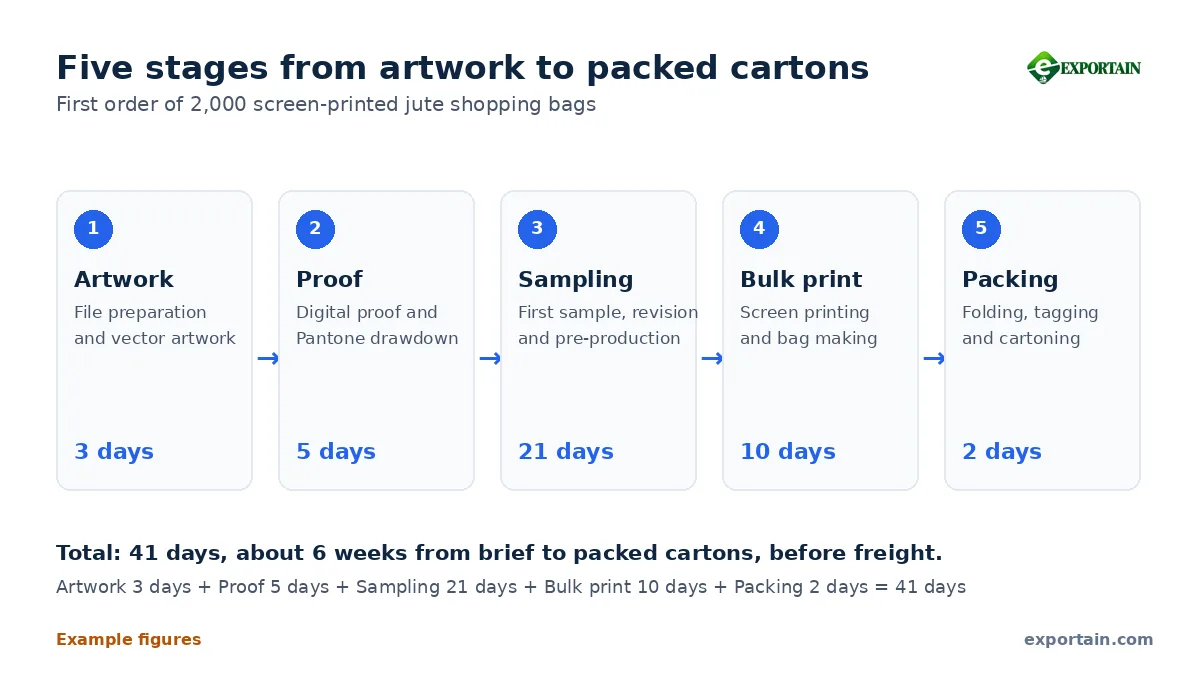
The diagram shows the five stages in order, with the example durations attached to each one.
Next steps on Exportain
Start with the specification, not the quotation. Compare that specification against our jute shopping bags manufacturers guide, check the MOQ guide before you fix the quantity, and read the quality control checklist before you approve the pre-production sample.
Sources
- Jute exports rise 37 per cent as Bangladesh plans to double earnings by 2031. The Financial Express, (accessed )
- Private Label Clothing: How to Launch Your Own Brand. Awexa International (accessed )
- How to Choose the Best Jute Bags for Your Business. AP Commercials (accessed )
- How to Print a Logo on Any Bag. CustomInk (accessed )
- How to Print on Jute Bags. Bene Bags, (accessed )
- CMYK vs Pantone Packaging: Getting Brand Colors Right. BoxSense (accessed )
- How to Properly Label Textiles in the EU. Bergstrand Sustainability Consultancy, (accessed )
- Avoid Being Labeled Noncompliant: The Basics of Textile and Wool Product Labeling. Textile World (accessed )
- Trademark Registration in Bangladesh: Before You File. SUPREMEiP (accessed )
- Bangladesh sourcing
- Private label
- Brand packaging
- Jute bags
- Jute shopping bags
- Screen printing
- textile labelling
- trademark
About the author
Sourcing from Bangladesh?
Post a request for quotation and suppliers on Exportain can send you their quotes directly.
Post an RFQ