Tea, Spices & Rice Sourcing Guide for Bangladesh: Spec Sheets, Vetting and Testing
Tea exports were 2.45 million kg in 2024 and spice exports a record USD 56.31 million. This sourcing guide covers spec sheets for tea grades and spice forms, supplier vetting, sampling and lab testing, contracting and shipment.
Short answer
Sourcing tea and spices from Bangladesh works when you buy against a written specification, not a product name. Write the tea grade or spice form, the measurable limits behind it, and the test method into a spec sheet, vet the estate, blender or packer against its licences and export history, test production samples for moisture, volatile oil and residues, then contract on MOQ, price validity, Incoterm and inspection point.
On this page
Key takeaways
Tea exports were 2.45 million kg in calendar 2024 against a large domestic trade run through weekly auctions under Bangladesh Tea Board supervision, and all tea exports require Tea Board clearance, so a tea lot is bought by grade code plus a tasted, approved sample.
Spice exports reached a record USD 56.31 million on EPB figures, in whole, powdered and mixed forms, and exporters name sterilisation capacity as the biggest barrier to the United States and European markets, so the treatment method belongs on the spec sheet.
Codex CXS 359-2024 caps powdered turmeric moisture at 10 percent with curcuminoids of at least 2 percent, and Codex CXS 327-2017 caps cumin moisture at 10 percent with volatile oil of at least 2.0 ml per 100 g for Grade I whole cumin; ISO 3720 sets no moisture limit for black tea.
There is no industry-wide MOQ, price or lead time in this category; all three are quoted per company against a written specification, and aromatic rice is capped by a government allocation, halved in September 2026 with a minimum FOB price of USD 1.60 per kg.
This sourcing guide is for importers, food brands, wholesalers and sourcing agents in the United States, the United Kingdom, the European Union and the United Arab Emirates buying tea, spices or aromatic rice from Bangladesh by a repeatable method. The companion pillar, the tea and spices industry in Bangladesh, maps production, clusters and export scale. This guide does the next job: writing a specification sheet for a tea grade or a spice form, vetting the supplier behind it, sampling and lab-testing the lot, and contracting and shipping what passed.
Market overview with latest data
Read the market briefly, because the numbers decide where your sourcing effort belongs, then move to method. Three facts shape a buying plan in this category.
Tea is a large domestic trade with a narrow export window. Bangladesh exported 2.45 million kg of tea in calendar 2024, up 57.55 percent on the year before, earning Tk 45.96 crore.1 Against production measured in tens of millions of kilograms, that is a small surplus, so a tea buyer competes with the home market. Most of the trade passes through one mechanism: in the 2024-25 season, over 87.2 million kg, more than 97 percent of all auctioned tea, passed through Chattogram, on Bangladesh Tea Board figures.2
Spices are the growth line, and treatment capacity is its bottleneck. Spice exports reached a record USD 56.31 million on Export Promotion Bureau (EPB) figures, up from around USD 9.24 million in fiscal year 2010-11, driven by the Bangladeshi diaspora and demand in the Gulf, North America, Europe and parts of Asia.3 Exporters name sterilisation capacity as the biggest barrier to stringent markets such as the United States and Europe, which is why treatment is a specification item here, not an afterthought.3
Aromatic rice is permission-based. In September 2026 the Ministry of Commerce halved the approved fragrant rice export allocations of 278 exporters, set a minimum FOB export price of USD 1.60 per kg, and kept approvals valid until 31 December 2026.4 A rice line therefore starts with an allocation check, before any discussion of grade or price.
The method follows from those three facts: specify the product so a laboratory can measure it, vet the company so the paperwork matches the product, and test the lot before you contract the volume.
Main products and production clusters
Tea, spices and rice are classified by form, not by marketing name. Tea and spices sit in Chapter 9 of the Harmonized System, and the headings split by product and, at six digits, by whether the product is whole or ground.5 The headings you will use most often are:
HS heading | What it covers | Typical Bangladesh products |
|---|---|---|
0902 | Tea, whether or not flavoured | Black CTC tea in bulk, packet tea, green and specialty tea |
0904 | Pepper of the genus Piper; dried or crushed or ground fruits of the genus Capsicum or Pimenta | Dried red chilli and ground chilli lines |
0909 | Seeds of anise, badian, fennel, coriander, cumin, caraway and similar seeds | Coriander seed, cumin seed, black cumin and fenugreek seed |
0910 | Ginger, saffron, turmeric, thyme, bay leaves, curry and other spices, including mixtures | Turmeric whole and powder, ginger, mixed and ready-mixed curry spices |
Agree the six-digit subheading with your supplier and broker before you order, because the heading decides the duty line and product rules at destination. A ready-mix recipe and a tea extract can leave these headings for the food preparations chapters, so a blend needs its own classification check.
How do you write a specification sheet for tea?
A tea spec sheet names the product in the order a grader would check it: manufacture type (CTC, orthodox or green), the grade code exactly as the seller offers it, garden or blend origin, season or invoice lot, and the measurable limits from the compliance section. Grade codes in the CTC trade sit in three families, broken, fannings and dust, and the same code from two gardens is not the same tea, because liquor character follows the garden and the season. That is why the auction system works as it does: broking firms collect samples from each lot, professional tea tasters assess leaf and liquor quality to estimate a probable price, and catalogues go to buyers over a week before the auction.2 Copy that discipline into a private purchase: grade code plus a tasted, approved sample, never the code alone.
Clusters follow the auction map. Tea from estates in Sylhet, Chattogram and Panchagarh is stored in warehouses ahead of auction, Chattogram hosts 16 licensed warehouses, and the large buyers' blending factories are also based there.2 For a packet or blended line, your supplier is usually a Chattogram blender or an estate's packing operation; for a single-garden line, your supplier is the estate, and the auction or an approved direct sale is the route the tea travels.
How do you write a specification sheet for a spice?
A spice spec sheet starts with the botanical name and the form, because the form changes the standard that applies and the test panel that proves it. Bangladesh exports spices in whole, powdered and mixed forms; popular items include red chilli powder, cinnamon, clove, coriander seed, cumin, ginger and turmeric, and many spices, including cinnamon, clove and coriander, are imported, processed locally and then exported.3 Write, in this order: botanical name, form (whole, cracked, ground or mixed, with recipe percentages for a mix), raw material origin where it is imported, grade where the standard sets grades, moisture, total ash and acid-insoluble ash, the strength marker (volatile oil for seed spices, curcuminoids for turmeric), treatment method, pack size and material, and batch coding. The compliance section gives the Codex numbers behind two of those lines, for turmeric and for cumin.
Aromatic rice takes a shorter spec sheet and a longer permission check: variety type, milling degree, broken percentage, moisture and pack weight on the product side, and the exporter's current allocation, validity date and unused balance on the permission side.4
How to find and verify suppliers
Supplier vetting here is a match test before it is a trust test: does this company's licence, site and trade history match the exact form on your spec sheet? Build the shortlist from more than one channel. Start with the sector bodies, add Bangladesh export data and Exportain trade intelligence for context, then work Bangladeshi suppliers listings by product and ask each candidate for its current export markets and reference products in your heading.
Run the vetting as a document exercise, in this order:
Identity and export registration. Trade licence and export registration in the company's own name, matching the name on the invoice, packing list and bank documents. A mismatch here becomes a payment and customs problem later.
Product-specific permission. For tea: weekly auctions are held under Bangladesh Tea Board supervision, growers must sell at least 75 percent of produce through auctions, direct sales of up to 25 percent need Tea Board approval, and all tea exports require Tea Board clearance.2 Ask which route your lot travels, in writing. For rice, the current Ministry of Commerce allocation letter, showing quantity, validity and unused balance.4
Site match. For spices, the processing site behind the form: cleaning, grinding, blending and packing lines for a ground or mixed line, and the treatment route, in-house or contracted, for a regulated destination.3 A trader who cannot name the site that will grind your recipe has not yet sourced your product.
Export history. Anonymised bills of lading or shipment summaries for your target market, showing heading, form and recency. History in a neighbouring form, whole seed against your ground order, is weaker evidence than it looks, because the test panel and treatment step differ by form.
Test evidence. A recent test report for the exact product and form on your spec sheet, from a laboratory accredited for the methods named, read against the compliance limits below. A report for a different harvest, form or destination panel does not cover your lot.
Reference packing. Photographs and a physical sample of the export packing, with batch coding visible, because moisture protection and traceability are decided by the pack, not the product page.
On Exportain, read badges for what they are. Supplier profiles carry document and photo review badges: the badge records that documents and photos were reviewed by Exportain staff, verification is free, and membership never grants a badge.6 A badge is not a factory inspection, a food safety certification or a guarantee, and Exportain is not a party to the contract for goods; it does not inspect goods, book freight or clear customs.6 Use the badge as a first filter, then run the six checks above yourself or through an inspection firm you appoint.
Two red flags end a conversation early: a spice exporter who quotes for the United States or the European Union without naming a treatment step has not priced your market's entry conditions,3 and a rice exporter who cannot show a current allocation letter is offering tonnage the government has not released.4
MOQ, pricing and lead times
There is no industry-wide MOQ, standard price or standard lead time for tea, spices or aromatic rice from Bangladesh, and no official body publishes one. All three are quoted per company, per product and per order, against a written specification. What follows is how each of the three is built in a sourcing programme, so you can compare quotes on equal terms.
MOQ. The minimum is set by the stage that produces your form. A bulk tea order carries the auction lot and blending minimums behind it; a packet tea or branded spice order carries printing and packing-line minimums per design and pack size; a ground spice order carries grinding and batch minimums per recipe; an aromatic rice order is capped from above by the exporter's remaining allocation.4 State your target quantity per product, form and pack size, and ask each supplier to quote its MOQ on the same basis.
Pricing. Each group prices off a different base, and your spec sheet makes the bases comparable. Tea prices form at auction under Tea Board supervision, with packet tea priced off auction or direct-purchase cost plus blending and packing.2 Spice prices build from raw material cost, an import price for the imported-input lines, plus cleaning, grinding, blending, treatment where the market requires it, testing and packing.3 Aromatic rice sits under a government floor: a minimum FOB export price of USD 1.60 per kg, a regulatory minimum, not a quote for your variety and packing.4 Compare quotes only at the same Incoterm, form and specification, with price validity and the test and treatment inclusions in writing.
Example figures. For illustration only: a buyer specifies 5,000 retail packs of ground turmeric at 200 g per pack, the same recipe, treatment and test panel, at FOB Chattogram, from two packers. Supplier A quotes USD 1.10 per pack, itemised as raw material and grinding USD 0.62, treatment and testing USD 0.18, pack and carton USD 0.21 and export costs USD 0.09. Supplier B quotes USD 0.96 per pack with no itemisation. The example totals are USD 5,500 and USD 4,800. The example shows the method, not a market price: the buyer asks Supplier B for the same itemisation, treatment route and test panel before treating the USD 700 gap as a saving, because an unitemised gap on a ground spice for a regulated market is usually a missing treatment or test step.
Lead times. A lead time is a chain, not a single number, and two stages sit outside the supplier's control. For tea it runs auction purchase or approved direct purchase, blending, packing, testing and booking, inside a weekly auction calendar.2 For spices it runs raw material purchase, including import time for imported inputs, cleaning, grinding, blending, treatment, packing and booking; treatment is the bottleneck stage exporters name.3 For rice it runs milling and packing inside the allocation validity window, which for the current round ends on 31 December 2026.4 Ask for the stages separately, agree what starts the clock, normally written order confirmation plus approved sample or artwork, and put the outside-control stages on the timetable as named dates.
Quality, certifications and compliance
Quality here is decided by three layers: the destination market's food law, the product standard your goods are sold against, and your own specification, sampling and testing. Sustainability claims and farm audits sit in the companion guide to sustainable tea and spices from Bangladesh; this section covers the product and safety file every buyer needs, claimed or not.
What measurable limits belong on a tea spec sheet?
For black tea, ISO 3720:2011 sets the chemical requirements that indicate tea produced under good production practice, and it is a matter for the parties whether to apply them to a consignment.7 Its Table 1 requires, on a dry basis: water extract of at least 32 percent, total ash between 4 and 8 percent, water-soluble ash of at least 45 percent of total ash, acid-insoluble ash of at most 1.0 percent, crude fibre of at most 16.5 percent, and total polyphenols of at least 9 percent, each by the ISO method the standard names.7 One limit the standard deliberately does not set is moisture: ISO 3720 specifies no limit for the moisture content of tea as received, providing instead that the loss in mass at 103 degrees Celsius may be determined and recorded in the test report.7 If your programme needs a moisture ceiling, write your own figure and method beside it, because citing ISO 3720 alone leaves that line empty. Sampling follows ISO 1839, which is why the buying process pairs a tasted sample with a lab sample from the same lot.7
What measurable limits belong on a spice spec sheet?
Codex commodity standards give the same kind of anchors for spices, one product at a time. For turmeric, CXS 359-2024 sets chemical characteristics by style: moisture of at most 12 percent for whole and pieces styles and at most 10 percent for powdered or ground turmeric, total ash of at most 8 percent on a dry basis for whole and pieces and 9 percent for powder, acid-insoluble ash of at most 1.5 percent, and curcuminoids, the colouring power, of at least 2 percent for every style.8 For cumin, CXS 327-2017 grades whole and cracked cumin in three grades and sets, on a dry basis: moisture of at most 10 percent for whole, cracked and ground cumin, volatile oil of at least 2.0 ml per 100 g for Grade I whole or cracked, 1.5 for Grades II and III, and 1.3 for ground, with total ash maxima of 8.5, 10.0 and 12.0 percent by grade and 9.5 percent for ground.9 Read together, the spec method is clear: moisture caps tighten when a spice is ground, the strength marker is product-specific (curcuminoids for turmeric, volatile oil for cumin), and ash limits catch the soil and sand that cleaning was meant to remove. Write the standard number, style and grade beside each figure, so the laboratory tests against the same table you quoted.
How do you sample and test a lot?
Sampling and testing turn the spec sheet into evidence. Work in four steps:
Sample the lot, not the showroom. Draw the pre-shipment sample from the production lot that will ship, across cartons or bags, and seal a counter-sample both parties keep. For tea, pair the lab sample with a taster's liquor assessment of the same lot, following the auction practice of lot samples assessed before sale.2
Test the product panel. Moisture, ash and the strength marker from the tables above, by the methods the cited standard names, for the exact form ordered. A whole-spice result does not clear a ground-spice shipment, because grinding changes moisture behaviour and mixes lots.
Test the safety panel for the destination. For the United States, the Food and Drug Administration's spice risk profile found Salmonella in approximately 6.6 percent of spice shipments offered for entry during fiscal years 2007 to 2009, and approximately 12 percent adulterated with filth such as insects and animal hair; its foreign supplier verification rule requires importers to verify that imported food is produced to the same safety level as food produced in the United States.10 That is the evidence behind the treatment line: name the treatment, the facility and the post-treatment test, and keep treated and untreated stock separate. For the European Union, Regulation (EC) No 396/2005 sets product-specific maximum residue levels (MRLs) and a default of 0.01 mg/kg where no specific MRL is set.11 Your residue panel therefore names the active substances your destination checks, product by product, rather than asking for a generic pesticide test.
Check the panel against the destination before you ship. The Bangladesh Food Safety Authority (BFSA) maintains a searchable repository of export testing requirements by product category, subcategory and destination country, with the required parameter and its reference point of action for each line.12 Run your product and destination through it when you draft the spec sheet, and again before shipment, while the lot can still be treated, retested or redirected.
Which certifications matter. Buyers most often build their file from three parts: a food safety management system at the packing site, such as HACCP-based controls or ISO 22000 where the buyer requires it; batch test reports from a laboratory accredited for the methods used, against the tables above; and market-specific schemes the buyer's customers require, evidenced by a current certificate naming the product, form and site. A certificate for a different site, form or expired scope does not cover your consignment, and no certificate replaces the lot test: the certificate covers the system, the test report covers the goods.
Shipping, Incoterms and duties
Tea, spices and aromatic rice normally leave by sea from Chattogram, with small urgent consignments also moving by air from Dhaka. Packing drives freight economics and moisture risk together: ground spices and tea pick up moisture in a damp container, so confirm carton dimensions, net weights, liner and moisture protection in the specification, and keep carton batch codes matched to the lot test report.
Incoterms® 2020 is the current edition of the ICC rules, in force since 1 January 2020: eleven three-letter trade terms that clarify the tasks, costs and risks in the delivery of goods from sellers to buyers, recognised as the global standard for interpreting the most common terms in foreign trade.13 The four rules you will meet most often in this category work as follows:
Rule | Who arranges and pays main freight | Where risk passes to the buyer | Practical note for this category |
|---|---|---|---|
EXW (Ex Works) | Buyer | At the seller's premises | Buyer carries export clearance workload, including the tea clearance and rice allocation paperwork; rarely suitable for a first order |
FOB (Free On Board) | Buyer | When goods are on board the vessel at the named loading port | The common Bangladesh term; the aromatic rice minimum price is itself set as an FOB price, for example FOB Chattogram, Incoterms® 20204 |
CIF (Cost, Insurance and Freight) | Seller, plus minimum insurance | When goods are on board at the loading port | Seller's freight is convenient, but risk still passes at loading, not at arrival |
DAP (Delivered at Place) | Seller | At the named destination place, ready for unloading | Buyer still clears import and pays duty unless the contract says otherwise |
Always write the rule with its named place and edition, for example "FOB Chattogram, Incoterms® 2020". Exportain does not book freight or clear customs, so the freight forwarder and customs broker are separate appointments to name in the order paperwork.6
Two contracting points belong here because both are shipping risks priced at signing. First, the inspection point: set it after treatment and packing, before cartons are sealed, and make shipment release depend on the lot test report matching the spec sheet, not on the calendar. Second, for rice, an allocation-shortfall clause: the government may cancel an approval at any time in the public interest, and the September 2026 revision halved allocations, so the contract needs an agreed answer on quantity, price and delivery date if the seller's quota is cut after signing.4
Duties are decided by the heading, the origin of the goods and the destination's preference scheme, in that order. As a least developed country, Bangladesh benefits from the Everything But Arms (EBA) arrangement, which grants duty-free, quota-free access to the EU for all products except arms and ammunition, and 91 percent of Bangladesh's exports to the EU enter duty- and quota-free.14 Goods that meet the EBA rules of origin and ship with the required proof of origin therefore enter the EU without customs duty while Bangladesh holds that status. Preference is a property of the consignment, not the country: if the origin evidence fails, the standard third-country duty applies, and for a blended spice the origin analysis follows the recipe and processing, which matters where part of the raw material is imported.3 For the United States, the United Kingdom and the UAE, read the duty beside your confirmed six-digit code in the destination tariff; this guide states no rate for them, because rates vary by heading and form.
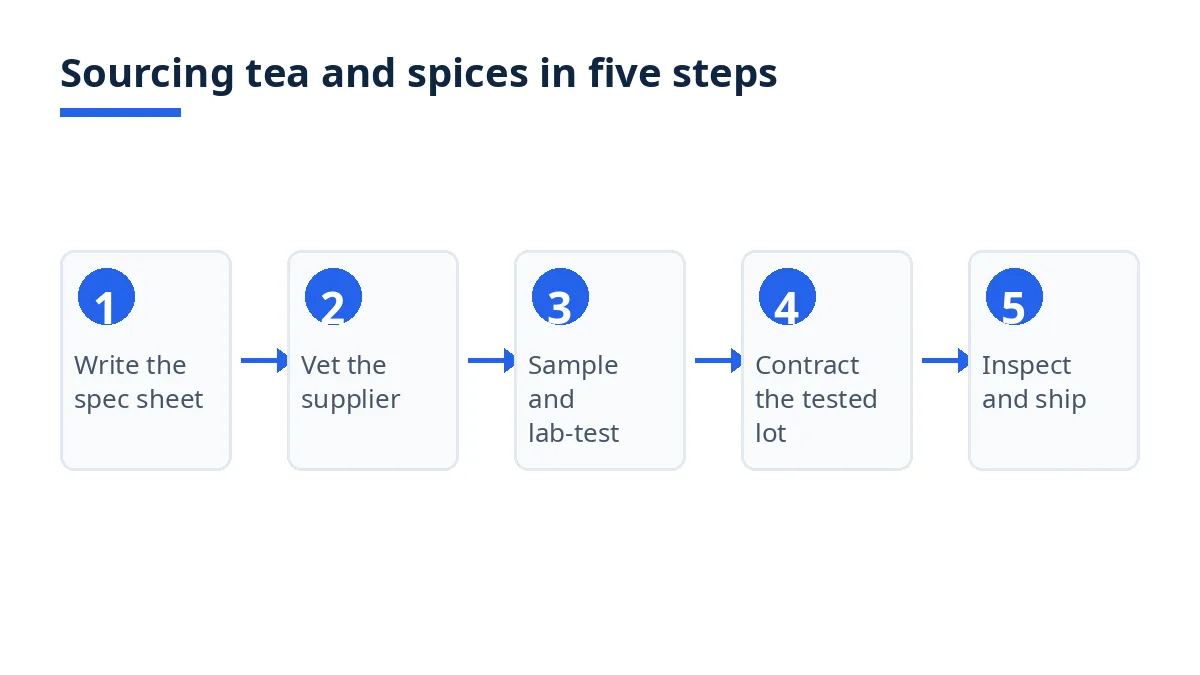
The buying process below pulls these threads together.
Step-by-step buying process
Write the specification sheet. Product before supplier: HS heading, botanical name or tea manufacture type, grade code or spice form, the measurable limits from the cited standard, treatment method, pack size and packing, target quantity and destination market.5 7 8 9
Shortlist and vet suppliers. Match the company type to the form, then run the six document checks in the verification section, including the Tea Board clearance route for tea and the current allocation for rice.2 4 6
Sample and test. Taste the tea lot and lab-test production-representative goods for the product panel and the destination safety panel, check the panel in the BFSA export testing repository, and approve a counter-sample in writing.10 11 12
Contract the tested product. Fix MOQ, itemised unit price with its validity period, the Incoterm with its named place, the staged lead time, payment terms, the inspection point, and the remedy if a lot fails the spec, all in the purchase order.13
Produce, inspect and ship. Monitor treatment and packing first, inspect finished goods against the counter-sample and test report, then ship with the origin evidence your duty position depends on and, for rice, inside the allocation validity window.14 4
Related guides
Read the tea and spices industry in Bangladesh pillar for the data behind this method, sustainable tea and spices from Bangladesh for organic and traceability claims, and how to import from Bangladesh for the general import sequence. Incoterms for shipments from Bangladesh works through the delivery terms in more detail.
FAQs
Is Bangladesh a good place to source tea, spices & rice?
Bangladesh is a credible sourcing option for packet and specialty tea, processed and branded spices, and permitted aromatic rice, where the specification, vetting and testing in this guide are run actively. Tea exports were 2.45 million kg in calendar 2024, spice exports reached a record USD 56.31 million, and aromatic rice moves only under government allocation.1 3 4 The constraints are the small tea surplus, sterilisation capacity for regulated spice markets, and permission-based rice exports.3 4 Source product by product, against a spec sheet, not on the country label.
What is the typical MOQ?
There is no published typical MOQ for tea, spices or aromatic rice from Bangladesh, and no official body sets one. Each supplier quotes its MOQ from its production stage: an auction, blending or packing minimum for tea, a grinding or packing-line minimum per spice recipe and pack size, or a milling minimum for rice, where the remaining government allocation can cap the order below the commercial MOQ.4 State your target quantity on the same basis, so quotes can be compared directly.
How long is the lead time?
There is no standard lead time: yours is the sum of its stages. For tea the chain runs through a weekly auction calendar, blending, packing, testing and booking.2 For spices it runs raw material purchase, cleaning, grinding, blending, treatment, packing and booking, with treatment the bottleneck stage.3 For rice it runs inside the allocation validity window, ending 31 December 2026 for the current round.4 Ask for the stages separately and agree in writing what starts the clock.
Which certifications matter?
The requirements that matter are the ones your destination and your buyers require for the exact product and form. The measurable base is the product standard: ISO 3720 for black tea, and the Codex standard for the spice, such as CXS 359-2024 for turmeric and CXS 327-2017 for cumin, each with moisture, ash and strength-marker limits.7 8 9 On top of that sit the destination safety file, EU residue limits under Regulation (EC) No 396/2005 and the treatment expectations behind the FDA spice risk profile for the United States, plus any scheme your customers name, evidenced by a current certificate for the product and site.11 10 A certificate covers a system; the lot test report covers your goods, and a complete file carries both.
Next steps on Exportain
Browse Bangladeshi suppliers by tea, spice or rice product, use Exportain trade intelligence for the market picture, and post a free RFQ at Exportain RFQs with your specification sheet, target quantity and destination market so suppliers quote against the same written brief.
Sources
- Tea exports jump by 58% in 2024. The Business Standard, (accessed )
- From London and Kolkata to Chattogram: The tea auction hub driving Bangladesh's trade. The Business Standard, (accessed )
- Spice exports surge five times in 15 years. Times of Bangladesh, (accessed )
- Govt cuts fragrant rice export quota by 50%. The Business Standard, (accessed )
- HS Nomenclature, Chapter 9: Coffee, tea, mate and spices. World Customs Organization (accessed )
- Supplier verification: Earn trust badges buyers can see. Exportain (accessed )
- ISO 3720:2011 Black tea — Definition and basic requirements. International Organization for Standardization, (accessed )
- CXS 359-2024 Standard for dried or dehydrated roots, rhizomes and bulbs — Turmeric. Codex Alimentarius Commission (FAO/WHO) (accessed )
- CXS 327-2017 Standard for Cumin. Codex Alimentarius Commission (FAO/WHO) (accessed )
- Questions & Answers on Improving the Safety of Spices: Risk Profile on Pathogens and Filth in Spices. US Food and Drug Administration, (accessed )
- Pesticide residues in food and animal feed: summary of Regulation (EC) No 396/2005. European Commission, EUR-Lex (accessed )
- Search Export Testing Requirements. Bangladesh Food Safety Authority (accessed )
- Incoterms® rules. International Chamber of Commerce (ICC) (accessed )
- EU trade relations with Bangladesh. European Commission, (accessed )
- Incoterms
- quality control
- Bangladesh Export Data
- Category Pillars
- Supplier Sourcing
- Tea Bangladesh
- Spices Bangladesh
- Rice Bangladesh
About the author
Sourcing from Bangladesh?
Post a request for quotation and suppliers on Exportain can send you their quotes directly.
Post an RFQ