

Sustainable Tea, Spices & Rice From Bangladesh: Certifications and Green Factories
Tea production was 94,927 thousand kg in 2025 and spice exports reached a record USD 56.31 million, but no official series separates claim-bearing production. This pillar guide covers what organic and Rainforest Alliance certification require, residue rules, traceability and packaging checks.
Short answer
Sustainable tea, spices and rice from Bangladesh means claims you can verify lot by lot: an organic control chain under Regulation (EU) 2018/848 where organic is claimed, a farm audit such as Rainforest Alliance for tea where that claim is made, residue testing against destination limits, one-lot traceability, and packaging that meets destination rules. No single certificate is required for every product in every market.
On this page
Key takeaways
Tea production was 94,927 thousand kg in calendar 2025 on Bangladesh Tea Board figures, but no official series separates claim-bearing production, so the sustainable supply base is built estate by estate and lot by lot.
An EU organic claim needs the Regulation (EU) 2018/848 control chain: production compliance, controls by a recognised control body, a certificate covering the operators including the exporter, and traceable supplier identification.
EU maximum residue levels under Regulation (EC) No 396/2005 apply equally to imports, with a default of 0.01 mg/kg where no specific level is set; Implementing Regulation (EU) 2019/1793 adds increased controls on listed consignments.
Rainforest Alliance certification rests on a farm audit against its Sustainable Agriculture Standard; the seal needs a licence agreement, and a packer buying certified leaf needs its own supply chain position for the claim to reach your pack.
Aromatic rice exports run only under named Ministry of Commerce allocations, halved in September 2026 with a minimum FOB price of USD 1.60 per kg, so a rice claim is only as good as the allocation behind the consignment.
Sustainable tea, spices and rice from Bangladesh is not a product category with its own label. It is a way of buying three different trades: every environmental or social claim is tied to a named standard, a current certificate whose scope covers the estate, plant and product in your order, evidence that follows the lot from field to carton, and packaging that meets the rules of the market where the goods will be sold. This pillar guide is for importers, food brands, wholesalers and sourcing agents in the United States, the United Kingdom, the European Union and the United Arab Emirates who want that evidence file, not a marketing claim. It deals only with the sustainability layer: what the certifications actually require, how traceability works, which residue rules destination markets enforce, and how packaging is checked.
Market overview with latest data
Read the three product groups separately, because the sustainability evidence sits in a different place in each. Tea is estate-grown and mostly drunk at home, so certified production competes for a small export surplus. Spices are ground, blended and packed in Bangladesh, partly from imported raw material, so the claim file sits at the processing plant as much as at the farm. Aromatic rice exports run only under government permission, so the first question, whether the consignment can legally leave, is a policy question before it is a farming question. The companion tea and spices industry in Bangladesh pillar covers production, regions and the export structure behind all three groups in full.
Tea production was 94,927 thousand kg in calendar 2025 on Bangladesh Tea Board figures, while cumulative tea exports were 1,323 thousand kg in the year to June 2025-26, because domestic demand absorbs most of what the gardens produce.1 That narrow surplus shapes the certified offer: an estate that certifies does so for packet, orthodox and specialty lines where a buyer pays for the audit, not for the bulk CTC volume the home market takes. Current tea reporting also names limited access to international certification, including Rainforest Alliance certification, among the barriers to higher-value tea exports.1
Spice exports reached a record USD 56.31 million on Export Promotion Bureau (EPB) figures, up from around USD 9.24 million in fiscal year 2010-11, with demand led by the Bangladeshi diaspora and the Gulf states.2 No official series separates claim-bearing production from that total, and no official body publishes a market share for sustainable tea, spices or rice. The verifiable unit is the individual estate, plant and lot.
Aromatic rice production rose from 5.79 lakh tonnes in fiscal year 2017-18 to 10.23 lakh tonnes in fiscal year 2023-24, with 33 types cultivated, while exports run on case-by-case government approval and export earnings fell to USD 0.06 million in FY2023-24.3 The September 2026 revision halved allocations for 278 exporters and set a minimum FOB export price of USD 1.60 per kg for fragrant rice, with the current window ending on 31 December 2026.4 A sustainability claim on rice is only as good as the allocation behind the consignment: certified farming on tonnage the government has not released is not an export offer.
Main products and production clusters
Tea, spices and rice are classified in two chapters of the Harmonized System: tea and spices in Chapter 9, and rice in Chapter 10, cereals.5 Sustainability status does not change the heading: an organic turmeric powder and a conventional one share a classification, and the claim lives in the certification file, not the tariff line. The headings you will use most often are:
HS heading | What it covers | The sustainability question to settle in writing |
|---|---|---|
0902 | Tea, whether or not flavoured | Which estate grew the lot, and does a farm certificate cover that estate and that season |
0904 | Pepper of the genus Piper; dried or crushed or ground fruits of the genus Capsicum or Pimenta | Residue test panel for the destination market; treatment method for microbial control |
0909 | Seeds of anise, badian, fennel, coriander, cumin, caraway and similar seeds | Origin of the seed lot, because several lines are imported, processed and re-exported |
0910 | Ginger, saffron, turmeric, thyme, bay leaves, curry and other spices, including mixtures | Drying and storage record behind the lot; blend recipe and the certified status of each ingredient |
1006 | Rice | The exporter's current government allocation, and the variety and field group behind a farm claim |
Agree the six-digit subheading with your supplier and broker for each product before you order, because the heading decides the duty line and the product rules at destination.5
The product families carry different evidence. For tea, the claim sits at the estate: black CTC is the volume product, and green, orthodox and organic lines are the smaller end where certification is concentrated. Production is estate-based across Sylhet, Moulvibazar, Habiganj, Panchagarh and Chattogram, and the certificate is issued to an estate or grower group, so confirm the named holder is the estate your lot came from.1 For spices, many raw materials, including cinnamon, clove and coriander, are imported, processed locally and then exported, so a farm-origin claim on a blended pack may rest on fields outside Bangladesh.2 For rice, the export product is aromatic rice only, in types such as Chinigura and Kalijira, and the cluster that matters is the short list of companies holding a current export allocation.3 4
How to find and verify suppliers
Find suppliers through more than one channel so you can cross-check what a company tells you. Start with the Bangladesh Tea Board for tea estates and exporters and the exporter associations for spices and rice, add Bangladesh export data and Exportain trade intelligence for market context, then work Bangladeshi suppliers listings by product. With each candidate, separate three questions that are often merged: is the product legal and safe for my market, is the farm or plant behind it certified, and is the claim on this consignment covered by that certificate. Each question has a different document behind it.
Verification for a sustainability claim is a document exercise. Ask for, and read, the following before you discuss price in detail:
The scope certificate for every standard you rely on: standard and version, certification or control body, estate, group or site address, product scope and expiry date. A certificate for one estate, line or season does not cover another.
The transaction evidence for your shipment: the lot documentation tying your consignment to the certified supply, including the certificate of inspection for an EU organic consignment.
A traceability test on one lot: the supplier identifies where the tea, spice ingredient or paddy in that lot came from and who received the adjacent lots, while you time it.
The residue and treatment file: the test panel run on the lot, the laboratory, and the treatment method used for microbial control on spice lines.
The packaging declaration for your pack format: materials by layer, recycled content where claimed, and the evidence behind any recyclable wording.
For rice, the current Ministry of Commerce allocation letter showing quantity, validity date and unused balance.4
On Exportain, read badges for what they are. Supplier profiles carry document and photo review badges: the badge records that documents and photos were reviewed by Exportain staff, verification is free, and membership never grants a badge.6 A badge is not a factory inspection, an organic certificate, a sustainability audit or a guarantee. Exportain is a B2B marketplace and is not a party to the contract for goods; it does not inspect goods, book freight or clear customs.6 Use the badge as a first filter, then run the checks above yourself or through a firm you appoint.
Two red flags end a conversation early: a supplier offering a claim it cannot attach to a named standard and a current certificate is selling wording, not evidence, and a rice exporter who cannot show a current allocation is offering tonnage the government has not released.
MOQ, pricing and lead times
There is no industry-wide MOQ, standard price or standard lead time for tea, spices or aromatic rice from Bangladesh, and no official body publishes one. All three are quoted per estate, plant and order against a written specification. Certification moves all three, and the movement should be visible in the quote rather than absorbed into one higher price.
MOQ. The minimum is set by the certified supply behind the order as much as by the production run. A certified tea lot is finite: the output of one estate or grower group in one season, audited as that unit. A certified spice ingredient lot carries its own size as a ceiling, and segregated production, where certified and conventional runs are kept apart with cleaning and changeover, raises the practical minimum for a ground or blended line. An aromatic rice order is capped by the exporter's remaining allocation, which can bind before any commercial MOQ is reached.4 State your target quantity per product, per form and per claim, and ask for the MOQ and the available certified volume on the same basis.
Pricing. Your unit price is built from raw material, processing, packing, testing and export costs to the agreed Incoterm point. The sustainability file adds identifiable lines: certified raw material at its own price, audit fees spread across certified volume, segregated runs, added residue and microbial testing, and upgraded packaging where your claim requires it. For aromatic rice, the September 2026 revision set a regulatory floor of USD 1.60 per kg FOB; that floor is a government minimum, not a market quote for your variety and packing.4 Ask for the sustainability lines itemised: a premium that cannot be itemised cannot be checked at renewal.
Example figures. For illustration only: 10,000 retail packs of ground turmeric at 200 g per pack, with an organic claim on the turmeric, are quoted by two packers at FOB Chattogram. Supplier A quotes USD 1.46 per pack itemised as raw material and grinding USD 0.90, certified premium and segregation USD 0.13, sterilisation and residue testing USD 0.18, pack and carton USD 0.16 and export costs USD 0.09. Supplier B quotes USD 1.28 with no itemisation. The totals are USD 14,600 and USD 12,800. The example shows the method, not a market price: the buyer asks Supplier B which control body certified the turmeric and for the same itemisation before treating the USD 1,800 gap as a saving, because an unitemised gap on a claim-bearing spice is usually the claim itself.
Lead times. A lead time is a chain: certified raw material purchase, tied to a harvest or plucking window, cleaning, grinding or blending, treatment, packing, laboratory release, inspection and booking, then transit. Certification adds two links: the certified lot must be available, not just the crop, and any audit, renewal or consignment certificate your claim depends on must complete before shipment. For rice, the chain must also fit inside the allocation validity window.4 Ask for the stages separately and agree what starts the clock, normally order confirmation plus approved sample or artwork.
Quality, certifications and compliance
Quality in this category is decided by three layers: destination food law, the Bangladesh export conditions for the product, and your own specification and testing. Sustainability evidence sits inside those layers, not beside them. No single certificate covers all three, none is required for every product in every market, and a certificate proves only what its scope says: that estate, plant or product group, that standard, until that expiry date.
Organic claims: a legal definition, not a description. Organic is the most tightly defined claim in this guide. Under Article 45 of Regulation (EU) 2018/848, a product may be imported from a third country and placed on the EU market as organic only where it complies with the regulation's production chapters, all operators including exporters have been subject to controls by a recognised control body and hold a certificate confirming compliance, and operators can at any time identify their suppliers and those suppliers' control bodies, so the consignment stays traceable.7 Tea, a spice or rice grown without synthetic inputs but without that control chain is not organic for EU labelling. Check that the control body is recognised for the activity and country, that the certificate covers your exporter and product, and that the consignment travels with its certificate of inspection.
Rainforest Alliance-type certification: what the audit actually covers. Rainforest Alliance certification is the scheme buyers name most often for tea in this category. On the organisation's own account, a farm prepares against the Rainforest Alliance Sustainable Agriculture Standard, chooses an authorised certification body, hosts a field audit in which the body checks compliance with the standard, and, if the farm passes, may sell its crop as Rainforest Alliance Certified; use of the seal additionally requires a licence agreement and approval through the scheme's claims platform.8 On tea specifically, the organisation states that certification prohibits deforestation, land conversion and ecosystem destruction, and requires certified farms to provide safe working conditions including protective equipment, clean drinking water and decent living quarters, to inform workers of their right to freedom of association and collective bargaining, and to operate gender, grievance and child labour committees under its assess-and-address approach; larger farms must pay at least the local minimum wage while showing progress toward a living wage.9 Two limits matter to a buyer. First, the certificate belongs to the farm or group that was audited: a blender or packer buying certified leaf still needs its own supply chain position in the scheme before the claim can pass to your pack. Second, certification is a farm system audit, not a batch test: it does not replace the residue panel below.
Residue and pesticide rules: the destination sets the limit. A certificate never overrides a residue limit, because the limit is destination food law. In the EU, maximum residue levels (MRLs) are set in Regulation (EC) No 396/2005, the same MRLs apply to food produced in the EU and food imported from third countries, and where no specific MRL is set, a default level of 0.01 mg/kg applies.10 The full list is public in the EU Pesticides Database: list the plant protection products used on your tea, spice crop or paddy, look up each substance-product pair before you order, and test the production lot against that panel.10 On top of the MRL system, Commission Implementing Regulation (EU) 2019/1793 temporarily increases official controls on certain food and feed from certain third countries and imposes special conditions on listed consignments because of risks that include pesticide residues, mycotoxins, microbiological contamination and ethylene oxide; Annex II consignments travel with an official certificate and sampling and analysis results.11 The listings are commodity-and-country specific and revised as control data changes, so check the current annexes for your product and origin at order stage.11 In the United States, the duty sits with your importer: the Food and Drug Administration (FDA) Foreign Supplier Verification Programs (FSVP) rule requires importers to run risk-based verification that imported food meets applicable United States safety standards, covering hazard analysis that expressly includes pesticide residues, supplier evaluation and approval, verification activities such as audits, sampling and testing or records review, and corrective actions.12
Spice hygiene and microbial treatment. Spices carry a second, non-chemical file. The Codex Alimentarius code of hygienic practice for spices and dried aromatic herbs, CAC/RCP 42-1995, sets the baseline: drying should reach a safe moisture level as fast as possible to prevent mould growth, mechanical drying is preferred to open-air drying, and spices should be cleaned and sorted to remove physical hazards.13 In the Bangladesh trade, exporters name sterilisation capacity as the main barrier to the United States and European markets: gamma radiation sterilisation is reported as required for many spice products entering those markets, Gulf and Malaysian buyers accept heat-treated product, and shipments more than halved while the main Savar irradiation facility was closed for renovation from November 2023 to July 2025.2 Write the treatment method, facility and test panel into the purchase specification.
Traceability: the legal floor and the working test. In the EU, Article 18 of Regulation (EC) No 178/2002 requires traceability of food at all stages of production, processing and distribution, requires operators to identify any person who supplied them, and requires systems to identify the businesses they supplied, available to authorities on demand.14 That one-step-back, one-step-forward floor does not by itself require full internal lot genealogy, but a sustainability claim needs exactly that: a claim about one estate's tea or one certified turmeric lot is provable only if the lot can be followed through blending, grinding or milling to your cartons. Run the test before the first order: pick one finished lot and ask for the field or purchase records behind it, the processing records that kept it separate or accounted for it, and the despatch record tying it to a carton range.
Packaging. Tea chests and liners, spice pack films and rice sacks are part of the sustainability file. The EU Packaging and Packaging Waste Regulation 2025/40 (PPWR) entered into force on 11 February 2025 and will generally apply from 12 August 2026; it covers all packaging regardless of material or origin, and requires all packaging to be recyclable, meaning designed for material recycling and able to be collected, sorted and recycled at scale, with the recycled-at-scale requirement entering into force in 2035 and recyclability grades applying from 2030.15 In practice, a multi-layer spice film that protects aroma may fail a recyclability grade. Agree pack material per product against the destination's rules, and record recycled content where you claim it.
Green claims and green factory claims. In the EU, Directive (EU) 2024/825 on empowering consumers for the green transition treats generic environmental claims such as eco-friendly or green without substantiation as greenwashing, requires sustainability labels to be based on a certification scheme or established by public authorities and verified by an independent third party, and bans claiming a benefit for the whole product when it applies only to one part.16 Apply the same discipline to factory claims in any market. There is no tea, spice or rice specific green-factory certificate a buyer can check for a Bangladeshi estate factory or packing plant, so verify each claim one item at a time: metered energy use per tonne, the fuel behind withering, drying and sterilisation, and water, effluent and waste records. Ask for the metered record, not the brochure.
Your own quality system. Write the specification so an inspector can measure it: for tea, grade, blend composition and the estate or group behind the lot; for spices, botanical name, form, moisture, treatment method and residue panel; for rice, variety type, milling degree, broken percentage and moisture. Approve a counter-sample, set the inspection point before cartons are sealed, and keep batch codes matched to the cartons shipped.
Shipping, Incoterms and duties
Tea, spices and aromatic rice normally leave by sea from Chattogram, with small urgent spice and packet tea consignments also moving by air from Dhaka. The sustainability variables in shipping are concrete: moisture protection decides whether a spice lot arrives inside its specification, and carton and sack dimensions decide cube use in the container. Confirm dimensions, net weights and moisture protection in the specification before the Incoterm is chosen.
Incoterms® 2020 is the current edition of the ICC rules, in force since 1 January 2020: eleven three-letter trade terms that clarify the tasks, costs and risks involved in the delivery of goods from sellers to buyers, recognised as the global standard for interpreting the most common terms in foreign trade.17 The four rules you will meet most often on orders in this category work as follows:
Rule | Who arranges and pays main freight | Where risk passes to the buyer | Practical note for this category |
|---|---|---|---|
EXW (Ex Works) | Buyer | At the seller's premises | Buyer carries export clearance workload, including the rice allocation paperwork; rarely suitable for a first order |
FOB (Free On Board) | Buyer | When goods are on board the vessel at the named loading port | The common Bangladesh term; the aromatic rice minimum price is itself set as an FOB price, for example FOB Chattogram, Incoterms® 20204 |
CIF (Cost, Insurance and Freight) | Seller, plus minimum insurance | When goods are on board at the loading port | Seller's freight is convenient, but risk still passes at loading, not at arrival |
DAP (Delivered at Place) | Seller | At the named destination place, ready for unloading | Buyer still clears import and pays duty unless the contract says otherwise |
Always write the rule with its named place and edition, for example "FOB Chattogram, Incoterms® 2020". Exportain does not book freight or clear customs, so the freight forwarder and customs broker are separate appointments to name in the order paperwork.6
Duties are decided by the heading, the origin of the goods and the destination's preference scheme, in that order. As a least developed country, Bangladesh benefits from the Everything But Arms (EBA) arrangement under the EU's Generalised Scheme of Preferences, which grants duty-free, quota-free access to the EU for all products except arms and ammunition, and 91 percent of Bangladesh's exports to the EU enter duty- and quota-free.18 Bangladesh is the largest EBA beneficiary, with EUR 19 billion in exports benefitting in 2024 at a 96 percent utilisation rate.18 Tea, spices and rice that meet the EBA rules of origin and ship with the required proof of origin therefore enter the EU without customs duty while Bangladesh holds that status. Two cautions apply. First, preference is a property of the consignment, not the country: if the origin evidence fails, the standard third-country duty applies, and for a blended spice the origin analysis follows the recipe and the processing, which matters where ingredients were imported.2 Second, EBA status waives duty only: EU food law, including the MRL limits,10 the Article 18 traceability duty,14 and the organic control chain,7 applies in full. For the United States, the United Kingdom and the UAE, read the duty beside your confirmed six-digit code in the destination tariff for the entry date; this guide states no rate for them.
One shipping control is specific to rice: the government may cancel an approval at any time in the public interest, so a rice contract needs an allocation-shortfall clause if the seller's quota is cut after signing.4
Step-by-step buying process
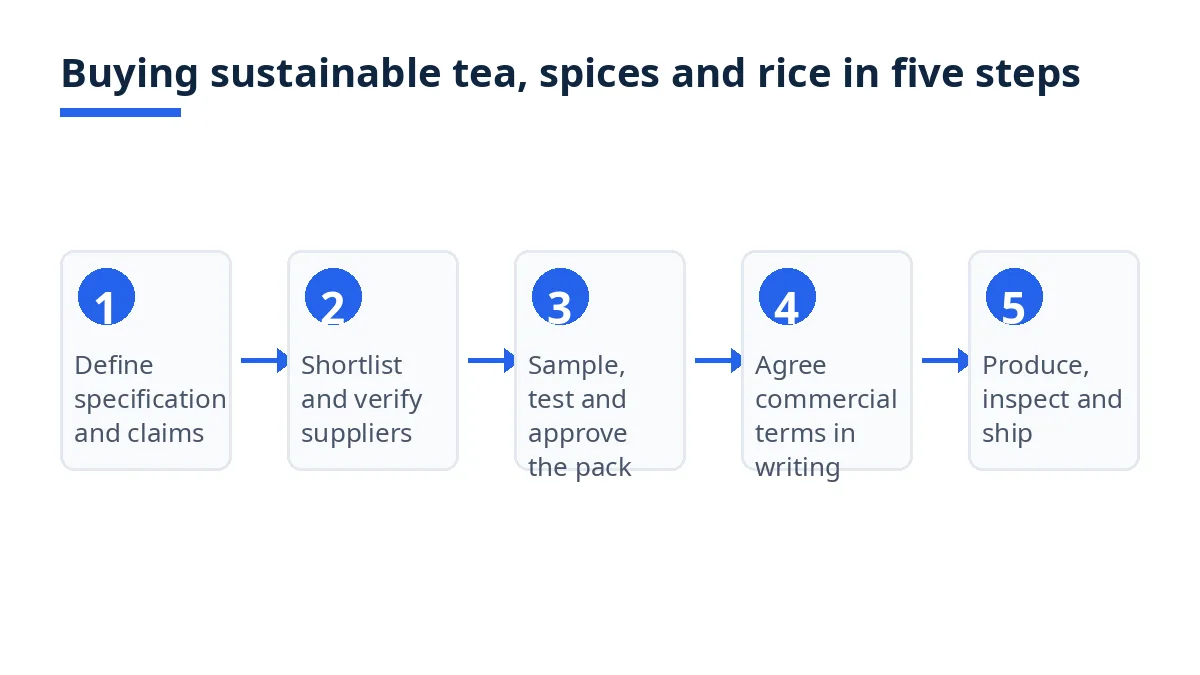
Define the specification and the claims. Write the product before you shop for it: HS subheading, form (leaf, whole, ground, mixed or milled), grade or recipe, the exact claims and the named standard behind each one, pack format and material, target quantity, and destination market.
Shortlist and verify suppliers. Build a shortlist, confirm the supplier type matches the form, then run the certificate scope, transaction evidence and one-lot traceability checks above, including the current rice allocation where rice is in scope.4 6
Sample, test and approve the pack. Order samples against the specification, test production-representative goods against your destination residue panel, and approve a counter-sample and the destination label proof, including every claim, in writing.10 16
Agree commercial terms in writing. Fix MOQ and available certified volume, itemised unit price with validity period and sustainability lines shown separately, the Incoterm with named place, staged lead time, payment terms and inspection point, all in the purchase order.17
Produce, inspect and ship. Monitor the certified lot and segregated run first, inspect and test finished goods against the counter-sample, run the traceability file for the shipped lots, then ship with the origin evidence your duty position depends on and, for rice, inside the allocation window.14 18
Related guides
Read how to import from Bangladesh for the general import sequence, Bangladesh export data for category scale, and the Incoterms for shipments from Bangladesh guide for delivery terms. The sustainable processed food from Bangladesh pillar applies the same evidence approach to the neighbouring packed-food category.
FAQs
Is Bangladesh a good place to source tea, spices & rice?
Bangladesh is a credible sourcing option for packet and specialty tea, processed and branded spices, and permitted aromatic rice where the claim, specification and evidence file are managed actively. Tea production was 94,927 thousand kg in calendar 2025, spice exports reached a record USD 56.31 million, and aromatic rice production reached 10.23 lakh tonnes in FY2023-24.1 2 3 No official series separates claim-bearing production from those totals, so the sustainable supply base is the set of estates and plants whose certificates, lots and records you have checked.
What is the typical MOQ?
There is no published typical MOQ for tea, spices or aromatic rice from Bangladesh, and no official body sets one. Each supplier quotes its MOQ from its production stage: an auction, blending or packing minimum for tea, a grinding or packing-line minimum per spice recipe and pack size, or a milling and packing minimum for rice. A claim-bearing order adds the size of the certified lot behind the claim and, for rice, the exporter's remaining government allocation.4
How long is the lead time?
There is no standard lead time: yours is the sum of certified raw material purchase, processing, treatment where the market requires it, packing, laboratory release, inspection and booking, then transit. Two stages carry dated constraints: the certified lot must be available in your shipping window, not just the crop, and a rice order must ship inside its allocation validity window, which for the current round ends on 31 December 2026.4 Ask for the stages separately and agree what starts the clock.
Which certifications matter?
The certifications that matter are the ones your destination law, your channel and your pack claims require for the exact product and form; none is a general badge and none is required for every product in every market. An EU organic claim needs the Regulation (EU) 2018/848 control chain: production compliance, controls by a recognised control body, a certificate covering the operators including your exporter, and supplier identification that keeps the consignment traceable.7 A Rainforest Alliance claim needs the audited farm or group behind the lot and the scheme's supply chain position for the claim to reach your pack.9 8 Neither replaces destination food law: EU residue limits under Regulation (EC) No 396/2005,10 traceability under Article 18 of Regulation (EC) No 178/2002,14 and, for the United States, your importer's FSVP verification.12
Next steps on Exportain
Browse Bangladeshi suppliers by tea, spice or rice product, use Exportain trade intelligence to check the market picture behind this guide, and post a free RFQ at Exportain RFQs with your specification, the claims you need evidenced, target quantity and destination market so suppliers in this category can quote against the same written brief.
Sources
- Monthly Statistical Bulletin for the Month of June, 2026: Tea Production, Sale, Market Price and Export. Bangladesh Tea Board (accessed )
- Spice exports surge five times in 15 years. Times of Bangladesh, (accessed )
- Aromatic rice production nearly doubles in seven years. The Daily Star, (accessed )
- Govt cuts fragrant rice export quota by 50%. The Business Standard, (accessed )
- Harmonized System. World Customs Organization (accessed )
- Supplier verification: Earn trust badges buyers can see. Exportain (accessed )
- Regulation (EU) 2018/848, Article 45 Import of organic and in-conversion products. European Union (accessed )
- How to Get Rainforest Alliance Certified: A Guide for Farmers. Rainforest Alliance, (accessed )
- Rainforest Alliance Certified Tea: Meet the Farmers Behind it. Rainforest Alliance (accessed )
- Q&As - pesticides: Maximum residue levels. European Commission (accessed )
- Commission Implementing Regulation (EU) 2023/1110 amending Implementing Regulation (EU) 2019/1793 on temporary increase of official controls and special conditions. European Commission, EUR-Lex (accessed )
- FSMA Final Rule on Foreign Supplier Verification Programs (FSVP) for Importers of Food for Humans and Animals. U.S. Food and Drug Administration (accessed )
- Code of Hygienic Practice for Spices and Dried Aromatic Herbs (CAC/RCP 42-1995). FAO; WHO (accessed )
- Regulation (EC) No 178/2002, Article 18 Traceability. European Union (accessed )
- The EU Packaging and Packaging Waste Regulation: when will it come into effect and what does it cover?. European Commission (accessed )
- Directive (EU) 2024/825 – Empowering Consumers for the Green Transition. Department of Enterprise, Trade and Employment, Ireland (accessed )
- Incoterms® rules. International Chamber of Commerce (ICC) (accessed )
- EU trade relations with Bangladesh. European Commission, (accessed )
- Incoterms
- quality control
- Bangladesh Export Data
- Category Pillars
- Supplier Sourcing
- Tea Bangladesh
- Spices Bangladesh
- Rice Bangladesh
About the author
Sourcing from Bangladesh?
Post a request for quotation and suppliers on Exportain can send you their quotes directly.
Post an RFQ


