Sustainable Agro & Processed Food From Bangladesh: Certifications and Green Factories
Agro-exports reached USD 1.03 billion in FY2024, including USD 341.73 million from processed food. This pillar guide covers what each certification actually requires, traceability, packaging rules, green claims and buyer due diligence.
Short answer
Sustainable processed food from Bangladesh is food whose claims you can verify lot by lot: GLOBALG.A.P. certification at the farm where a farm claim is made, a plant food safety scheme such as FSSC 22000 or BRCGS, one-step traceability that follows the ingredient lot through the plant, and packaging that meets destination rules such as the EU PPWR. No single certificate is required for every product in every market.
On this page
Key takeaways
Agro-exports were USD 1.03 billion in FY2024 on BIDA figures, including USD 341.73 million from processed food alone, but no official series separates claim-bearing production, so the sustainable supply base is built plant by plant.
There is no single sustainability certificate for processed food: the evidence layers are destination food law, a plant scheme such as FSSC 22000 or BRCGS, farm certification under GLOBALG.A.P. IFA where a farm claim is made, and the lot-level traceability file.
GLOBALG.A.P. IFA certification requires an annual third-party audit, compliance with 100 percent of Major Musts and at least 95 percent of Minor Musts, and a certificate valid for one year.
EU law requires food traceability at all stages under Article 18 of Regulation (EC) No 178/2002, and the Packaging and Packaging Waste Regulation 2025/40 generally applies from 12 August 2026 with all packaging required to be recyclable.
FSSC 22000 Version 6 additional requirements include food loss and waste, linked to Sustainable Development Goal 12.3; FAO reports 13.4 percent of food produced globally is lost after harvest and before retail.
Sustainable processed food from Bangladesh is not a category with its own label. It is a way of buying biscuits, snacks, spices, juices, pickles, sauces and ready-to-cook foods: every environmental or social claim is tied to a named standard, a current certificate whose scope covers the plant and product, a traceable lot, and packaging that meets the rules of the market where the food will be sold. This pillar guide is for importers, distributors, retailers and sourcing agents in the United States, the United Kingdom, the European Union and the United Arab Emirates who want that evidence file, not a marketing claim. The companion pillar on the processed food industry in Bangladesh covers the industry's export series and factory landscape; this guide deals only with the sustainability layer.
Market overview with latest data
Start with scale, stated carefully. The Bangladesh Investment Development Authority (BIDA) puts agro-exports at USD 1.03 billion in FY2024, including USD 341.73 million from processed food alone, with over 700 products exported to more than 140 countries.1 BIDA counts more than 1,000 processors and 250 exporters, and names sustainable cold chain, climate-smart agriculture, modern packaging and traceability among its priority areas.1 Those figures describe the whole agro basket, not a sustainability segment: no official series separates claim-bearing processed food from the rest, so a quoted market share for sustainable processed food is a number no official body publishes.
One global figure explains why food loss sits at the centre of the file. The Food and Agriculture Organization of the United Nations (FAO) reports that 13.4 percent of food produced globally is lost after harvest and before reaching retail, while 19 percent of food available to consumers is wasted at retail, in food service and in households, and that food loss and waste generate around 10 percent of global greenhouse gas emissions.2 For a buyer, loss is the variable you can measure first: spoiled raw material, product rejected at laboratory release, and stock expired in your warehouse are all recorded in a well-run plant. Ask for those records before a carbon figure, because a plant that does not measure its own loss cannot substantiate a wider claim.
Main products and production clusters
Processed foods are classified across Section IV of the Harmonized System, and the chapter follows the product and its composition, not the brand or the claim.3 Sustainability status does not change the heading: an organic spice and a conventional spice share a classification, and the claim lives in the certification file. The families you will use most often are:
Product family | Typical Bangladesh products | The sustainability question to settle in writing |
|---|---|---|
Biscuits and dry foods | Biscuits, cakes, noodles | Pack film recyclability in your market; sourcing evidence for palm oil and named ingredients |
Snacks | Chanachur, chips, roasted nuts | Frying oil management records; pack material and empty-space ratio |
Spices, whole and ground | Turmeric, chili, cumin, blends | Traceability to lot; drying and storage; residue testing against your market's limits |
Fruit products | Juices, jams, dried fruit, pulp | Contracted, spot-bought or certified-group fruit; fate of pomace and rejected fruit |
Pickles, chutneys and sauces | Mango pickles, chili sauces | Ingredient sourcing; glass versus plastic pack decision |
Frozen and ready-to-cook | Paratha, frozen snacks, ready meals | Cold chain energy and temperature records; loss before loading |
Agree the six-digit subheading with your supplier and broker for each stock-keeping unit (SKU) before ordering, because the heading decides the duty line and product rules at destination.3
The farm end of these families is where one certification genuinely belongs. GLOBALG.A.P. Integrated Farm Assurance (IFA) is a farm-level standard built on food safety, environment, workers' health, safety and welfare, production processes and traceability, for the farms and producer groups growing your fruit, vegetables and combinable crops such as grains and pulses.4 A processor buying mango, turmeric or chili from IFA-certified production is buying an audited farm system behind the ingredient. A processor buying the same crop on the spot market may sell you a safe, legal product, but not that farm claim: your specification should say which you are paying for.
Production clusters follow the industry pattern: raw material moves from farming districts into plants in the factory belt around Dhaka, Gazipur, Narayanganj and Chattogram. For sustainability buying, geography matters twice: the distance and cold chain between harvest and plant decide much of the raw material loss figure, so ask where the plant buys and how the crop travels; and the certificate is issued to a site address, so confirm it is the plant making your order.
How to find and verify suppliers
Find suppliers through more than one channel so you can cross-check what a factory tells you. Start with sector association and exporter lists, add Bangladesh export data and Exportain trade intelligence for context, then work Bangladeshi suppliers listings by product family. With each candidate, separate three questions suppliers often merge: is the product legal and safe for my market, is the plant's system certified, and is this claim on this product certified. Each has a different document behind it.
Verification for a sustainability claim is a document exercise. Ask for, and read, the following before you discuss price in detail:
The scope certificate for every standard you rely on: standard and version, certification body, site address, product scope, expiry date. One line's certificate does not cover others.
The transaction evidence for your shipment: the lot documentation that ties your consignment to the certified supply.
A traceability test on one lot: the plant identifies the suppliers of the main ingredients in that lot and the customers who received adjacent lots, while you time it.
The packaging declaration for your SKU: materials by layer, recycled content where claimed, and the evidence behind any recyclable wording on the pack.
The claims file: every environmental or social statement on your pack or listing, each matched to its certificate, test report or metered record.
Audit reports and corrective actions: the latest audit summary, non-conformances raised, and evidence they were closed.
On Exportain, read badges for what they are. Supplier profiles carry document and photo review badges: the badge records that documents and photos were reviewed by Exportain staff, verification is free, and membership never grants a badge.5 A badge is not a factory inspection, a food safety certification, a sustainability audit or a guarantee. Exportain is a B2B marketplace and is not a party to the contract for goods; it does not inspect goods, book freight or clear customs.5 Use the badge as a first filter, then run the checks above yourself or through a firm you appoint.
Two red flags end a conversation early: a factory offering a claim it cannot attach to a named standard and current certificate is selling wording, not evidence, and a supplier that cannot run the one-lot test in evaluation will not run it in a recall.
MOQ, pricing and lead times
There is no industry-wide MOQ, standard price or standard lead time for processed food from Bangladesh, sustainable or otherwise, and no official body publishes one. All three are quoted per factory, product and order, against a written specification. Sustainability requirements move all three, and the movement should be visible in the quote rather than absorbed into one higher price.
MOQ. The minimum is set by the production run and the certified supply behind it. A certified lot is finite: a spice blend built on one certified turmeric lot, or a juice built on one producer group's mango harvest, carries that lot's size as a ceiling as well as the line minimum as a floor. Segregated production, where certified and conventional runs are kept apart with cleaning and changeover, raises the practical minimum. State your target quantity per SKU and per claim, and ask for the MOQ and available certified volume on the same basis.
Pricing. Your unit price is built from raw materials, processing, packing, testing and export costs to the agreed Incoterm point. The sustainability file adds identifiable lines: certified raw material at its own price, audit fees spread across certified volume, segregated runs, upgraded packaging where your market or claim requires it, and added testing. Ask for those lines itemised: a premium that cannot be itemised cannot be checked at renewal, and a quote cheaper than the conventional quote for the same specification usually means an evidence line has been dropped.
Example figures. For illustration only: 30,000 retail packs of a ground spice blend, with farm certification claimed for the main ingredient, are quoted by two suppliers at FOB Chattogram. Supplier A quotes USD 1.12 per pack itemised as product and grinding USD 0.78, certified premium and segregation USD 0.11, printed recyclable pack USD 0.14 and testing, packing and export costs USD 0.09. Supplier B quotes USD 0.97 with no itemisation. The totals are USD 33,600 and USD 29,100. The example shows the method, not a market price: the buyer asks Supplier B which standard the claim rests on and for the same itemisation, before treating the USD 4,500 gap as a saving: an unitemised gap on a claim-bearing product is usually the claim itself.
Lead times. A lead time is a chain: certified raw material purchase, tied for fruit and spice lines to a harvest window, ingredient and packaging procurement, the segregated production slot, laboratory release, inspection and booking, then transit. Certification adds two links: the certified lot must be available, not just the crop, and any audit or renewal your claim depends on must complete before shipment. Ask for the stages separately, agree what starts the clock, normally order confirmation plus approved artwork and sample, and do the shelf-life arithmetic in writing: a run arriving with too little shelf life left becomes food waste.2
Quality, certifications and compliance
Quality in processed food is decided by three layers: destination food law, the systems and schemes the plant runs, and your own specification and testing. Sustainability evidence sits inside those layers, not beside them. No single certificate covers all three, none is required for every product in every market, and a certificate proves only what its scope says: that site, those products, that standard, until that expiry date.
The reference framework: Codex and HACCP. The Codex Alimentarius General Principles of Food Hygiene, code of practice CXC 1-1969 in its 2023 FAO and WHO edition, set out the principles operators should follow at all stages of the food chain, with an annex of tools for determining critical control points in a Hazard Analysis and Critical Control Point (HACCP) system.6 Codex texts are international standards established to protect consumer health and ensure fair practices in the food trade.6 Ask the factory which hygiene and HACCP system it runs, for which lines, audited by whom and when: a HACCP plan is a description, not a certificate, and the answer you need is the audit record behind it.
Plant-level schemes: FSSC 22000 and BRCGS. FSSC 22000 is a certification scheme for food safety management systems: the Foundation FSSC states that the scheme uses ISO 22000 for the management system and the ISO 22002 series for sector-specific prerequisite programs (PRPs), with FSSC's own additional requirements on top, audited by licensed, accredited certification bodies.7 Version 6 of those additional requirements covers food defense, food fraud mitigation, allergen management and environmental monitoring, and adds a food loss and waste requirement linked to Sustainable Development Goal 12.3.8 BRCGS Global Standard Food Safety, now in its 9th issue, is the retailer-facing scheme: BRCGS describes it as a framework to manage product safety, integrity, legality and quality in food manufacturing, processing and packing, and as the first standard to be benchmarked by the Global Food Safety Initiative (GFSI).9 Neither scheme is a sustainability certificate. Both are food safety systems whose records, on allergens, fraud prevention, environmental monitoring and food loss and waste, form part of the evidence a claim can rest on.7 8 9
Farm-level certification: GLOBALG.A.P. IFA. Where the claim concerns how the crop was grown, the certificate sits at the farm, not the factory. Under GLOBALG.A.P. IFA, compliance is audited annually by an accredited, independent third-party body, a successful audit results in a certificate valid for one year, and producers must comply with 100 percent of Major Musts and at least 95 percent of Minor Musts.4 Every registered producer carries a 13-digit GLOBALG.A.P. Number (GGN), checkable in the GLOBALG.A.P. IT platform, and the standard's core topics include traceability and segregation and waste and pollution management.4 When a processor claims certified raw material, ask for the producer group certificate behind the lot and the chain-of-custody paperwork carrying the claim from farm to factory; the processor's own certificate does not create a farm claim.
Traceability: the legal floor and the working test. In the European Union, Article 18 of Regulation (EC) No 178/2002 requires food traceability at all stages of production, processing and distribution, that operators identify any person who supplied them, and that they hold systems to identify the businesses they supplied, available to authorities on demand.10 That one-step-back, one-step-forward floor does not require full internal lot genealogy, but a sustainability claim needs exactly that: a claim about one lot is provable only if the lot can be followed through the plant. In the United States, the duty sits with your importer: the Food and Drug Administration (FDA) Foreign Supplier Verification Program (FSVP) rule requires importers to perform risk-based activities to verify that imported food meets applicable United States safety standards, including hazard analysis, evaluation of the food and supplier risk, supplier approval, verification activities such as audits, sampling and testing or records review, and corrective actions.11 Expect the importer to ask the plant for hazard analysis support, audit reports and test records.
Organic claims. Organic is the most tightly defined claim in this guide, and the definition is legal, not descriptive. Under Article 45 of Regulation (EU) 2018/848, a product may be imported from a third country and sold in the EU as organic only where it complies with the regulation's production chapters, all operators including exporters have been controlled by a recognised control body and hold a certificate confirming compliance, and operators can at any time identify their suppliers and those suppliers' control bodies for importers and authorities.12 A product grown without synthetic inputs but without that control chain is not organic for EU labelling. Check the control body behind any organic wording, and that the certificate covers your exporter and product.
Packaging. The EU Packaging and Packaging Waste Regulation 2025/40 (PPWR) entered into force on 11 February 2025 and will generally apply from 12 August 2026; it covers all packaging regardless of material or origin, sets requirements for manufacturing, composition and the reusable or recoverable nature of packaging on the EU market, and requires all packaging to be recyclable, meaning designed for material recycling and able to be collected, sorted and recycled at scale, with the recycled-at-scale requirement entering into force in 2035 and recyclability grades applying from 2030.13 In practice: agree pack material per SKU against the destination's collection reality, record recycled content where claimed, and check recyclable wording against the PPWR position for your date.13
Green claims and factory claims. In the EU, Directive (EU) 2024/825 on empowering consumers for the green transition adds generic environmental claims and sustainability labels not based on a certification scheme or established by public authorities to the banned commercial practices list, so wording such as eco-friendly or green on a pack needs recognised, excellent environmental performance behind it, and a home-made badge is not evidence.14 Apply the same discipline to factory claims in any market. There is no food-specific green-factory certificate a buyer can check for a Bangladeshi plant, so verify each claim one item at a time: metered energy use per tonne, water and effluent records, food loss and waste measurement of the kind FSSC 22000 Version 6 requires,8 and farm certification waste records where they apply.4 Ask for the metered record, not the brochure.
Your own quality system. Write the specification so a laboratory can measure it: recipe and ingredients with allergens and required certified status, net weight, pack materials and format, batch coding, shelf life, and the microbiological and chemical limits your destination law sets. Approve a pre-production sample and the final label proof, including every claim, in writing, and test goods from the actual run.
Shipping, Incoterms and duties
Processed food normally leaves by sea from Chattogram, the main seaport, in dry containers for shelf-stable goods and reefer containers for frozen lines. The sustainability variables are concrete: the reefer temperature record, cube use in the container, and shelf life consumed in transit. Packing drives freight economics: biscuits are bulky relative to weight, juices heavy relative to value, and a half-empty carton is packaging waste and freight cost at once, so cartons per container, gross weight and empty-space ratio belong in the specification before the Incoterm is chosen. For frozen lines, agree the set point and a data logger in the purchase order.
Incoterms® 2020 is the current edition of the ICC rules, in force since 1 January 2020: eleven three-letter trade terms that clarify the tasks, costs and risks in the delivery of goods, recognised as the global standard for interpreting the most common terms in foreign trade.15 The four rules you will meet most often work as follows:
Rule | Who arranges and pays main freight | Where risk passes to the buyer | Practical note for processed food |
|---|---|---|---|
EXW (Ex Works) | Buyer | At the seller's premises | Buyer carries export clearance workload; rarely suitable for a first order |
FOB (Free On Board) | Buyer | When goods are on board the vessel at the named loading port | The common Bangladesh term; name the port, for example FOB Chattogram, Incoterms® 2020 |
CIF (Cost, Insurance and Freight) | Seller, plus minimum insurance | When goods are on board at the loading port | Seller's freight is convenient, but risk passes at loading, not arrival, and shelf life runs from production |
DAP (Delivered at Place) | Seller | At the named destination place, ready for unloading | Buyer still clears import and pays duty unless the contract says otherwise |
Always write the rule with its named place and edition, for example "FOB Chattogram, Incoterms® 2020". Exportain does not book freight or clear customs, so name the forwarder and broker separately in the order paperwork.5
Duties are decided by the heading, the origin of the goods and the destination's preference scheme, in that order. As a least developed country, Bangladesh benefits from the Everything But Arms (EBA) arrangement under the EU's Generalised Scheme of Preferences, which grants duty-free, quota-free access to the EU for all products except arms and ammunition, and 91 percent of Bangladesh's exports to the EU enter duty- and quota-free.16 Bangladesh is the largest EBA beneficiary, with EUR 19 billion in exports benefitting in 2024 at a 96 percent utilisation rate.16 Processed food meeting the EBA rules of origin, shipped with the required proof of origin, therefore enters the EU without customs duty while Bangladesh holds that status. Two cautions apply. First, preference is a property of the consignment, not the country: if the origin evidence fails, the standard third-country duty applies. Second, EBA status waives duty only: EU food law, including the Article 18 traceability duty,10 the organic control chain,12 and the PPWR timetable,13 applies in full. For the United States, the United Kingdom and the UAE, read the duty beside your confirmed six-digit code in the destination tariff for the entry date; this guide states no rate for them, because food rates vary by heading.
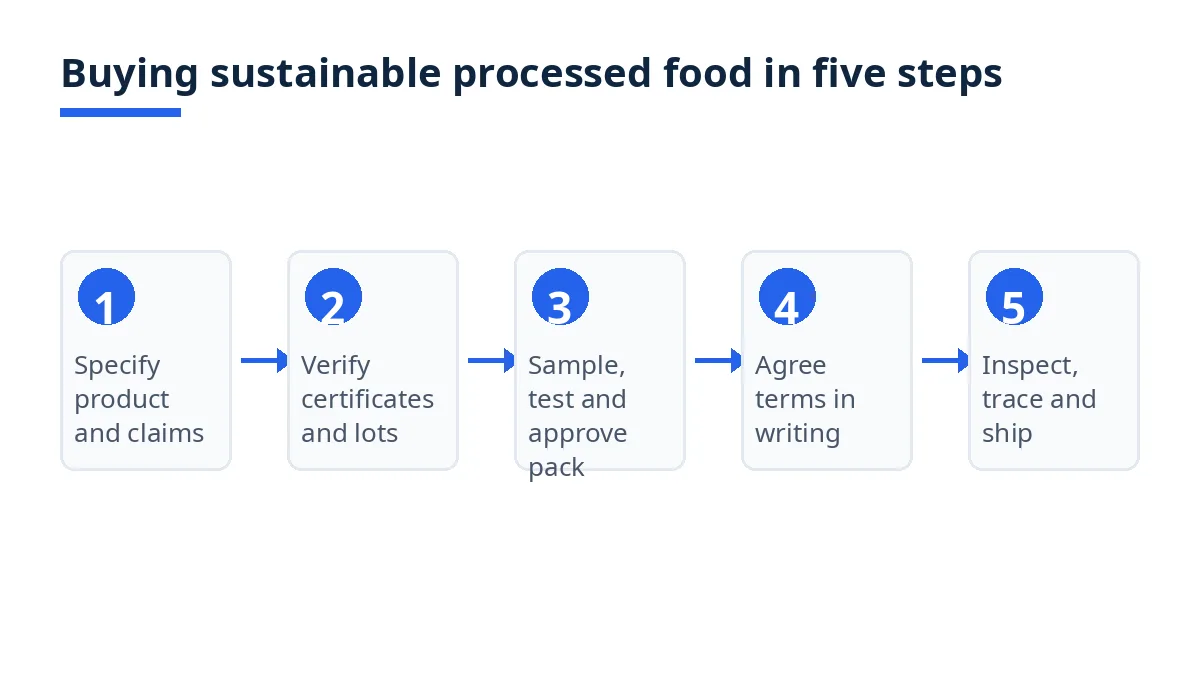
Step-by-step buying process
Define the specification and the claims. Write the product before you shop for it: HS subheading, recipe and ingredients with allergens, the exact claims and standard behind each one, pack format and material, total and minimum remaining shelf life, target quantity per SKU, and destination market.
Shortlist and verify suppliers. Build a shortlist, confirm the plant and site address, then run the certificate scope, transaction evidence and one-lot traceability checks above.4 5
Sample, test and approve the pack. Order samples against the specification, test production-representative goods, and approve a counter-sample and the destination label proof in writing.13 14
Agree commercial terms in writing. Fix MOQ per SKU and available certified volume, itemised unit price with validity period and sustainability lines shown separately, the Incoterm with named place, staged lead time, minimum remaining shelf life at delivery, payment terms and laboratory release point, all in the purchase order.15
Produce, inspect and ship. Monitor the raw material lot and segregated run first, inspect and test finished goods against the counter-sample and batch specification, run the traceability file for the shipped lots, then ship with the origin evidence your duty position depends on.10 16
Related guides
Read how to import from Bangladesh for the general import sequence, Bangladesh export data for category scale, and the Incoterms for shipments from Bangladesh guide for delivery terms. The sustainable frozen seafood from Bangladesh pillar applies the same evidence approach to the neighbouring category. The companion processed food industry in Bangladesh pillar covers the industry's capacity, clusters and export data in full.
FAQs
Is Bangladesh a good place to source agro & processed food?
Bangladesh is a credible sourcing option for biscuits, snacks, spices, juices and pickles where the claim, recipe, label and evidence file are managed actively. BIDA puts agro-exports at USD 1.03 billion in FY2024, including USD 341.73 million from processed food, across more than 700 products and 140 destination countries.1 No official series separates claim-bearing production from the rest, so the sustainable supply base is the set of plants whose certificates, lots and records you have checked, not a national total.1
What is the typical MOQ?
There is no published typical MOQ for processed food from Bangladesh, and no official body sets one. Each factory quotes its MOQ from its production stage: a line run minimum per recipe, a batch minimum per flavour, or a printing minimum per pack design. A claim-bearing order adds the size of the certified lot and segregated-run cost, so ask for the certified volume alongside the MOQ.
How long is the lead time?
There is no standard lead time: yours is the sum of certified raw material purchase, ingredient and packaging procurement, the segregated production slot, laboratory release, inspection, booking and transit. The certified lot, not just the crop, must be available. Ask for the stages separately, agree in writing what starts the clock, and check the total against the minimum remaining shelf life you require on arrival, because expired stock is food waste: globally, 13.4 percent of food is lost after harvest and before retail.2
Which certifications matter?
The certifications that matter are the ones your destination law, channel and pack claims require for the exact product; none is a general badge. The legal floor is destination food law: EU traceability under Article 18 of Regulation (EC) No 178/2002,10 and, for the United States, your importer's FSVP verification of the plant.11 On top of that floor, buyers most often name a plant scheme, FSSC 22000, built on ISO 22000 with ISO 22002 prerequisite programs and additional requirements including food loss and waste under Version 6,7 8 or BRCGS Food Safety Issue 9 for retailer supply.9 A farm claim needs GLOBALG.A.P. IFA at the producer, against 100 percent of Major Musts and at least 95 percent of Minor Musts.4 An EU organic claim needs the Regulation (EU) 2018/848 control chain and certificate.12
Next steps on Exportain
Browse Bangladeshi suppliers by processed food product, use Exportain trade intelligence for the market picture, and post a free RFQ at Exportain RFQs with your specification, the claims you need evidenced, target quantity and destination market so suppliers quote against the same brief.
Sources
- Bangladesh's Agro-Processing Revolution. Bangladesh Investment Development Authority (accessed )
- Reducing food loss and waste to protect forests and transform agrifood systems. Food and Agriculture Organization of the United Nations, (accessed )
- Harmonized System. World Customs Organization (accessed )
- Integrated Farm Assurance for combinable crops. GLOBALG.A.P. (accessed )
- Supplier verification: Earn trust badges buyers can see. Exportain (accessed )
- General principles of food hygiene, Codex Alimentarius Code of Practice No. CXC 1-1969 (2023 edition). FAO and WHO, Codex Alimentarius Commission (accessed )
- FSSC 22000 Food Safety Certification Scheme. Foundation FSSC (accessed )
- FSSC 22000 V6 Additional Requirements. Foundation FSSC (accessed )
- BRCGS Food Safety Global Standard. BRCGS (accessed )
- Regulation (EC) No 178/2002, Article 18 Traceability. European Union (accessed )
- FSMA Final Rule on Foreign Supplier Verification Programs (FSVP) for Importers of Food for Humans and Animals. U.S. Food and Drug Administration (accessed )
- Regulation (EU) 2018/848, Article 45 Import of organic and in-conversion products. European Union (accessed )
- The EU Packaging and Packaging Waste Regulation: when will it come into effect and what does it cover?. European Commission (accessed )
- Directive (EU) 2024/825 – Empowering Consumers for the Green Transition. Department of Enterprise, Trade and Employment, Ireland (accessed )
- Incoterms® rules. International Chamber of Commerce (ICC) (accessed )
- EU trade relations with Bangladesh. European Commission, (accessed )
About the author
Sourcing from Bangladesh?
Post a request for quotation and suppliers on Exportain can send you their quotes directly.
Post an RFQ