The Agro & Processed Food Industry in Bangladesh: Capacity, Clusters and Key Players
Dry food was the largest processed line at USD 186.60 million in FY2024-25 inside the EPB agriculture basket of USD 988.62 million. This pillar guide covers products, clusters, supplier checks, MOQ, food safety, Incoterms and duties.
Short answer
The processed food industry in Bangladesh makes biscuits and dry foods, snacks, spices, pickles, juices and packaged foods for export. The EPB agriculture basket that contains the processed lines earned USD 988.62 million in FY2024-25, with dry food the largest processed line at USD 186.60 million. Buyers source it by specifying recipe, pack and shelf life, verifying the factory's food safety file, and agreeing MOQ, price, Incoterm and lead time per order.
On this page
Key takeaways
The EPB does not publish a processed food total: its Agriculture Products (Chapter 04-24) basket earned USD 988.62 million in FY2024-25, up 2.52 percent, and includes tobacco at USD 251.93 million alongside the food lines.
Dry food under Chapter 19, covering biscuits, bread, pastry and pasta type products, was the largest processed line at USD 186.60 million in FY2024-25, down 14.06 percent on the year.
BAPA counted 479 member companies exporting processed food to more than 145 countries in February 2025, while industry analysis puts the sector at more than 200 firms worth an estimated USD 2.5 billion, most of it serving the domestic market.
Packaged food manufacturers must register with the BFSA under the 2026 regulations, and products on the BSTI mandatory list, 239 products at the last additions, need a certification mark licence; neither replaces destination market food law.
There is no industry-wide MOQ, price or lead time for processed food; all three are quoted per factory against a written specification that states recipe, pack format and minimum remaining shelf life on arrival.
The processed food industry in Bangladesh turns farm output into packaged, shelf-stable and ready-to-cook foods for export: biscuits and dry foods, snacks, spices, pickles, juices, drinks and sauces. This pillar guide is for importers, distributors, retailers and sourcing agents in the United States, the United Kingdom, the European Union and the United Arab Emirates weighing Bangladesh as a processed food origin. It covers the latest export data, products and clusters, supplier checks, MOQ, pricing and lead times, food safety and compliance, shipping, Incoterms and duties, and a step-by-step buying process.
Market overview with latest data
Start with a data warning, because the headline series is easy to misread. The Export Promotion Bureau (EPB) does not publish a single total for processed food alone. In Bangladesh Export Statistics 2024-2025, the closest series is "Agriculture Products (Chapter 04-24)", a basket spanning primary goods and manufactured lines, which also includes tobacco. On that EPB fiscal-year series, the basket earned USD 1,028.14 million in FY2020-21, USD 1,162.25 million in FY2021-22, USD 827.10 million in FY2022-23, USD 964.34 million in FY2023-24 and USD 988.62 million in FY2024-25.1 The FY2024-25 result was 2.52 percent growth on the year, and it fell short of the EPB target of USD 1,116.00 million for agricultural products by 11.41 percent.1 2
The mix inside that total decides what a buyer is looking at. Tobacco, at USD 251.93 million, was the largest single line and is not a food line at all.1 The largest food processing line was dry food, the Chapter 19 group covering biscuits, bread, pastry and pasta type products, at USD 186.60 million, down from USD 217.14 million in FY2023-24, a fall of 14.06 percent.1 Animal or vegetable fats and oils under Chapter 15 earned USD 118.04 million, vegetables USD 81.12 million, fruits USD 67.51 million, spices USD 56.31 million, beverages, spirits and vinegar under Chapter 22 USD 35.47 million, and sugar and sugar confectionery under Chapter 17 USD 20.82 million.1 The processed share of the basket is the manufactured lines, not the USD 988.62 million total.
The demand picture has two layers. Bangladeshi companies export processed food items to more than 140 countries, including the United States, the United Kingdom, Saudi Arabia and the UAE.3 Reporting on the sector notes that the primary consumers of these exports are Bangladeshi migrants living abroad, whose demand for familiar tastes carries much of the trade, and that penetration of mainstream retail in destination markets is still limited.3
Two pressures showed up in FY2024-25 and belong in any sourcing plan. The first is route risk to India, a major nearby market: goods worth USD 145 million went to India in FY2024-25, down from USD 192 million in FY2023-24, after India restricted entry of goods including processed foods through land ports other than Bhomra, and dry food exports fell by more than 14 percent while sugar and confectionery dropped 17 percent.4 The second is cost: exporters cited cuts in cash incentives, high import costs for ingredients used in processing foods, and limited air cargo space with higher freight charges.2 Industry analysis puts the domestic industry at more than 200 food processing firms and an estimated value of USD 2.5 billion, which is why domestic demand, not exports, absorbs most factory output.3
Main products and production clusters
Processed foods sit in Section IV of the Harmonized System, prepared foodstuffs, and the chapter follows the product, not the brand. Chapter 20 covers preparations of vegetables, fruit, nuts or other parts of plants, and its notes draw lines a buyer will meet in practice: headings 20.07 and 20.08 do not apply to fruit jellies or sugar-coated almonds sold as sugar confectionery under heading 17.04 or chocolate confectionery under heading 18.06.5 The chapters you will use most often are:
HS chapter | What it covers | Typical Bangladesh products |
|---|---|---|
17 | Sugars and sugar confectionery | Sugar confectionery and toffees |
19 | Preparations of cereals, flour, starch or milk; pastrycooks' products | Biscuits, bread and pastry lines, noodles and pasta; the EPB dry food line sits here 1 |
20 | Preparations of vegetables, fruit, nuts or other parts of plants | Fruit juices under heading 20.09, jams and marmalades under 20.07, pickles and prepared vegetables 5 |
21 | Miscellaneous edible preparations | Sauces under heading 21.03, soups and broths under 21.04, and mixed snack foods classified by composition |
22 | Beverages, spirits and vinegar | Non-alcoholic drinks and fruit-based beverages |
Agree the six-digit subheading with your supplier and broker for each stock-keeping unit (SKU) before you place the order, because the heading decides which duty line, food rules and label rules customs applies at destination.
The product offer follows the chapters. The volume lines are biscuits and dry foods under Chapter 19, the single largest processed line in the EPB breakdown.1 Snacks, including potato chips and flakes, chanachur and roasted nuts, serve diaspora retail and food service. Fruit processing covers juices and drinks, jams, pickles and chutneys, built on seasonal fruit such as mango, pineapple and jackfruit, which industry analysis names as suitable for juices, dried fruit and other value-added products.3 Match the supplier type to the product stage: a biscuit plant with high-speed packing lines is the right source for a private-label biscuit programme, and the wrong source for a small-batch pickle contract. Production sits in two layers, a growing belt and a factory belt. Fruit, vegetables and spices move from farming districts into processing plants that cluster where power, packaging suppliers, labour and port access meet. Industrial Police counts during the July 2021 lockdown, when only essential production kept running, placed operating food processing and other essential factories across Ashulia on the outskirts of Dhaka, Gazipur, Narayanganj, Mymensingh, Chattogram and Khulna.6 The count is dated and partial, but the geography it records is the standing factory belt around Dhaka, with Chattogram serving the main seaport. Confirm the plant address in the verification step, because Dhaka head offices and factories are often different places.
Key players fall into three groups. The first is the Bangladesh Agro-Processors' Association (BAPA) itself, the sector association formed in 1998, whose 479 member companies export processed food to more than 145 countries.7 The second is the processing sector itself, more than 200 firms on the industry estimate above, from large diversified groups to the small and medium plants that dominate the count and sell mainly to the domestic market.3 Export reporting names the pattern: PRAN-RFL Group is described in Daily Star reporting as one of Bangladesh's exporters of agro-processed goods routing consignments to India, and Square Food & Beverage as an exporter focused on the United States and Europe that largely avoided the India route disruption.4
How to find and verify suppliers
Find suppliers through more than one channel so you can cross-check what a factory tells you. Start with the BAPA membership named above, add Bangladesh export data and Exportain trade intelligence for market context, then work Bangladeshi suppliers listings by product family.
Verification for food is a document exercise with a laboratory attached. Ask for, and read, the following before you discuss price in detail:
Trade licence and export registration in the company's own name, plus the factory address your inspection will use.
BFSA status: manufacturers of packaged food must register with the BFSA under the Safe Food (Registration and Licensing) Regulations, 2026, and specialised categories, including fortified, functional and multi-stage processed foods and food additives, sit in the licensing net.8
BSTI certification mark licence where your product is on the BSTI mandatory list; the list stood at 239 products after additions that included food items such as green tea, soy sauce, chutneys, decorated cakes, malt based food and cheeses.9
The food safety file: the HACCP plan or equivalent hygiene system for the exact line, recent laboratory reports for your product family, and allergen controls where your recipe contains allergens.5. Export history: anonymised shipment summaries for your target market, showing product, chapter and recency.
Plant profile evidence: production lines and daily capacity per product, packing formats, cold storage where the product needs it, and whether pack printing is in-house or bought in.
On Exportain, read badges for what they are. Supplier profiles carry document and photo review badges: the badge records that documents and photos were reviewed by Exportain staff, verification is free, and membership never grants a badge.10 A badge is not a factory inspection, a food safety certification or a guarantee. Exportain is a B2B marketplace and is not a party to the contract for goods between buyer and seller; it does not inspect goods, book freight or clear customs.10
Two red flags end a conversation early: a factory that quotes a firm export price before it has seen your recipe, pack format and destination market is not pricing your product, and a supplier that cannot produce its BFSA registration position and, where it applies, its BSTI licence has not answered the first compliance question.8 9
MOQ, pricing and lead times
There is no industry-wide MOQ, standard price or standard lead time for processed food from Bangladesh, and no official body publishes one. All three are quoted per factory, per product and per order, against a written specification. Food adds one variable other categories do not have: shelf life. Every quote should be read against the shelf life remaining when the goods reach your warehouse.
MOQ. The minimum order quantity is set by the production run, not by your carton count. A biscuit or noodle order carries the line's minimum run per recipe and the printing minimum for your film, foil or carton design; a juice order carries the batch minimum per flavour and the bottle, cap and label minimums; a private-label order carries all of those plus your artwork costs. State your target quantity per SKU, per variant and per pack size in your enquiry, and ask the factory to quote its MOQ on the same basis, so two factories answer the same question.
Pricing. The EPB mix shows why a single processed food price does not exist: in the same fiscal year, dry food earned USD 186.60 million and beverages USD 35.47 million, at very different values per tonne and per case.1 Your unit price is built from raw materials, which for fruit lines are seasonal and bought in a short harvest window, imported ingredients and packaging where they apply, and exporters name high import costs for ingredients used in processing foods as a direct cost pressure.2 Processing, packing, laboratory testing and export costs to the agreed Incoterm point complete the build. Compare quotes only at the same Incoterm, recipe and pack specification, and ask each factory to state the raw material basis and price-validity period in writing.
Example figures. For illustration only: a specification for 40,000 retail packs of mango juice drink in the buyer's own label is quoted by two suppliers at the same Incoterm, FOB Chattogram. Supplier A quotes USD 0.42 per pack itemised as product and filling USD 0.27, printed pack and carton USD 0.09 and testing, packing and export costs USD 0.06. Supplier B quotes USD 0.38 per pack with no itemisation. The totals are USD 16,800 from Supplier A and USD 15,200 from Supplier B. The example shows the method, not a market price: the buyer asks Supplier B for the same itemisation, and for the fruit content and shelf life behind the quote, before treating the USD 1,600 gap as a saving.
Lead times. A lead time is a chain, not a single number: raw material purchase, which for mango, pineapple and jackfruit lines is tied to the harvest season, ingredient and packaging procurement, the production slot, laboratory release, inspection and booking, then transit. Ask for the stages separately and agree what starts the clock, normally written order confirmation plus approved label artwork and sample, not the first enquiry. Then do the shelf-life arithmetic in writing: production date plus transit plus your required remaining shelf life on arrival must fit inside the product's total shelf life.
Quality, certifications and compliance
Quality in processed food is decided by three layers: the Bangladesh-side duties on the factory, the destination market's food law, and your own specification and testing. No single certificate covers all three layers, and no certificate is required for every product in every market.
Bangladesh-side duties: BFSA and BSTI. The Safe Food Act, 2013 is the base law, and the Safe Food (Registration and Licensing) Regulations, 2026, published in the official gazette on 16 July 2026, make registration and licensing mandatory for specified categories, with applications called for from 1 November 2026.8 Manufacturers of packaged food must register with the Bangladesh Food Safety Authority (BFSA), four categories of business dealing with specialised products must hold business, premises and product licences, registration and licences are valid for three years, and every package must carry the BFSA registration number.8 Separately, the Bangladesh Standards and Testing Institution (BSTI) runs a mandatory certification marks scheme, and its list stood at 239 products after additions that included food items named above.9 Neither duty is an export certificate. Both are evidence that the factory and the product are legal and identified at home, which is the first page of your supplier file.
The reference framework: Codex and HACCP. The Codex Alimentarius General Principles of Food Hygiene, code of practice CXC 1-1969 in its 2023 FAO and WHO edition, set out the principles food business operators should follow at all stages of the food chain, and the edition adds an annex with tools for determining critical control points in a HACCP system.11 Codex texts are international reference standards established to protect consumer health and ensure fair practices in the food trade.11 In practice: ask the factory which hygiene and HACCP system it runs, for which lines, audited by whom and when. Management system and retail scheme certificates, such as ISO 22000 or a retailer-named scheme, are buyer or market requirements that sit on top of the legal file. Ask for them when your channel requires them, by name, and read the certificate's scope and site address against your factory and product.
European Union. Regulation (EU) No 1169/2011 on the provision of food information to consumers, in application since 13 December 2014, governs the label your EU customer will read: it provides clearer and harmonised presentation of allergens such as soy, nuts, gluten and lactose for prepacked foods, with emphasis in the list of ingredients, mandatory allergen information for non-prepacked foods, nutrition information for the majority of prepacked processed foods since 13 December 2016, and the same labelling requirements for online selling as for buying in a shop.12 Agree the EU label, in the language of the member state of sale, at sampling stage, and check your SKU against the product-specific EU rules for its category as well.
United States. FDA regulations require food facilities to register with the FDA and require the FDA to be given advance notice on shipments of imported food; the registration rules took effect on 12 December 2003 under the Bioterrorism Act.13 The Food Safety Modernization Act amended section 415 of the Federal Food, Drug, and Cosmetic Act to require facilities manufacturing, processing, packing or holding food for consumption in the United States to renew registrations every other year, and FDA systems include a Foreign Supplier Verification Program importer portal, under which the United States importer verifies its foreign suppliers.13 The practical file is therefore: an active FDA facility registration for the plant making your product, label artwork that meets United States rules, and shipment data supplied in time for the importer's advance notice filing.
Your own quality system. Write the specification so a laboratory and an inspector can measure it: recipe and ingredient list with allergens, fruit or active content where it defines the product, net weight, packaging materials and pack format, batch coding and date marking, shelf life and storage conditions, and the limits your destination law sets for the category. Approve a pre-production sample and the final label proof in writing, and test production-representative goods from the actual run. A showroom sample proves the recipe; only a batch test proves the shipment.
Shipping, Incoterms and duties
Processed food from Bangladesh normally leaves by sea from Chattogram, the country's main seaport, in dry containers for shelf-stable goods and in reefer containers for frozen lines. Air freight serves small, high-value or urgent consignments, and exporters cite limited air space and higher freight charges as a live constraint.2 Packing drives the freight economics: biscuits and snacks are bulky relative to weight, juices are heavy relative to value, and both facts belong in the specification, as cartons per container and gross weight per carton. For frozen lines, agree the temperature set point and the evidence, a data logger in the container, in the purchase order.
Incoterms® 2020 is the current edition of the ICC rules, in force since 1 January 2020. The rules are eleven three-letter trade terms that clarify the tasks, costs and risks involved in the delivery of goods from sellers to buyers, and they are recognised as the global standard for interpreting the most common terms in foreign trade.14 In your own words, the four rules you will meet most often work as follows:
Rule | Who arranges and pays main freight | Where risk passes to the buyer | Practical note for processed food |
|---|---|---|---|
EXW (Ex Works) | Buyer | At the seller's premises | Buyer carries export clearance workload; rarely suitable for a first order |
FOB (Free On Board) | Buyer | When goods are on board the vessel at the named loading port | The common Bangladesh term; name the port, for example FOB Chattogram, Incoterms® 2020 |
CIF (Cost, Insurance and Freight) | Seller, plus minimum insurance | When goods are on board at the loading port | Seller's freight is convenient, but risk still passes at loading, not at arrival |
DAP (Delivered at Place) | Seller | At the named destination place, ready for unloading | Buyer still clears import and pays duty unless the contract says otherwise |
Always write the rule with its named place and edition, for example "FOB Chattogram, Incoterms® 2020". Exportain does not book freight or clear customs, so the freight forwarder and customs broker are separate appointments to name in the order paperwork.10
Duties are decided by the chapter from the products table, the origin of the goods and the destination's preference scheme, in that order. As a least developed country, Bangladesh benefits from the Everything But Arms (EBA) arrangement under the EU's Generalised Scheme of Preferences, which grants duty-free, quota-free access to the EU for exports of all products except arms and ammunition, and 91 percent of Bangladesh's exports to the EU enter duty- and quota-free.15 Bangladesh is the largest beneficiary under the EBA arrangements, with EUR 19 billion in exports benefitting from these preferences in 2024 at a 96 percent utilisation rate.15 Processed food that meets the EBA rules of origin and ships with the required proof of origin therefore enters the EU without customs duty while Bangladesh holds that status. Two cautions apply. First, preference is a property of the consignment, not the country: if the origin evidence fails, the standard third-country duty applies, and EBA status does not waive EU food law. Second, route rules can cost more than duty: India's land port restrictions moved Bangladesh-India processed food trade onto a single port in 2025 and cut the flow, a reminder to price the route, not only the tariff.4 For the United States, the United Kingdom and the UAE, read the duty beside your confirmed six-digit code in the destination tariff for the entry date; this guide states no rate for them, because food rates vary by heading.
The buying process below pulls these threads together.
Step-by-step buying process
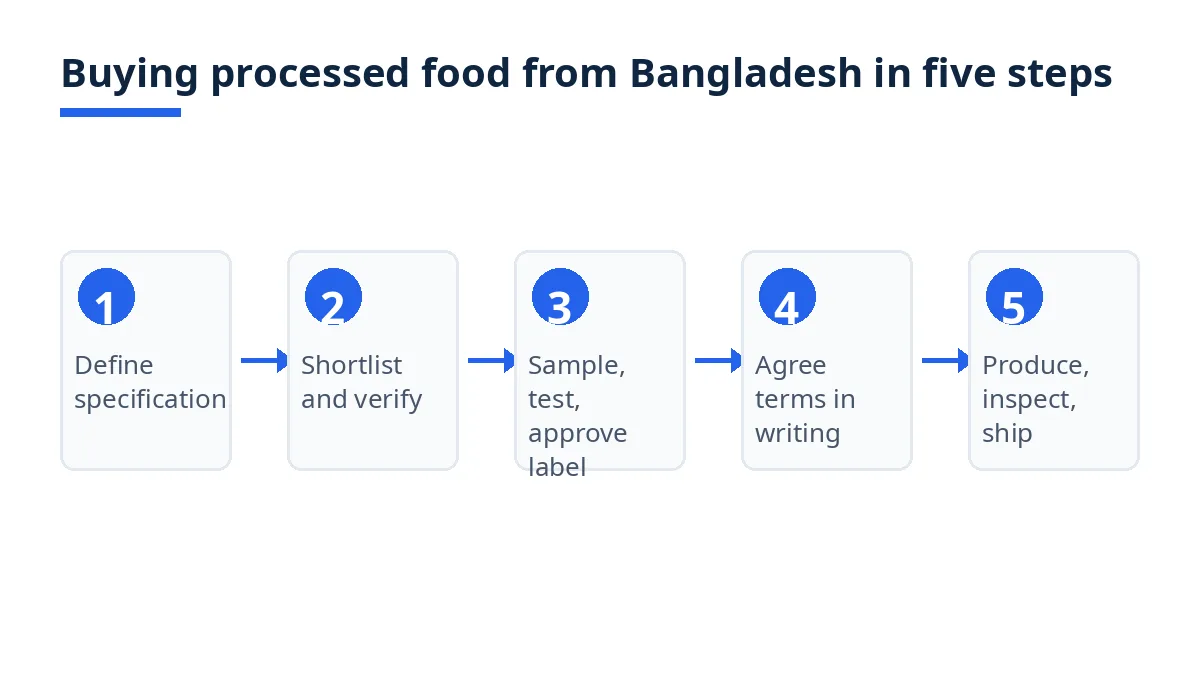
Define the specification. Write the product before you shop for it: HS chapter and subheading, recipe and ingredients with allergens, pack format and label markets, total shelf life and minimum remaining shelf life on arrival, target quantity per SKU, and destination market.
Shortlist and verify suppliers. Build a shortlist from BAPA and supplier listings, confirm the factory and its address, then run the BFSA, BSTI and food safety file checks in the verification section.7 8 9
Sample, test and approve the label. Order samples against the specification, test production-representative goods, and approve a counter-sample and the destination-market label proof in writing, including allergen and nutrition panels where they apply.12 13
Agree commercial terms in writing. Fix MOQ per SKU, itemised unit price with its validity period, the Incoterm with its named place, the staged lead time and its start point, the minimum remaining shelf life at delivery, payment terms and the laboratory release point, in the purchase order.14
Produce, inspect and ship. Monitor the raw material and production stages first, inspect and test finished goods against the approved counter-sample, then ship with the origin evidence your duty position depends on.15
Related guides
Read how to import from Bangladesh for the general import sequence behind the food steps above, the frozen seafood industry in Bangladesh pillar for the neighbouring food category, and Bangladesh export data for category scale. The guide to Incoterms for shipments from Bangladesh covers the delivery terms in more detail.
FAQs
Is Bangladesh a good place to source agro & processed food?
Bangladesh is a credible sourcing option for biscuits and dry foods, snacks, juices, pickles and spices where the recipe, label and food safety file are managed actively. The EPB agriculture basket, which includes the processed lines, earned USD 988.62 million in FY2024-25, dry food was the largest processed line at USD 186.60 million, and BAPA counts 479 member companies exporting to more than 145 countries.1 7 The constraints to price in are the fall in dry food earnings that year, the India route disruption, and a sector in which most capacity serves the domestic market.1 4 3 Source factory by factory, not on the country label.
What is the typical MOQ?
There is no published typical MOQ for processed food from Bangladesh, and no official body sets one. Each factory quotes its MOQ from its production stage: a line run minimum per recipe, a batch minimum per flavour, or a printing minimum per pack design. State your target quantity per SKU, variant and pack size in your enquiry, so quotes can be compared directly.
How long is the lead time?
There is no standard lead time: yours is the sum of its stages, raw material purchase, ingredient and packaging procurement, the production slot, laboratory release, inspection and booking, and transit. The first stage is seasonal for fruit lines, because mango, pineapple and jackfruit are bought in a harvest window.3 Ask for the stages separately and agree in writing what starts the clock.
Which certifications matter?
The requirements that matter are the ones your destination market and your buyers require for the exact product. On the Bangladesh side, a packaged food manufacturer must be registered with the BFSA under the 2026 regulations, specialised categories require licences, and a product on the BSTI mandatory list needs its certification mark licence.8 9 The hygiene reference framework is Codex CXC 1-1969 with its HACCP annex.11 For the EU, food information and allergen labelling under Regulation (EU) No 1169/2011 is a legal requirement for prepacked foods.12 For the United States, the factory must hold an active FDA facility registration, renewed every other year, and the importer files advance notice and runs supplier verification.13 Buyer-named scheme certificates sit on top of that legal file and do not replace it.
Next steps on Exportain
Browse Bangladeshi suppliers by processed food product, use Exportain trade intelligence to check the market picture, and post a free RFQ at Exportain RFQs with your specification, target quantity, destination market and required shelf life so suppliers quote against the same written brief.
Sources
- Bangladesh Export Statistics 2024-2025. Export Promotion Bureau (EPB) (accessed )
- Exports fetch $48.28b in FY25. The Financial Express (accessed )
- Agro-processing calls for strategic push. The Financial Express (accessed )
- Processed food exports slow further. The Daily Star, (accessed )
- Harmonized System: Chapter 20 notes (2022 edition). World Customs Organization (accessed )
- 338 factories running operations across country during lockdown. The Daily Star, (accessed )
- BAPA Foodpro Expo kicks off tomorrow. The Financial Express (accessed )
- Registration, licence mandatory for food businesses from 1 November. The Business Standard, (accessed )
- BSTI includes 37 more products under mandatory quality certificate. Samakal (accessed )
- Supplier verification: Earn trust badges buyers can see. Exportain (accessed )
- General principles of food hygiene, Codex Alimentarius Code of Practice No. CXC 1-1969 (2023 edition). FAO and WHO, Codex Alimentarius Commission (accessed )
- Food information to consumers - legislation. European Commission (accessed )
- Registration of Food Facilities and Other Submissions. U.S. Food and Drug Administration (accessed )
- Incoterms® rules. International Chamber of Commerce (ICC) (accessed )
- EU trade relations with Bangladesh. European Commission, (accessed )
- Incoterms
- quality control
- Bangladesh Export Data
- Category Pillars
- Supplier Sourcing
- Processed food
- Agro processing
About the author
Sourcing from Bangladesh?
Post a request for quotation and suppliers on Exportain can send you their quotes directly.
Post an RFQ