Sustainable Frozen Seafood & Fish From Bangladesh: Certifications and Green Factories
Frozen fish and shrimp exports reached USD 388.7 million on EPB data. This guide explains what ASC, MSC and BAP actually certify, and how a buyer checks scope and validity before relying on a claim.
Short answer
Sustainable frozen seafood from Bangladesh is shrimp and fish produced inside a stated certification scope: ASC or BAP for farmed product, MSC for wild-caught product, with plant approval and residue testing for the destination market. Buyers source it by fixing the exact claim first, checking the certificate holder, site, scope and expiry, approving tested samples, and agreeing MOQ, price and lead time in writing.
On this page
Key takeaways
Frozen fish and shrimp exports were USD 388.7 million on EPB data in the last reported year, with frozen shrimp at USD 296.29 million on 23,238 tonnes and frozen fish at USD 92.41 million.
ASC and BAP certify farmed seafood and MSC certifies wild-caught seafood; the three systems are not interchangeable, and none certifies a whole company by default.
The ASC Shrimp Standard includes over 100 performance indicators, prohibits antibiotic use, requires water quality monitoring and forbids any clearing of mangrove forests.
BAP certifies the farmed chain in star stages, from the processing plant alone up to the full chain of plant, farm, hatchery and feed mill, under an annual third-party audit.
A green factory claim in this sector refers to the plant and its operation; building ratings reported for garment factories do not transfer to seafood plants.
If you buy frozen shrimp or fish and your customers ask for certified aquaculture, certified wild catch or proof of residue testing, sustainable frozen seafood bangladesh is a sourcing route that needs claim-by-claim checking. Part of the supply base works inside recognised certification systems and export approval regimes. This guide explains what those systems certify, what they do not certify, and how you check a claim before it reaches your packaging.
This article is the sustainability companion to the wider frozen seafood industry in Bangladesh pillar. The focus here stays narrow: farm and fishery certification, plant standards, food safety controls, green factory claims and claim wording.
Market overview with latest data
Export Promotion Bureau (EPB) data put exports of frozen fish and shrimp at USD 388.7 million in the last fiscal year reported, up 19.33 percent from USD 325.73 million a year earlier, after two years of decline.1 Frozen shrimp remained the main earner at USD 296.29 million on 23,238 tonnes, while frozen fish exports rose 19.38 percent in value to USD 92.41 million on 7,951 tonnes.1 The average export price for frozen shrimp eased from USD 12.98 to USD 12.75 per kilogram.1
China led shrimp markets in that year at USD 56.69 million, followed by the Netherlands at USD 47.39 million and the United Kingdom at USD 44.96 million, and European markets account for more than half of frozen shrimp earnings.1 For frozen fish, India led at USD 62.54 million, followed by China and the United Kingdom.1 The same report records that stricter EU rules on antibiotic residues and sustainability certification are raising compliance costs for exporters.1
Capacity is not the constraint. According to the Bangladesh Frozen Foods Exporters Association (BFFEA), Bangladesh has 110 fisheries processing facilities, but only 30 to 40 remain active and just 10 operate at full capacity.1 A certified programme is therefore a subset of an active plant output, not a separate industry. This guide treats every claim at programme level: species, site, scope and expiry date, never at company level by default.
Market access moves on evidence. On-board block frozen shrimp, processed and frozen directly on fishing vessels, had not been approved for export to the EU until certification was granted in 2025, when the EU certified five vessels following a December 2023 inspection mission on European hygiene and processing regulations.2 The first consignment under that approval went to Belgium in October 2025.2
Main products and production clusters
The sustainable offer follows the same product families as the conventional offer, because certification attaches to a farm, a fishery and a site rather than to a product name.
Black tiger shrimp (bagda). The Department of Fisheries records brackish water aquaculture of tiger shrimp, Penaeus monodon, across Satkhira, Khulna, Cox's Bazar and Bagerhat districts.3 This is the farmed shrimp on which certification questions concentrate: pond siting, water quality, feed and disease management.
Freshwater prawn (galda). The giant freshwater prawn, Macrobrachium rosenbergii, is also cultured in the brackish water belt and is largely cultured in the southwest region.3 Prawn programmes sit inside the same farm standards where the scheme scope covers the species, so check the species line on the certificate rather than assuming cover.
Sea-caught shrimp and fish. Wild products move through a different claim route, because a fishery certificate and a farm certificate answer different questions. Bangladesh exports IQF, semi-IQF, peeled undeveined (PUD), peeled and deveined (P&D) and semi-cooked shrimp to Europe, while block frozen shrimp went mainly to Japan and China before the 2025 EU approvals.2
Frozen fish and other products. The Department of Fisheries lists the major export items as raw shrimp block frozen, IQF shrimp and white fish, PUD and P&D shrimp block frozen, consumer packs of raw frozen shrimp, chilled and frozen hilsa, dry, salted and dehydrated fish, live fish, eel fish and crab, plus a small quantity of value added products.3 Treat any sustainability wording for wild fish as a fishery question, not a farming question.
Production geography splits in two. Farming concentrates in the southwest coastal belt around Khulna, Satkhira and Bagerhat, with brackish water culture also in Cox's Bazar.3 Export inspection concentrates where the Fish Inspection and Quality Control (FIQC) stations sit: the department runs three inspection and quality control stations at Khulna, Chattogram and Dhaka, each with testing laboratories, and acts as the competent authority for export quality.3
How to find and verify suppliers
Start from the claim you need to make, then work backwards to the supply chain that can support it. A farmed-shrimp claim needs a certified farm inside a certified chain. A wild-caught claim needs a certified fishery and a certified chain of custody after landing. A food safety claim needs plant approval and test evidence for your market. If you need none of these, do not pay for certification language that adds cost without adding evidence.
Build the shortlist from association lists, trade data, referrals and supplier platforms, including finding suppliers in Bangladesh. Then run the same checks on every name:
Identity and site. Match the legal name and plant address across the trade licence, the association listing and the certificate the supplier sends you. A certificate naming a different entity or site does not cover your order.
Scope. Read what the certificate covers: standard, species, product forms, processes and sites. Scope is the most commonly skipped check, and the one that decides whether a claim is accurate.
Validity. Check the expiry date and, where the scheme offers a public register, confirm the certificate there before you place the order, not after production.
Chain of custody. Ask how certified material is kept separate from conventional material at intake, processing and packing, and which document will accompany your shipment. If a stage sits outside the chain, the claim stops there.
Plant approval for your market. Ask which destination approvals the plant holds and which health certificate will travel with the goods. The Department of Fisheries mandate includes enforcing quality control measures and issuing health certificates for exportable fish and fish products.3
Samples and testing. Order samples in your specification and test count size, net weight after deglazing and residue status through an accredited laboratory. Approve a sample in writing and keep a sealed counter-sample.
Independent inspection. For larger programmes, commission a pre-shipment inspection and agree sampling and defect limits in the order using the AQL acceptance quality limit method.
Warning signs include a certificate offered for a species it does not list and a label supplied as an image file instead of a numbered certificate. Either should pause the order until it is resolved in writing.
MOQ, pricing and lead times
There is no single typical minimum order quantity (MOQ), price or lead time for sustainable frozen seafood. Each is quoted per supplier, per species and per form against a written specification.
MOQ is set by the smallest workable lot at each stage: the certified farm lot or fishery landing available in the season, the processing run for one form and count size, and the container plan. Keeping certified material separate through processing and packing is easier at larger volumes, and a programme drawing on a small certified farm base carries a higher practical minimum than a conventional line from the same plant. Expect minimums per species, per form and per count size, and reduce them by simplifying forms or accepting a certified stock lot already in cold storage.
Pricing is built from raw material cost by species and season, processing and freezing, glazing and packing, testing, certification and audit costs, cold storage, inland transport and the export margin. The EPB series puts the average frozen shrimp export price at USD 12.75 per kilogram in the last reported year, a sector average across species and forms, not a quotation for any one programme.1 Compare quotations only on an identical specification that states the exact claim, standard and product form, and ask each supplier to state what its price includes and excludes, in writing.
Lead times cover raw material availability in season, processing and freezing slots, testing, inspection, packing, cold storage and transport to port, after sample approval. A certified lot that is not in stock adds a procurement stage first, and a wild programme depends on landings. Plan backwards from your in-store date and add buffer for re-testing.
For method only, consider this comparison. Example figures: two plants quote for the same certified shrimp specification, one at USD 12.60 per kilogram EXW and one at USD 12.95 per kilogram FOB. Adding inland transport and loading of USD 0.42 per kilogram to the EXW quote gives a like-for-like FOB cost of USD 13.02 per kilogram, so the plant that looked cheaper is more expensive on equal terms.
Quality, certifications and compliance
This section decides whether a sustainability claim survives contact with your customer, your regulator and your compliance team. Read each framework for what it actually certifies. None of them certifies a whole company in general terms, and none replaces your specification, sampling, testing or inspection. The three systems below are not interchangeable: ASC and BAP address farmed seafood, while MSC addresses wild-caught seafood.
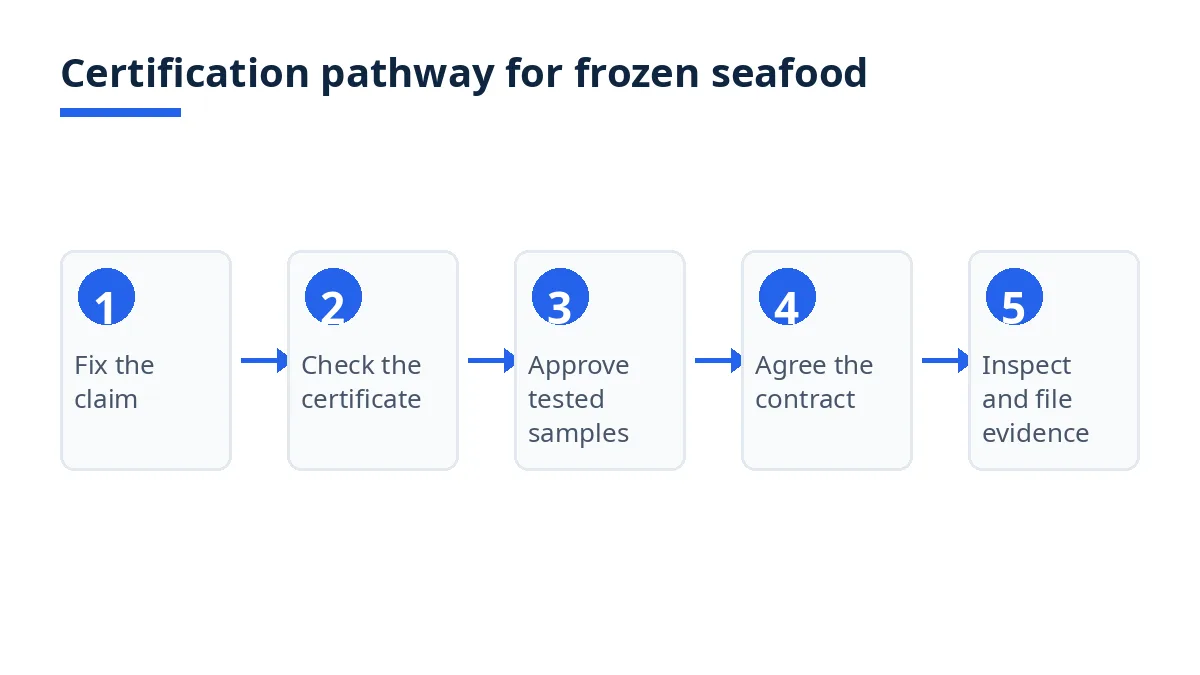
The diagram below summarises the certification pathway, from fixing the claim to filing the evidence.
What does ASC certify?
The Aquaculture Stewardship Council (ASC) certifies farmed seafood. Its Shrimp Standard includes over 100 performance indicators that farmers must meet to show that they are protecting the environment and respecting their workforce.4 Requirements include the prohibition of antibiotic use, monitoring of water quality, paying workers fair wages, providing worker training and engaging in consultation and dialogue with local communities.4 ASC certified farms must also implement health management plans to reduce disease prevalence.4
Habitat protection is a hard line in the standard. The ASC Shrimp Standard forbids any clearing of mangrove forests and in some cases will require the restoration of cleared forests.4 The standard was launched in 2014, and ASC reports over 320 shrimp farms certified around the world producing over 220,000 metric tonnes, with the majority in Vietnam, Ecuador, Indonesia and Honduras.4 Read that as global context only. It is not a count of certified farms in Bangladesh, and this guide makes no such claim, because no opened source states one. An ASC certificate supports a claim only for shrimp produced on the certified farm unit. It does not certify wild-caught product.
What does MSC certify?
The Marine Stewardship Council (MSC) certifies wild-caught seafood, not farmed seafood. The MSC maintains two standards: the Fisheries Standard for environmentally sustainable fishing, and the Chain of Custody Standard for products in the supply chain.5 The Fisheries Standard determines if a fishery is well-managed and environmentally sustainable, it is open to all fisheries that catch marine or freshwater organisms in the wild, and a successful fishery can sell its catch with the MSC blue fish label.5
Fisheries are assessed by an independent, third-party auditor, not by the MSC, and must prove they meet all three principles of the standard: sustainable fish stocks, minimal environmental impact, and effective management.6 The certification bodies measure performance using 28 indicators across those three principles.6 The Chain of Custody Standard then provides assurance that certified products are kept separate from non-certified products throughout the supply chain and can be traced back to a certified fishery.5
The practical point is the sequence. A wild shrimp or fish claim needs a certified fishery first and a certified chain after it. A plant cannot create an MSC claim by processing alone, and farmed bagda or galda cannot carry one at all. Ask for the fishery certificate and the chain of custody certificate as two separate documents.
What does BAP certify?
Best Aquaculture Practices (BAP), run by the Global Seafood Alliance (GSA), is a third-party certification programme for farmed seafood that covers the production chain in stages.7 Its four-star system represents each piece of that chain: one star for the processing plant, a second for the farm, a third for the hatchery or the feed mill, and a fourth star when the entire production chain, processing plant, farm, hatchery and feed mill, has attained BAP certification.7 Certification requires passing an annual third-party audit and correcting any non-conformities found during the audit.7
At each step, BAP standards cover four pillars: environmental responsibility, social accountability, food safety, and animal health and welfare.7 8 The environmental pillar covers water quality, proper disposal of waste and protection of marine habitats, while the food safety pillar covers sanitation, product handling and transport confirmed by product inspections.8 GSA also maintains a Seafood Processing Standard, which verifies responsible practices at land-based processing plants.9
The star count is the scope statement. A one-star programme certifies the plant only, and it supports no claim about the farm behind your shrimp. Word your claim at the level the stars prove.
How do food safety controls and market approval differ from certification?
Certification is voluntary. Food safety control and market approval are not. The Codex Alimentarius Code of Practice for Fish and Fishery Products, CAC/RCP 52-2003, sets the reference practice for production, storage and handling on board vessels and on shore, and it incorporates the Hazard Analysis Critical Control Point (HACCP) approach.10 Under that code, frozen product should be at minus 18 degrees Celsius or lower, and fresh product should not exceed 4 degrees Celsius, with temperatures of incoming lots recorded.10
In Bangladesh, the Department of Fisheries is the competent authority for export quality, with its three FIQC stations and their testing laboratories at Khulna, Chattogram and Dhaka.3 Health certificates are obtained from the FIQC office before shipment.2 The EU vessel approvals of 2025 show how destination approval works: an inspection mission assessed selected vessels against European hygiene and processing regulations, five vessels were certified and listed, and the first on-board frozen shipment to Europe followed.2
Keep the three layers in separate files. A farm or fishery certificate answers where the raw material came from. A plant standard or approval answers how it was processed and whether the plant may ship to your market. Test reports answer what was found in your lot. No one layer substitutes for another.
What is a green factory in frozen seafood processing?
In this sector, a green factory claim usually refers to the plant and its operation: energy used in freezing and cold storage, water use and effluent handling, and waste disposal. Those subjects appear inside the farm and plant standards above rather than as a standalone seafood rating. BAP environmental responsibility covers water quality, proper disposal of waste and habitat protection,8 GSA programme standards address habitat conservation, water quality and effluent,9 and waste management sits among the supplementary components the ASC Shrimp Standard met in benchmarking.4
Two cautions follow. First, building ratings reported for Bangladesh garment factories do not transfer to seafood plants, and this guide makes no claim about how many seafood plants hold a building rating, because no opened source states that number. Ask the individual plant for its own rating document and check the rated address against the plant making your order. Second, an efficient plant can still process a non-compliant lot, and a conventional plant can process a fully certified one. Keep building claims, product certificates and lot test reports in separate files.
How do you check a certificate before you rely on it?
Use the same sequence for every scheme:
Read the document, not the logo. A logo image proves nothing. Require the certificate itself, with number, holder, issuing body, standard and version, scope, site address and validity dates.
Match the holder and the site. The holder must be the legal entity you are contracting with, or a named stage in its chain, and the site must be the farm, vessel or plant in your plan.
Match the scope to your product. The species, forms and processes listed must cover your order and your intended claim, including the star level where the scheme uses one.
Check validity on the production date and the ship date. A certificate that expires mid-programme needs a renewal plan agreed in advance. BAP certification, for example, runs on an annual third-party audit.7
Confirm in the scheme register where one exists. GSA publishes a list of certified producers, and more than 4,000 producers in more than 40 countries are certified to GSA standards.9 Keep a dated record of your check.
Require the shipment document. For chain of custody claims, agree which document will accompany your goods, and print the claim only after it arrives and matches the shipment.
What quality controls sit alongside certification?
Certification does not test whether a shrimp lot meets your count size or whether the net weight survives deglazing. Specify measurable quality in the purchase order: species and scientific name, product form, count size and tolerance, glaze percentage and net weight basis, microbiological limits, residue limits for your destination, freezing method, packing format and labelling.
Then control it in stages. Approve a pre-production sample, test through an accredited laboratory against your destination limits, and always inspect before shipment against the approved sample and specification. Agree the sampling method in the order itself using AQL acceptance quality limit and pre-shipment inspection. Keep reports, retained samples and certificate copies from each shipment so the printed claim can be evidenced later.
Shipping, Incoterms and duties
Most frozen seafood exports move by sea in reefer containers, with samples and urgent small consignments by air. The cold chain is the product. Under the Codex code of practice, frozen product should be held at minus 18 degrees Celsius or lower,10 and the on-board freezing practice reported for the EU-approved vessels follows the same line: blocks are stored at minus 18 degrees Celsius in vessel cold storage and again kept at minus 18 degrees Celsius in shore-based cold storage after landing.2 Agree the temperature record, container set point and data logger placement before the price is fixed.
The Incoterms rules published by the International Chamber of Commerce are eleven three-letter trade terms used in contracts for the sale and purchase of goods, and they clarify the tasks, costs and risks involved in delivering goods from sellers to buyers.11 Incoterms 2020, the current version, entered into force on 1 January 2020.11 Under EXW you arrange almost everything from the plant gate. Under FOB the supplier delivers goods on board at the named Bangladeshi port and you control the main freight. Under CIF the supplier arranges freight and minimum insurance to your destination port, while risk passes at loading. Under DDP, duties and clearance sit with the seller, a term to use only where you have checked the seller arrangements in your market. Name the port or place precisely.
Duties must be checked, not assumed. Duty depends on the exact HS classification, your destination tariff and any preferential scheme applying to Bangladesh on the import date, and arrangements differ between the EU, the UK, the USA and the UAE. Classify the product first, then confirm the current rate and origin evidence in your destination official tariff or with your broker, before you calculate landed cost with the landed cost imports from Bangladesh method. A sustainability certificate does not change the duty rate. Origin evidence and classification do.
On the Bangladesh side, goods may not be loaded for export until a Bill of Export has been submitted and approved, supported by the export letter of credit or contract, a commercial invoice, a packing list, an EXP form certified by an authorised dealer bank, a certificate of origin, a VAT registration certificate and a taxpayer identification number.12 For frozen fish, a quality control certificate from the Department of Fisheries is also necessary where the destination country requires one.12 Check names, codes, weights and quantities across draft documents as soon as they arrive.
Step-by-step buying process
Decide the claim first. Write down the exact claim your packaging will carry, the standard behind it, and the market where it will be sold.
Fix the specification. Species and scientific name, product form, count size, glaze, net weight basis, quality limits, labelling, packing and delivery window, with tolerances as numbers.
Shortlist suppliers. Build the list from more than one route, then run the identity, site, scope and validity checks in this guide on each name.
Request comparable quotations. Send the identical specification, including the exact certification scope required, and require delivery term, currency, validity, MOQ and lead time in writing.
Sample and test. Approve physical samples, run residue and microbiological tests against your destination limits, and seal a counter-sample.
Verify certificates again at contract stage. Repeat the register check, record certificate numbers and expiry dates in the purchase order, and agree the shipment documents that will support the claim.
Agree the contract. Purchase order with full specification, inspection rights, document list, claim wording, payment terms tied to re-checked bank details, and the agreed delivery term and named place.
Control production. Confirm the certified raw material lot and the processing slot, and resolve any request to substitute species, form or source in writing before it happens, since a substitution can void the claim.
Inspect, ship and file the evidence. Inspect before shipment, confirm the cold chain record, and file the certificate copies, test reports and shipment documents with the order record.
Related guides
Read the frozen seafood industry in Bangladesh pillar for capacity and clusters in full. Use how to import from Bangladesh for the import sequence, pre-shipment inspection and AQL acceptance quality limit for inspection, and Bangladesh export data for the wider EPB picture.
FAQs
Is Bangladesh a good place to source frozen seafood & fish?
It can be, when the supplier, the specification and the claim are right. EPB data show frozen fish and shrimp exports recovering to USD 388.7 million in the last reported year, with shrimp at USD 296.29 million, across a sector where Europe takes more than half of shrimp earnings.1 Part of that supply base works inside recognised systems such as ASC, MSC and BAP, and the Department of Fisheries runs export inspection through its FIQC stations.3 Results depend on checking the individual farm, fishery and plant.
What is the typical MOQ?
There is no single typical MOQ. Minimums are set by the certified farm lot or fishery landing available in season, the processing run for one form and count size, and the container plan, quoted per species, per form and per count size. A small certified programme drawing on a limited farm base usually carries a different minimum from a conventional line from the same plant. Ask each supplier to state its MOQ against your exact specification and claim.
How long is the lead time?
Lead time is species- and programme-specific. It covers raw material availability in season, processing and freezing slots, testing, inspection, packing, cold storage and transport to port, after sample approval. A certified lot that is not in stock adds a procurement stage first. Require a written lead time and build buffer for re-testing.
Which certifications matter?
It depends on the claim you need to make. For farmed shrimp, ASC applies, with over 100 performance indicators covering antibiotic prohibition, water quality monitoring, worker conditions and mangrove protection.4 BAP applies across the farmed chain in star stages, from the plant alone up to the full chain of plant, farm, hatchery and feed mill, under its four pillars.7 8 For wild-caught product, MSC applies, through a certified fishery assessed on sustainable stocks, minimal environmental impact and effective management, plus a certified chain of custody.5 6 Alongside any of these, your lot still needs plant approval for your market, FIQC health certification where required,3 2 and testing against your destination limits.
Next steps on Exportain
Browse suppliers by product category and note the exporters whose species, forms and certification scope match your claim, then check category data in trade intelligence before you enquire. When your specification is ready, use how to import from Bangladesh to run the order.
Sources
- Frozen fish, shrimp exports rebound with 19% growth, India and China top destinations. The Business Standard, (accessed )
- Bangladesh shrimp exports set for rebound with first on-board frozen shipment to Europe. The Business Standard, (accessed )
- About Department of Fisheries: history, mandate and export of fish and fish products. Department of Fisheries, Government of Bangladesh (accessed )
- ASC Shrimp Standard Recognised by Global Sustainable Seafood Initiative. Aquaculture Stewardship Council, (accessed )
- The MSC Standards. Marine Stewardship Council (accessed )
- The MSC Fisheries Standard. Marine Stewardship Council (accessed )
- Understanding the Best Aquaculture Practices Four-Star System. Global Seafood Alliance (accessed )
- The BAP Label. Global Seafood Alliance (accessed )
- Our Certification Programs. Global Seafood Alliance (accessed )
- Code of Practice for Fish and Fishery Products, CAC/RCP 52-2003. Codex Alimentarius, FAO and WHO (accessed )
- Incoterms® rules. International Chamber of Commerce (ICC) (accessed )
- Customs Clearance Procedures for Export. Bangladesh Customs, National Board of Revenue (accessed )
- quality control
- Bangladesh Export Data
- Supplier Sourcing
- Frozen seafood Bangladesh
- Shrimp exports
- ASC certification
- BAP certification
About the author
Sourcing from Bangladesh?
Post a request for quotation and suppliers on Exportain can send you their quotes directly.
Post an RFQ