The Tea, Spices & Rice Industry in Bangladesh: Capacity, Clusters and Key Players
Tea production was 94,927 thousand kg in 2025, spice exports reached a record USD 56.31 million, and aromatic rice exports run on government allocation. This pillar guide covers products, clusters, supplier checks, MOQ, compliance, Incoterms and duties.
Short answer
The tea and spices industry in Bangladesh covers estate tea, processed spices and aromatic rice. Tea production was 94,927 thousand kg in 2025 with a small export surplus, spice exports reached a record USD 56.31 million, and aromatic rice exports run only under government allocation. Buyers specify form and grade, verify licences and allocations, and agree MOQ, price, Incoterm and lead time per order.
On this page
Key takeaways
Tea production was 94,927 thousand kg in calendar 2025 on Bangladesh Tea Board figures, while cumulative tea exports were 1,323 thousand kg in the year to June 2025-26, because domestic demand consumes 90 to 95 million kg a year.
Spice exports reached a record USD 56.31 million on EPB figures, up from USD 9.24 million in FY2010-11; the BBS Chapter 9 total of Tk 8,122,769,504 for FY2024-25 is a coffee, tea, mate and spices basket, not a single-product figure.
Aromatic rice production rose to 10.23 lakh tonnes in FY2023-24, but exports run only under named Ministry of Commerce allocations, halved in September 2026, with a minimum FOB price of USD 1.60 per kg.
There is no industry-wide MOQ, price or lead time for tea, spices or aromatic rice; all three are quoted per company and per product against a written specification, with sterilisation and quota windows as dated constraints.
The tea, spices and rice industry in Bangladesh joins three different trades under one category heading: an estate-grown tea sector whose output is mostly drunk at home, a spice sector built on grinding, blending and packing for diaspora and Gulf demand, and a rice sector where only aromatic rice moves into export, and then only under government permission. This pillar guide is for importers, food brands, wholesalers and sourcing agents in the United States, the United Kingdom, the European Union and the United Arab Emirates weighing Bangladesh as an origin for tea, spices or aromatic rice. It covers production and export data, products and clusters, supplier checks, MOQ, pricing and lead times, compliance, shipping, Incoterms and duties, and a step-by-step buying process. Detailed sourcing method follows in the companion guides; this article maps the industry itself.
Market overview with latest data
Read the three product groups separately, because they share a category label but not a market logic. Tea is a large domestic industry with a small export surplus. Spices are a small but fast-growing export line driven by processed and branded packs. Rice is a food-security crop first: total rice output is large, exports are confined to aromatic rice, and the export tap is opened, narrowed or closed by the Ministry of Commerce according to domestic supply and prices. A buyer who averages the three together will misread all three.
Tea: production near 95 million kg, exports near 1 to 2 million kg. The Bangladesh Tea Board monthly statistical bulletin records calendar-year production of 93,042 thousand kg in 2024 and 94,927 thousand kg in 2025, against a 2025 production target of 103,000 thousand kg.1 The same bulletin records cumulative tea exports of 1,323 thousand kg with an FOB value of Tk 355,441 thousand for the year to June 2025-26, and 1,984 thousand kg with an FOB value of Tk 433,518 thousand for the year to June 2024-25.1 A calendar-year reading tells the same story at a slightly different cut: Bangladesh exported 2.45 million kg of tea in calendar 2024, up 57.55 percent on the year before, earning Tk 45.96 crore, with shipments to Pakistan, Afghanistan, Russia, the United States, Singapore, Cyprus, Denmark, France and Spain.2 Keep the two series apart: the Tea Board bulletin is organised by auction season and month, the calendar figure is a January-to-December total, and neither is an Export Promotion Bureau (EPB) fiscal-year figure.
The reason exports stay small is domestic demand. In 2023 the gardens harvested a record 102.92 million kg, and annual domestic demand consumes 90 to 95 million kg, leaving only a narrow surplus for export; blenders still import around 610,000 kg for niche quality requirements.3 Exports of 2.2 million kg in the first 10 months of 2024 sit far below the 13.65 million kg shipped in 2002.3 For a tea buyer, Bangladesh is a real but selective origin: bulk CTC supply is contested by the home market, and the exportable offer concentrates in packet tea, orthodox and specialty lines, and diaspora brands.
Spices: a record export line, still small in the national basket. Spice exports reached a record USD 56.31 million, up from around USD 9.24 million in fiscal year 2010-11 on EPB figures, a rise of more than five times in 15 years.4 The run rate points the same way: July-to-October spice earnings were USD 12.03 million in FY2022-23, USD 16.05 million in FY2023-24, USD 19.30 million in FY2024-25 and USD 20.46 million in FY2025-26, a four-month slice of the EPB fiscal-year series, not a full-year total.5 Demand is led by the Bangladeshi diaspora of more than one crore people abroad, with the Gulf states the core market.4
The customs basket behind the headline. The Bangladesh Bureau of Statistics (BBS) foreign trade tables record exports by Harmonized System chapter in taka for fiscal year 2024-25. Chapter 9, coffee, tea, mate and spices combined, totalled Tk 8,122,769,504.6 That total is a basket, not a tea figure and not a spice figure. Inside the chapter, heading 0910, ginger, saffron, turmeric and other spices, was the largest line at Tk 6,802,941,304, followed by heading 0902, tea, at Tk 495,188,837, heading 0909, spice seeds, at Tk 413,285,235, and heading 0904, pepper and capsicum, at Tk 398,280,888.6 Rice sits outside Chapter 9: heading 1006, rice, recorded Tk 899,975,927, inside a Chapter 10 cereals total of Tk 922,711,425.6 Quote the BBS values in taka as published; the table gives no exchange rate.
Rice: aromatic production has doubled, exports are permission-based. Aromatic rice production rose from 5.79 lakh tonnes in fiscal year 2017-18 to 10.23 lakh tonnes in fiscal year 2023-24, on a food ministry document, with 33 types of aromatic rice cultivated, grown in the Aman season.7 Export earnings from aromatic rice tell the opposite story: USD 2.88 million in FY2019-20, USD 2.06 million the following year, USD 1.07 million in FY2021-22, then a halt in FY2022-23 under a ban, and USD 0.06 million in FY2023-24, with no aromatic rice exported as of December in FY2024-25, all on EPB data.7 The gap between a 10.23 lakh tonne crop and near-zero exports is policy, not capacity: rice exports require case-by-case government approval, as the shipping section below sets out.8 A rice buyer is therefore buying inside a quota system, and the first commercial question is whether the exporter holds a current, unused allocation.
Main products and production clusters
Tea, spices and rice are classified in two chapters of the Harmonized System. Tea and spices sit in Chapter 9, coffee, tea, mate and spices, and rice sits in Chapter 10, cereals.9 The headings you will use most often are:
HS heading | What it covers | Typical Bangladesh products |
|---|---|---|
0902 | Tea, whether or not flavoured | Black CTC tea in bulk, packet tea, green tea and specialty orthodox tea |
0904 | Pepper of the genus Piper; dried or crushed or ground fruits of the genus Capsicum or Pimenta | Dried red chilli, ground chilli and pepper lines |
0909 | Seeds of anise, badian, fennel, coriander, cumin, caraway and similar seeds | Coriander seed, cumin seed, black cumin and fenugreek seed |
0910 | Ginger, saffron, turmeric, thyme, bay leaves, curry and other spices, including mixtures | Turmeric powder, ginger, mixed and ready-mixed curry spices |
1006 | Rice | Aromatic rice such as Chinigura and Kalijira types, semi-milled or wholly milled |
Agree the six-digit subheading with your supplier and broker for each product before you order, because the heading decides the duty line and the product rules at destination. Two classification traps recur in this category. First, a mixed seasoning that no longer behaves as a spice mixture can leave Chapter 9 for the food preparations chapters, so a ready-mix recipe needs its own classification check. Second, tea extracts and instant preparations are not heading 0902 leaf tea. This guide states headings at four digits; your broker confirms the six-digit line for the exact form, whole, ground or mixed, and packing size.
Tea products and clusters. The volume product is black CTC tea sold loose through auction and packed tea sold under brand; green tea, orthodox and organic lines are the smaller, higher-value end. Production is estate-based: 168 commercial estates across Sylhet, Moulvibazar, Habiganj, Panchagarh and Chattogram cover about 280,000 acres.3 Greater Sylhet holds most estates, Chattogram holds a second cluster and hosts the auction, and Panchagarh is the newer flatland area.3 Oversight rests with the Bangladesh Tea Board, which sets auction rules, licenses factories and regulates exports, and nearly all tea is traded weekly in Chattogram under Tea Board floor prices.3 Key players named in current reporting are MM Ispahani Limited, Abul Khair Consumer Products Limited, Kazi & Kazi Tea Estate Limited and Halda Valley Tea Estate Limited, alongside the state-linked National Tea Company, in which the government holds a 51 percent stake.2 3 Treat that list as named examples, not as a ranking: no source opened for this guide ranks tea exporters by volume.
Spice products and clusters. Bangladesh exports spices in three forms, whole, powdered and mixed, and the popular items are red chilli powder, cinnamon, clove, coriander seed, cumin, ginger and turmeric.4 Read that list with care: many spices, including cinnamon, clove and coriander, are imported, processed locally and then exported, so part of the spice trade is a grinding, blending, sterilising and packing trade built on imported raw material, not only a farm trade.4 Processing clusters around the food manufacturing base in and near Dhaka and the port city of Chattogram, where the large food companies run grinding, blending and packing plants; the named exporters in current reporting include the food divisions of PRAN and Square, whose directors comment publicly on sterilisation capacity and market access.4 Match the supplier type to the form: a packer-blender is the right source for a retail ready-mix, and the wrong source for a single-origin whole spice lot.
Rice products and clusters. The export product is aromatic rice only. The 33 cultivated types include the Chinigura and Kalijira types sold into diaspora and Gulf markets, grown in the Aman season, with high-yielding varieties producing 448 to 821 kg per bigha against 187 to 299 kg for local varieties.7 The major hubs are Naogaon, Rajshahi, Panchagarh, Rangpur, Mymensingh, Dinajpur, Sherpur and Thakurgaon, a northern belt distinct from the tea east and the spice processing base.7 Because exports run on named company allocations, the cluster that matters to a buyer is the short list of companies holding a current export permission for your shipping window.8
How to find and verify suppliers
Find suppliers through more than one channel so you can cross-check what a company tells you. Start with the sector bodies named above, the Bangladesh Tea Board for tea estates and exporters and the exporter associations for spices and rice, add Bangladesh export data and Exportain trade intelligence for market context, then work Bangladeshi suppliers listings by product and ask each candidate for its current export markets and reference products in your heading.
Verification in food categories is a document exercise first:
Trade licence and export registration in the company's own name, plus, for rice, the current Ministry of Commerce allocation showing quantity, validity date and unused balance.8
For tea, the estate or factory licence position under the Bangladesh Tea Board, and whether the offer is auction-bought loose tea, the estate's own packet tea, or a blend.3
For spices, the processing file: grinding and blending site, batch coding, and the sterilisation route for the destination market, because exporters name sterilisation capacity as the main barrier to the United States and European markets.4
Export history: anonymised bills of lading or shipment summaries for your target market, showing heading, form and recency.
Test reports for the exact product and batch type you plan to buy, and packing evidence covering pack sizes, moisture protection and destination-language labelling.
On Exportain, read badges for what they are. Supplier profiles carry document and photo review badges: verification is free, Exportain staff review every submission, and the badge is a document and photo review, not a factory inspection, while membership never grants a badge.10 A badge is not a food safety certification or a guarantee. Exportain is not a party to the contract for goods; it does not inspect goods, book freight or clear customs.10 Use the badge as a first filter, then run the checks above yourself or through an inspection firm you appoint.
Two red flags end a conversation early: a rice exporter who cannot show a current allocation letter is offering tonnage the government has not released, and a spice exporter who quotes for the United States or the EU without naming a sterilisation step has not priced your market's entry conditions.8 4
MOQ, pricing and lead times
There is no industry-wide MOQ, standard price or standard lead time for tea, spices or aromatic rice from Bangladesh, and no official body publishes one. All three are quoted per company, per product and per order, against a written specification. What follows is how each of the three is built, so you can compare quotes on equal terms.
MOQ. The minimum is set by the form, not by the buyer's carton count. A bulk tea order carries the auction lot and blending minimums behind it; a packet tea or branded spice order carries printing and packing-line minimums per design and pack size; a ground spice order carries grinding and batch minimums per recipe; an aromatic rice order is capped from above by the exporter's remaining allocation, which can be the binding limit before any commercial MOQ is reached.8 State your target quantity per product, per form and per pack size in your enquiry and ask each supplier to quote its MOQ on the same basis.
Pricing. Each group prices off a different base. Tea prices form at the weekly Chattogram auction under Tea Board floor prices, with packet tea priced off auction cost plus packing.3 Spice prices build from raw material cost, an import price for the imported-input lines, plus cleaning, grinding, blending, sterilisation where the market requires it, and packing.4 Aromatic rice sits under a government floor: the September 2026 revision set a minimum FOB export price of USD 1.60 per kg for fragrant rice.8 That floor is a regulatory minimum, not a market quote for your grade and packing. Compare quotes only at the same Incoterm, form and specification, with the price validity period in writing.
Example figures. For illustration only: a buyer specifies 10,000 retail packs of turmeric powder at 200 g per pack, the same recipe and Incoterm, FOB Chattogram, from two packers. Supplier A quotes USD 1.42 per pack itemised as raw material and grinding USD 0.88, sterilisation and testing USD 0.19, pack and carton USD 0.24 and export costs USD 0.11. Supplier B quotes USD 1.27 per pack with no itemisation. The totals are USD 14,200 and USD 12,700. The example shows the method, not a market price: the buyer asks Supplier B for the same itemisation and its sterilisation route before treating the USD 1,500 gap as a saving, because an unitemised gap on a ground spice for a regulated market is usually a missing treatment or test step.
Lead times. A lead time is a chain, not a single number. For tea it runs auction purchase, blending, packing, testing and booking. For spices it runs raw material purchase, including import time for imported inputs, cleaning, grinding, blending, sterilisation, packing and booking; sterilisation is the bottleneck stage, with the Institute of Radiation and Polymer Technology in Savar closed from November 2023 to July 2025 for renovation and a lower-capacity interim service in its place.4 For rice it runs milling and packing inside the allocation validity window, which for the current round ends on 31 December 2026.8 Ask for the stages separately and agree what starts the clock, normally written order confirmation plus approved sample or artwork.
Quality, certifications and compliance
Quality in this category is decided by three layers: the destination market's food law, the Bangladesh export conditions for the product, and your own specification and testing. No single certificate covers all three, and a certificate for one layer does not discharge the others.
Bangladesh-side conditions. For aromatic rice, the September 2026 revision imposed 10 mandatory conditions: compliance with the Export Policy 2024-27, customs verification of quality and authenticity before each shipment, documents to the Commerce Ministry Export-2 branch after each consignment, non-transferable approvals with no subcontractor shipping, and a Proceeds Realisation Certificate proving earnings were repatriated.8 Build those steps into your order timetable. For tea, the Bangladesh Tea Board licenses factories and regulates exports, and auction sale under its rules is the normal route for loose tea.3 For spices, name the applicable Bangladesh Standards and Testing Institution standard for the pack in your specification alongside the destination rules.
Destination food safety and the sterilisation point. The compliance point that decides spice orders for regulated markets is microbial treatment. After the Covid-19 pandemic, developed countries tightened food safety rules, and exporters report that gamma radiation sterilisation is required for many spice products entering those markets, while Gulf and Malaysian buyers accept heat-treated product.4 Shipments to the United States and Europe more than halved during the Savar facility closure because consignments could not be sterilised in time.4 Write the treatment method, facility and test panel into the purchase specification at order stage, and require a batch test report for the exact spice, because a whole spice, a ground spice and a blend do not carry the same risk profile. For tea and rice, the equivalent discipline is a batch specification covering moisture, foreign matter and the destination's pesticide residue and contaminant limits, tested on production goods, not on showroom samples.
Which certifications matter. Buyers most often build their file from three parts: a food safety management system at the packing site, such as HACCP-based controls or ISO 22000 where the buyer requires it; batch test reports from a laboratory accredited for the methods used; and market-specific schemes the buyer's customers require, such as organic certification for an organic line, evidenced by the certifier's current certificate naming the product and site. Current tea reporting names limited access to international certification, including Rainforest Alliance certification, among the barriers to higher-value tea exports, which is why each certificate must be checked by name, scope and expiry.3 A certificate naming a different site, product form or expired scope does not cover your consignment.
Your own quality system. Write the specification so an inspector can measure it: for tea, grade and blend composition; for spices, botanical name, form, moisture, pack size and treatment method; for rice, variety type, milling degree, broken percentage, moisture and pack weight. Approve a counter-sample, set the inspection point before cartons are sealed, and keep batch codes matched to the cartons shipped.
Shipping, Incoterms and duties
Tea, spices and aromatic rice normally leave by sea from Chattogram, with small urgent spice and packet tea consignments also moving by air from Dhaka. Confirm carton dimensions, net weights and moisture protection in the specification, because those numbers set your freight cost per unit under any Incoterm.
Incoterms® 2020 is the current edition of the ICC rules, in force since 1 January 2020. The rules are eleven three-letter trade terms that clarify the tasks, costs and risks involved in the delivery of goods from sellers to buyers, and they are recognised as the global standard for interpreting the most common terms in foreign trade.11 In your own words, the four rules you will meet most often on orders in this category work as follows:
Rule | Who arranges and pays main freight | Where risk passes to the buyer | Practical note for this category |
|---|---|---|---|
EXW (Ex Works) | Buyer | At the seller's premises | Buyer carries export clearance workload, including the rice allocation paperwork; rarely suitable for a first order |
FOB (Free On Board) | Buyer | When goods are on board the vessel at the named loading port | The common Bangladesh term; the aromatic rice minimum price is itself set as an FOB price, for example FOB Chattogram, Incoterms® 20208 |
CIF (Cost, Insurance and Freight) | Seller, plus minimum insurance | When goods are on board at the loading port | Seller's freight is convenient, but risk still passes at loading, not at arrival |
DAP (Delivered at Place) | Seller | At the named destination place, ready for unloading | Buyer still clears import and pays duty unless the contract says otherwise |
Always write the rule with its named place and edition, for example "FOB Chattogram, Incoterms® 2020". Exportain does not book freight or clear customs, so the freight forwarder and customs broker are separate appointments to name in the order paperwork.10
Duties are decided by the heading, the origin of the goods and the destination's preference scheme, in that order. As a least developed country, Bangladesh benefits from the Everything But Arms (EBA) arrangement, which grants duty-free, quota-free access to the EU for all products except arms and ammunition.12 Bangladesh is the largest EBA beneficiary, with EUR 19 billion in exports benefitting in 2024 at a 96 percent utilisation rate.12 Tea, spices and rice that meet the EBA rules of origin and ship with the required proof of origin therefore enter the EU without customs duty while Bangladesh holds that status. Preference is a property of the consignment, not the country: if the origin evidence fails, the standard third-country duty applies, and for a blended spice the origin analysis follows the recipe and processing. For the United States, the United Kingdom and the UAE, read the duty beside your confirmed six-digit code in the destination tariff; this guide states no rate for them.
One shipping control is specific to rice. The government may cancel an approval at any time in the public interest, and the September 2026 revision halved allocations for 278 exporters, of whom 129 companies had exported 2,419 tonnes against 45,270 tonnes approved as of 30 August 2026.8 A rice contract therefore needs an allocation-shortfall clause covering price, quantity and delivery date if the seller's quota is cut after signing.
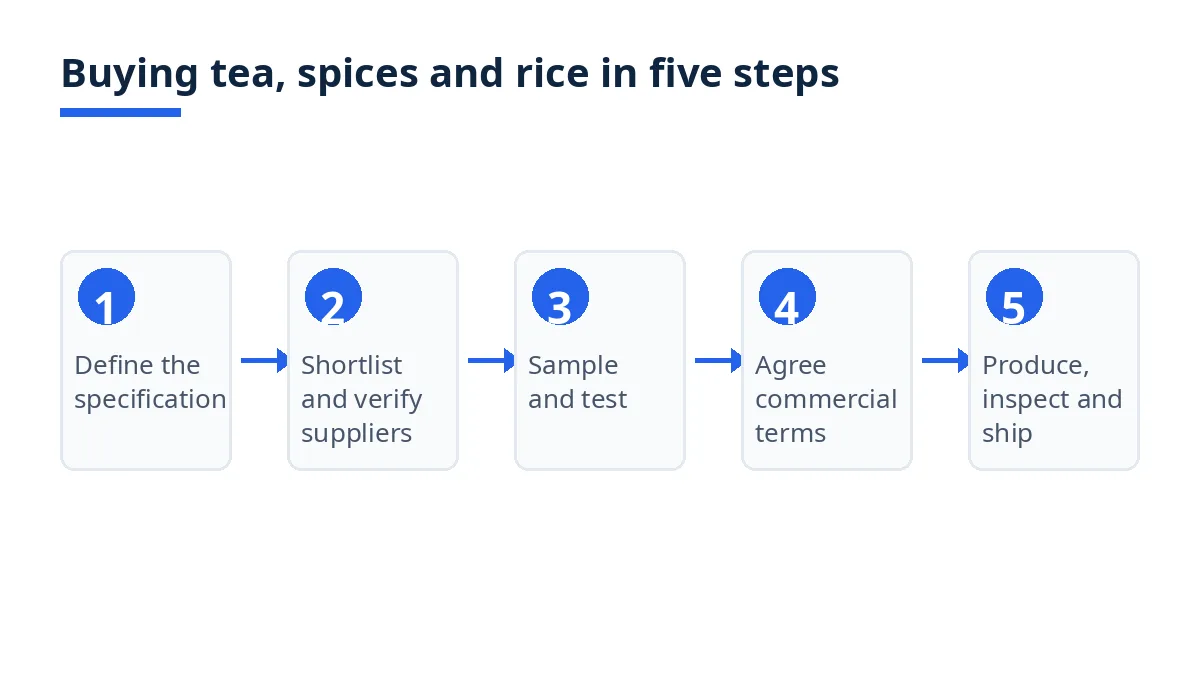
The buying process below pulls these threads together.
Step-by-step buying process
Define the specification. Write the product before you shop for it: HS heading, product form (leaf, whole, ground, mixed or milled), grade or recipe, pack size and packing, target quantity per product and design, destination market and the treatment and test file that market requires.9 4
Shortlist and verify suppliers. Build a shortlist from sector body lists and supplier listings, confirm the supplier type matches the form, then run the document checks in the verification section, including the current rice allocation where rice is in scope.8 10
Sample and test. Order samples against the specification, test production-representative goods for the destination panel, including sterilisation evidence for regulated spice markets, and approve a counter-sample in writing.4
Agree commercial terms in writing. Fix MOQ per product and pack, itemised unit price with its validity period, the Incoterm with its named place, the staged lead time and its start point, payment terms and the inspection point, all in the purchase order.11
Produce, inspect and ship. Monitor the treatment and packing stages first, inspect finished goods against the approved counter-sample and specification, then ship with the origin evidence your duty position depends on and, for rice, inside the allocation validity window.12 8
Related guides
Read how to import from Bangladesh for the general import sequence behind the steps above, the processed food industry in Bangladesh pillar for the neighbouring packed-food category, and Bangladesh export data for category scale. The guide to Incoterms for shipments from Bangladesh works through the delivery terms in more detail.
FAQs
Is Bangladesh a good place to source tea, spices & rice?
Bangladesh is a credible sourcing option for packet and specialty tea, processed and branded spices, and permitted aromatic rice, where the specification and compliance file are managed actively. Tea production was 94,927 thousand kg in calendar 2025, spice exports reached a record USD 56.31 million, and aromatic rice production reached 10.23 lakh tonnes in FY2023-24.1 4 7 The constraints are the small tea surplus against 90 to 95 million kg of domestic demand, sterilisation capacity, and permission-based rice exports.3 4 8 Source product by product, not on the country label.
What is the typical MOQ?
There is no published typical MOQ for tea, spices or aromatic rice from Bangladesh, and no official body sets one. Each supplier quotes its MOQ from its production stage: an auction, blending or packing minimum for tea, a grinding, blending or packing-line minimum per spice recipe and pack size, or a milling and packing minimum for rice, where the exporter's remaining government allocation can cap the order below the commercial MOQ.8 State your target quantity on the same basis in your enquiry, so quotes can be compared directly.
How long is the lead time?
There is no standard lead time: yours is the sum of its stages, raw material purchase, processing, treatment where the market requires it, packing, testing, inspection and booking, then transit. Two stages in this category carry dated constraints: spice sterilisation capacity, interrupted from November 2023 to July 2025 at the main Savar facility, and the rice allocation validity window, which for the current round ends on 31 December 2026.4 8 Ask for the stages separately and agree in writing what starts the clock.
Which certifications matter?
The requirements that matter are the ones your destination market and your buyers require for the exact product and form. For spices entering the United States and European markets, the operative requirement exporters name is sterilisation with batch testing, while Gulf and Malaysian buyers accept heat-treated product.4 For aromatic rice, the operative Bangladesh-side file is the Export Policy 2024-27 conditions: customs verification of quality and authenticity before each shipment and a Proceeds Realisation Certificate after it.8 Buyers may also name food safety management, organic or sustainability certificates in their own vendor manuals; those schemes sit on top of the legal file and do not replace it, and each certificate must name your product, site and current dates.
Next steps on Exportain
Browse Bangladeshi suppliers by tea, spice or rice product, use Exportain trade intelligence to check the market picture behind this guide, and post a free RFQ at Exportain RFQs with your specification, target quantity and destination market so suppliers in this category can quote against the same written brief.
Sources
- Monthly Statistical Bulletin for the Month of June, 2026: Tea Production, Sale, Market Price and Export. Bangladesh Tea Board (accessed )
- Tea exports jump by 58% in 2024. The Business Standard, (accessed )
- Can the local tea industry recover?. The Daily Star, (accessed )
- Spice exports surge five times in 15 years. Times of Bangladesh, (accessed )
- Vegetable, fruit, spice exports exceed $100m in Jul-Oct. The Financial Express (accessed )
- Foreign Trade Statistics: Export of Commodities by Chapter (Table-01) and by Heading (Table-02), FY2024-25. Bangladesh Bureau of Statistics (accessed )
- Aromatic rice production nearly doubles in seven years. The Daily Star, (accessed )
- Govt cuts fragrant rice export quota by 50%. The Business Standard, (accessed )
- Harmonized System. World Customs Organization (accessed )
- Supplier verification: Earn trust badges buyers can see. Exportain (accessed )
- Incoterms® rules. International Chamber of Commerce (ICC) (accessed )
- EU trade relations with Bangladesh. European Commission, (accessed )
- Incoterms
- quality control
- Bangladesh Export Data
- Category Pillars
- Supplier Sourcing
- Tea Bangladesh
- Spices Bangladesh
- Rice Bangladesh
About the author
Sourcing from Bangladesh?
Post a request for quotation and suppliers on Exportain can send you their quotes directly.
Post an RFQ