How to Import Jute Bags From Bangladesh in 2026: Complete Buyer Guide
Importing jute bags from Bangladesh runs through eight steps in order: define the bag, check the maker, compare quotations on one term, settle payment, sample twice, agree inspection, ship, and clear the import. A worked order of 8,000 laminated totes to Felixstowe lands at $2.26 per bag.
Short answer
To import jute bags from Bangladesh, write a specification covering fibre, weave, GSM, size, handles, print and packing, then shortlist makers through the JDPC directory and check the exporter. Compare quotations on one delivery term, settle payment under a letter of credit, approve a production sample, agree an AQL inspection plan, and confirm the HS code and labels with your broker before the container ships.
On this page
A buyer in Manchester wants 8,000 laminated jute totes, and the order touches eight jobs. This guide walks that route in the order it happens. Every figure here is labelled as an example, and every rule is named.
In 2025-26, Bangladesh earned $132.3 million from jute sacks and bags, a rise of 5.03 per cent, within $883.7 million of jute and jute goods exports in total.1
Step 1 — Decide what the bag is for
A jute bag order starts with the use, because the use fixes the fibre, the weave and the finish. Jute comes in two main varieties: white jute and Tossa jute, and Tossa fibre is softer, silkier and stronger than white jute.2 The cloth woven from it is also called hessian or burlap, and it is sold in bleached, dyed and laminated forms.2 Hessian suits shopping bags and light sacks, while heavier sacking fabric suits bulk goods. Cloth weight is measured in grams per square metre (GSM): a retail shopping bag often sits near 280 to 350 GSM. Lamination adds structure and resists water. Sacks for cocoa beans, coffee beans or shelled nuts are made under the IJO Standard 98/01, which limits unsaponifiable matter in the bag to less than 1,250 mg/kg.3
Step 2 — Put the bag on paper: the specification
Write the specification before asking for a price, and send the same version to every maker. Put a tolerance on every measurement, because jute is a coarse natural fibre. The specification is also the document the sample is judged against. Our finding and checking makers guide shows how to check a maker once the specification is ready.
Line | What to write down |
|---|---|
Bag type and use | Tote, sack or food-grade sack, and what it will carry |
Fibre and weave | White or Tossa jute, hessian or sacking cloth |
Fabric weight | GSM with tolerance, e.g. 350 GSM ±5% |
Size | Length, width, gusset, handle drop, in cm, measured flat |
Handles and print | Handle material; print method and colours |
Finish and packing | Laminated or unlined; folding, and bags per bale or carton |
Labels and quantity | Fibre content, origin, language; pieces per size and print |
Step 3 — Shortlist makers and check the exporter
Start with the Jute Diversification Promotion Centre (JDPC), the state body that supports diversified jute products. Set up in 2002, the centre counts 1,100 registered entrepreneurs across 282 product types, with six service centres in Dhaka, Rangpur, Jashore, Chattogram, Tangail and Jamalpur.4 Makers cluster around the mills and the ports. The firm that signs the export documents is the exporter, and it may or may not be the firm that sews the bags, so ask each supplier to say in writing whether it makes the bags, trades them or acts as an agent. Our jute bags exporters checklist works through the registration checks, including the Export Registration Certificate.
Step 4 — Compare quotations on one delivery term
Ask every supplier to quote on the same delivery term and the same named port. Start from FOB Chattogram: under it the seller covers the goods, export packing, the truck to the port, export clearance and loading, while the buyer covers ocean freight, marine insurance, import duty and destination handling. Incoterms 2020 is the edition of the International Chamber of Commerce rules in force since 1 January 2020, and it holds 11 rules that split cost, risk and duties between buyer and seller.5 Buyers most often weigh CIF against FOB. CIF works only for sea freight, its default cover is Institute Cargo Clauses (C), and the seller pays the freight and the insurance.5 A CIF price therefore bundles freight and insurance into the seller figure, while an FOB price leaves both out, so compare orders on landed cost per bag. Our jute bags price guide opens an FOB quotation.
Step 5 — Settle payment before the sample
Settle payment terms before the sample is made. A letter of credit is a bank promise to pay the seller once the seller presents matching documents, and letters of credit in Bangladesh follow the Uniform Customs and Practice for Documentary Credits, known as UCP 600.6 Bangladesh Bank has directed banks to comply with UCP 600 for all letter-of-credit transactions, for imports and for exports.6 Banks in Bangladesh may also handle trade through cash in advance, documentary collection and open account, and documentary collection follows the Uniform Rules for Collection (URC).6 The paper trail runs with the payment: the commercial invoice is the bill for the goods, the packing list shows what is in each carton, and a negotiable bill of lading is both the carrier receipt and the document of title.7 Bangladesh adds its own papers: the EXP form carries the export declaration and is certified by the authorised dealer bank, while the Bill of Export is the exporter's declaration to Customs.7 Check the documents against each other before the container is sealed, and write the payment split, timing and triggers into the order.
Step 6 — Sample twice, then lock the reference bag
Work in two sample rounds. The first round tests the product itself: style, fabric, size, handles and print method. The second round tests the production run: the exact bag, built on the production line, to the exact specification. Hold the second round until the first is approved on paper, and ask for the sample in the final fabric: a sample in a heavier cloth is a different product. Test the sample the way the bag will be used: open it fully, check that it stands upright empty, measure it flat, and hang the load it is sold to carry from the handles. Jute is a hard surface to print on, so keep line weight at 1 mm or thicker and ask for a print proof at actual size. When the second-round sample passes every point, approve it on paper and keep it sealed as the reference for the run. Our private label guide works through artwork and print approvals for a branded bag.
Step 7 — Agree inspection and packing before cutting
Inspection is agreed in the order, before cutting starts. AQL stands for acceptable quality limit. It comes from the ISO 2859-1 sampling standard, also published as ANSI/ASQ Z1.4, and it sets the sample size and how many defective units send the lot back.8 General Inspection Level II is the default, with the usual limits AQL 0 for critical defects, 2.5 for major ones and 4.0 for minor ones.8 A lot of 3,201 to 10,000 bags inspected at Level II takes code letter L, so 200 bags are drawn. At AQL 2.5 for major defects, 10 defects pass the lot and 11 fail it; at AQL 4.0 for minor defects, 14 pass and 15 fail.8 At or below the accept number the lot passes; at the reject number it fails.8 Name the inspector, the level and the AQL values in the order, and state who pays for re-inspection. Our the jute-bag quality checklist gives the inspection points for the sample and for the bulk run. Printed totes are often packed in cartons, while sacks are usually packed in bales. Jute absorbs moisture, so agree the moisture protection and the container cleanliness check before packing.
Step 8 — Ship, protect the load, and clear the import
With the lot passed, the container is loaded at Chattogram. Under FOB the buyer books the freight and the insurance; under CIF the seller has already done both, with Institute Cargo Clauses (C) as the default cover.5 Classification decides the duty, so settle it with the customs broker before the order ships rather than at the port: Packing sacks and bags of jute sit under HS 6305.10; a handled tote that looks like a handbag can sit under 4202.92 instead, so the design and the intended use decide the code.9 Labels cause more trouble at the destination than any other part of the bag. Selling into the European Union brings Regulation (EU) 1007/2011 into play: textile products sold to consumers must carry a durable label stating fibre composition, using only the fibre names in Annex I.10 The label must be durable and legible, in the language of the country where the product is sold.10 When the manufacturer is outside the EU, the importer must ensure the label is supplied and the information on it is accurate.10 See the HS code guide for the full classification.
Worked example: 8,000 laminated totes to Felixstowe
Example figures. A grocery chain in England orders 8,000 laminated jute shopping totes, 38 x 33 x 14 cm, 320 GSM laminated jute with cotton handles and a two-colour screen print, shipped FOB Chattogram to Felixstowe. The numbers below are illustrative, not a market price.
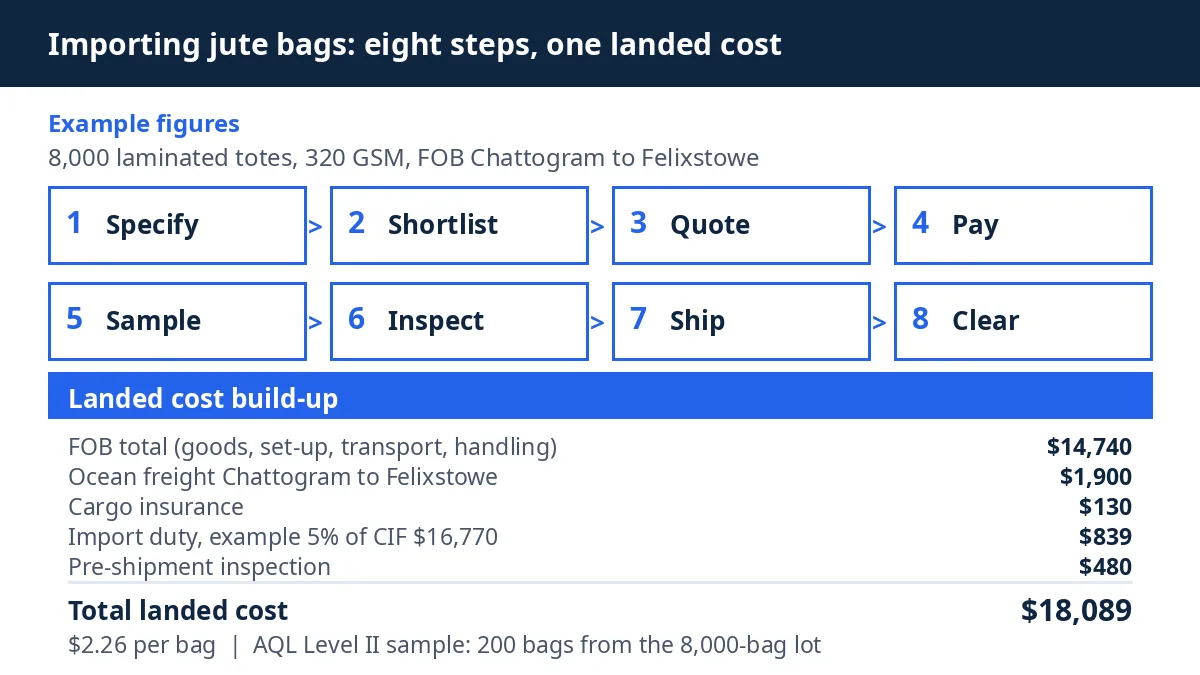
Cost line | Amount |
|---|---|
Goods, 8,000 totes at $1.75 each | $14,000 |
Print plates and set-up, two colours | $320 |
Inland transport to Chattogram | $260 |
Export handling | $160 |
FOB total | $14,740 |
Ocean freight, Chattogram to Felixstowe | $1,900 |
Cargo insurance | $130 |
CIF value | $16,770 |
Import duty, example 5% of the $16,770 CIF value | $839 |
Pre-shipment inspection | $480 |
Total landed cost | $18,089 |
Landed cost per bag | $2.26 |
Goods, set-up, transport and handling come to $14,740; freight and insurance give a CIF value of $16,770; duty at the example rate of 5 per cent is $838.50, rounded to $839; and $18,089 divided by 8,000 bags is $2.26 per bag. The inspection plan goes into the order before production: for an 8,000-bag lot, Level II assigns code letter L, which means 200 bags are drawn for inspection.8
Five mistakes that stall a first jute-bag import
The first mistake is asking for a price before writing the specification: a supplier that does not know the GSM, the size and the print cannot quote a real price. The second mistake is comparing an FOB price with a CIF price: one leaves freight and insurance out, the other bundles them in, so compare on landed cost per bag instead. The third mistake is paying a deposit before the payment route is settled. The fourth mistake is shipping without moisture protection: jute takes up damp from a wet store, a wet container or a wet port, and mould found at arrival is a claim against a shipment already paid for. The fifth mistake is leaving the labels until the end: fibre composition, origin marking and the language of the selling country all have to be right before the labels are printed.
Questions buyers ask about importing jute bags
How long does a first jute-bag import take?
The clock runs from the approval of the second-round sample. Sampling, bulk production and sea freight each take weeks.
Which HS code do jute bags use?
It turns on the bag: packing sacks and bags of jute sit under HS 6305.10, while a handled tote that looks like a handbag can sit under 4202.92.9 Confirm the code with the customs broker before the order ships.
Do jute bags need a food-grade certificate?
Only when the bag will hold food. Sacks for cocoa beans, coffee beans or shelled nuts are made under IJO Standard 98/01, which limits unsaponifiable matter to less than 1,250 mg/kg.3
What should the order say about inspection?
Name the standard, the level, the AQL values, the inspector and the re-inspection payer before production starts. For a lot of 8,000 bags at Level II, that means a sample of 200 bags.8
Next steps on Exportain
Write the specification first: bag type, fibre, weave, GSM, size, handles, print, finish, labels and packing. Then find suppliers on Exportain or post an RFQ with that specification, naming the delivery term. Read how to buy before placing the order.
Sources
- Jute exports rise 37 per cent as Bangladesh plans to double earnings by 2031. The Financial Express, (accessed )
- Jute Cloth & The Golden Fibre It Is Made Of. SewGuide (accessed )
- IJO Standard 98/01: Special Criteria for the Manufacture of Jute Bags used in the Packing of Selected Food Materials. International Jute Study Group (accessed )
- Jute Diversification Promotion Centre weaves success for 1,100 entrepreneurs. Daily Sun, (accessed )
- Incoterms® 2020. International Chamber of Commerce (ICC) (accessed )
- BB asks banks to follow URC documentary collection for transparent contract-based trade. The Business Standard, (accessed )
- The papers that move trade. Open Trade Bangladesh (accessed )
- AQL Calculator — Free ISO 2859-1 Sample Size Tool. SDF Clothing (accessed )
- Bag HS Codes Guide: 6305 Breakdown for Importers. FreightAmigo, (accessed )
- Regulation (EU) No 1007/2011. EUR-Lex (accessed )
- letter of credit
- Incoterms 2020
- import from Bangladesh
- aql inspection
- Jute bags
- HS code 6305
- Jute shopping bags
About the author
Sourcing from Bangladesh?
Post a request for quotation and suppliers on Exportain can send you their quotes directly.
Post an RFQ