Import Jute Shopping Bags From Bangladesh: Retail Buyer Steps 2026
A Rotterdam grocery chain orders 5,000 printed jute shoppers from Bangladesh. This retail buyer guide covers sizes and GSM, print approval, EU labelling, HS code 4202.22.30, sampling, payment and packing, with a worked landed cost of $2.08 per bag.
Short answer
To import retail-ready jute shopping bags from Bangladesh, brief the bag by retail use with size, GSM, handles and lamination, approve a print strike-off and a pre-production sample, label the fibre composition to the rules of the destination market, classify the bag under HS 4202.22.30, inspect the lot under ISO 2859-1 General Inspection Level II, and pay under a letter of credit on FOB Chattogram terms.
On this page
Key takeaways
Plastic bag rules in the EU, England and California now drive retail demand for durable reusable jute shoppers.
A standard grocery shopper is 40 x 35 x 15 cm in laminated jute at 350 GSM, with cross-stitched cotton webbing handles.
Approve a print strike-off on the real cloth before production, because coarse jute takes ink unevenly.
EU Regulation 1007/2011 requires the fibre composition by weight, in descending order, on a durable label.
Example figures put 5,000 printed shoppers to Rotterdam at $10,405 landed, or $2.08 per bag.
A grocery chain in Rotterdam needs 5,000 branded jute shoppers for its checkout lanes, and the order is a retail product first and a textile shipment second. The bag has to carry a logo shoppers can read at arm's length, hold a full weekly shop and survive a damp walk home.
Demand for jute shopping bags is growing alongside home furnishings, technical textiles and packaging, and Dhaka has set a $2 billion target for jute export earnings by 2031.1 The most recent full-year figures show the scale: jute and jute goods brought in 883.7 million US dollars in fiscal year 2025-26, a rise of 7.75 per cent year on year, while sacks and bags alone reached 132.3 million dollars after growing 5.03 per cent.1
Why are retailers switching to jute shopping bags now?
In the European Union, Directive (EU) 2015/720 required member states to cut consumption of lightweight plastic carrier bags, defined as bags with a wall thickness below 50 microns, to no more than 90 bags per person by the end of 2019 and 40 per person by the end of 2025.2 England raised its single-use carrier bag charge from 5p to 10p on 21 May 2021 and extended it to all businesses, after the charge had cut plastic bag sales in major supermarkets by 95 per cent since 2015.3 California's Senate Bill 1053, signed on 22 September 2024, bans film plastic carryout bags at checkout from 1 January 2026, while stores may sell recycled paper bags for at least 10 cents each and offer durable reusable bags made of cloth or other approved materials.4
A jute shopper fits the gap these rules create: a natural fibre bag a customer can carry for months and a retailer can print with a brand. A bag sold as reusable has to survive repeated use, so test handles, seams and print rather than taking the claim on trust.
What does a retail-ready jute shopping bag look like?
A retail-ready bag is judged on the shop floor, not in a fibre laboratory. Size, weight, handles and finish matter more than the name of the fibre. Cloth weight, measured in grams per square metre (GSM), sets the feel and the strength: natural hessian runs about 280 to 350 GSM, laminated jute about 350 to 420 GSM, and Juco, a blend of 75 per cent jute and 25 per cent cotton, about 290 to 340 GSM.5 Lamination coats the inside of the cloth with a thin polypropylene film, which adds structure, resists water and wipes clean, while Juco gives a smoother surface that takes finer print.5
Retail use | Size in cm | Fabric | Handles |
|---|---|---|---|
Boutique or gift shop | 30 x 25 x 12 | Juco 320 GSM | Padded cotton webbing |
Standard grocery shopper | 40 x 35 x 15 | Laminated jute 350 GSM | Cotton webbing, cross-stitched |
Heavy grocery or wine | 45 x 40 x 18 | Laminated jute 420 GSM | Padded rope or wide webbing |
Handles deserve the same attention as fabric. Ask for handles stitched through the body of the bag with a cross-stitch or box stitch, not tacked to the top edge, and add a base board or reinforced gusset so the bag stands upright on a checkout belt.
How do you brief print and branding so the logo survives the shelf?
Print is where a shopping bag earns its keep as a brand carrier, and it is also where most retail orders go wrong. Coarse jute takes ink unevenly, so bold one- or two-colour screen printing suits it best, while fine detail, small text and photographic artwork need a smoother surface such as Juco or a cotton pocket sewn onto the bag.5 Send the artwork as a vector file with Pantone references, and name the exact print size and position on each face.
Ask for a print strike-off before production starts: one printed panel, or one finished bag, showing the real ink on the real cloth. Check it in daylight and at arm's length, and look for ink that has bled into the weave, colours that differ from the Pantone reference, and text that has lost its edges. Approve the strike-off in writing and keep it as the reference the production run is judged against. Our private label guide for jute shopping bags covers brand placement and artwork files in more detail.
Which labels and marks must a retail bag carry?
A bag sold to a consumer in the European Union must carry a fibre composition label, and the rules are precise. Regulation (EU) No 1007/2011 requires textile products to be labelled with the name and percentage by weight of all constituent fibres, in descending order, using only the fibre names listed in its Annex I.6 The terms "100 %", "pure" and "all" may be used only for a product made of a single textile fibre, and the label must be durable, easily legible, visible and accessible, in the official language or languages of the country where the product is sold.6
Plan the label at the brief stage, not at the packing stage, and confirm the wording in each language of the markets the bags will reach.
How do you choose the right HS code for a shopping bag?
The HS code follows the use of the bag, and a shopping bag and a packing sack sit under different headings. Handbags and shopping bags of jute fall under 4202 22 30, while jute sacking bags and hessian bags for packing fall under 6305.7 That distinction matters at the border: the heading drives the duty rate, the import declaration and the documents your broker files.
Confirm the heading with your customs broker before the goods ship, and give the broker the bag's size, fabric, lamination and intended use, not just the words "jute bag". Make sure the commercial invoice, packing list and bill of lading agree on the quantity, the description and the HS code. Our guide to the HS code for jute shopping bags sets out the classification in full.
How does sampling work for a branded retail order?
A retail order needs three samples, and each one answers a different question. The first is an unprinted prototype that confirms size, GSM, handles and construction. The second is the print strike-off, which confirms the artwork on the real cloth. The third is the pre-production sample, the first finished bag from the production line, which becomes the gold seal sample the shipment is judged against.
Inspection of the finished lot follows the same logic. Under ISO 2859-1, the usual plan for consumer goods is General Inspection Level II, single sampling, with AQL 2.5 for major defects and AQL 4.0 for minor defects, and zero tolerance for critical defects.8 The lot size sets the sample: a lot of 1,201 to 3,200 bags draws a 125-bag sample, and at AQL 2.5 the lot passes with 7 or fewer major defects and fails at 8.8 Write the plan into the purchase order before production starts, and name the defect list: print misregistration, handle stitching failure, wrong GSM, torn seams, stains and damp odour all count as major defects for a retail bag.
How do you pay for and ship a retail order?
Most first retail orders from Bangladesh are quoted FOB Chattogram, and the term is worth understanding before prices are compared. Under Incoterms 2020, FOB means the seller delivers the goods loaded on board the vessel nominated by the buyer at the named port of shipment, and risk passes to the buyer at that point.9 The seller handles transport to the port, loading and export formalities, while the buyer contracts the carrier, pays the ocean freight and clears the goods on import.9
Payment for a first order is usually a letter of credit. A letter of credit is a bank's undertaking to pay the exporter when the exporter presents documents that comply with the credit's terms, and most credits are issued subject to the ICC's UCP 600 rules.10 Under UCP 600, credits are irrevocable, documents must normally be presented within 21 calendar days after shipment, and the bank has a maximum of five banking days to examine them.10 The invoice, packing list, bill of lading and certificate of origin must match the credit word for word, or the bank can refuse payment on a paperwork discrepancy even when the goods are perfect.
How should retail bags be packed for the shelf?
Retail packing is part of the product, because the bags arrive at a distribution centre that has to count, store and send them on. Ask for the bags folded flat, banded in sets of ten, and packed in export cartons lined against damp, with the count, size, colour and print marked on the outside of each carton. Confirm the carton size and weight with your warehouse before production, because a carton too heavy for one person to lift will be broken down on arrival and the count will be lost.
Worked example: 5,000 printed shoppers for a grocery chain in Rotterdam
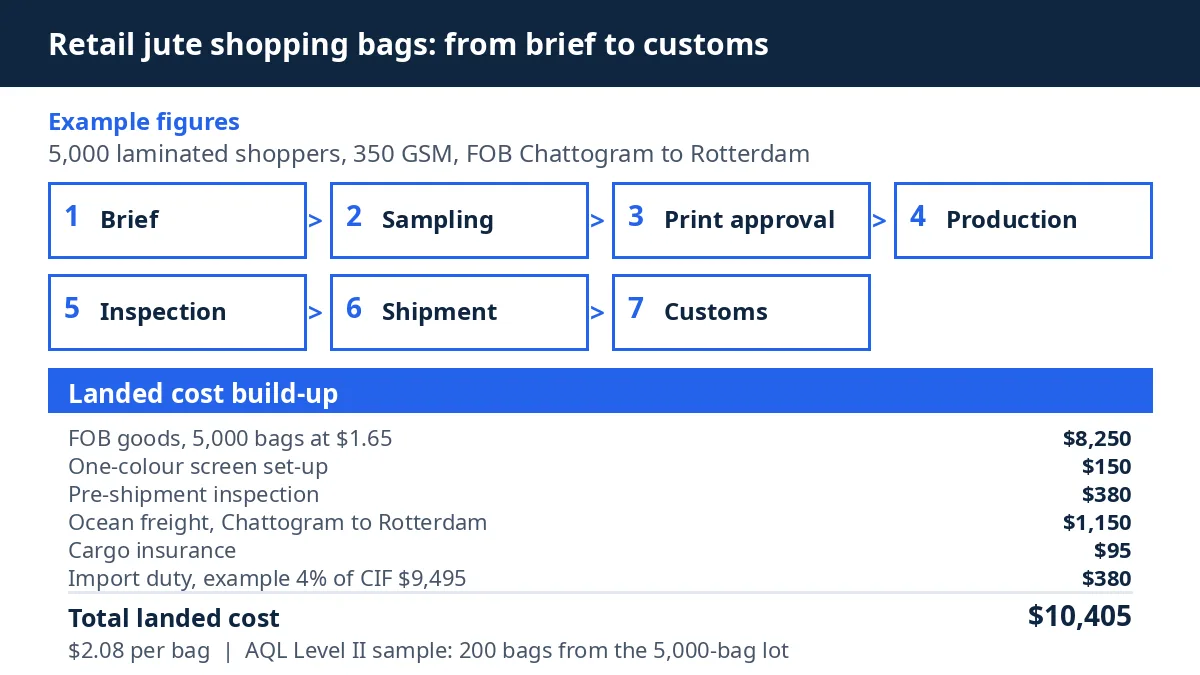
A grocery chain in Rotterdam orders 5,000 laminated jute shoppers, 40 x 35 x 15 cm, 350 GSM, one-colour screen print, padded cotton handles, FOB Chattogram. The figures below are example figures, shown to illustrate how a retail landed cost is built, not a quotation.
Cost line | Example figures |
|---|---|
FOB goods, 5,000 bags at $1.65 | $8,250 |
One-colour screen set-up | $150 |
Pre-shipment inspection | $380 |
Ocean freight, Chattogram to Rotterdam | $1,150 |
Cargo insurance | $95 |
Import duty, example 4% of CIF $9,495 | $380 |
Total landed cost | $10,405 |
The landed cost is $10,405, or $2.08 per bag. The screen set-up adds $0.03 per bag at this quantity, which is why a print charge that looks small on a quotation matters far more on a 500-bag order than on a 5,000-bag order. Inspection draws a 200-bag sample from the 5,000-bag lot under ISO 2859-1 General Inspection Level II, and at AQL 2.5 the lot passes with 10 or fewer major defects.8
Mistakes retail buyers make on a first jute shopping bag order
Approving print from a screen image instead of a strike-off on the real cloth, then finding the ink has bled into the weave across 5,000 bags.
Specifying fine text and a detailed logo on coarse hessian, where the weave swallows the detail.
Leaving the fibre composition label until packing, then discovering the wording is wrong for the market where the bags will sell.
Comparing quotations on different delivery terms, so a low FOB price beats a better CIF price on paper and loses on landed cost.
Skipping the pre-production sample to save a week, then having no gold seal sample when the shipment arrives with the wrong handle length.
Questions buyers ask about importing jute shopping bags
How long does a first retail order take?
Allow time for the prototype, the print strike-off and the pre-production sample before production starts, then production, inspection and ocean freight.
Can a jute shopping bag be washed?
Spot clean it rather than machine washing it, because water and agitation can distort the weave and fade the print. A laminated bag wipes clean with a damp cloth.
What if the print colour is wrong on arrival?
The gold seal sample decides the question. Compare the shipment against the approved pre-production sample and the approved strike-off, count the defective bags under the AQL plan in the purchase order, and raise the claim with the inspection report and photographs before the goods are distributed.
Next steps on Exportain
Start with the makers who already handle retail finishing: our guide to jute shopping bag manufacturers in Bangladesh explains how to find and check them, and the wholesale guide for jute shopping bags shows how prices and order sizes work for retail buyers. Post a request for quotation with your size, GSM, print and packing, and compare the replies on one delivery term. For the numbers behind the example above, see our price breakdown for jute shopping bags.
Sources
- Jute exports rise 37 per cent as Bangladesh plans to double earnings by 2031. The Financial Express, (accessed )
- Directive (EU) 2015/720 of the European Parliament and of the Council of 29 April 2015 amending Directive 94/62/EC as regards reducing the consumption of lightweight plastic carrier bags. EUR-Lex, (accessed )
- 10p plastic bag charge introduced in England. GOV.UK, (accessed )
- California's Plastic Bag Ban 2.0: What You Need to Know About SB 1053. LawInc (accessed )
- Jute Packaging Material, Jute Bag Material Wholesale and What Jute Bags Are Made Of. Ruixing Gifts (accessed )
- Regulation (EU) No 1007/2011. EUR-Lex (accessed )
- Bag HSN code by material: 4202, 3923 or 6305?. StitchMagic (accessed )
- What Is AQL (Acceptable Quality Limit)? Apparel QC Sampling Explained. Adstronaut (accessed )
- FOB & FAS Incoterms® 2020 explained: Key differences. ICC Academy (accessed )
- Letter of Credit Explained: How LCs Protect Exporters. Hexaco Global (accessed )
- letter of credit
- import from Bangladesh
- aql inspection
- HS code 4202
- Jute shopping bags
- Retail buying
- EU textile labelling
About the author
Sourcing from Bangladesh?
Post a request for quotation and suppliers on Exportain can send you their quotes directly.
Post an RFQ