Best Incoterm for Importing Plastic & Melamine From Bangladesh
FCA is usually the best Incoterm for containerised plastic and melamine products from Bangladesh: risk passes at handover to your carrier and the seller clears export. It compares EXW, FOB, CIF, DAP and DDP, explains the food-contact paperwork, and prices one container to the United States.
Short answer
For most containerised orders of plastic and melamine products from Bangladesh, FCA named place (Incoterms 2020) is the best term: risk passes when the goods are handed to your carrier, you control freight and insurance, and the seller still clears the goods for export. Use CIF only when you want the seller to arrange freight and minimum insurance to your port, and DAP or DDP when you want delivery to your door. Avoid FOB for containers and EXW unless you can clear export in Bangladesh.
On this page
Key takeaways
FCA is usually the best term for containerised plastic and melamine from Bangladesh, because risk passes when the goods reach your carrier.
FOB leaves a risk gap for containers: the box sits at the terminal for days before loading, while the seller still carries the risk.
CIF buys only minimum Clause (C) insurance and risk still passes on board at Chattogram, so check the cover before you rely on it.
Melamine tableware must meet EU migration limits of 2.5 mg/kg for melamine and 15 mg/kg for formaldehyde, and US rules allow the resin as a food-contact surface.
Under DDP the seller clears import and pays duty, so confirm the HS 3924.10 duty rate before you accept the price.
The 11 rules of Incoterms 2020, issued by the International Chamber of Commerce (ICC), divide delivery duties, costs and risk between buyer and seller.1 Seven work for any mode of transport, including containers, and four are written for sea transport only.2
Plastic and melamine products are a growing export line for Bangladesh. In FY2024-25 the country earned $284.05 million from plastic-goods exports, up 16.21 percent on the previous year, and kitchenware and tableware alone brought in $43.12 million.3 The three letters at the end of the purchase order decide who pays for each leg, who carries the risk, and who clears the goods at each border.
What is the best Incoterm for plastic and melamine imports?
For most containerised orders, FCA (Free Carrier) named place, under Incoterms 2020, is the best term. Risk passes to you when the goods are handed to the carrier you named, you control the freight and the insurance, and the seller still handles export clearance.2
CIF is the main alternative when you would rather have the seller arrange the freight and the insurance to your port. DAP and DDP suit buyers who want the goods delivered to their door, with the seller carrying the risk for the whole journey. EXW and FOB look cheaper on the quotation, and both carry traps for this product family.
Why do plastic and melamine change the Incoterm choice?
Three features pull the choice in different directions. Plastic household goods, toys, furniture and melamine tableware are light for their size, so a 40-foot container fills up on volume and freight is a large share of the landed cost. The goods are packed in cartons and nested or stacked, so the load depends on how the container was stuffed and handled at the terminal. And melamine tableware touches food, which brings migration limits and lab reports into the purchase.
How do the six realistic terms compare for this product family?
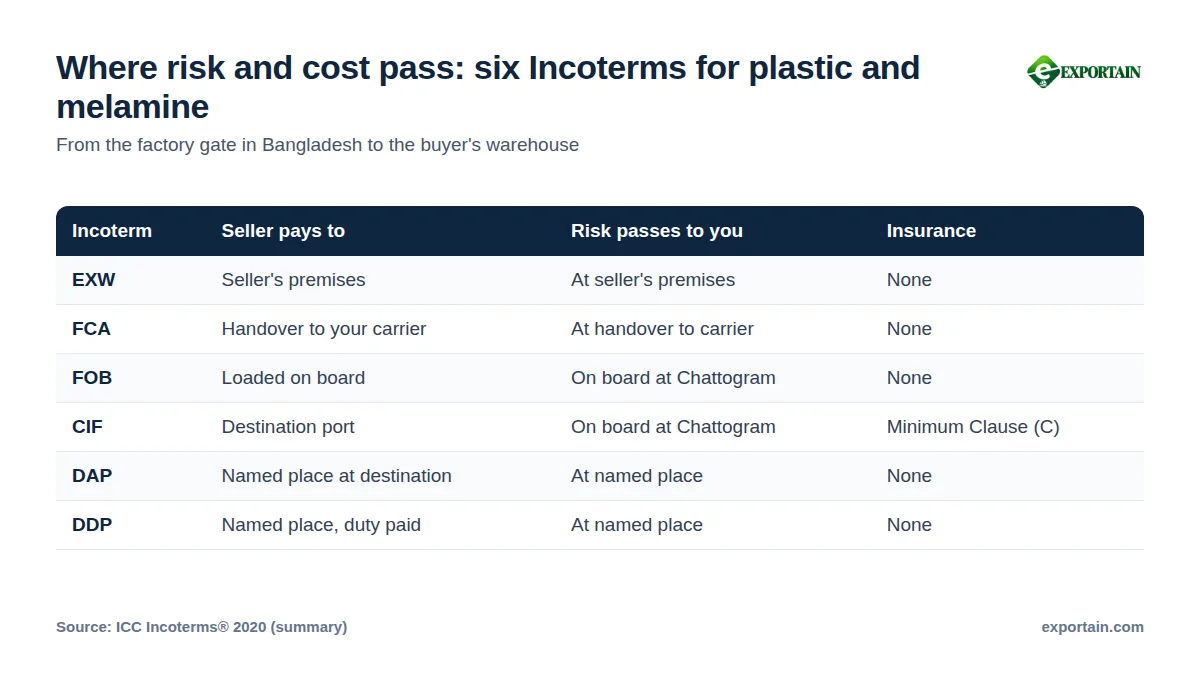
Six terms cover nearly every plastic and melamine order from Bangladesh. The table compares them on the four questions that decide the price: who pays the main carriage, where risk passes, who must insure, and who clears import.2
Term | Seller pays carriage to | Risk passes to you | Insurance the seller must buy | Import clearance and duty |
|---|---|---|---|---|
EXW (Ex Works) | Seller's premises only | At the seller's premises | None | You |
FCA (Free Carrier) | Handover to your carrier | When handed to your carrier | None | You |
FOB (Free on Board) | Loaded on board at Chattogram | On board the vessel | None | You |
CIF (Cost, Insurance and Freight) | Named destination port | On board at Chattogram | Minimum Clause (C) | You |
DAP (Delivered at Place) | Named place at destination | At the named place, ready for unloading | None | You |
DDP (Delivered Duty Paid) | Named place at destination | At the named place, cleared for import | None | Seller |
Under CIF the seller pays the freight but the risk still passes to you on board at Chattogram.2 Under DAP and DDP the seller keeps both cost and risk to the destination, and only DDP moves import clearance and duty onto the seller.2
Why does FCA usually win for containerised orders?
FCA fits the way a container actually moves. The seller clears the goods for export and hands them to the carrier you named, at the place you named, and delivery is complete at that handover.2 Risk passes at the same moment, so there is no gap in which the goods sit in a yard with the risk still on the seller.
The ICC's own guidance is to use FCA for containerised cargo.2 FOB, CFR and CIF were written for cargo loaded over a ship's side. A container does not work that way: you hand the box to the terminal days before the vessel loads it, and from that moment you cannot see it, move it or protect it.2
FCA also gives you control of the two costs that dominate a light, bulky shipment: the ocean freight and the insurance. Banks usually require an on-board bill of lading, and Incoterms 2020 deals with this: under FCA the parties may agree that the buyer will instruct its carrier to issue one to the seller once the goods are loaded.1
When does FOB still work, and where does it fail?
FOB still works when the goods are not containerised. A bulk or break-bulk load of plastic furniture or large moulded items, lifted onto a vessel at Chattogram, fits FOB: risk passes when the goods are on board.2
For a container, FOB fails in a specific way. The container is stuffed, sealed and delivered to the terminal days before the vessel sails, and under FOB the seller keeps the risk until the box is loaded on board.2 If a terminal tractor damages the container, the seller bears a loss on goods it no longer controls, while your insurance may not yet have attached. The gap runs from a couple of days to a week.2
What does CIF actually buy you?
CIF buys a freight booking and a minimum insurance policy inside the seller's price. The seller pays the ocean freight and must insure the goods to the named destination port, with the minimum cover set at Institute Cargo Clauses (C).1 That cover is a limited, named-perils policy, and the seller must insure for at least 110 percent of the contract value.2
What CIF does not buy you is risk cover for the voyage. Risk passes to you when the goods are placed on board at Chattogram, exactly as under FOB.2 If the container is lost or damaged at sea, the loss is yours and your remedy is the claim on the policy the seller bought.2
Chipped rims, scratched furniture and crushed cartons are the kinds of damage a limited named-perils policy may not answer, so write wider cover into the contract or choose FCA. CIF also leaves import clearance, duty and taxes with you, and it ends at the port, not at your warehouse.2
What food-contact paperwork must travel with melamine tableware?
The Incoterm decides who pays and who carries the risk. It does not decide whether melamine tableware may be sold in your market, and no Incoterm can fix a consignment that fails a migration test.
For the European Union, the strictest import regime for melamine kitchenware is Commission Regulation (EU) No 284/2011, but its scope is narrow: it covers polyamide and melamine plastic kitchenware originating in or consigned from China or Hong Kong.4 Melamine tableware made in Bangladesh is outside that regulation, so a Bangladesh consignment does not need the declaration and laboratory report it demands.4
The EU migration limits still apply to Bangladesh goods: melamine must not migrate above 2.5 mg per kg of food, and formaldehyde must stay under 15 mg per kg of food.5 Products used again and again, such as plates and bowls, are tested three times in a row, and the result of the third test must stay under the limit.5
Melamine mixed with bamboo fibre or other plant fillers is not authorised for food contact in the EU.5 The German Federal Institute for Risk Assessment advises against using melamine tableware for hot food or in the microwave, because melamine releases more melamine and formaldehyde above 70 degrees Celsius.5
For the United States, 21 CFR 177.1460 allows melamine-formaldehyde resins as the food-contact surface of moulded articles, provided the finished articles yield net chloroform-soluble extractives of no more than 0.5 milligram per square inch of food-contact surface.6
When are DAP and DDP worth the higher price?
DAP suits a buyer who wants one delivered price to the warehouse door without handing the seller the import border. The seller arranges and pays the carriage to the named place and carries the risk all the way there.2 You clear the goods for import, pay the duty and taxes, and unload.
DDP goes one step further and is the only rule under which the seller clears the goods for import and pays the duty and taxes.2 For a first order or a buyer entering a new market, DDP removes the two jobs a buyer is least equipped to do at arm's length: the customs entry and the duty calculation.
DDP has a condition buyers often skip: the seller must be able to act as importer of record in your country. Plastic tableware falls under HS 3924.10, and the US general duty runs from 3.4 percent to 6.5 percent: plates, cups and bowls at 6.5 percent, trays at 5.3 percent, other articles at 3.4 percent.7
A worked example: one container of melamine tableware to the United States
The numbers below are Example figures for one 20-foot container of 10,000 melamine dinner sets shipped from Chattogram to New York, classified under HS 3924.10.20, which carries a general duty rate of 6.5 percent.7
Cost line | FCA Chattogram | CIF New York | DDP New York |
|---|---|---|---|
Goods, 10,000 dinner sets | $24,000 | $24,000 | $24,000 |
Packing and inland transport to Chattogram | $450 | $450 | $450 |
Export clearance in Bangladesh | $120 | $120 | $120 |
Ocean freight, Chattogram to New York | $2,100 | $2,100 | $2,100 |
Marine insurance | $150 | $150 | $150 |
US import duty at 6.5 percent of $24,000 | $1,560 | $1,560 | $1,560 |
Total landed cost, Example figures | $28,380 | $28,380 | $28,380 |
The totals are identical; what changes is who pays each line and who carries the risk. Under FCA you pay the freight, the insurance and the duty.2 Under CIF the seller pays the freight and the minimum insurance, but the risk is still yours from loading on board.2 Under DDP the seller pays every line, including the duty.2
What mistakes cost plastic and melamine buyers the most?
Using FOB for a container leaves the risk with the seller while the goods sit at the terminal, out of its control.2 Assuming CIF means full cover is the second mistake: CIF requires only minimum Clause (C) insurance, and the risk passes to you on board at Chattogram.2 Choosing EXW without checking who can clear export is the third: under EXW the buyer clears export in the seller's own country.2 Confusing DAP with DDP is the fourth: only DDP moves import clearance and duty to the seller.2 The fifth is naming a vague place: under FCA, DAP, DPU and DDP the named place is the delivery point.2 The sixth is leaving the edition out of the contract: write the rule, the named place and the edition. The seventh is ordering melamine tableware without the migration test report for the destination market.
How should the term appear in your contract?
Write the term as three parts: the rule, the named place and the edition. "FCA Chattogram Container Freight Station, Incoterms 2020" is complete; "FCA Bangladesh" is not. The named place under FCA, DAP, DPU and DDP is the delivery point, while under CPT, CIP, CFR and CIF it is the destination the seller pays carriage to.2
An Incoterm says nothing about the price, the payment terms, when ownership passes, or the law governing the contract.2 The rules are a long-standing standard: first published by the ICC in 1936, they are recognised by UNCITRAL as the global standard for the most common terms in foreign trade, and Incoterms 2020 entered into force on 1 January 2020.8
Next steps on Exportain
Start with the product detail before you settle the term: our plastic products sourcing guide covers specs, moulds and testing, and the HS code guide for melamine tableware sets out the classification behind the duty lines in this article. Then check the melamine tableware quality control checklist before production starts. When you are ready to buy, post an RFQ at /rfqs/new with your chosen Incoterm written in full, and read /how-to-buy for the steps from quotation to order.
Sources
- Incoterms® 2020. International Chamber of Commerce (ICC) (accessed )
- Incoterms 2020 Explained | All 11 Rules for Thai Trade. WorldLink (accessed )
- Plastic export earnings up 147pc in 5 yrs. The Financial Express, (accessed )
- Commission Regulation (EU) No 284/2011 of 22 March 2011 laying down specific conditions and detailed procedures for the import of polyamide and melamine plastic kitchenware originating in or consigned from the People’s Republic of China and Hong Kong Special Administrative Region, China. European Commission, (accessed )
- Melamine and Nylon Kitchenware from China: EU Import Rules. Westwood Sourcing, (accessed )
- 21 CFR 177.1460 - Melamine-formaldehyde resins in molded articles. Cornell Law Institute (accessed )
- Plastic food containers & kitchenware HS Code (3924.10) – 10-Digit HTS, US Duty & Cost Calculator. KleverKlimb (accessed )
- Incoterms® rules. International Chamber of Commerce (ICC) (accessed )
About the author
Sourcing from Bangladesh?
Post a request for quotation and suppliers on Exportain can send you their quotes directly.
Post an RFQ