Quality Control Checklist for Melamine Tableware From Bangladesh
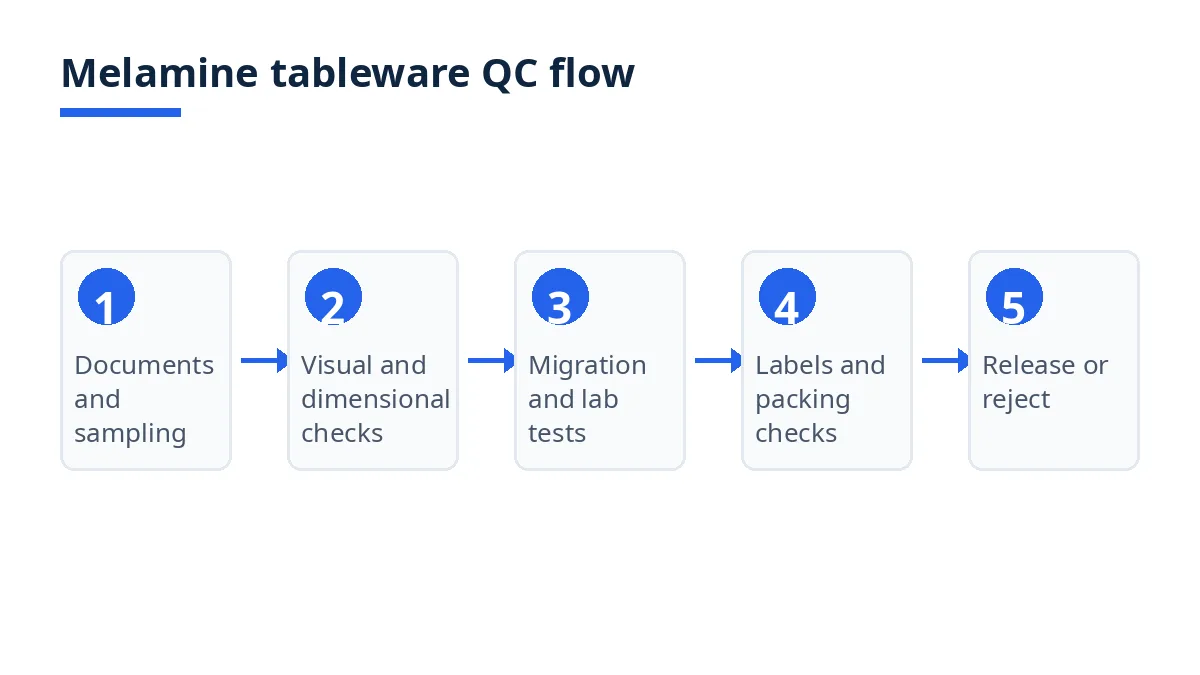
A numbered QC checklist for melamine tableware from Bangladesh: documents and sampling, surface and rim checks, dimensions and stacking, migration and lab tests, labels and packing, with fixes for crazing, chipping and discolouration.
Short answer
Use this melamine tableware quality control checklist to check documents and sampling, surface defects such as crazing and chipping, dimensions and stacking, migration evidence against the destination market, and labels and packing on melamine tableware from Bangladesh before shipment. Agree tolerances, test methods and acceptance numbers in the purchase order.

On this page
Key takeaways
Agree the sample, tolerances, test methods and acceptance numbers before inspection, and draw the sample randomly across styles, colours and cartons.
Check every piece under a strong light for crazing, rim chips, glaze faults and colour drift, because melamine faults hide in the surface, not the size.
Treat migration evidence as a separate gate: for the EU, melamine at 2.5 mg/kg and formaldehyde at 15 mg/kg of food under Regulation (EU) No 10/2011, per colour and lot.
Confirm the filler is authorised for the destination and that care and use-limit wording on the pack matches the test evidence, then record every result with photos.
Use this melamine tableware quality control checklist when you buy plates, bowls, cups, trays and serving pieces from Bangladesh, checking the shipment before it leaves the factory. Melamine looks simple on the table, but its faults hide in the glaze, the rim and the foot: fine crazing, a chipped rim, and colour drift between cartons. Work through the list against the approved sample, the purchase order and the packing specification. Draw the sample randomly across styles, colours and cartons, and agree the sampling plan before inspection starts. ISO 2859-1 provides sampling schemes indexed by acceptance quality limit (AQL) for lot-by-lot inspection.1
Why this checklist matters
Melamine tableware fails in ways that a quick carton-opening check misses. A plate can measure correctly and still craze after its first hot wash, a bowl can stack neatly and still rock on the table, and a printed pattern can sit off-centre on one piece and true on the next. The surface is the food-contact surface, so a cracked, deeply scratched or crazed piece is not just a cosmetic reject.
A written checklist settles arguments before they start. Each item is checked against the approved sample and the agreed tolerance, and each result is recorded as pass, fail or not applicable, with a photo where the defect needs proof. Agree the acceptance numbers per defect class in the purchase order, and treat any food-contact test result as a separate gate: a piece that looks perfect still fails if its migration report does not cover the destination market.1
Before you start
Do not begin until the references are complete: an approved sample for every style and colour, the purchase order, the size and weight chart with tolerances, the artwork proofs, the packing specification, and the food-contact test reports for the destination market. Confirm which market each lot serves: the EU framework rule requires food-contact materials to be made so that, under normal or foreseeable use, they do not transfer constituents to food in quantities that could endanger health, change the food unacceptably, or spoil its taste and smell.2
For the EU, ask for migration evidence against the plastics regulation, not a general statement of compliance. Under Commission Regulation (EU) No 10/2011, the specific migration limit for melamine is 2.5 mg/kg of food and for formaldehyde it is 15 mg/kg of food.3 The EU's special import conditions for melamine kitchenware from China and Hong Kong require a laboratory report showing formaldehyde release not exceeding 15 mg/kg of food; those conditions do not apply to Bangladesh, but they show the evidence level EU buyers should still request from any origin.4 For the United States, the rule for melamine-formaldehyde resins in molded articles sets a chloroform-soluble extractives limit of 0.5 mg per square inch of food-contact surface.5 Check that every report names the material, colour tested, and lot covered.
The full checklist (numbered, printable)
Documents and sampling
Confirm the approved sample, purchase order, size chart, artwork proofs and packing specification are present and match before any carton is opened.
Confirm the sampling plan in writing: lot size, inspection level, sample size and acceptance numbers per defect class.1
Draw the sample randomly across styles, colours, sizes and cartons, including pieces from the middle and bottom of cartons.
Confirm the food-contact reports cover this material, this decoration and this lot, and that the market named on each report matches the order.
Confirm the declaration of compliance, where required, names the manufacturer, product and regulation claimed against.
Appearance and surface
Check every sampled piece under a strong, even light for crazing: fine cracks in the glaze, especially inside bowls and around the foot.
Check rims, handles and spouts for chips, cracks and rough edges, by sight and by touch.
Check the foot and base for cracks, warping and rough moulding flash, and stand each flat piece on a flat surface to check it does not rock.
Check the glaze for dull patches, pinholes, blisters, orange-peel texture and scratches against the approved sample.
Check printed patterns, decals and rim bands for centring, completeness, colour match and blurred or missing elements.
Check colour consistency within each piece, between pieces in a set, and across cartons, under the same light, against the approved standard.
Check for discolouration, yellowing, stains and mould marks, including inside stacked pieces where a stain can hide.
Melamine can still crack, chip, scratch or fracture under excessive force, unsuitable temperatures or improper cleaning, and damaged pieces should be removed rather than shipped.6
Dimensions, weight and function
Measure diameter, length, width and height of each sampled piece against the size chart, recording actual values, not pass marks alone.
Weigh sampled pieces against the chart weight: a large gap from the sample can point to thinner walls or a different moulding.
Check wall thickness at rim and base where specified, and compare feel and rigidity with the sample.
Check that pieces stack cleanly without rocking, jamming or rim damage, and that lids fit their own base only.
Check handles, knobs and feet for secure fixing, correct alignment and no wobble, and that any detachable part is present and fits.
Check capacity where specified, for bowls, cups and jugs, by filling a sampled piece to the stated level.
Check that the shape and profile of each piece match the sample.
Food-contact and lab tests
Review the migration evidence for the destination market: for the EU, melamine at 2.5 mg/kg and formaldehyde at 15 mg/kg of food under Regulation (EU) No 10/2011.3
Confirm the test conditions match the intended use: hot and acidic food and repeated washing increase release, and the German Federal Institute for Risk Assessment notes that melamine-formaldehyde resin is attacked by hot, acidic food and that surface damage speeds the process.3
Confirm the report covers every colour and decoration in the lot, since pigments and decals can change the result; record any uncovered colour as an open item.
Confirm the filler is authorised for the destination: bamboo and other plant-based materials are not listed in Regulation (EU) No 10/2011 and are therefore not authorised as fillers under that regulation.3
Where required, confirm dishwasher-resistance evidence at the manufacturer's stated conditions, and check the pack's care wording matches those conditions.
Check the use limits on the pack or leaflet: melamine is generally not suitable for microwave or oven use, and its suitability for hot food depends on the manufacturer's stated limits.6
Labels, claims and packing
Check that every piece or set carries the required markings, and that no label, claim or care symbol promises a use the test evidence does not support.
Check the brand, country of origin, care instructions and microwave or dishwasher wording against the purchase order, and check spelling.
Check barcodes and set-content stickers scan and match the purchase order, and that each set contains exactly the specified pieces and quantities.
Check inner packing: pieces separated so rims cannot chip each other, dividers or sleeves where specified, and no loose moulding flash inside.
Check carton quantities, assortment ratios and markings against the packing list, and weigh and measure cartons.
Check cartons protect the goods in transit: no crushed corners, no damp, and no hard insert that can press a rim or scratch a glaze.
Photograph defects by style and colour, record the carton of each defective piece, and keep one retained sample per style.
Common failures and how to fix them
Crazing is the failure buyers miss most often, because it is faint until the light catches it. It points to a glaze or curing problem: stop, check the whole sampled group under a strong light, and segregate the affected lot. Chipped rims usually trace to handling after moulding or to pieces packed rim-to-rim without separators: re-check the packing line and add the required separator before more cartons are closed.
Discolouration across a lot usually means more than one material batch or decoration run: re-sort complete sets before packing. A piece that rocks points to a warped base or uneven foot: check the moulding and cooling step, and measure the base. Colour drift between cartons points to a decoration or pigment change: compare each carton against the approved standard.
When a migration report is missing, covers the wrong colour, or names a different lot, the shipment is not ready however clean the visual check looks. Above the agreed acceptance level, options are re-inspection after sorting or rework, documented partial acceptance, or rejection.
Downloadable template / summary table
Copy the checklist into your inspection sheet, add the size chart, tolerances and acceptance numbers, and record a result per piece.
Section | Checks | Evidence |
|---|---|---|
Documents and sampling | References, sampling plan, random draw | Purchase order, sample, plan |
Appearance and surface | Crazing, chips, glaze, print, colour | Light check, photos |
Dimensions and function | Size, weight, stacking, fit | Measurements, fit check |
Food-contact and lab tests | Migration limits, filler, care limits | Lab reports per colour |
Labels and packing | Markings, barcodes, separators, cartons | Packing list, photos |
How Exportain helps
Exportain is a B2B marketplace connecting buyers with Bangladeshi suppliers of melamine tableware and plastic products, so the specifications behind this checklist can be agreed at enquiry stage, before production. Use inspection services when you plan the check, and read the AQL acceptance quality limit explainer to set the sampling plan. Supplier profiles show which document and photo checks have been recorded, not factory inspections.
FAQs
When should this checklist be used?
Use it at final inspection, when goods are finished and largely packed. For larger and first orders, also use it during production, while faults can still be corrected.
Who should complete it?
The buyer, a local agent or an independent inspector can complete it, using the approved sample, size chart and a random sample.
What are the most common failures?
Crazing, chipped rims, discolouration, colour drift, warped bases and missing or mismatched migration reports are the failures buyers find most often.
Can a third party do it?
Yes, if you share the approved references, tolerances, acceptance levels and test requirements first.
Next steps on Exportain
Before production, agree your size chart, tolerances, sampling plan and destination-market test evidence, then read the AQL acceptance quality limit explainer and the pre-shipment inspection guide, and plan the check with inspection services. You can also post a free RFQ on Exportain and get quotes from verified Bangladeshi suppliers via RFQs.
Sources
- ISO 2859-1:2026 - Sampling procedures for inspection by attributes — Part 1: Sampling schemes indexed by acceptance quality limit (AQL) for lot-by-lot inspection. International Organization for Standardization (accessed )
- Regulation (EC) No 1935/2004 on materials and articles intended to come into contact with food. European Parliament and Council, (accessed )
- Questions and answers on tableware and kitchen utensils made of melamine-formaldehyde resin (MFR). German Federal Institute for Risk Assessment (BfR) (accessed )
- Commission Regulation (EU) No 284/2011 laying down specific conditions and detailed procedures for the import of polyamide and melamine plastic kitchenware originating in or consigned from China and Hong Kong. European Commission, (accessed )
- 21 CFR 177.1460 - Melamine-formaldehyde resins in molded articles. Cornell Law Institute (accessed )
- Why Melamine Dinnerware Is Popular in Foodservice. RestaurantSupply (accessed )
- pre-shipment inspection
- quality control
- aql inspection
- Melamine tableware
- Bangladesh plastic products
- Food-contact materials
About the author
Sourcing from Bangladesh?
Post a request for quotation and suppliers on Exportain can send you their quotes directly.
Post an RFQ