HS Code for Melamine Tableware: Classification Guide for Importers
Melamine tableware points indicatively to 3924.10, with the material and function tests, US, EU, UK and UAE national codes, and food-contact checks explained.
Short answer
Melamine tableware points indicatively to subheading 3924.10, tableware and kitchenware of plastics, inside heading 3924. The code turns first on the melamine-formaldehyde material and then on table function: plates, cups and serving dishes sit at 3924.10, while other household articles sit at 3924.90. Confirm the full national code in the destination tariff before filing.
On this page
Key takeaways
Melamine tableware points indicatively to subheading 3924.10, tableware and kitchenware of plastics, while other melamine household articles sit at 3924.90 or outside heading 3924.
The deciding tests are material first and function second: melamine-formaldehyde resin in a finished tableware piece, not resin powder and not a melamine-look coating.
In the United States, 3924.10 splits by piece type, so serving dishes and trays take different ten-digit lines even when they share the same material mix.
EU melamine lines split by origin and consignment, so a China or Hong Kong line must not be borrowed for Bangladesh-origin ware.
Only the first six digits are shared: the EU extends to eight digits, the United States and United Kingdom to ten, and the UAE is moving from eight to twelve.
A melamine dinner plate, serving tray and bowl look like one product family on a supplier catalogue, but customs reads each piece by its material and use. This guide works from the material outward: the melamine test, then the tableware test, then the national extension. All headings here are indicative: confirm the full national code in the destination tariff before filing. For the general method, read HS codes: how to classify your product.
Quick answer: melamine tableware points to 3924.10 (indicative)
Melamine tableware points indicatively to subheading 3924.10, tableware and kitchenware of plastics, inside heading 3924. The UK tariff lists tableware and kitchenware at 3924 10 and other articles at 3924 90.1 A melamine plate, cup, bowl or serving dish therefore starts at 3924.10, while a melamine article that is not tableware or kitchenware does not. Treat 3924.10 as a starting point, not a finished code: each destination extends the six digits further, and food-contact rules sit alongside the code rather than inside it.
Start from the material: what counts as melamine
Melamine tableware is made from melamine-formaldehyde resin, a thermoset resin formed by reacting melamine with formaldehyde. United States food-contact rules describe these resins as those produced when one mole of melamine reacts with not more than three moles of formaldehyde, and allow them as the food-contact surface of moulded articles under prescribed conditions.2 That thermoset character is the first test on a supplier specification: a thermoplastic plate that merely looks like melamine, or a plate with a melamine-look coating over a different body, is not automatically melamine tableware. Ask the supplier to state the resin system in writing.
The second material test is the stage of the goods. Melamine resin in primary forms, such as liquids, pastes and powders, is classified as melamine resin rather than as tableware.3 A shipment of resin powder and a shipment of finished plates therefore take different lines. Do not carry a resin code onto a finished-goods entry.
The third test is the blend. A published United States ruling on a serving dish and trays made of 50 percent melamine and 50 percent urea plastic classified the pieces by use, not by melamine share alone: the serving dish took the plates-and-dishes line and the trays took the tray line, both inside 3924.10.4 Record the full composition, including any urea, bamboo fibre or other filler, and let the function test below do the work a percentage cannot do.
Tableware at 3924.10 or other articles at 3924.90
Inside heading 3924, the split is by function. Subheading 3924.10 covers tableware and kitchenware, and 3924.90 covers the other household and toilet articles in the heading.1 Ask of each piece: is it used to serve, eat or drink from, or to prepare food, or is it a household article of another kind. A melamine dinner plate, soup bowl, cup, saucer, serving dish and platter sit on the tableware side. A melamine soap dish, a storage container with no table function, or a household article that merely happens to be made of melamine sits on the other side.
Function also separates pieces that share a shape. In the ruling noted above, an oval dish too narrow to support and carry other dishes was treated as a serving dish, while wider open receptacles used to hold, carry or support plates, bowls and drinking vessels were treated as trays.4 Both lines sit inside 3924.10, but they are different national lines, so describe each piece by its use, not its catalogue name.
Sets need the same piece-by-piece reading: plates, bowls and cups can be entered piece by piece, but a set mixing tableware with another household article cannot be forced under one line.
How the code builds: 2, 4, 6 and then national digits
The Harmonized System is a multipurpose international product nomenclature developed by the World Customs Organization (WCO), comprising more than 5,000 commodity groups, each identified by a six-digit code, and used by more than 200 countries and economies as a basis for their customs tariffs.5 The European Commission describes the same hierarchy: chapters at two digits, headings at four digits and subheadings at six digits, with countries subdividing the six-digit categories further.6 For melamine tableware the build-up reads as follows.
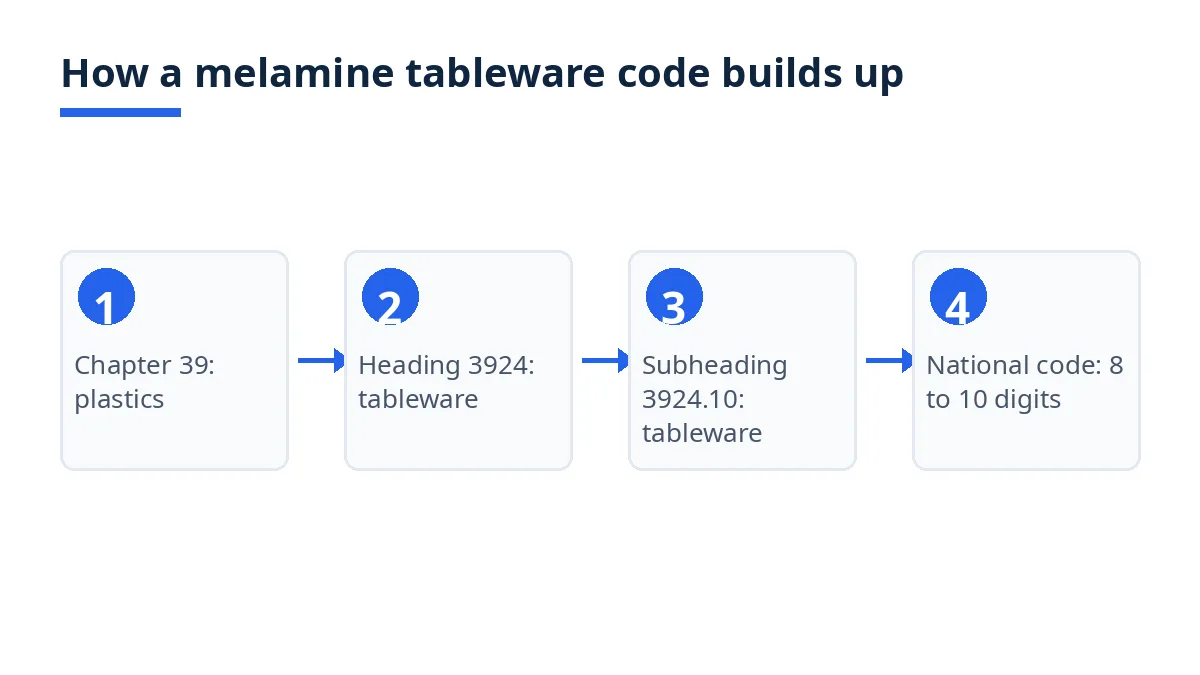
Chapter 39 covers plastics and articles thereof. Heading 3924 narrows that chapter to tableware, kitchenware, other household articles and hygienic or toilet articles, of plastics. Subheading 3924.10 narrows the heading to tableware and kitchenware. Everything after the sixth digit is national detail for one customs territory and does not travel to another, so a code copied from another destination is a starting point for the first six digits only. The current edition is HS 2022, and some countries stay with a previous version for a time, which is another reason to check the destination tariff for the entry date.6
National codes: US HTS, EU CN and TARIC, UK commodity code, UAE
United States: HTS, ten digits. The United States schedule splits 3924.10 by piece type: plates, cups, saucers, bowls, creamers, gravy boats, serving dishes and platters take one ten-digit line, and trays take another.4 Read the full ten-digit line for each piece in the current Harmonized Tariff Schedule.
European Union: CN at eight digits, TARIC for measures. The Combined Nomenclature uses eight-digit codes built on the six-digit subheading.6 For melamine kitchenware and tableware from China or Hong Kong, the Swedish food authority notes a specific CN code for kitchenware containing polyamide or melamine consigned from China or Hong Kong, a separate code for the same goods from other countries, and a further code for tableware of polyamide and melamine.7 For Bangladesh-origin ware, read the TARIC line for origin Bangladesh and the entry date, and do not borrow a China or Hong Kong line.
United Kingdom: commodity code, ten digits. The UK builds its commodity code on the same first six digits.6 The UK tariff lists tableware and kitchenware at 3924 10, then splits kitchenware containing polyamide or melamine and other tableware and kitchenware, and lists other articles at 3924 90.1 Take the full ten-digit code from the UK Trade Tariff for the piece and entry date.
United Arab Emirates: twelve-digit transition. The UAE expanded its customs tariff code from eight digits to twelve digits, announced for 1 January 2025, with Dubai Customs beginning flexible implementation at the twelve-digit level in July 2025 while the eight-digit level remained operational during the transition.8 For a UAE entry, check whether the declaration for the entry date requires the twelve-digit line or still accepts the eight-digit line, and build from 3924.10 outward rather than copying a US or UK code.
Food-contact compliance is separate from classification
A correct HS code does not by itself clear a melamine shipment for food contact. In the United States, melamine-formaldehyde resins may be used as the food-contact surface of moulded articles only under prescribed conditions, including a limit on chloroform-soluble extractives.2 In the European Union, melamine kitchenware and tableware from China or Hong Kong must be checked at the border, and the analytical report must show formaldehyde release into food or food simulants does not exceed 15 mg/kg.7 Those are market-entry conditions, not classification rules: a plate can sit correctly at 3924.10 and still fail a food-contact check. Keep the two files apart: the classification file holds the description, reasoning and national code, while the compliance file holds the resin declaration and migration test report. Melamine ware is serving ware, not cookware, so do not describe it as microwave-safe or oven-safe on the strength of its HS code.
How to confirm the code officially
Write a precise description for each piece: resin, piece type, dimensions, weight, filler or composite share, and table use.
Start from the official tariff for the destination, and read the heading text and Chapter 39 notes.
Check published rulings for similar pieces: the serving-dish and tray ruling above shows how customs separates pieces by use inside 3924.10, and a ruling on a near-identical piece is stronger evidence than a supplier code.4
For a borderline piece, such as a composite bowl or a piece that could serve as either a dish or a tray, apply for a binding decision before you ship. In the United Kingdom, a legally binding decision is generally valid for 3 years.9 In the European Union, the equivalent route is Binding Tariff Information, and in the United States it is a binding ruling from US Customs and Border Protection.
Give your broker the description and confirmed code for each piece, and use the same codes throughout the entry, invoice and packing list.
Common classification mistakes
Filing resin powder as tableware. Resin in primary forms is melamine resin, not finished tableware.3
Filing every melamine article at 3924.10. Only tableware and kitchenware sit at 3924.10. A melamine household article that is not tableware or kitchenware belongs at 3924.90 or outside heading 3924.1
Filing a tray as a serving dish, or the reverse. In the United States schedule, serving dishes and trays take different ten-digit lines inside 3924.10, separated by whether the piece carries other vessels or serves food itself.4
Copying a China or Hong Kong melamine line for Bangladesh-origin ware. The EU melamine lines split by origin and consignment.7 Read the line for origin Bangladesh.
Copying a full national code across destinations. Only the first six digits are shared internationally.6
Treating a food-contact test as a classification. Migration limits and border checks decide whether the ware may enter the market, not which heading it sits in.7 2
Related duties and documents
This guide states no duty rates: the code decides which duty line customs applies, and a rate on a plate line does not carry to a tray line or another destination. Read the rate beside your confirmed code for your origin and entry date, and check what proof of origin a preference claim requires. Keep the description, composition declaration, confirmed codes, binding decision, food-contact test report and origin evidence together in the shipment file, with each piece type as a separate invoice line.
FAQs
What is the HS code for melamine tableware?
Melamine tableware points indicatively to subheading 3924.10, tableware and kitchenware of plastics, inside heading 3924.1 Confirm the full national code for the destination and piece type before filing, because the United States splits 3924.10 by piece, and the EU and UK split it by melamine content and origin.7 4
Is the HS code the same in every country?
Only the first six digits are shared. Countries subdivide the six-digit categories into national subheadings, with the EU Combined Nomenclature using eight-digit codes.6 The United States and the United Kingdom extend to ten digits, and the UAE is moving from eight to twelve digits.8
How do I confirm the correct code?
Describe each piece precisely, read the heading text and Chapter 39 notes in the destination tariff, and check published rulings for similar pieces, such as the serving-dish and tray ruling inside 3924.10.4 For a borderline piece, apply for a binding decision before shipping.9
What happens if I use the wrong code?
A wrong code brings the wrong duty line, the wrong import controls and a delayed clearance while customs reclassifies the goods. A binding decision in advance gives a legally binding classification for the goods described, and in the United Kingdom it is generally valid for 3 years.9 If you find an error after filing, tell your broker promptly.
Next steps on Exportain
Browse Bangladeshi suppliers on Exportain, where supplier profiles carry document and photo review badges, and compare melamine tableware ranges with the confirmed codes stated per piece. The HS code explainer covers the 2-4-6 structure, and the classification method guide walks through the heading and notes reading. Exportain is not a party to the goods contract and does not inspect goods, book freight or clear customs, so keep your broker and any binding decision at the centre of the entry.
Sources
- Tableware, kitchenware, other household articles and hygienic or toilet articles, of plastics - UK Integrated Online Tariff, heading 3924. GOV.UK, HM Revenue and Customs (accessed )
- 21 CFR 177.1460 - Melamine-formaldehyde resins in molded articles. Cornell Law Institute (accessed )
- HS Code for Melamine Resin. FreightAmigo (accessed )
- Customs Ruling NY N326467 - The tariff classification of plastic trays and a plastic serving dish from China. U.S. Customs and Border Protection (accessed )
- What is the Harmonized System (HS)?. World Customs Organization (accessed )
- Harmonised System. European Commission (accessed )
- Import of kitchen- and tableware from China and the Hong Kong region. Swedish Food Agency (accessed )
- Dubai Customs implements expanded tariff code. Deloitte Middle East (accessed )
- Check what you'll need to get a legally binding decision on a commodity code. GOV.UK, HM Revenue and Customs (accessed )
- HS Codes
- Customs Classification
- importing from Bangladesh
- tariff codes
- Plastic products
- Melamine tableware
About the author
Sourcing from Bangladesh?
Post a request for quotation and suppliers on Exportain can send you their quotes directly.
Post an RFQ