Plastic Products Sourcing Guide for Bangladesh: Specs, Moulds and Testing
A method-first sourcing guide for plastic products from Bangladesh: write the resin, mould and wall-thickness spec, settle tooling ownership, vet factories, test food-contact articles and contract per order.
Short answer
Sourcing plastic products from Bangladesh works by specification and tooling, not by catalogue. Write the resin or compound grade, mould and cavity, wall thickness and food-contact status into a specification, vet the factory and its mould position against documents and test files, settle mould ownership and custody in the contract, sample and test production articles, then agree MOQ, price, Incoterm and inspection point per order.
On this page
Key takeaways
Source by method, not by catalogue: fix the resin or compound grade, the mould and cavity, dimensions, wall thickness, piece weight and food-contact status in a written specification first, because the quote, the test file and the inspection all read from that one document.
Mould terms are contract terms: state who pays for the mould, who owns it once paid for, how it is identified and where it is held, that it is used only for the owner's orders, who maintains it, and how it is released when the order moves factories.
For EU food-contact articles, Regulation (EU) No 10/2011 is the operative file: authorised substances only, specific and overall migration limits met, and a written declaration of compliance for the finished article, supported by migration test evidence.
There is no industry-wide MOQ, price or lead time for plastic products from Bangladesh; all three are quoted per factory and per article, plastic-goods shipments were USD 284.05 million in FY2024-25 on the EPB series, and tooling may sit inside or outside the unit price.
Sourcing plastic products from Bangladesh works as a method, not a catalogue purchase. This plastic products sourcing guide is for importers, brands, retailers and sourcing agents in the United States, the United Kingdom, the European Union and the United Arab Emirates who buy moulded, extruded or pressed plastic and melamine articles. It covers the specification — resin, mould, wall thickness and food-contact status — then supplier vetting, mould and tooling ownership and custody as contract practice, sampling and testing evidence, and contracting and shipment. Industry scale and clusters are treated in the companion industry pillar and kept brief here; sustainability claims are summarised as a route and left in depth to the companion guide named below.
Market overview with latest data
Keep the market picture short, because the decisions in this guide are made at article and factory level. On the Export Promotion Bureau (EPB) fiscal-year shipment series, plastic-goods exports were USD 284.05 million in fiscal year 2024-25, up 16.21 percent on the previous year and up from USD 115.28 million in FY2020-21.1 Inside the FY2024-25 total, PVC bags earned USD 51.53 million and kitchenware and tableware USD 43.12 million, so bag, household-goods and tableware buyers face three different sub-markets inside one headline.1 The full data treatment, including why the EPB and Bangladesh Bank series differ, is in the plastic and melamine products industry in Bangladesh pillar.
Two facts from the same reporting shape the method that follows. Demand growth was reported in household items such as PVC bags, kitchenware and tableware — the moulded and pressed articles where specification and tooling decide the result — and the industry remains dependent on imported moulds, mainly from China, while association leaders named high certification testing costs in India and Singapore as a constraint.1 Read those points as sourcing instructions: mould origin, mould ownership and where testing happens belong in your enquiry from the first exchange, because each carries cost and time that a unit price alone does not show.
Main products and production clusters
The product range follows the material and the process, and the specification must name both. Plastic articles are classified in Chapter 39 of the Harmonized System, where "plastics" means the materials of headings 39.01 to 39.14 that are or have been capable of being formed, usually by heat and pressure, by moulding, casting, extruding, rolling or another process into shapes retained when the external influence is removed.2 The headings a buyer will meet most often, on the chapter notes, are:
HS heading or range | What the chapter notes cover | Typical specification focus |
|---|---|---|
39.01 to 39.14 | Polymers in primary forms: liquids and pastes, and blocks, lumps, powders including moulding powders, granules and flakes | Resin or compound identity and grade — the input every later article is made from |
39.17 | Tubes, pipes and hoses: hollow products generally used for conveying, conducting or distributing gases or liquids | Internal diameter and cross-section, wall thickness and pressure use; a non-round internal section can move the product out of this heading |
39.18 | Wall or ceiling coverings of plastics, in rolls of a width not less than 45 cm, fixed permanently on a backing | Roll width, backing material and surface decoration |
39.20 and 39.21 | Plates, sheets, film, foil and strip, and blocks of regular geometric shape, whether or not printed or surface-worked | Thickness, width, surface work and whether the sheet is only cut into rectangles or worked further |
39.25 | Builders ware not covered by earlier headings, from reservoirs and tanks over 300 litres to doors, windows, shutters and fittings for permanent installation | Capacity or fitted dimensions, and whether the article is structural or a fitting |
The chapter notes also list what Chapter 39 does not cover, including articles of other sections such as furniture, toys and brushes, so the material alone does not settle the heading.2 Agree the six-digit subheading with your supplier and broker for each article before you order, because the heading decides the duty line and product rules at destination. Melamine tableware is specified like any other pressed article in this guide: by compound, shape, dimensions and food-contact status, not by the word melamine alone.
Production clusters, factory counts and key players are covered in full in the plastic products industry in Bangladesh pillar. The method point is narrower: buy the article from the process that makes it. An injection moulder is the right source for a moulded storage box, an extrusion line for pipe and film, and a pressing operation for melamine tableware. Ask a factory offering all three which process runs in-house, at which address, and which stages are subcontracted, before comparing its price with a specialist's.
How to find and verify suppliers
Find suppliers through more than one channel so you can cross-check what a factory tells you. Start with the plastic products industry in Bangladesh pillar for the category picture, add Bangladesh export data and Exportain trade intelligence for context, then work Bangladeshi suppliers listings by product and ask each candidate for its current export markets and reference articles in your heading.
Verification is a specification and tooling exercise first and a document exercise alongside it. Ask for, and read, the following before you discuss price in detail:
The specification match: confirmation, article by article, that the factory can mould, extrude or press to your resin, dimensions and wall thickness, plus the process and site address where your order would run.
The mould position: which moulds the factory already holds, which mould a new article needs, where it would be made, and who would own it — the tooling terms below start here.
Trade licence and export registration in the company's own name, plus export history for your target market: anonymised shipment summaries showing heading, article and recency.
The food-contact evidence file, where any article touches food: the declaration and test evidence for the finished article.3
Test reports for the exact article and material you plan to buy, not a similar article in a different resin or wall thickness.
Capacity evidence by process: moulding or pressing capacity per day for your article type, and which stages — colouring, printing, decal work, assembly, packing — are in-house or subcontracted.
On Exportain, read badges for what they are. Supplier profiles carry document and photo review badges: the badge records that documents and photos were reviewed by Exportain staff, verification is free, and membership never grants a badge.4 A badge is not a factory inspection, certification or guarantee, and Exportain is a marketplace, not a party to the contract for goods. Use it as a first filter, then run the checks above yourself or through an inspection firm you appoint.
Two red flags end a conversation early: a factory that quotes a firm unit price before it has seen your wall thickness and food-contact status is not pricing your article, and a factory that cannot say who would own the mould for a new design has not answered the tooling question that decides whether you can move the order.
MOQ, pricing and lead times
There is no industry-wide MOQ, standard price or lead time, and no body publishes one. All three are quoted per factory, per article and per order, against a written specification. What follows is how each is built, so you can compare quotes on equal terms.
MOQ. The minimum order quantity is set by the production stage and the tooling, not by the buyer's carton count. A moulded article carries a machine and mould minimum per design and colour; an extruded article carries a line and printing minimum per size and design; a melamine article carries a pressing minimum per shape and colour. A new mould adds a second question: whether the mould cost is charged separately, spread across an agreed quantity, or carried by the factory against a committed volume. State your target quantity per article, colour and design in your enquiry, and ask the factory to state its MOQ and mould charge on the same basis.
Pricing. Your unit price is built from resin or compound grade and its price at the time of purchase, moulding, extrusion or pressing cost, colour masterbatch and printing or decal work, assembly and finishing, packing, tooling where it is spread into the unit price, and export costs to the agreed Incoterm point. Resin and tooling are the two layers a headline price hides, and both are import-linked, so ask each factory to state the resin grade, the price-validity period, and whether tooling is inside or outside the unit price, in writing.1 Compare quotes only at the same Incoterm, specification and tooling treatment.
Example figures. For illustration only: 60,000 moulded storage boxes are quoted by two suppliers at the same Incoterm, FOB Chattogram, with tooling treated differently. Example figures: Supplier A quotes USD 0.92 per box with the new mould charged separately at USD 4,800, so the order totals USD 55,200 for the goods plus USD 4,800 for the mould, USD 60,000 in all. Example figures: Supplier B quotes USD 1.00 per box with the mould cost spread into the unit price and no separate charge, so the order totals USD 60,000. The example figures show the method, not a market price: the quotes cost the same on this order and diverge on the next, because the buyer who paid the USD 4,800 mould charge under the example figures owns a mould to price against a repeat order, while Supplier B's buyer has paid for tooling inside a unit price without a stated ownership position. Under the example figures, the mould charge equals USD 0.08 per box across 60,000 boxes — the whole gap between the two unit prices. Ask which structure you are being quoted before comparing numbers.
Tooling cost structure. Discuss tooling as structure, never as a single unexplained line. Separate in the quote: mould design and making; mould material and cavity count as the maker states them; trial and sampling runs; maintenance and repair during the mould's working life; and storage when idle. State which elements are one-off charges and which are inside the unit price, and what happens to each on a repeat order, design change or factory move. A mould price without its cavity count and trial terms is not yet comparable.
Lead times. A lead time is a chain, not a single number: resin or compound purchase, mould making or preparation where a new design applies, moulding, extrusion or pressing, printing and finishing, inspection and booking, then transit. The mould link is the longest single link on a new article and sits before production starts, so a lead time without a separate mould stage is incomplete for any new design. A food-contact article carries the offshore testing link as well.1 Ask for the stages separately and agree what starts the clock — normally written order confirmation plus approved sample.
Quality, certifications and compliance
Quality is decided by three layers: the destination market's product law, the product standard your article is sold against, and your own specification and testing. The specification is where the layers meet, so write it so an inspector can measure it.
Write the product specification first. A complete specification states: the resin or compound, by polymer and grade designation as the supplier confirms it, including any recycled share stated per article; the mould, with its cavity count; dimensions with tolerances; wall thickness at the thinnest load-bearing section, not only an average; weight per piece with its tolerance; colour reference and masterbatch basis; finish and any print or decal placement; the food-contact status, stated plainly as food-contact or not food-contact; and packing, by pieces per carton with carton dimensions and gross weight. Wall thickness and piece weight belong together: a cheaper quote on the same drawing is often a thinner wall and a lighter piece, and the weight tolerance is what lets an inspector prove it.
Settle mould ownership and custody in the contract. Mould and tooling terms are contract practice, written before the mould is made, not after the first order ships. The purchase documents should state: who pays for the mould and on what stages; who owns it once paid for, in the buyer's name where the buyer has paid in full; an identifying mark or serial reference, recorded with photographs at completion; where it is held, in custody for the owner rather than as the factory's own asset; that it is used only for the owner's orders and not for goods sold to any third party; who maintains it, who pays for wear repairs, and how its condition is reported; the notice and release procedure when the owner moves it to another factory, including the condition it must be released in; and what happens on a design change, priced and recorded as a change to the same identified mould. None of these terms has a standard market wording: they are agreed per order, and a buyer who has not agreed them holds a weaker position than the payment record alone suggests.
Food-contact articles: Regulation (EU) No 10/2011 for the EU. Where an article is a plastic material or article intended to come into contact with food and is placed on the EU market, Regulation (EU) No 10/2011 sets the frame: only substances on the EU list of authorised substances may be used in its manufacture, all such articles must comply with specific and overall migration limits, and the manufacturer must draw up a written declaration of compliance identifying the materials, articles and substances, renewed when substantial changes in composition or production occur.3 Regulation (EU) 2025/351, which has applied since 16 March 2025, also clarifies substance purity and the added declaration information for articles made using substances manufactured from waste.3 Apply the route, not the label: name the food-contact status in the specification, require the declaration of compliance for the finished article — for melamine tableware, the pressed article as sold, not the compound in general — and require migration test evidence for the production material, through a laboratory accredited for those methods. A factory statement that an article is food grade, without the declaration and test file behind it, is not evidence. For other markets, run the same route against that market's own rules and name them in the order file.
Sustainability claims: summarise the route, check the claim. Where an offer carries a recycled-content or other environmental claim, use the route set out in depth in the companion guide on sustainable plastic products from Bangladesh: state the claim in writing, name the rule or scheme behind it, match the document to the site and article in your order, and confirm it is current at shipment. Keep it separate from the food-contact file: a recycled-content record does not answer a migration question, and a food-contact declaration does not prove a recycled share.
Sampling and testing evidence. Approve samples in stages and keep the evidence tied to the production material. Order a pre-production sample off the production mould, approve a counter-sample in writing, and test production-representative articles — taken from the run, not showroom pieces — for dimensions, wall thickness, piece weight, and migration where the article touches food.3 For lot inspection at shipment, agree the sampling basis in the purchase order: ISO 2859-1 defines a system of acceptance sampling plans for inspection by attributes, indexed by acceptance quality limit (AQL) for lot-by-lot inspection, with single, double and multiple sampling schemes and switching rules between normal, tightened and reduced inspection.5 The standard supplies the sampling system; the AQL values, inspection level and defect classification — which defects count as critical, major or minor on your article — are yours to set in the order documents. Set the inspection point before cartons are sealed, so a failed lot can still be sorted or reworked.
Origin standards and buyer-named audits. Ask which Bangladesh standards apply at origin, whether any mandatory certification covers your article, and for the certificate or test record relied on, matched to site and product. Buyer-named audits sit on top of the legal file; they do not replace the declaration, test reports or sampling inspection.
Shipping, Incoterms and duties
Plastic goods normally leave by sea from Chattogram, the country's main seaport. Packing drives the freight economics more than weight does: moulded household goods, storage boxes and tableware are bulky relative to weight, so freight is often charged on volume, while film, bags and pipe pack densely by comparison. Confirm pieces per carton, carton dimensions and cartons per pallet or container in the specification, because those numbers set your freight cost per unit under any Incoterm. Where a buyer-owned mould travels, treat it as its own shipment with its own paperwork, recorded in the custody terms.
Incoterms® 2020 is the current edition of the ICC rules, in force since 1 January 2020. The rules are eleven three-letter trade terms that clarify the tasks, costs and risks involved in the delivery of goods from sellers to buyers, and are recognised as the global standard for interpreting the most common terms in foreign trade.6 The four rules you will meet most often on plastic goods orders work as follows:
Rule | Who arranges and pays main freight | Where risk passes to the buyer | Practical note for plastic goods |
|---|---|---|---|
EXW (Ex Works) | Buyer | At the seller's premises | Buyer carries export clearance workload; rarely suitable for a first order |
FOB (Free On Board) | Buyer | When goods are on board the vessel at the named loading port | The common Bangladesh term for container loads; name the port, for example FOB Chattogram, Incoterms® 2020 |
CIF (Cost, Insurance and Freight) | Seller, plus minimum insurance | When goods are on board at the loading port | Seller's freight is convenient on bulky goods, but risk still passes at loading, not at arrival |
DAP (Delivered at Place) | Seller | At the named destination place, ready for unloading | Buyer still clears import and pays duty unless the contract says otherwise |
Always write the rule with its named place and edition, for example "FOB Chattogram, Incoterms® 2020". Exportain does not book freight or clear customs, so the forwarder and broker are separate appointments to name in the order paperwork.4
Duties are decided by the heading, the origin of the goods and the destination's preference scheme, in that order. As a least developed country, Bangladesh benefits from the Everything But Arms (EBA) arrangement, which grants duty-free, quota-free access to the EU for exports of all products except arms and ammunition, and 91 percent of Bangladesh's exports to the EU enter duty- and quota-free.7 Bangladesh is the largest beneficiary under the EBA arrangements, with EUR 19 billion in exports benefitting from these preferences in 2024 at a 96 percent utilisation rate.7 Plastic goods that meet the EBA rules of origin and ship with the required proof of origin therefore enter the EU without customs duty while Bangladesh holds that status. Two cautions apply. Preference is a property of the consignment, not the country: if the origin evidence fails, the standard third-country duty applies. EBA status waives duty only: the food-contact file applies to a duty-free consignment. For the United States, the United Kingdom and the UAE, read the duty beside your confirmed six-digit code in the destination tariff for the entry date; this guide states no rate for them, because rates vary by heading and article.
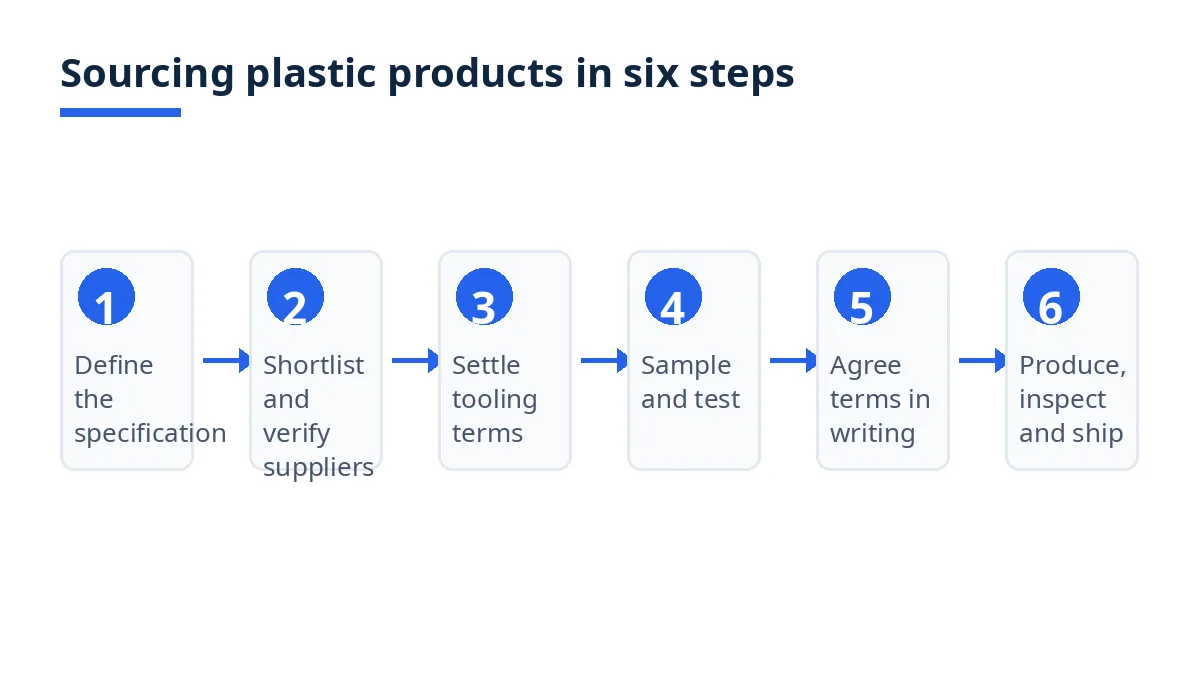
Step-by-step buying process
Define the specification. Write the article before you shop for it: HS subheading, resin or compound grade, mould and cavity position, dimensions, wall thickness and piece weight with tolerances, colour and finish, food-contact status, packing, target quantity per article and colour, and destination market.2 3
Shortlist and verify suppliers. Build a shortlist from the industry pillar and supplier listings, confirm the process and site address for your article, then run the specification, mould, document and test-file checks above.1 4
Settle tooling before sampling. Agree who pays for, owns, holds and maintains the mould, how it is identified, and how it is released on a move — recorded in the purchase documents before mould making starts.
Sample and test. Approve a pre-production sample off the production mould and a counter-sample in writing, and test production-representative articles against the specification, including migration evidence where the article touches food.3 5
Agree commercial terms in writing. Fix MOQ per article and colour, the itemised unit price with tooling shown inside or outside it and its validity period, the Incoterm with its named place, the staged lead time with mould and testing stages separate, payment terms and the inspection point, all in the purchase order.6
Produce, inspect and ship. Monitor the mould trial and first run, inspect finished goods against the approved counter-sample and agreed sampling basis, then ship with the origin evidence your duty position depends on.5 7
Related guides (links to cluster articles)
Read the plastic and melamine products industry in Bangladesh pillar for export data, products, clusters and key players, how to import from Bangladesh for the general import sequence, and Incoterms for shipments from Bangladesh for the delivery terms in detail. The companion guide on sustainable plastic products from Bangladesh covers recycled-content and green-claims verification in depth and is the next read where an offer carries an environmental claim.
FAQs
Is Bangladesh a good place to source plastic & melamine products?
Bangladesh is a credible sourcing option for plastic household goods, packaging articles, pipe and melamine tableware where the specification, resin grade, mould ownership and food-contact file are managed actively. Plastic-goods shipments were USD 284.05 million in FY2024-25 on the EPB series, up 16.21 percent on the year, with PVC bags and kitchenware and tableware the named growth lines.1 The constraints to price in are import-linked moulds and resin and offshore certification testing.1 Source factory by factory, not on the country label.
What is the typical MOQ?
There is no published typical MOQ, and no official body sets one. Each factory quotes its MOQ from its production stage: a machine and mould minimum per moulded design and colour, an extrusion and printing minimum per film, bag or pipe size and design, or a pressing minimum per melamine shape and colour. A new mould adds a tooling charge or committed volume beside the production minimum, so ask for the two figures separately.
How long is the lead time?
There is no standard lead time: yours is the sum of its stages, resin or compound purchase, mould making or preparation where it applies, moulding, extrusion or pressing, printing and finishing, inspection and booking, and transit. On a new design the mould stage sits before production and is usually the longest single stage, and a food-contact article adds the offshore testing link.1 Ask for the stages separately and agree in writing what starts the clock.
Which certifications matter?
The documents that matter are the ones your destination market and buyers require for the exact article. For EU food-contact plastics, the operative file is Regulation (EU) No 10/2011: authorised substances only, specific and overall migration limits met, and a written declaration of compliance for the finished article, as clarified by Regulation (EU) 2025/351.3 For shipment inspection, the sampling system is ISO 2859-1, with the AQL values and defect classes set in your own order documents.5 At origin, ask which Bangladesh standards and any mandatory certification cover your article and read the certificate against site and product. Buyer-named audits sit on top of the legal file and do not replace it.
Next steps on Exportain
Browse Bangladeshi suppliers by plastic or melamine product, use Exportain trade intelligence for the market picture, and post a free RFQ at Exportain RFQs with your specification, quantity and destination market so suppliers quote against the same brief, with tooling shown on the same basis.
Sources
- Plastic export earnings up 147pc in 5 yrs. The Financial Express, (accessed )
- Harmonized System: Chapter 39 Plastics and articles thereof notes. World Customs Organization (accessed )
- Plastic materials and articles in contact with food: Regulation (EU) No 10/2011 summary. European Commission, EUR-Lex (accessed )
- Supplier verification: Earn trust badges buyers can see. Exportain (accessed )
- ISO 2859-1:2026 - Sampling procedures for inspection by attributes — Part 1: Sampling schemes indexed by acceptance quality limit (AQL) for lot-by-lot inspection. ISO (accessed )
- Incoterms® rules. International Chamber of Commerce (ICC) (accessed )
- EU trade relations with Bangladesh. European Commission, (accessed )
About the author
Sourcing from Bangladesh?
Post a request for quotation and suppliers on Exportain can send you their quotes directly.
Post an RFQ