

Sustainable Plastic & Melamine Products From Bangladesh: Certifications and Green Factories
Sustainable plastic products from Bangladesh is a claims file, not a label. This pillar guide covers how buyers verify recycled content, food-contact compliance, EPR duties at origin and EU green-claims wording, document by document.
Short answer
Sustainable plastic products from Bangladesh means claims a buyer can check: a stated recycled content backed by chain-of-custody records, food-contact compliance for the finished article, the factory EPR position at origin, and green-claim wording that matches the evidence for the exact product and order in hand.
On this page
Key takeaways
The EPR Guidelines on Plastic Waste Management, 2026 were published in the Bangladesh Gazette on 13 August 2026: obligated entities register with the Department of Environment in phases, collect at least 15 percent and recycle 7.5 percent in the first two years, rising to 30 and 15 percent, while establishments producing solely against export orders fall outside the guidelines.
A recycled-content claim is three checkable facts: the input and its origin, the percentage in the finished article, and the chain-of-custody record to your consignment. The Global Recycled Standard verifies and tracks recycled raw materials through the supply chain using the Content Claim Standard, and a certificate for another site does not cover your order.
For EU food-contact articles, Regulation (EU) No 10/2011 requires authorized substances, compliance with specific and overall migration limits and a written declaration of compliance for the finished article; Regulation (EU) 2025/351, applied since 16 March 2025, adds purity, declaration and repeat-use duties.
Recycled plastic in EU food contact follows a separate route under Regulation (EU) 2022/1616: a suitable recycling technology, an EU register of technologies, recyclers and processes, and a recycler declaration of compliance. A general recycled-content certificate does not answer that file.
ISO 14001 certifies an environmental management system for a named organization and site, not a product, a recycled percentage or a migration result. For EU consumer sales, Directive (EU) 2024/825 bans generic claims unless substantiated and allows sustainability labels only on a certification scheme or public authority basis.
Sustainable plastic products from Bangladesh is not a product category with its own label. It is a way of buying plastic and melamine goods: every environmental claim is tied to a named rule, scheme or standard, a current document whose scope covers the site and the article in your order, and a claim wording that says no more than the evidence supports. This pillar guide is for importers, brands, retailers and sourcing agents in the United States, the United Kingdom, the European Union and the United Arab Emirates who want that evidence file. The companion pillar on the plastic products industry in Bangladesh covers the industry's export data, products, clusters and key players in full; this guide does not repeat that data treatment. It deals only with the sustainability layer: recycled-content claims, food-contact compliance, extended producer responsibility (EPR) duties in Bangladesh, green-claims discipline for EU-bound goods, and the document route a buyer follows for each claim.
Market overview with latest data
Keep the market picture brief, because the sustainability file sits at site and article level, not in a national total. No official series opened for this guide separates claim-bearing or certified production from total plastic goods output, so there is no defensible market size for sustainable plastic products from Bangladesh. The verifiable unit is the individual factory, its registration and certificate file, and the consignment in front of you. What has changed, and what a buyer can date and check, is the rule set around the claims.
At origin, the change is the Extended Producer Responsibility (EPR) Guidelines on Plastic Waste Management, 2026. The Ministry of Environment, Forest and Climate Change issued the guidelines by publishing them in the Bangladesh Gazette on 13 August 2026, according to a ministry press release reported by Bangladesh Sangbad Sangstha (BSS), the national news agency.1 The guidelines apply to all recyclable and non-recyclable plastic products and listed products manufactured or used in Bangladesh, and to their manufacturers, importers and brand owners, and they divide plastic products into five categories: rigid plastic, flexible plastic, styrofoam or EPS, single-use plastic not banned by the government, and other products including sanitary napkins, diapers and cigarette filters.1 Reporting of the same gazette states that the guidelines were issued under Section 13 of the Bangladesh Environment Conservation Act 1995.2
The buyer-critical points in the framework are the exclusion, the phasing and the targets. Export-oriented industrial establishments producing products solely on the basis of export orders remain excluded from the guidelines.1 The exclusion is written for the export-only establishment, not for plastic production in general: a factory that also places products on the Bangladesh market is, for those domestic lines, inside the framework. The Department of Environment (DoE) will list the obligated entities in phases, large industrial establishments in the first two years, medium-sized enterprises in the next two years, and small industrial establishments in the fifth year; registration is mandatory within six months of listing and each registration period is three years.1 Obligated entities must collect at least 15 percent of waste and recycle 7.5 percent in the first two years, rising to collecting 30 percent and recycling 15 percent in subsequent years, and organizations must submit a progress report every year, without which registration will not be renewed.1 Obligated entities may manage collection, recycling and disposal independently or jointly through a Producer Responsibility Organisation, waste collected above the target may be sold as plastic credits through government-approved mechanisms, and the DoE will conduct regular inspections, audits and verification, and may take legal action, including suspension or cancellation of registration, where false information is submitted.2 1
At destination, the European Union has tightened both halves of the file in the same period. On product safety, Regulation (EU) 2025/351 has applied since 16 March 2025 as an amendment to the food-contact plastics rules, clarifying substance purity, the declaration of compliance and repeat-use articles, with transitional provisions for materials and articles first placed on the market before 16 September 2026.3 On recycled content in food-contact articles, Regulation (EU) 2022/1616 sets the conditions under which recycled plastic made from waste may be sold for food contact at all.4 Between the product rules and the wording rules sits the scheme layer: the Global Recycled Standard (GRS) is one route buyers use to verify a recycled-content claim, because it is built to verify and track recycled raw materials through the supply chain.5 On claim wording, Directive (EU) 2024/825 requires member states to have transposed its rules by 27 March 2026, with the requirements entering into force through national legislation by 27 September 2026.6 A claim file assembled in 2024 may therefore fail in 2026 on wording alone, even where the product itself has not changed. Each layer is covered, with its document route, in the compliance section below.
Main products and production clusters
The sustainability question changes with the product family, not with the district the factory sits in. Production clusters, capacity and the industry's product range are covered in the industry pillar linked above; the claim layer follows the article, its material and its end use.
Product family | The claim you will hear | What actually proves it |
|---|---|---|
Melamine tableware and plastic kitchenware | Food-safe, food-grade, suitable for repeated use | The finished-article food-contact file: declaration of compliance and migration evidence for the exact article, material and color, in the compliance section below |
Household and storage goods, hangers, brushes and other molded articles | Made with recycled content, a stated percentage of recycled plastic | Chain-of-custody records for the input and a scheme certificate whose scope covers the site and product category, plus the percentage stated per article, not per factory |
Film, bags and packaging articles | Recycled content, recyclable, EPR-compliant supply | The input record as above; for packaging placed on the Bangladesh market, the producer's EPR registration position; for EU consumer sales, claim wording that meets the green-claims rules |
Pipe, tanks and builders ware | Recycled content, long service life | The material specification and the stated recycled share for that product line; a durability claim is a factual claim about the article and needs test or specification evidence behind it |
PET flakes, regrind and recycled resin sold as an input | Food-grade recycled material, closed-loop material | The recycling technology and registration route for food-contact use where food contact is claimed; for non-food use, the input origin and sorting record |
Two rules cut across the table. First, a sustainability claim does not change the customs heading: the heading follows the article and its material, so agree the six-digit subheading with your supplier and broker before you order, as the industry pillar explains. Second, read every claim at article level: a factory may run one line on documented recycled input and the rest on virgin resin, and hold a certificate for one site while your order is made at another. The claim that matters is the one attached to your article, your site and your consignment.
How to find and verify suppliers
Find suppliers through more than one channel so you can cross-check what a factory tells you. Start with the association and listing routes set out in the industry pillar, add Bangladesh export data for context, then work Bangladeshi suppliers listings by product. With each candidate, separate four questions suppliers often merge into one green description: what exactly is claimed, which rule or scheme stands behind it, which site and article the document covers, and whether it is current at the date your order ships.
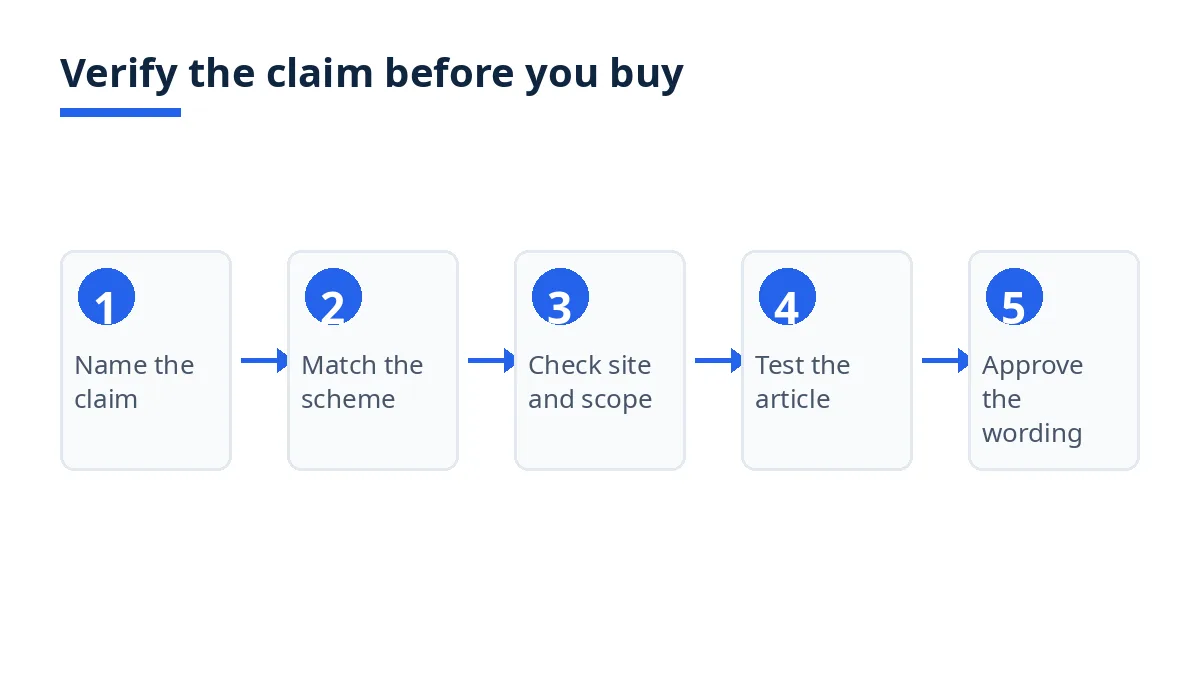
Verification for a sustainability claim is a document exercise. Ask for, and read, the following before you discuss price in detail:
The claim list itself, in writing: every environmental statement in the offer, each one matched to the rule, scheme or standard behind it. A claim the supplier will not list is a claim you cannot verify.
The EPR position at origin: whether the establishment produces solely against export orders, in which case it falls outside the EPR Guidelines 2026, or also sells into Bangladesh, in which case ask whether it has been listed by the DoE, whether it is registered, and for its latest annual progress report position.1
The recycled input record, where recycled content is claimed: the input type and origin, the percentage claimed for your article, and the chain-of-custody documentation that follows the material to your consignment, including a scheme scope certificate where a scheme such as the GRS is named.5
The food-contact file, where the article will touch food: the declaration of compliance for the finished article and the migration evidence behind it, for the material and color you are buying, as the compliance section sets out.3
The environmental management file, where a green factory claim is made: the certificate relied on, its issuing body, site address and scope, plus the operating records behind it, such as waste transfer records for production scrap and rejected stock.
The site file: trade license and export registration in the company's own name, the factory address you will inspect against, and export history for your target market showing product and recency.
A traceability test on one consignment: the supplier identifies the input lot, the production run and the carton range your test batch went into, while you time it.
On Exportain, read badges for what they are. Supplier profiles carry document and photo review badges: verification is free, the seller completes each check in the verification centre of the seller portal, Exportain staff review every submission, and approved checks earn badges shown on the company page, product listings and quotations.7 It is a document and photo review, not a factory inspection, an environmental audit or a guarantee, and membership plans never grant a trust badge.7 Exportain is not a party to the contract for goods; it does not inspect goods, book freight or clear customs. Use the badge as a first filter, then run the checks above yourself or through an inspection firm you appoint.
Two red flags end a conversation early: a supplier that markets a management-system certificate as proof that a specific product is recycled or food-safe, and a factory that states a recycled percentage for its output in general but cannot state the input lot and percentage for the article it is quoting you.
MOQ, pricing and lead times
There is no industry-wide MOQ, standard price or standard lead time for plastic or melamine products from Bangladesh, and no official body publishes one. All three are quoted per factory, per article and per order, against a written specification. Claim-bearing production moves all three, and the movement should be visible in the quote rather than absorbed into one higher price.
MOQ. The minimum is set by the production stage and by the claim. A molded article carries a machine and mold minimum per design and color; a certified-input order adds a segregation minimum, because a production run on documented recycled input must be large enough to run, record and keep separate from virgin-input production; a new food-contact article adds testing that a factory will not commission below a commercial volume. State your target quantity per article, per color and per claim in your enquiry, and ask which parts of the quoted minimum are production minimums and which are documentation or testing minimums.
Pricing. Your unit price is built from resin or compound cost, molding or extrusion cost, color masterbatch and printing, assembly and finishing, packing into cartons, and export costs to the agreed Incoterm point. The sustainability file adds identifiable lines: certified or documented recycled input where it prices above virgin resin, segregation and chain-of-custody record keeping, migration or other testing for the article, audit and certification fees spread across volume, and, for a supplier's domestic lines, EPR collection and recycling costs under the 2026 guidelines.1 Ask for those lines itemized: a compliance premium that cannot be itemized cannot be checked at renewal, and a quote that drops the evidence lines is usually dropping the evidence.
Example figures. For illustration only: 30,000 storage boxes with a stated recycled-content claim, quoted by two suppliers at the same Incoterm, FOB Chattogram. Supplier A quotes USD 1.24 per box itemized as material and molding USD 0.86, documented recycled input and chain-of-custody records USD 0.12, article testing USD 0.06 and packing and export costs USD 0.20. Supplier B quotes USD 1.09 per box with no itemization and no input record offered. The worked example totals are USD 37,200 from Supplier A and USD 32,700 from Supplier B. The example shows the method, not a market price: the buyer asks Supplier B for the same itemization and the input record behind the claim before treating the USD 4,500 gap as a saving, because an unitemized gap on a claim-bearing article is usually undocumented input or a thinner section.
Lead times. A lead time is a chain, not a single number: resin or compound purchase, mold making or preparation where it applies, molding or extrusion, printing and finishing, inspection and booking, then transit. Claim-bearing orders add two links: documented input must be procured and recorded before the run, not substituted during it, and any test report, certificate renewal or registration step your claim depends on must be current at shipment. Ask for the stages separately and agree what starts the clock, normally written order confirmation plus approved sample.
Quality, certifications and compliance
Quality in this category is decided by three layers: the Bangladesh rules at origin, the destination market's product and claims law, and your own specification and testing. No single certificate covers all three, none is required for every product in every market, and a certificate proves only what its scope says: that site, those activities or products, that standard, until that expiry date.
EPR duties in Bangladesh: the origin layer. The EPR Guidelines 2026 make producers, importers and brand owners responsible for the post-use management of plastic products placed on the Bangladesh market, through the DoE listing, registration and reporting route described in the market overview.1 2 For an export buyer, the operative questions are narrow. If your supplier produces solely against export orders, its establishments fall outside the guidelines, and the correct file entry is that exclusion, stated by the supplier in writing.1 If the supplier also sells domestically, its EPR registration and annual reporting form part of its regulatory standing at origin, and a registration lapsed for failure to report is a fact about the factory you are relying on.1 Do not accept an EPR registration, where one exists, as evidence about your export consignment: the framework governs products placed on the Bangladesh market, not the recycled content or safety of the goods in your container.2
Recycled-content claims: state the input, the percentage and the custody chain. A recycled-content claim is three facts, not one adjective: what the input was, what share of the finished article it forms, and how it was tracked from input to consignment. Textile Exchange describes the Global Recycled Standard (GRS) as a full product standard to verify and track recycled raw materials through the supply chain, which also includes processing criteria to prevent the use of potentially hazardous chemicals and verifies social or environmental production at the facilities, and which uses the chain of custody requirements of the Content Claim Standard (CCS).5 Read a GRS claim at that scope: the standard is a verification and tracking system for recycled material, operated through certification of the organizations in the chain. It is not a food-contact approval, not a statement that the whole factory output is recycled, and not a substitute for the destination market's product law. Verify it by matching the certificate to the legal entity, site, product category and validity dates in your order, and by asking for the chain-of-custody record that connects the certified input to your shipment. Where no scheme is used, the claim rests on the supplier's own input invoices, production records and mass balance for the run; ask for those records and state in the purchase order that the percentage is per finished article.
Recycled plastic in food contact: a separate, stricter route in the EU. Recycled content and food contact pull in opposite directions, and the EU regulates the combination directly. Regulation (EU) 2022/1616 lays down the rules for the sale of plastic materials and articles manufactured with a suitable recycling technology from waste plastic that are intended to come into contact with food, for the development and operation of the recycling technologies, processes and installations that produce that recycled plastic, and for the use of recycled plastic in food contact.4 Suitable technologies must ensure the recycled plastic is microbiologically safe and does not release its constituents into food in amounts that could endanger human health or unacceptably change the food's composition or its color, aroma, taste and texture, and recyclers must draw up a compliance monitoring summary sheet for each decontamination installation and provide a declaration of compliance in the form the regulation sets out.4 The buyer route follows from that structure: where a supplier offers recycled content in a food-contact article for the EU, ask which technology and installation produced the recycled plastic, how it appears in the EU register the regulation establishes for technologies, recyclers, processes, schemes and decontamination installations, and for the declaration and monitoring documents behind the batch.4 A general recycled-content certificate does not answer those questions. For non-food articles, the 2022/1616 file does not apply, and the claim is verified through the custody chain above.
Food-contact compliance: Regulation (EU) No 10/2011 and the 2025/351 update. Commission Regulation (EU) No 10/2011 governs plastic materials and articles intended to come into contact with food placed on the EU market. Only substances included in the EU list of authorized substances may be used in manufacture, all plastic materials and articles must comply with the specific and overall migration limits in the regulation's annexes, and the manufacturer must draw up a written declaration of compliance identifying the materials, articles and intermediate products and their substances, renewed when substantial changes in composition or production occur.3 Melamine tableware sits inside this regime as a plastic article, so the compliance question is the migration behavior of the finished molded article, tested in the material and color you are buying. Regulation (EU) 2025/351, applied since 16 March 2025, further clarifies the rules: substances used in manufacture, including those manufactured from waste, must be of a high degree of purity, the declaration must include additional information needed to demonstrate food safety, including, where relevant, information on non-intentionally added substances and on material intended for reprocessing, and repeat-use articles must be designed to prevent increased migration over successive uses and be accompanied by information on safe use.3 Materials and articles that complied with the previous rules and are first placed on the market before 16 September 2026 may continue to be placed on the market until stocks are exhausted.3 Write the destination rule set into your purchase specification, because a file built for one market does not discharge another.
Green claims for EU-bound goods: Directive (EU) 2024/825. Product law decides whether the article may be sold; claims law decides what you may say about it. Directive (EU) 2024/825, the Empowering Consumers for the Green Transition Directive, protects consumers against greenwashing, and its requirements enter into force through national legislation by 27 September 2026, applying to EU and EEA traders and to non-EU companies selling to EU and EEA consumers.6 Under the rules as summarized by Ireland's Department of Enterprise, Trade and Employment, generic claims such as eco-friendly or carbon neutral are banned unless substantiated, sustainability labels are only allowed if based on a certification scheme or established by public authorities and verified by an independent third party, traders may not suggest a benefit applies to the entire product or business when it relates only to a specific part or base a neutral or reduced greenhouse gas claim on offsetting, and future performance claims need clear, verifiable commitments, an implementation plan with measurable, time-bound targets, and regular independent verification.6 Apply that discipline at artwork stage: replace a generic word with the specific, evidenced fact, state which part of the product the fact covers, and keep the supporting document in the order file for as long as the claim stays on the pack.
Environmental management certification: ISO 14001. ISO describes ISO 14001 as the internationally recognized standard for environmental management systems: a framework for an organization to design and implement an environmental management system and continually improve its environmental performance, covering resource usage and waste management through to monitoring environmental performance.8 ISO 14001 enables certification by third-party certification bodies, organizations should use the full designation when referring to certification, for example certified to ISO 14001 followed by the edition year, and certified organizations usually undergo surveillance audits annually, with a recertification audit every three years; the current edition is ISO 14001:2026.8 Read the claim at that scope: the certificate attests that the named organization at the named site runs a management system meeting the standard. It does not certify a product, state a recycled percentage, set a migration or discharge result for your consignment, or replace the EPR position, the food-contact file or a recycled-content custody chain. Verify it through the certificate number and issuing body, and check that the site address and scope match the plant making your order.
Your own quality system. Write the specification so an inspector can measure it: resin or compound grade, the recycled input type and percentage per article where claimed, dimensions and wall thickness, weight per piece, color reference, print placement, and packing by pieces per carton with carton dimensions and gross weight. Approve a pre-production sample, a counter-sample and the final artwork including every claim in writing, set the inspection point before cartons are sealed, and test production-representative goods for migration where the article touches food.
Shipping, Incoterms and duties
Plastic goods from Bangladesh normally leave by sea from Chattogram, the country's main seaport. Claim-bearing cartons must stay identifiable to the consignment the documents describe, so carton marks, lot codes and packing lists should carry the same identifiers as the custody and test file; and bulky molded goods ship on volume, so pieces per carton and carton dimensions set your freight cost per unit under any Incoterm.
Incoterms® 2020 is the current edition of the ICC rules, in force since 1 January 2020. The rules are eleven three-letter trade terms that clarify the tasks, costs and risks involved in the delivery of goods from sellers to buyers, and they are recognized as the global standard for interpreting the most common terms in foreign trade.9 In your own words, the four rules you will meet most often on orders in this category work as follows:
Rule | Who arranges and pays main freight | Where risk passes to the buyer | Practical note for plastic goods |
|---|---|---|---|
EXW (Ex Works) | Buyer | At the seller's premises | Buyer carries export clearance workload; rarely suitable for a first order |
FOB (Free On Board) | Buyer | When goods are on board the vessel at the named loading port | The common Bangladesh term for container loads; name the port, for example FOB Chattogram, Incoterms® 2020 |
CIF (Cost, Insurance and Freight) | Seller, plus minimum insurance | When goods are on board at the loading port | Seller's freight is convenient, but risk still passes at loading, not at arrival |
DAP (Delivered at Place) | Seller | At the named destination place, ready for unloading | Buyer still clears import and pays duty unless the contract says otherwise |
Always write the rule with its named place and edition, for example "FOB Chattogram, Incoterms® 2020". Exportain does not book freight or clear customs, so the freight forwarder and customs broker are separate appointments to name in the order paperwork.7
Duties are decided by the heading, the origin of the goods and the destination's preference scheme, in that order. As a least developed country, Bangladesh benefits from the Everything But Arms (EBA) arrangement under the EU's Generalised Scheme of Preferences, which grants duty-free, quota-free access to the EU for exports of all products except arms and ammunition, and 91 percent of Bangladesh's exports to the EU enter duty- and quota-free.10 Bangladesh is the largest beneficiary under the EBA arrangements, with EUR 19 billion in exports benefitting from these preferences in 2024 at a 96 percent utilization rate.10 Plastic goods that meet the EBA rules of origin and are shipped with the required proof of origin therefore enter the EU without customs duty while Bangladesh holds that status. Two cautions apply. First, preference is a property of the consignment, not the country: if the origin evidence fails, the standard third-country duty for the heading applies. Second, EBA status waives duty only: the food-contact file, the recycled-plastic rules and the green-claims discipline above apply in full to a duty-free consignment. For the United States, the United Kingdom and the UAE, read the duty beside your confirmed six-digit code in the destination tariff for the entry date; this guide states no rate for them, because rates vary by heading and by article.
The buying process below pulls these threads together.
Step-by-step buying process
Define the specification and the claims. Write the product before you shop for it: HS subheading, resin or compound grade, the exact claims you intend to make, the rule or scheme behind each one, article dimensions and weight, color and print, packing, target quantity per article and design, and destination market.
Shortlist and verify suppliers. Confirm the factory address and its EPR position at origin, then run the claim list, recycled input, food-contact file and traceability checks in the verification section.1 5 7
Sample, test and approve the wording. Test production-representative goods against the specification, and approve a counter-sample and the destination label and artwork proof, including every claim, in writing.3 6
Agree commercial terms in writing. Fix MOQ per article and claim, itemized unit price with its validity period and compliance lines shown separately, the Incoterm with its named place, the staged lead time and its start point, payment terms and the inspection point, all in the purchase order.9
Produce, inspect and ship. Monitor input procurement and the production run first, inspect finished goods against the approved counter-sample and specification, assemble the custody, test and registration records for the shipped lots, then ship with the origin evidence your duty position depends on.4 10
Related guides (links to cluster articles)
Read the plastic products industry in Bangladesh pillar for the industry's export data, products, clusters and supplier structure behind this sustainability layer, how to import from Bangladesh for the general import sequence, and Bangladesh export data for category scale. The guide to Incoterms for shipments from Bangladesh works through the delivery terms in more detail.
FAQs
Is Bangladesh a good place to source plastic & melamine products?
Bangladesh is a credible sourcing option for plastic household goods, packaging articles and melamine tableware where the claim file is managed actively, factory by factory. The origin rule set is now dated and checkable: the EPR Guidelines 2026 were published in the Bangladesh Gazette on 13 August 2026 and set collection and recycling targets for obligated entities placing products on the domestic market, while export-only establishments fall outside their scope.1 2 No official series separates claim-bearing production from total output, so the sustainable supply base is the set of factories whose certificates, custody records and test files you have checked for your article, not a country-level label.
What is the typical MOQ?
There is no published typical MOQ for plastic or melamine products from Bangladesh, and no official body sets one. Each factory quotes its MOQ from its production stage: a machine and mold minimum per molded design and color, an extrusion and printing minimum per film or bag size and design, or a pressing minimum per melamine shape and color. A claim-bearing order adds segregation, documentation and testing minimums on top of the production minimum, so ask for the two separately and state your target quantity on the same basis in your enquiry.
How long is the lead time?
There is no standard lead time: yours is the sum of resin or compound purchase, mold making or preparation where it applies, molding or extrusion, printing and finishing, inspection and booking, and transit. Two links carry dated constraints on a claim-bearing order: documented recycled input must be procured and recorded before the production run, and any test report, certificate or registration your claim depends on must be current at shipment, which matters where an EPR registration runs for a three-year period and a management-system certificate runs on annual surveillance.1 8 Ask for the stages separately and agree in writing what starts the clock.
Which certifications matter?
The certifications and documents that matter are the ones your destination law, your channel and your product claims require for the exact article and site; none is a general badge. For EU food-contact plastics, the operative file is Regulation (EU) No 10/2011 as updated by Regulation (EU) 2025/351: authorized substances only, migration limits met, and a written declaration of compliance for the finished article.3 Recycled plastic in EU food contact adds the suitable-technology and register route of Regulation (EU) 2022/1616.4 A recycled-content claim may be verified through the Global Recycled Standard,5 and an environmental management claim may rest on ISO 14001, which certifies a management system for a named organization and site, not a product.8 Consumer-facing wording for EU sales must also meet Directive (EU) 2024/825.6
Next steps on Exportain
Browse Bangladeshi suppliers by plastic or melamine product, use Exportain trade intelligence to check the market picture behind this guide, and post a free RFQ at Exportain RFQs with your specification, the claims you need evidenced, target quantity and destination market so suppliers in this category can quote against the same written brief.
Sources
- EPR guidelines on plastic waste management issued. Bangladesh Sangbad Sangstha (BSS), (accessed )
- Bangladesh enforces 2026 EPR guidelines, divides plastic products into 5 categories. The Financial Express, (accessed )
- Plastic materials and articles in contact with food: Regulation (EU) No 10/2011 summary. European Commission, EUR-Lex (accessed )
- Recycled plastic packaging in contact with food: Regulation (EU) 2022/1616 summary. European Commission, EUR-Lex (accessed )
- What is the Global Recycled Standard (GRS)?. Textile Exchange (accessed )
- Directive (EU) 2024/825 – Empowering Consumers for the Green Transition. Department of Enterprise, Trade and Employment, Ireland (accessed )
- Supplier verification: Earn trust badges buyers can see. Exportain (accessed )
- ISO 14001:2026 - Environmental management systems. International Organization for Standardization (accessed )
- Incoterms® rules. International Chamber of Commerce (ICC) (accessed )
- EU trade relations with Bangladesh. European Commission, (accessed )
- quality control
- Category Pillars
- Supplier Sourcing
- GRS
- Sustainability certifications
- Plastic products
- Melamine tableware
About the author
Sourcing from Bangladesh?
Post a request for quotation and suppliers on Exportain can send you their quotes directly.
Post an RFQ


