Best Incoterm for Importing Ceramics & Tableware From Bangladesh
FCA is the best Incoterm for most ceramics and tableware imports from Bangladesh by sea in a container, with CIP the better choice for high-value porcelain. This guide compares all seven realistic terms, the insurance each one buys, and the packing and breakage rules that protect a fragile load.
Short answer
For most buyers, FCA is the best Incoterm for importing ceramics and tableware from Bangladesh by sea in a container, with CIP as the better choice for high-value porcelain or air freight. FCA passes risk at handover to the carrier, which matches how containers move, and lets you control freight and insurance. CIP adds all-risk cover bought by the seller. First-time buyers can use DAP for a single delivered price, while DDP works only when the seller can clear import customs in your country.
On this page
Key takeaways
FCA is the usual choice for containerised ceramics from Bangladesh, because risk passes at handover to the carrier.
FOB is the wrong term for containers: risk passes only on loading, leaving a gap at the terminal.
CIF buys only minimum Clause (C) cover, which does not cover handling damage; CIP buys all-risk Clause (A) cover.
Agree packing, a breakage allowance and the insurance clause in the purchase order before production starts.
Ceramics and tableware are among the most unforgiving goods to import. A dinner set that leaves a factory in Gazipur in perfect condition can arrive overseas as shards if the delivery term, the packing and the insurance do not work together. This guide explains which Incoterm fits a ceramics shipment from Bangladesh.
What is the best Incoterm for importing ceramics from Bangladesh?
For most buyers, FCA is the best Incoterm for importing ceramics and tableware from Bangladesh by sea in a container, with CIP as the better choice for high-value porcelain or air freight. FCA gives you control of the main carriage and your own insurance, and risk passes at handover to the carrier. CIP adds all-risk insurance bought by the seller. First-time buyers who want a single price to their door can use DAP, while DDP is worth using only when the seller can genuinely clear import customs in your country.
Incoterms 2020, the current edition of the International Chamber of Commerce rules, contains 11 rules that divide cost, risk and obligations between seller and buyer.1 The rules settle who pays for carriage, who clears customs and who insures the goods, but they do not set the price or the payment terms.2
Why does ceramics change the Incoterm decision?
Bangladesh is a real source for this trade. The country has 75 ceramic manufacturers, including 20 tableware producers, and its factories can produce 310 million pieces of tableware a year.3 Ceramic exports reached more than 50 countries, with export earnings of $35.22 million in FY25.3 The Incoterm you choose decides who bears the loss when a container of plates is damaged.
How does each Incoterm work for a ceramics shipment?
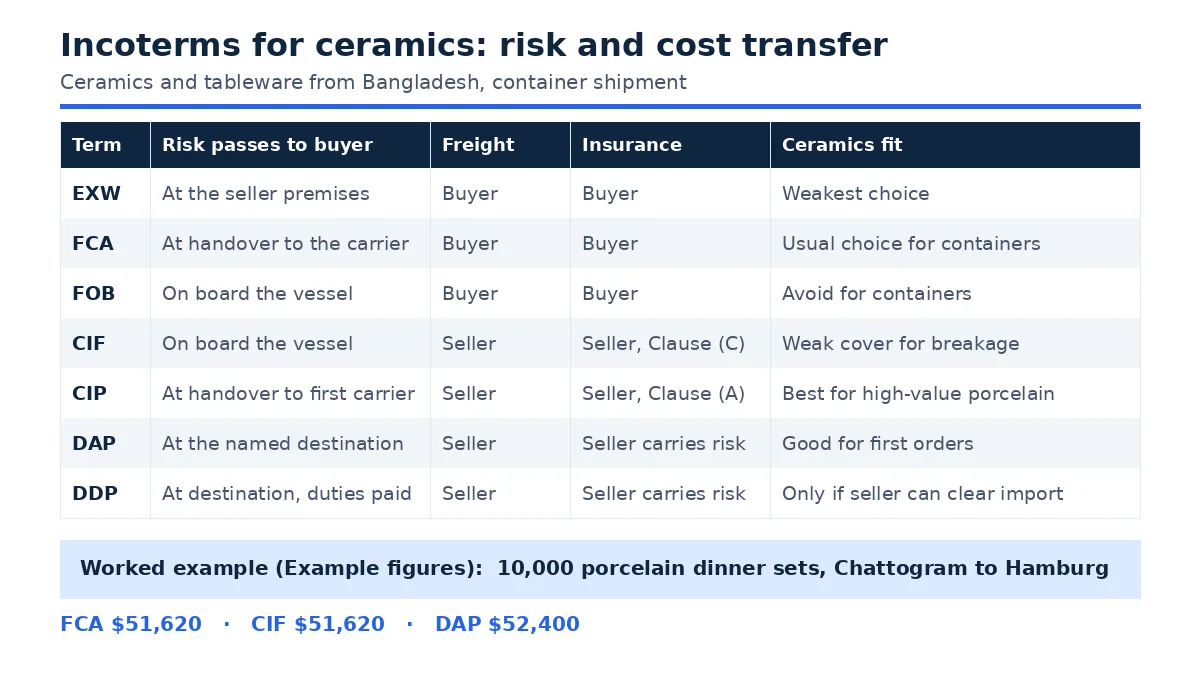
The table below compares the seven terms a ceramics buyer is most likely to use. EXW, FCA, CPT, CIP, DAP, DPU and DDP work for any mode of transport, while FOB, CFR and CIF are sea and inland waterway rules only.2
| Incoterm | Risk passes to buyer | Main carriage paid by | Insurance | Import clearance and duty | | EXW | At the seller premises | Buyer | Buyer arranges own cover | Buyer | | FCA | At handover to the carrier | Buyer | Buyer arranges own cover | Buyer | | FOB | When loaded on board the vessel | Buyer | Buyer arranges own cover | Buyer | | CIF | When loaded on board the vessel | Seller | Seller, minimum cover only | Buyer | | CIP | At handover to the first carrier | Seller | Seller, all-risk cover | Buyer | | DAP | At the named destination, ready for unloading | Seller | Seller carries the risk to destination | Buyer | | DDP | At the destination, duties paid | Seller | Seller carries the risk to destination | Seller |
Why is FCA the usual choice for a container of ceramics?
Under FCA, the seller delivers the goods, cleared for export, to a carrier you name, and risk passes at handover.2 That point matches the real journey of a container, which is handed to the carrier at a terminal days before it is loaded on a vessel. FCA is the recommended rule for containerised cargo, and the ICC guidance is to use FCA, or CPT and CIP, for containerised goods instead of the sea-only rules.2
What is wrong with FOB for a container of tableware?
FOB is the term most buyers ask for out of habit, and it is the most common mistake in container trade. FOB, CFR and CIF were written for bulk cargo loaded directly onto a ship, and with containers you hand the box to the terminal days before loading.2 Under FOB the risk passes only when the goods are loaded on board, so during the gap at the terminal the container is out of the seller's hands while the risk still sits with the seller. For a container, use FCA instead of FOB.
When do DAP and DDP suit a ceramics buyer?
Under DAP the seller delivers to the named destination, ready for unloading, and you handle import clearance and duties.2 Under DDP the seller delivers with import duties and taxes paid, which is the maximum seller obligation.2 DAP suits a first order or a small buyer who wants one price to the door. DDP suits a buyer who cannot clear customs in the destination country, but it puts real cost and risk on a seller who may not know your country's rules.2
What does insurance actually cover under CIF and CIP?
Only two Incoterms 2020 rules oblige anyone to buy insurance: CIF and CIP, and in both the obligation sits with the seller, for the buyer's benefit.4 Under CIF, minimum cover under Institute Cargo Clauses (C) is enough. Under CIP, the ICC requires Clause (A) cover, with an insured value of at least 110 percent of the contract price.4 Clause (A) covers all risks except those expressly excluded, while Clauses (B) and (C) only cover the risks they list, and (C) is the narrowest, built for major events such as fire, sinking and collision.4 Theft, pilferage and handling damage are only covered under Clause (A).4
That difference decides claims on ceramics. A chipped rim from handling or a carton dropped at a terminal is the kind of damage Clause (C) does not cover, so a buyer on CIF terms who expects the seller's policy to pay for breakage will be disappointed. The fix is to negotiate CIP, or to buy a top-up policy yourself, and to ask for the seller's policy before the goods ship.4 All three clause levels also exclude insufficient packing, so a weak carton can turn a claim into a refusal.4
If you buy on FCA, FOB or EXW, no one is obliged to insure, so buy your own all-risk policy with breakage cover confirmed in writing.4 Standard marine cargo cover does not automatically include full breakage cover for fragile goods, and many policies exclude or restrict breakage of brittle articles unless specifically endorsed.5 Confirm in writing with your insurer whether breakage is covered, what packing standard is required and what the deductible is.5
How do packaging and breakage rules fit the Incoterm?
The Incoterm decides who pays when goods break. The packing specification decides how often they break, so agree the packing in the purchase order before production starts.
Ceramics break in three ways, and each needs a different defence: compression, when the weight stacked above crushes the pieces below; shock, from a dropped carton or a forklift bump; and vibration and abrasion, which work pieces loose over weeks at sea until glaze rubs and rims chip.5 A packing plan that covers only one of the three still produces claims.5
A practical packing plan has four layers. Each piece is wrapped so that no ceramic surface touches another, with extra material at rims, spouts, handles and feet.5 Wrapped pieces go into cells made by corrugated dividers or small inner boxes, which immobilise them against vibration and carry some vertical load.5 The master carton should use double-wall board, with a base pad and a top pad, and a maximum gross weight one person can handle, commonly around 20 to 25 kilograms.5 Cartons are then stacked in an interlocking pattern on a pallet, with edge protectors and straps.5
Agree an acceptable breakage allowance before you order, commonly a low single-digit percentage in typical market practice, with a clear remedy such as credit against the next order or replacement in the following shipment.5 Prefer a full container over a shared container: a full container is loaded once, sealed and opened at destination, while shared-container cargo is handled multiple times and stacked next to unknown goods.5 If your volume only fits a shared container, compensate with heavier packing and full palletising.5
What about duties, HS codes and EU preferences?
The Incoterm does not set your duty, but it decides who pays it. Under DDP the seller pays import duty, under every other term in the table above you do. Check the duty before you agree the price.
For the EU, Bangladesh currently enjoys duty-free, quota-free access under the Everything But Arms scheme, which covers all products except arms and ammunition for least developed countries.6 That preference is the reason DAP often works well for EU buyers: the duty at import is zero under the scheme. The preference position is changing as Bangladesh prepares to graduate from least developed country status, and the government is pursuing a free trade agreement and the GSP+ facility alongside it.6 Confirm the preference with your broker before each shipment.
Ceramic tableware sits in Chapter 69 of the Harmonized System. Heading 6911 covers tableware, kitchenware, other household articles and toilet articles of porcelain or china, while heading 6912 covers the same goods made of anything other than porcelain or china, such as stoneware and earthenware.7 Within 6911, subheading 6911.10 covers tableware and kitchenware.7 The split turns on the ceramic body, not the glaze or the decoration, so get a written statement of body type and composition from the factory and put it on the commercial documents.7
A worked example: one container of porcelain dinner sets
Example figures. A buyer in Germany orders 10,000 porcelain dinner sets from a factory in Gazipur. The goods value is $48,000, the ocean freight from Chattogram to Hamburg is $3,200, the all-risk insurance premium is $420, and the import duty is zero under the Everything But Arms preference.
Under FCA Chattogram, the buyer pays $48,000 for the goods, then $3,200 for freight and $420 for insurance, a total of $51,620. Risk passes at handover to the carrier.
Under CIF Hamburg, the seller quotes $51,620 as well. The seller pays the freight and buys minimum Clause (C) cover, while risk passes on loading at Chattogram. If a pallet is damaged by handling at the destination terminal, the buyer's claim under Clause (C) is likely to fail.
Under DAP Hamburg, the seller quotes $52,400 for goods, freight and insurance to the buyer's warehouse. Risk stays with the seller until arrival. The DAP price is $780 above the FCA total.
What mistakes do ceramics buyers make with Incoterms?
Using FOB for a container. FOB was written for cargo loaded directly onto a ship, not for a sealed container handed to a terminal. Use FCA instead.
Treating CIF as full cover. CIF buys minimum Clause (C) insurance. For fragile tableware, ask for CIP or buy your own all-risk policy with breakage cover.
Leaving packing out of the contract. The Incoterm does not specify board grade, dividers or carton weight. Write the packing specification into the purchase order.
Agreeing DDP without checking import clearance. Under DDP the seller must clear import customs, and in some countries a foreign seller cannot carry out import formalities at all.8
Using EXW to save money. EXW leaves export clearance with the buyer, and a buyer without an agent in Bangladesh can spend more fixing clearance than the term saved.8
How should you write the Incoterm into your contract?
Write the term in full, with the named place and the edition, for example "FCA Chattogram, Incoterms 2020" or "CIP Hamburg, Incoterms 2020". Then add four lines to the purchase order: the packing specification and carton weight limit, the insurance clause and insured value, the breakage allowance and remedy, and the documents that must travel with the goods. Ask the seller to confirm each line in writing before production starts. When the goods arrive, photograph the container before unloading and each damaged piece with its packing intact, because claims are more often lost on missing evidence than on policy wording.5
Next steps on Exportain
Start with the ceramics sourcing guide to find the right product and supplier type, then check the HS code for ceramic tableware to confirm the classification for your market. Use the ceramic tableware quality control checklist to set the inspection points for your order, and read our overview of all 11 Incoterms rules for Bangladesh shipments before you choose. When you are ready to buy, post an RFQ on Exportain with the Incoterm and packing specification written into it.
Sources
- Incoterms® 2020. International Chamber of Commerce (ICC) (accessed )
- Incoterms 2020: the 11 rules, who pays and bears the risk. OVRSEA, (accessed )
- Tk19,000cr ceramics industry gears up for global leap. The Business Standard, (accessed )
- Cargo Insurance for Brazil: Coverage, Incoterms and Claims. DHL (accessed )
- Shipping Bali Ceramics and Pottery Without Breakage. Bali Handicraft Wholesale, (accessed )
- EU invites Bangladesh to share success story in preferential mkt access. The Financial Express, (accessed )
- HS Classification and Preferential Origin for Ceramic Tableware. Storiware (accessed )
- DDP & EXW Incoterms® 2020 explained: Key differences. ICC Academy (accessed )
About the author
Sourcing from Bangladesh?
Post a request for quotation and suppliers on Exportain can send you their quotes directly.
Post an RFQ