Ceramics & Tableware Sourcing Guide for Bangladesh
Ceramics exports were USD 35.22 million on EPB data in the last fiscal year reported, with tableware the main export line. This pillar guide covers products, clusters, supplier checks, MOQ, pricing, food-contact compliance, Incoterms and duties.
Short answer
Bangladesh sources ceramics and tableware through factories concentrated around Gazipur, Narayanganj, Dhaka, Narsingdi, Mymensingh and Habiganj, making porcelain and other ceramic tableware, tiles and sanitaryware. Tableware is the main export line. Buyers source it by fixing body, glaze and decoration in a written specification, verifying an operating factory, testing food-contact migration, and agreeing MOQ, price, Incoterm and lead time per order.
On this page
Key takeaways
Ceramic exports were USD 35.22 million on EPB proceeds data in the last fiscal year reported, down from a peak of USD 68.97 million in 2018-19; BCMEA shipment figures are counted differently and must not be added to the EPB total.
According to BCMEA data, Bangladesh has 76 ceramic factories producing tableware, tiles, sanitaryware and ceramic bricks, including 31 tile factories, concentrated around Gazipur, Narayanganj, Dhaka, Narsingdi, Mymensingh and Habiganj.
Tableware is the primary export line: BCMEA members shipped tableware worth Tk 501.38 crore in the past fiscal year on association shipment figures, while tiles are mainly a domestic product.
There is no industry-wide MOQ, price or lead time for ceramics; all three are quoted per factory and per design against a written specification, with firing and gas supply the main lead-time risk.
For the EU, Council Directive 84/500/EEC sets lead and cadmium migration limits for ceramic articles intended to come into contact with foodstuffs and requires a written declaration under Regulation (EC) No. 1935/2004.
Bangladesh makes ceramic tableware, tiles, sanitaryware and ceramic bricks for a large home market and a smaller export market, and the two markets do not behave in the same way. This ceramics sourcing guide is for importers, retailers, hospitality buyers and sourcing agents in the United States, the United Kingdom, the European Union and the United Arab Emirates weighing Bangladesh as a ceramics origin. It covers export data, products and clusters, supplier checks, MOQ, pricing and lead times, food-contact compliance, shipping, Incoterms and duties, and a step-by-step buying process.
Market overview with latest data
Start with the export figure, and read it on its own terms. According to the Export Promotion Bureau (EPB), ceramic exports in the last fiscal year fetched USD 35.22 million, down from a peak of USD 68.97 million in 2018-19.1 Do not rebuild the total from segment figures published by the industry association, because the two series are counted differently: EPB calculates exports based on the proceeds received, while the industry association tracks the shipment figures only.1 Adding one series to the other double-counts the trade.
The domestic market is the larger business, and that shapes how factories treat export orders. The overall ceramics market stood at Tk 8,250 crore in the 2024-25 fiscal year, according to data from the Bangladesh Ceramic Manufacturers and Exporters Association (BCMEA) reported in September 2026.2 Tiles show the split most clearly: in FY2024-25, local tile sales rose to Tk 5,854.12 crore, but tile export earnings fell to Tk 6.58 crore from Tk 16.77 crore.1 Domestic producers still held 81.94 percent of the tile market in that year.1 A tile factory is therefore mainly a domestic supplier that exports at the margin.
Tableware is the opposite case, and it is the segment this guide is mainly about. Tableware remains the primary export driver: BCMEA members shipped tableware worth Tk 501.38 crore in the past fiscal year, slightly down from a year earlier, while local tableware sales increased to Tk 792.99 crore.1 Keep that figure labelled for what it is, an association shipment figure for its members, separate from the EPB proceeds total above. Sanitaryware sits between the two patterns: its exports rose to Tk 101.89 crore from less than Tk 7 crore three years earlier, while local sales climbed to Tk 1,317.36 crore, accounting for 65 percent of the home market.1
Capacity has grown even as exports have fallen, and that gap is the central fact of the market. Since 2010, production capacity and investment have grown by around 150 percent, the home market has doubled to over Tk 10,000 crore on the measure used in that report, and import dependency has fallen from more than 40 percent to about 15 percent of demand in fiscal year 2024-25.1 According to BCMEA data, Bangladesh has 76 ceramic factories producing tableware, tiles, sanitaryware and ceramic bricks, including 31 tile factories.2 The sector has attracted around Tk 20,000 crore in investment and employs five lakh people, according to the same BCMEA data.2
Two structural costs explain much of the export weakness. The first is imported inputs: more than 90 percent of ceramic raw materials are sourced from abroad, exposing manufacturers to exchange-rate volatility and global supply disruptions.1 The second is energy, covered in the clusters section below: gas tariffs and irregular supply disrupt kiln operations, and production costs were reported to have risen by more than 35 percent while product prices increased by only 7 to 8 percent.1 Export incentives have also narrowed, from 10 percent in 2019 to 6 percent in the current budget reported in April 2026.1 Bangladesh is therefore an origin where the factory you choose, and the kiln time you secure, matter more than the country average.
Main products and production clusters
Ceramic products sit in Chapter 69 of the Harmonized System, and the heading follows the product type and, for tableware, the body material. The headings you will use most often are:
HS heading | What it covers | Typical Bangladesh products |
|---|---|---|
6907 | Ceramic flags and paving, hearth or wall tiles, and mosaic cubes | Floor and wall tiles for domestic and regional sale |
6910 | Ceramic sinks, wash basins, pedestals, baths, bidets, water closet pans, flushing cisterns, urinals and similar sanitary fixtures, including 6910.10 of porcelain or china | Sanitaryware sets and individual fixtures |
6911 | Tableware, kitchenware, other household articles and toilet articles, of porcelain or china, including 6911.10 tableware and kitchenware | Porcelain and bone china dinner sets, tea and coffee sets, plates, bowls, cups and mugs |
6912 | Ceramic tableware, kitchenware, other household articles and toilet articles, other than of porcelain or china, under 6912.00 | Stoneware and earthenware tableware and kitchenware |
6913 | Statuettes and other ornamental ceramic articles | Decorative and giftware pieces |
6914 | Other ceramic articles | Remaining ceramic articles not covered above |
The table follows the Chapter 69 structure published for the Harmonized System, in which 6911 covers tableware, kitchenware, other household articles and toilet articles of porcelain or china, and 6912.00 covers the same kinds of articles other than of porcelain or china.3 Agree the six-digit subheading with your supplier and broker for each product before you place the order. The porcelain or non-porcelain distinction between 6911 and 6912 is a body distinction, not a quality grade, and a stoneware set declared as porcelain will draw a classification query at destination.
The product offer follows the headings. Tableware under 6911 and 6912 is the export core: dinner sets, tea sets, coffee sets, plates, bowls, cups, mugs and serving pieces in porcelain, bone china and stoneware bodies, plain, decorated or printed. Tiles under 6907 are a volume domestic product with a small export tail. Sanitaryware under 6910 is the growth line, sold as matched sets and individual fixtures where glaze colour consistency across pieces matters. Match the factory type to the product: a tableware factory with decoration capacity is the right source for a retail dinner set, and the wrong source for a container of floor tiles, even when both call themselves a ceramics factory.
Ceramic factories are located in Gazipur, Mymensingh, Narayanganj, Habiganj and Bhola, according to BCMEA data.2 The industrial clusters named in the same reporting include Savar and Dhamrai in Dhaka; Rupganj and Meghnaghat in Narayanganj; Kashimpur, Bhabanipur, Bhawal Mirzapur, Sreepur and Mawna in Gazipur; Panchdona in Narsingdi; Bhaluka and Trishal in Mymensingh; and Madhabpur and Bahubal in Habiganj.2 For a tableware buyer, the practical shortlist geography is the Gazipur, Narayanganj and Dhaka belt, with Habiganj and Bhola as secondary locations.
Energy is the cluster issue you must price into every order, because ceramics is a kiln industry. Factories require around 15 pounds per square inch (PSI) of gas pressure, but pressure has frequently dropped to 3 to 4 PSI and at times to zero, forcing many factories to operate at only 34 to 40 percent capacity in the period reported in September 2026.2 Gas accounts for around 12 percent of ceramic production costs, according to the Bangladesh Ceramic Manufacturers and Exporters Association, and kilns require uninterrupted gas supply for about 24 hours, because sudden pressure drops can damage or destroy products inside them.2 Once a kiln is shut down, it takes another 48 to 72 hours to restart after gas pressure returns to normal.2 The association has separately reported zones in Mirpur, Savar, Rupganj and Kashimpur falling from the required 15 PSI to as low as 2 to 3 PSI or zero, resulting in production halts.4 Ask each shortlisted factory, in writing, how it fired its last three export orders. A factory that cannot answer that question cannot give you a reliable lead time.
How to find and verify suppliers
Find suppliers through more than one channel so you can cross-check what a factory tells you. Start with the Bangladesh Ceramic Manufacturers and Exporters Association membership for the segment you are buying, add Bangladesh export data and Exportain trade intelligence for market context, then work Bangladeshi suppliers listings by product, body and heading, and read the neighbouring ceramics industry in Bangladesh pillar for category background. Ask each candidate for its current export markets and reference products in your heading, not for a general company brochure.
Verification is a document exercise first and a kiln exercise second. Ask for, and read, the following before you discuss price in detail:
Trade licence and export registration in the company's own name, matched to the factory address in the cluster list above.
Association membership, where claimed, checked against the segment the factory actually produces, tableware, tiles or sanitaryware.2
Export history: anonymised bills of lading or shipment summaries for your target market, showing heading, product and recency, read against the EPB proceeds picture for the category.1
The body, glaze and decoration specification behind your product, including where the raw materials come from, because more than 90 percent of ceramic raw materials are sourced from abroad.1
Food-contact test reports for the exact body, glaze and decoration you plan to buy, covering the migration requirements in the compliance section below.
Kiln and capacity evidence: kiln count and type, forming method, decoration and printing lines, daily output by product, and how the factory handled gas pressure drops in its most recent export order.2
On Exportain, read badges for what they are. Verification is free, the seller completes each check in the verification centre of the seller portal, and Exportain staff review every submission; approved checks earn badges shown on the company page, product listings and quotations, and the review is a document and photo review, not a factory inspection.5 Membership plans are a separate product and never grant a trust badge.5 A badge is a first filter, not a certification or a guarantee. Exportain is not a party to the contract for goods; it does not inspect goods, book freight or clear customs. Use the badge to shortlist, then run the checks above yourself or through an inspection firm you appoint.
Two red flags end a conversation early. A factory that quotes a firm export price before it has seen your body, glaze, decoration and packing specification is not pricing your product. A factory that will not state its recent kiln record has not answered the first production question.2
MOQ, pricing and lead times
There is no industry-wide MOQ, standard price or standard lead time for ceramics from Bangladesh, and no official body publishes one. All three are quoted per factory, per body and per design, against a written specification. What follows is how each of the three is built, so you can compare quotes on equal terms.
MOQ. The minimum order quantity is set by the production stage, not by the buyer's carton count. A tableware order carries a forming and kiln minimum per shape, a glaze minimum per colour, and a decoration minimum per design, because a kiln load and a decoration run are the units the factory schedules. A tile order carries a minimum per size, surface and shade run. A sanitaryware order carries a minimum per model and glaze colour, because pieces fired in different loads can differ in shade. State your target quantity per product, per shape, per colour and per design, and ask the factory to quote its MOQ on the same basis.
Pricing. Your unit price is built from imported body and glaze materials, forming, firing energy, decoration or printing, sorting and grading, replacement of firing losses, packing, and export costs to the agreed Incoterm point. Raw materials are mostly imported, so the material line moves with the exchange rate,1 and gas is around 12 percent of production cost on BCMEA figures, with kiln interruptions destroying work in progress.2 Domestic fiscal charges also sit inside a factory's cost base: the Bangladesh Ceramic Manufacturers and Exporters Association states that ceramic tiles are subject to a 15 percent supplementary duty and sanitary ware to a 10 percent duty on locally manufactured products, and it has asked for those duties to be withdrawn.4 Compare quotes only at the same Incoterm, body, glaze and packing specification, and ask each factory to state the firing-loss allowance and the price-validity period in writing.
Example figures. For illustration only: a specification for 12,000 porcelain dinner plates with one printed design is quoted by two suppliers at FOB Chattogram. Supplier A quotes USD 2.40 per plate itemised as body, forming and firing USD 1.55, decoration USD 0.35, and sorting, packing and export costs USD 0.50. Supplier B quotes USD 2.10 per plate with no itemisation. The worked example totals are USD 28,800 from Supplier A and USD 25,200 from Supplier B. The example shows the method, not a market price: the buyer asks Supplier B for the same itemisation, and for the firing-loss allowance and glaze specification behind the quote, before treating the USD 3,600 gap as a saving.
Lead times. A lead time is a chain, not a single number: raw material purchase, body preparation, forming, drying, first firing, glazing and decoration, final firing, sorting and grading, inspection, packing and booking, then transit. Kilns require uninterrupted gas for about 24 hours, and a shutdown takes 48 to 72 hours to restart after pressure returns,2 so a failed firing is a remade batch, not a delay of hours. Ask for the lead time broken into its stages, with a stated gas-supply assumption, and agree what starts the clock, normally written order confirmation plus approved sample and decoration artwork, not the first enquiry.
Quality, certifications and compliance
Quality in ceramics is decided by three layers: the destination market's product law, the test methods your goods are sold against, and your own specification and inspection. For tableware, the first layer is food-contact law, because a plate, cup or bowl is an article intended to come into contact with food.
EU food-contact rules for ceramic articles. Under Council Directive 84/500/EEC, ceramic articles are articles manufactured from a mixture of inorganic materials with a generally high argillaceous or silicate content to which small quantities of organic materials may have been added; the articles are first shaped and the shape obtained is permanently fixed by firing, and they may be glazed, enamelled and decorated.6 The Directive is concerned with the possible migration of lead and cadmium from ceramic articles, and it sets limits for these compounds that must not be exceeded by ceramic articles which, in their finished state, are intended to come into contact with foodstuffs, or which are in contact with foodstuffs.6 The quantities of lead and cadmium transferred are determined by a test whose conditions are specified in Annex I to the Directive, using the method of analysis described in Annex II.6 At marketing stages up to and including the retail stage, ceramic articles not yet in contact with foodstuffs must be accompanied by a written declaration in accordance with Article 16 of Regulation (EC) No. 1935/2004, issued by the manufacturer or by a seller established within the EU and containing the information laid down in Annex III to Directive 84/500/EEC.6 Write the Directive, the test and the declaration into your purchase specification for EU orders, and require a test report for the production body, glaze and decoration, not for a showroom sample in a different glaze.
Other destination markets. The United States, the United Kingdom and the UAE each apply their own food-contact and product rules to ceramic tableware, and the test file that satisfies one market does not automatically satisfy another. Name the destination market in the order, name the standard or regulation your importer requires for that market, and require the report to identify the exact product, body, glaze and decoration tested. A retailer's or hospitality group's own vendor manual sits on top of the legal file and must be agreed at sampling stage.
Your own quality system. Write the specification so an inspector can measure it: body type under the correct heading, dimensions and capacity, weight per piece, glaze colour reference, decoration placement and colours, and performance points such as water absorption class for tiles, shade consistency across a sanitaryware set, and freedom from pinholes, cracks, crazing and warping on tableware. Approve a decorated pre-production sample and a counter-sample. Set the inspection point after sorting and grading and before cartons are sealed, because firing faults are visible at sorting and hidden after packing.
Shipping, Incoterms and duties
Ceramics from Bangladesh normally leave by sea from Chattogram, the country's main seaport. Packing drives both breakage and freight economics: tableware is fragile and bulky relative to value, tiles are heavy relative to value, and sanitaryware is bulky and fragile at once. Confirm pieces per carton, cartons per pallet and inner packing in the specification, and agree who bears breakage discovered at destination and how it is evidenced.
Incoterms 2020 is the current edition of the ICC rules, in force since 1 January 2020. The Incoterms rules are a set of eleven three-letter trade terms reflecting business-to-business practice in contracts for the sale and purchase of goods, recognised as the global standard for interpreting the most common terms in foreign trade, and they clarify the tasks, costs and risks involved in the delivery of goods from sellers to buyers.7 In your own words, the four rules you will meet most often on ceramics orders work as follows:
Rule | Who arranges and pays main freight | Where risk passes to the buyer | Practical note for ceramics |
|---|---|---|---|
EXW (Ex Works) | Buyer | At the seller's premises | Buyer carries export clearance workload; rarely suitable for a first order |
FOB (Free On Board) | Buyer | When goods are on board the vessel at the named loading port | A common Bangladesh ceramics term; name the port, for example FOB Chattogram, Incoterms 2020 |
CIF (Cost, Insurance and Freight) | Seller, plus minimum insurance | When goods are on board at the loading port | Seller's freight is convenient, but risk still passes at loading, not at arrival, so breakage cover needs separate attention |
DAP (Delivered at Place) | Seller | At the named destination place, ready for unloading | Buyer still clears import and pays duty unless the contract says otherwise |
Always write the rule with its named place and edition, for example "FOB Chattogram, Incoterms 2020". Exportain does not book freight or clear customs, so the freight forwarder and customs broker are separate appointments to name in the order paperwork.5
Duties are decided by the heading from the products table, the origin of the goods and the destination's preference scheme, in that order. As a least developed country, Bangladesh benefits from the Everything But Arms (EBA) arrangement under the EU's Generalised Scheme of Preferences, which grants duty-free, quota-free access to the EU for exports of all products except arms and ammunition.8 Bangladesh is the largest beneficiary under the EBA arrangements, with EUR 19 billion in exports benefitting from these preferences in 2024 at a 96 percent utilisation rate, and 91 percent of Bangladesh's exports to the EU enter duty- and quota-free.8 Ceramic goods that meet the EBA rules of origin and are shipped with the required proof of origin therefore enter the EU without customs duty while Bangladesh holds that status. Preference is a property of the consignment, not the country: if the origin evidence fails, the standard third-country duty for the heading applies. For the United States, the United Kingdom and the UAE, read the duty beside your confirmed six-digit code in the destination tariff for the entry date; this guide states no rate for them, because ceramics rates vary by heading and by body.
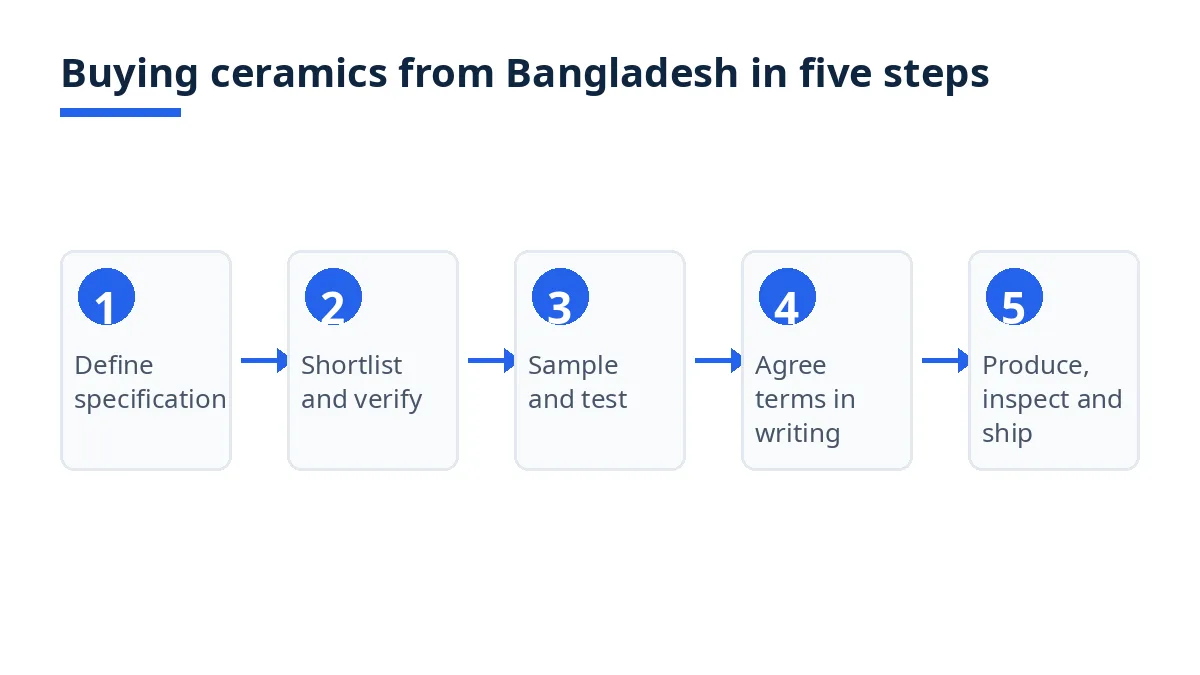
The buying process below pulls these threads together.
Step-by-step buying process
Define the specification. Write the product before you shop for it: HS heading and body type, dimensions and capacity, glaze and decoration, performance requirements, packing, target quantity per shape, colour and design, and destination market.
Shortlist and verify suppliers. Build a shortlist from association lists and supplier listings, confirm the factory is operating and which segment it produces, then run the document, test-report and kiln checks in the verification section.2 5
Sample and test. Order samples against the specification, test production-representative goods for lead and cadmium migration where food-contact rules apply, and approve a decorated counter-sample in writing.6
Agree commercial terms in writing. Fix MOQ per shape, colour and design, itemised unit price with its validity period, the Incoterm with its named place, the staged lead time with its gas-supply assumption and start point, payment terms, breakage terms and the inspection point, all in the purchase order.7
Produce, inspect and ship. Monitor the forming and firing stages first, inspect sorted and graded goods against the approved counter-sample and specification, then ship with the origin evidence your duty position depends on.8
Related guides
Read how to import from Bangladesh for the general import sequence, the ceramics industry in Bangladesh pillar for the industry picture, and Bangladesh export data for category scale. The guide to Incoterms for shipments from Bangladesh covers delivery terms in detail.
FAQs
Is Bangladesh a good place to source ceramics & tableware?
Bangladesh is a credible sourcing option for ceramic tableware, and a more selective one for tiles and sanitaryware, where the specification, kiln record and compliance file are managed actively. Tableware is the primary export driver, with BCMEA members shipping tableware worth Tk 501.38 crore in the past fiscal year on association shipment figures,1 while EPB proceeds data put total ceramic exports at USD 35.22 million, down from a peak of USD 68.97 million in 2018-19.1 According to BCMEA data, the country has 76 ceramic factories.2 The constraints to price in are imported raw materials at more than 90 percent of inputs,1 and gas pressure that can interrupt firing.
What is the typical MOQ?
There is no published typical MOQ for ceramics from Bangladesh, and no official body sets one. Each factory quotes its MOQ from its production stage: a forming and kiln minimum per tableware shape, a glaze minimum per colour, a decoration minimum per design, or a model and colour minimum for sanitaryware. State your target quantity on the same basis in your enquiry, per product, per shape, per colour and per design, so quotes can be compared directly.
How long is the lead time?
There is no standard lead time: yours is the sum of its stages, raw material purchase, body preparation, forming, drying, firing, glazing and decoration, final firing, sorting and grading, inspection, packing, booking and transit. The firing stage carries the main uncertainty, because kilns require uninterrupted gas for about 24 hours and a shutdown takes 48 to 72 hours to restart after pressure returns.2 Ask for the stages separately, with the gas-supply assumption stated, and agree in writing what starts the clock.
Which certifications matter?
The requirements that matter are the ones your destination market and your buyers require for the exact product. For the EU, the operative food-contact file for ceramic tableware is Council Directive 84/500/EEC: lead and cadmium migration limits for ceramic articles intended to come into contact with foodstuffs, testing under the conditions in Annex I with the method in Annex II, and a written declaration under Regulation (EC) No. 1935/2004 at marketing stages up to retail.6 For other markets, name the destination's own food-contact rules in the order and require a report for the exact body, glaze and decoration. Buyers may also name management, environmental or social audits in their own vendor manuals; those audits sit on top of the legal file and do not replace it.
Next steps on Exportain
Browse Bangladeshi suppliers by ceramic product and body, use Exportain trade intelligence to check the market picture behind this guide, and post a free RFQ at Exportain RFQs with your specification, target quantity and destination market so ceramics suppliers can quote against the same written brief.
Sources
- Ceramic boom hits export wall. TOB News, (accessed )
- Gas crisis pushes ceramics industry to the brink. The Business Standard, (accessed )
- Table Chapter 69 Ceramic products. Statistics Canada (accessed )
- Ensure uninterrupted gas supply, lift SD on ceramic products. The Financial Express (accessed )
- Supplier verification: Earn trust badges buyers can see. Exportain (accessed )
- Legislation on Specific Materials: ceramic articles under Directive 84/500/EEC. Food Safety Authority of Ireland (accessed )
- Incoterms® rules. International Chamber of Commerce (ICC) (accessed )
- EU trade relations with Bangladesh. European Commission, (accessed )
- Incoterms
- quality control
- Bangladesh Export Data
- Category Pillars
- Supplier Sourcing
- Ceramic tableware
- Ceramics Bangladesh
About the author
Sourcing from Bangladesh?
Post a request for quotation and suppliers on Exportain can send you their quotes directly.
Post an RFQ