

The Ceramics & Tableware Industry in Bangladesh: Capacity, Clusters and Key Players
Ceramic products exports were USD 35.22 million in FY2024-25 on the EPB Chapter 69 series, with porcelain tableware at USD 32.03 million. This pillar guide covers products and clusters, supplier checks, MOQ, pricing, lead and cadmium compliance for food-contact ware, Incoterms and duties.
Short answer
The ceramics and tableware industry in Bangladesh makes porcelain and china tableware, ceramic tiles and sanitaryware for a large home market and for export. Ceramic product exports were USD 35.22 million in fiscal year 2024-25 on the EPB Chapter 69 series, with porcelain tableware near 91 percent of the total. Buyers source it by specifying body, glaze and heading, testing lead and cadmium release for food-contact ware, and agreeing MOQ, price, Incoterm and lead time per order.
On this page
Key takeaways
Ceramic products exports were USD 35.22 million in fiscal year 2024-25 on the EPB Chapter 69 series, up 6.44 percent, and porcelain tableware under heading 6911 alone was USD 32.03 million, about 91 percent of the chapter total.
Association figures are a different series: BCMEA shipment tracking put member tableware shipments at Tk 501.38 crore in FY2024-25, and the association counts 75 manufacturers, 31 tile, 20 tableware, 20 sanitaryware and four ceramic-brick producers.
Bangladesh Bank records exports when proceeds are received and states that its receipts data differ from EPB data on valuation, timing and coverage; the Bank does not break ceramics out as a major commodity line, so EPB is the export-value series for this sector.
There is no industry-wide MOQ, price or lead time for ceramics; all three are quoted per factory against a written specification, with mould ownership settled in writing and kiln gas pressure checked as a production risk.
For EU food-contact tableware the operative file is Directive 84/500/EEC: lead and cadmium migration limits for the finished, decorated article, tested under its annexes, with a written declaration through the marketing stages.
The ceramics and tableware industry in Bangladesh makes porcelain and china tableware, ceramic tiles, sanitaryware, building bricks and refractory goods, first for a large home market and second for export. This pillar guide is for importers, brands, retailers and sourcing agents in the United States, the United Kingdom, the European Union and the United Arab Emirates weighing Bangladesh as a ceramics origin. It covers the latest export data and how the official and association series differ, products and clusters, supplier checks, MOQ, pricing and lead times, food-contact compliance, Incoterms and duties, and a step-by-step buying process.
Market overview with latest data
Ceramics is a small export line for Bangladesh with an outsized domestic industry behind it, and the headline figure depends on which series you read. On the Export Promotion Bureau (EPB) series, ceramic products exports, reported as Chapter 69 of the Harmonized System, were USD 35.22 million in fiscal year 2024-25, up 6.44 percent on the previous year.1 The fiscal year runs from July to June, and the EPB series is built from customs declarations in the National Board of Revenue's ASYCUDA World system.1 The five-year path is uneven: USD 31.11 million in FY2020-21, USD 41.36 million in FY2021-22, USD 43.38 million in FY2022-23, then a fall to USD 33.09 million in FY2023-24 before the partial recovery.1 Reporting of the same EPB data puts the earlier peak at USD 68.97 million in FY2018-19, so FY2024-25 sits at roughly half that peak even after the year's growth.2
Inside the chapter total, one heading dominates. Tableware, kitchenware and other household articles of porcelain or china, heading 6911, earned USD 32.03 million in FY2024-25 on the EPB four-digit series, about 91 percent of all Chapter 69 exports; every other heading is small beside it, as the products table below shows.1
A second set of figures circulates from the industry association, and it measures something different. TOB News noted in April 2026 that the EPB calculates exports on the basis it applies, while the industry association tracks shipment figures only.2 On the association's shipment tracking, BCMEA members shipped tableware worth Tk 501.38 crore in FY2024-25, against local tableware sales of Tk 792.99 crore.2 That one association shipment figure, for tableware alone, exceeds the whole EPB chapter total for the same year once converted: the two series are not interchangeable, so never add them together and state which series you are using whenever you quote either. Bangladesh Bank adds a third lens: its export receipts record exports when proceeds are actually received, and the Bank states that, due to differences in valuation, timing and coverage, its receipts data are likely to differ from data compiled and published by the Bangladesh Bureau of Statistics and the EPB.3 The Bank's commodity narrative does not break ceramics out as a major line, so this guide uses the EPB series for export values and the Bank publication for method only.
Scale figures for the industry itself are association figures, flagged as such wherever they appear in this guide. Reporting from Ceramic Expo Bangladesh 2025, organised by the BCMEA, put more than 70 factories in operation, a domestic market of around Tk 8,000 crore a year, exports to more than 50 countries earning approximately Tk 5 billion a year, investment above Tk 18,000 crore, and nearly five lakh people employed directly and indirectly.4 A later account, also citing the BCMEA, counted 75 manufacturers, split as 31 tile, 20 tableware, 20 sanitaryware and four ceramic-brick producers, with nearly Tk 190 billion invested.5 TOB News counted 75 factories, nearly 55,000 direct jobs and about half a million indirect jobs, and a home market doubled to over Tk 10,000 crore.2 The counts differ by report and date, so treat them as a range from the association's own reporting, not as a census. The same reporting puts local manufacturers' share of domestic demand at roughly 89 percent for tableware, 82 percent for tiles and 65 percent for sanitaryware, with import dependency down to about 15 percent of demand in FY2024-25.5 2
The operating constraint behind the export numbers is energy. Ceramic kilns run continuously at temperatures exceeding 1,000 degrees Celsius, and gas is both fuel and part of the production process.5 The BCMEA general secretary has said that gas tariffs have risen by nearly 200 percent over five years and that fluctuating gas pressure has cut the share of export-quality output from about 90 percent to around 65 percent, because even a small temperature deviation can make products unsuitable for export markets.2 At least 10 member factories were reported out of production.2
Main products and production clusters
Ceramic products sit in Chapter 69 of the Harmonized System. The chapter applies only to ceramic products that have been fired after shaping; articles heated to less than 800 degrees Celsius, for example to cure resins or remove water, are not considered fired and fall outside it.6 The chapter does not cover electrical insulators of heading 8546, articles of Chapter 94 such as furniture, or articles of Chapter 95 such as toys and games, so a ceramic lamp base, a ceramic-topped table and a ceramic chess set do not all sit in Chapter 69 even when they leave the same factory.6
The headings a buyer will use most often, with Bangladesh's FY2024-25 exports on the EPB four-digit series, are:
HS heading | What it covers | Bangladesh exports, FY2024-25 |
|---|---|---|
6901 | Bricks, blocks, tiles and other ceramic goods of siliceous fossil meals | USD 1.70 million |
6902 | Refractory bricks, blocks, tiles and similar constructional goods | USD 0.31 million |
6904 | Ceramic building bricks, flooring blocks, support or filler tiles | USD 0.08 million |
6907 | Ceramic flags and paving, hearth or wall tiles; mosaic cubes; finishing ceramics | USD 0.62 million |
6910 | Ceramic sinks, wash basins, baths, bidets, water closet pans and similar sanitary fixtures | USD 0.35 million |
6911 | Tableware, kitchenware, other household and toilet articles, of porcelain or china | USD 32.03 million |
6912 | Ceramic tableware, kitchenware, other household and toilet articles, not of porcelain or china | USD 0.10 million |
6913 | Statuettes and other ornamental ceramic articles | USD 0.01 million |
Heading values are the EPB four-digit series for fiscal year 2024-25; the listed headings sum to the chapter total together with the small 6903, 6905, 6909 and 6914 lines.1 6 Three product points decide most buying programmes. First, tableware is the export product: porcelain and china tableware and kitchenware under subheading 6911.10 is where the export experience and the order books are, and bone china is bought and sold inside that porcelain or china heading rather than under a heading of its own.1 6 Second, tiles are specified by water absorption: heading 6907 splits flags and paving, hearth or wall tiles into subheadings by water absorption coefficient, not exceeding 0.5 percent, over 0.5 percent up to 10 percent, and over 10 percent, so the absorption class belongs in your specification alongside size and thickness.6 Third, tiles and sanitaryware are domestic-first lines: sanitaryware local sales were reported at Tk 1,317.36 crore in FY2024-25, holding 65 percent of the home market, while tile local sales rose to Tk 5,854.12 crore even as tile exports fell to Tk 6.58 crore.2 A buyer sourcing them for export should expect export packing, documentation and inspection routines to be agreed explicitly rather than assumed.
Production clusters are a Dhaka-centred map, on the association's own statements. The BCMEA has named the industrial zones of Mirpur and Savar in and around Dhaka, Kashimpur in Gazipur and Rupganj in Narayanganj as the zones where ceramic factories face the sharpest gas pressure drops, which identifies those zones as working production locations.7 No source opened for this guide publishes a district-by-district factory census, so this guide does not invent one: ask each candidate for its factory address and verify production at that address, because the head office and the kiln are often in different places. Key players, for a buyer, are a structure rather than a ranking, and this guide names no company league table. The first group is the export-oriented tableware tier: the 20 tableware producers in the association count carry the heading 6911 export trade and ship to the more than 50 destination countries the association reports.5 4 The second group is the construction ceramics tier, the 31 tile and 20 sanitaryware producers, larger by plant count but selling mainly into the domestic market, so export orders compete with domestic construction demand for kiln time.5 2 The third group is the industrial and building ceramics tier, the ceramic-brick and refractory producers behind headings 6901, 6902 and 6904, at USD 2.09 million combined in FY2024-25.1 Match the tier to the product: an export tableware factory for a tableware programme, a tile or sanitaryware producer with agreed export routines for construction ceramics, an industrial ceramics maker for refractory goods.
How to find and verify suppliers
Find suppliers through more than one channel so you can cross-check what a factory tells you. Start with the BCMEA membership, add Bangladesh export data and Exportain trade intelligence for context, then work Bangladeshi suppliers listings by product and ask each candidate for its export markets and reference products in your heading.
Verification is a document exercise first and a visit exercise second. Ask for, and read, the following before discussing price in detail:
Trade licence and export registration in the company's own name, plus the factory address you will inspect against, stated separately from the head office.
Association membership, where claimed, read against the association-reported structure of the industry, where tableware, tile and sanitaryware producers are counted separately.5
Export history: anonymised bills of lading or shipment summaries for your target market, showing heading, product and recency, and separating exports from domestic sales, because for tiles and sanitaryware the domestic book is usually the larger one.2
The body, glaze and decoration route behind your product, including where clay, feldspar and glaze materials are sourced, because around 95 percent of raw materials are reported to be imported.5
Test reports for the exact article you plan to buy, including the lead and cadmium release file in the compliance section where the article will touch food.
Kiln evidence: kiln type and firing schedule, current gas pressure at the plant, and the share of output currently reaching export quality.2 7 Supplier profiles carry document and photo review badges: verification is free, the seller completes each check in the verification centre of the seller portal, Exportain staff review every submission, and approved checks earn badges shown on the company page, product listings and quotations.8 It is a document and photo review, not a factory inspection, and membership plans are a separate product that never grant a trust badge.8 Exportain is a B2B marketplace and is not a party to the contract for goods between buyer and seller; it does not inspect goods, book freight or clear customs. Use the badge as a first filter, then run the document checks above yourself or through an inspection firm you appoint. Two red flags end a conversation early: a factory that quotes a firm price before it has seen your body, glaze and decal specification is not pricing your product, and a supplier that cannot state its current kiln gas pressure has not answered the first production question this industry turns on.
MOQ, pricing and lead times
There is no industry-wide MOQ, standard price or standard lead time for ceramics and tableware from Bangladesh, and no official body publishes one. All three are quoted per factory, per product line and per order, against a written specification.
MOQ. The minimum order quantity is set by the kiln and the mould, not by the buyer's carton count. A tableware order carries a mould and forming minimum per shape and a decoration minimum per decal or colour; a tile order carries a production-run minimum per size, surface and absorption class; a sanitaryware order carries a casting and glazing minimum per model. State your target quantity per shape, design and size in your enquiry and ask the factory to quote its MOQ on the same basis, so two factories answer the same question. Where a new mould or model is needed, agree in writing who pays for it, who owns it and where it is stored.
Pricing. Your unit price is built from body raw materials, forming or casting, glazing and decoration, kiln energy, sorting and grading, packing, and export costs to the agreed Incoterm point. The heading spread shows why no single ceramics price exists: in the same EPB year, heading 6911 tableware earned USD 32.03 million while all heading 6907 tile exports earned USD 0.62 million, at very different values per tonne, per square metre and per piece.1 Two cost layers are volatile. Raw materials are import-linked, with around 95 percent of inputs, including clay, feldspar and glaze materials, reported as imported, so exchange-rate movement enters the quote.5 Energy is the second layer: gas is the kiln fuel, tariffs have risen sharply, and pressure failures destroy fired batches, so ask each factory to state its price-validity period and current firing conditions in writing.2 Compare quotes only at the same Incoterm and specification.
Example figures. For illustration only: a specification for 100,000 porcelain side plates is quoted by two suppliers at the same Incoterm, FOB Chattogram. Supplier A quotes USD 1.85 per plate itemised as body, glaze and firing USD 1.20, decal and finishing USD 0.35 and packing and export costs USD 0.30. Supplier B quotes USD 1.62 per plate with no itemisation. The worked example totals are USD 185,000 from Supplier A and USD 162,000 from Supplier B. The example shows the method, not a market price: the buyer asks Supplier B for the same itemisation, and for the lead and cadmium test file behind the quote, before treating the USD 23,000 gap as a saving.
Lead times. A lead time is a chain, not a single number: raw material purchase, mould or model preparation where it applies, forming or casting, glazing and decoration, firing, sorting, inspection and booking, then transit. One link is a named constraint: kilns need continuous gas at stable pressure, the BCMEA has reported required pressure of 15 PSI falling to as low as 2 to 3 PSI in the main industrial zones, and a firing interrupted by pressure loss can ruin the batch in the kiln, so a first order carries kiln-schedule risk that a repeat order does not.7 2 Ask for the stages separately, and agree what starts the clock, normally written order confirmation plus approved sample.
Quality, certifications and compliance
Quality in ceramics is decided by three layers: the destination market's product law, the metal-release file for food-contact tableware, and your own specification and inspection.
EU food-contact ceramics. Council Directive 84/500/EEC governs ceramic articles intended to come into contact with foodstuffs placed on the EU market. It defines ceramic articles as articles manufactured from a mixture of inorganic materials with a generally high argillaceous or silicate content, first shaped and then permanently fixed by firing, which may be glazed, enamelled and decorated, and it sets limits for the migration of lead and cadmium from those articles that must not be exceeded.9 The quantities transferred are determined by the test conditions in the directive's Annex I using the method of analysis in Annex II, and at marketing stages up to and including retail, articles not yet in contact with foodstuffs must be accompanied by a written declaration in accordance with Article 16 of Regulation (EC) No 1935/2004, issued by the manufacturer or by a seller established within the EU.9 Porcelain and bone china tableware is inside this regime: the compliance question is the lead and cadmium release of the finished, decorated article, so require the test file per shape family, glaze and decoration before bulk production, and test the decorated surface, not a plain white sample. For the United States, the United Kingdom and the UAE, the food-contact file differs by market; name the destination rule set in your specification and test against that set.
Your own quality system. Write the specification so an inspector can measure it: body type and grade, dimensions and weight per piece, glaze and decoration reference, water absorption class for tiles under the heading 6907 subheadings, defect tolerances for pinholes, warping, crazing and colour variation, and packing by pieces per carton with carton dimensions and gross weight.6 Approve a pre-production sample and a counter-sample, set the inspection point before cartons are sealed, and test production-representative goods, not showroom samples, for lead and cadmium release where the article touches food and for physical performance such as chipping and thermal shock. Because export-quality yield is the industry's named pressure point, agree the grading standard and the credit treatment for below-grade pieces in the purchase order, not after the kiln is unloaded.2
Certifications buyers ask for. Beyond the legal file, buyers commonly name management-system and social or environmental audits in their own vendor manuals. State them in the enquiry, ask which the factory already holds, and price the audit time into the lead time. A certificate never substitutes for the article-level test file above.
Shipping, Incoterms and duties
Ceramic goods from Bangladesh normally leave by sea from Chattogram, the country's main seaport. Ceramics are heavy, fragile and, for tiles and sanitaryware, bulky: freight economics are set by breakage control and packing density as much as by weight. Confirm pieces per carton, inner packing and dividers, palletisation and cartons per container in the specification. Incoterms® 2020 is the current edition of the ICC rules, in force since 1 January 2020. The rules are eleven three-letter trade terms that clarify the tasks, costs and risks involved in the delivery of goods from sellers to buyers, and they are recognised as the global standard for interpreting the most common terms in foreign trade.10 The four rules you will meet most often on ceramics orders work as follows:
Rule | Who arranges and pays main freight | Where risk passes to the buyer | Practical note for ceramic goods |
|---|---|---|---|
EXW (Ex Works) | Buyer | At the seller's premises | Buyer carries export clearance; rarely suitable for a first order |
FOB (Free On Board) | Buyer | When goods are on board the vessel at the named loading port | The common Bangladesh term for container loads; name the port, for example FOB Chattogram, Incoterms® 2020 |
CIF (Cost, Insurance and Freight) | Seller, plus minimum insurance | When goods are on board at the loading port | Minimum insurance may not reflect breakage risk on fragile goods |
DAP (Delivered at Place) | Seller | At the named destination place, ready for unloading | Buyer still clears import and pays duty unless the contract says otherwise |
Always write the rule with its named place and edition, for example "FOB Chattogram, Incoterms® 2020".
Duties are decided by the heading from the products table, the origin of the goods and the destination's preference scheme. As a least developed country, Bangladesh benefits from the Everything But Arms (EBA) arrangement under the EU's Generalised Scheme of Preferences, which grants duty-free, quota-free access to the EU for all products except arms and ammunition, and 91 percent of Bangladesh's exports to the EU enter duty- and quota-free.11 Bangladesh is the largest EBA beneficiary, with EUR 19 billion in exports benefitting from these preferences in 2024 at a 96 percent utilisation rate.11 Ceramic goods that meet the EBA rules of origin and ship with the required proof of origin therefore enter the EU without customs duty while Bangladesh holds that status. Preference is a property of the consignment, not the country: if the origin evidence fails, the standard third-country duty for the heading applies. For the United States, the United Kingdom and the UAE, read the duty beside your confirmed six-digit code in the destination tariff for the entry date; this guide states no rate for them.
Step-by-step buying process
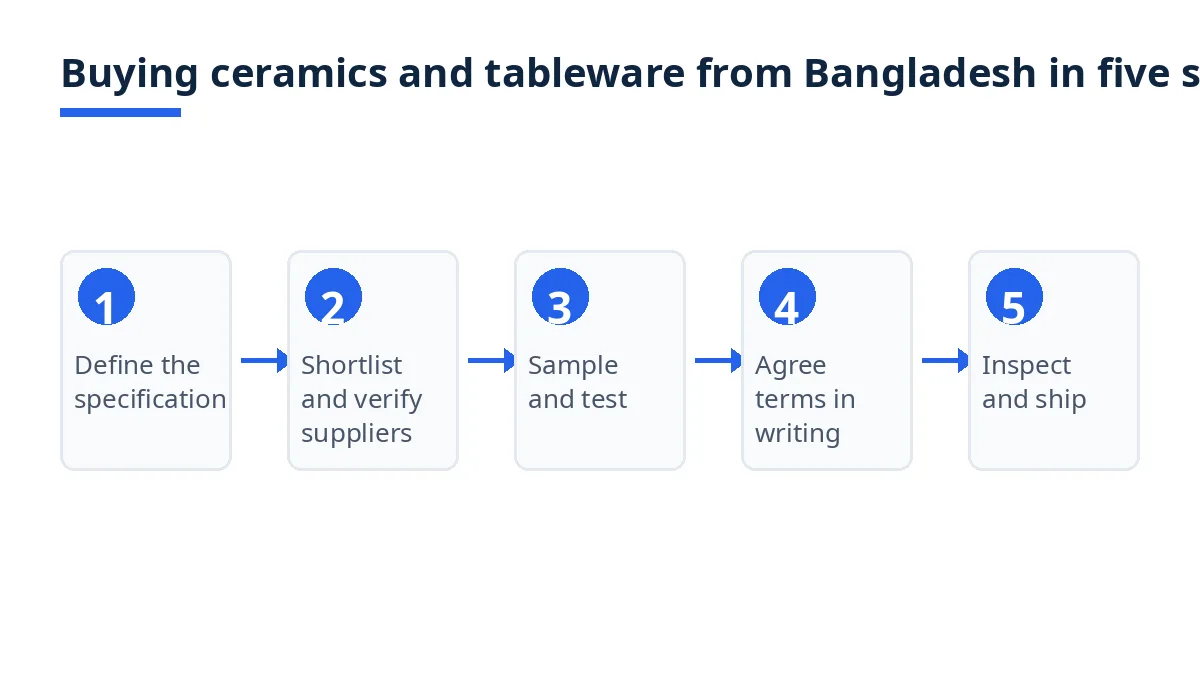
Define the specification. Write the product before you shop for it: HS heading and, for tiles, the water absorption class, body and glaze, dimensions and weight, decoration, packing, target quantity and destination market.6
Shortlist and verify suppliers. Build a shortlist from association lists and supplier listings, confirm whether the candidate is a tableware, tile or sanitaryware producer, then run the document checks in the verification section.5 8
Sample and test. Order samples against the specification, test production-representative goods for lead and cadmium release where the article touches food, and approve a counter-sample in writing.9
Agree commercial terms in writing. Fix MOQ per shape and design, mould ownership, itemised unit price with its validity period, the Incoterm with its named place, the staged lead time, payment terms, grading standard and the inspection point, all in the purchase order.10
Produce, inspect and ship. Monitor forming, glazing and firing first, inspect finished goods against the approved counter-sample, then ship with the origin evidence your duty position depends on.11
Related guides (links to cluster articles)
Read how to import from Bangladesh for the general import sequence, Bangladesh export data for category scale across sectors, and Incoterms for shipments from Bangladesh for the delivery terms in more detail.
FAQs
Is Bangladesh a good place to source ceramics & tableware?
Bangladesh is a credible sourcing option for porcelain and china tableware, where its export trade is concentrated, and a developing option for tiles and sanitaryware, where production is large but mainly domestic. Porcelain tableware was USD 32.03 million of the USD 35.22 million Chapter 69 total in FY2024-25 on the EPB series, and the association counts 20 tableware producers among 75 manufacturers.1 5 The constraint to price in is energy: gas pressure failures have cut the export-quality share of output, on the association's own account, and raw materials are mostly imported.2 5
What is the typical MOQ?
There is no published typical MOQ for ceramics or tableware from Bangladesh, and no official body sets one. Each factory quotes its MOQ from its production stage: a mould and forming minimum per tableware shape and decoration, a production-run minimum per tile size and absorption class, or a casting and glazing minimum per sanitaryware model. State your target quantity on the same basis, and settle mould ownership in writing, so quotes can be compared directly.
How long is the lead time?
There is no standard lead time: yours is the sum of its stages, raw material purchase, mould or model preparation where it applies, forming or casting, glazing and decoration, firing, sorting, inspection and booking, and transit. One stage carries a named risk: kilns need continuous gas at stable pressure, reported required pressure is 15 PSI against drops to 2 to 3 PSI in the main industrial zones, and an interrupted firing can ruin the batch.7 Ask for the stages separately and agree what starts the clock.
Which certifications matter?
The requirements that matter are the ones your destination market and your buyers require for the exact article. For ceramic tableware sold for food contact in the EU, the operative file is Directive 84/500/EEC: lead and cadmium migration from the finished article must stay within the directive's limits, tested under its Annex I conditions and Annex II method, with a written declaration accompanying the articles through the marketing stages.9 That file is built per shape, glaze and decoration, on production-representative goods. Buyers may also name management or social audits in their own vendor manuals; those sit on top of the legal file.
Next steps on Exportain
Browse Bangladeshi suppliers by ceramic tableware, tile or sanitaryware product, use Exportain trade intelligence to check the market picture behind this guide, and post a free RFQ at Exportain RFQs with your specification, target quantity and destination market so ceramics suppliers can quote against the same written brief.
Sources
- Bangladesh Export Statistics 2024-2025. Export Promotion Bureau (EPB) (accessed )
- Ceramic boom hits export wall. TOB News, (accessed )
- Annual Export Receipts of Goods and Services 2024-25. Bangladesh Bank (accessed )
- Bangladesh must tap ceramic export potential: commerce adviser. The Daily Star, (accessed )
- Policy should make local industry competitive, not merely protect it. The Financial Express, (accessed )
- Chapter 69 - Ceramic products, Australian Customs Tariff Schedule 3, Section XIII. Australian Border Force (accessed )
- Ensure uninterrupted gas supply, lift SD on ceramic products. The Financial Express, (accessed )
- Supplier verification: Earn trust badges buyers can see. Exportain (accessed )
- Legislation on Specific Materials: ceramic articles under Directive 84/500/EEC. Food Safety Authority of Ireland (accessed )
- Incoterms® rules. International Chamber of Commerce (ICC) (accessed )
- EU trade relations with Bangladesh. European Commission, (accessed )
- Incoterms
- quality control
- Bangladesh Export Data
- Category Pillars
- Supplier Sourcing
- Ceramic tableware
- Ceramics
About the author
Sourcing from Bangladesh?
Post a request for quotation and suppliers on Exportain can send you their quotes directly.
Post an RFQ


