Jute Shopping Bags Price in Bangladesh: FOB Cost Breakdown for Buyers
An FOB quotation for jute shopping bags hides eight cost layers, from fabric and lamination to inland freight and port charges. This guide takes the price apart, shows how MOQ and specification move the unit cost, and works through a 5,000-bag example at 1.75 dollars per bag.
Short answer
The FOB price of a jute shopping bag from Bangladesh is the sum of its cost layers up to loading on board at Chattogram: jute fabric, lamination, printing, handles, cutting and stitching, export packing, inland freight, and port and documentation charges, plus factory overhead and margin. Order size and specification move the unit cost most: larger orders spread fixed set-up costs thinner, while heavier fabric, lamination, extra print colours, and larger sizes each add cents per bag.
On this page
Key takeaways
FOB covers every cost up to loading on board at Chattogram, and nothing after it: ocean freight, insurance, duty, and destination delivery sit outside the price.
Fabric is the largest cost layer, and specification moves the unit cost: heavier GSM, lamination, extra print colours, and larger sizes each add cents per bag.
MOQ spreads fixed set-up costs thinner, so the worked example falls from 2.14 dollars at 1,000 bags to 1.75 dollars at 5,000 bags and 1.62 dollars at 10,000 bags.
Under Everything But Arms, Bangladeshi jute bags can enter the European Union duty-free where origin rules are met, while the standard rate for 6305.90 is 6.2 per cent.
A quotation for jute shopping bags from Bangladesh usually arrives as a single number per bag, followed by the three letters FOB and the name of a port. That number hides eight or nine separate cost layers. This article takes that price apart, layer by layer.
Bangladesh earned 883.7 million US dollars from jute and jute goods in fiscal year 2025-26, up 7.75 per cent from 820.8 million dollars the year before, according to Export Promotion Bureau data.1 Earnings from jute sacks and bags reached 132.3 million dollars in the same year, up 5.03 per cent.1
What an FOB price actually covers
FOB stands for Free On Board, and it is one of the 11 rules published by the International Chamber of Commerce under Incoterms 2020, which remains the current version in 2026.2 Under FOB, the seller delivers the goods on board the vessel nominated by the buyer at the named port of shipment, having cleared them for export, and risk passes to the buyer at that point.2 For jute shopping bags, the named port is almost always Chattogram.
The cost split follows the delivery point. The seller pays for export packaging, export clearance, inland transport to the origin port, terminal handling at the origin port, and loading on board.2 The buyer pays ocean freight, marine insurance, unloading at destination, import clearance and duties, and inland transport at destination.2 FOB does not include insurance, and neither party is obliged to insure the goods under the rule.2
The International Chamber of Commerce recommends FCA, Free Carrier, rather than FOB for containerised cargo loaded at the seller's facility.2
The eight layers of a jute shopping bag FOB price
Layer 1: jute fabric
Fabric is the largest single layer in most quotations. Jute shopping bags are usually cut from woven jute fabric measured in grams per square metre, known as GSM, from about 250 GSM to 400 GSM or more. Fabric price also moves with the raw jute market: exporters reported in 2026 that floods had damaged jute production and pushed up the price of raw jute.1
Layer 2: lamination
Many shopping bags carry a thin laminate layer, usually LDPE, on the inside face of the fabric. Lamination adds water resistance and stiffness so the bag holds its shape. It is a separate process, so ask the seller to quote laminated and unlaminated versions side by side.
Layer 3: printing
Printing is usually charged by the number of colours, the number of printed faces, and the size of the print area. A single-colour logo on one face is the cheapest option, and each extra colour adds a plate or screen, extra ink, and extra machine passes. See our quality control checklist for jute shopping bags for print checks.
Layer 4: handles and reinforcements
Handles are a small part of the bag by weight and a large part of how the bag is judged. The common options are jute tape handles cut from the same fabric, cotton webbing handles, and padded handles for heavier loads.
Layer 5: cutting, stitching and finishing
This layer covers the labour and machine time to cut, stitch, and finish the bag. More seams and features mean more operations: a bag with a gusset, a zip pocket, or an inner pocket needs more work than a plain open-top tote.
Layer 6: export packing
Export packing is the layer buyers most often forget to ask about, and it is part of the FOB price. The seller pays for export packaging under FOB,2 usually folded bags in polybags, packed in marked export cartons.
Layer 7: inland freight to Chattogram
The seller pays inland transport to the origin port under FOB,2 so trucking from the factory to the Chattogram terminal or depot sits inside the FOB price.
Layer 8: port, terminal handling and export documentation
The final layer covers port charges, handling, and export documentation. The seller pays origin terminal handling charges and loading on board under FOB.2 Port charges moved sharply in late 2025: the average container handling charge per twenty-foot equivalent unit at Chattogram rose from Tk 11,849 to Tk 16,243, and the charge for loading and unloading containers from vessels rose from 43.40 dollars to 68.00 dollars.3
How MOQ moves the unit cost
Minimum order quantity, or MOQ, is the second-largest driver of unit cost after specification. Set-up costs are roughly the same whether the order is for 1,000 bags or 10,000 bags. Spread over more bags, each bag carries a smaller share of those fixed costs. Example figures for one specification follow.
Order size | FOB per bag, Example figures |
|---|---|
1,000 bags | 2.14 dollars |
5,000 bags | 1.75 dollars |
10,000 bags | 1.62 dollars |
The drop from 1,000 to 5,000 bags is large because the fixed costs are divided five ways. Our jute shopping bag MOQ guide explains quantity negotiation in steps.
How size and specification move the unit cost
The table below uses Example figures against a base bag of 38 by 42 by 15 centimetres in 340 GSM laminated jute.
Change to the specification | Effect on FOB per bag, Example figures |
|---|---|
Fabric 340 GSM to 400 GSM | +0.12 dollars |
Add lamination | +0.14 dollars |
Third print colour | +0.05 dollars |
Print on both faces | +0.08 dollars |
Cotton webbing instead of jute tape handles | +0.07 dollars |
Larger bag, 45 by 48 by 18 cm | +0.09 dollars |
Reinforced base and bar tacks | +0.04 dollars |
Inner pocket with zip | +0.11 dollars |
No single change here is large on its own, but three or four together can add 0.30 dollars or more to a bag that started near 1.50 dollars.
A worked example: 5,000 laminated bags, FOB Chattogram
The specification is a laminated jute shopping bag, 38 by 42 by 15 centimetres, 340 GSM fabric, two-colour print on one face, cotton webbing handles, and reinforced base. The order is 5,000 bags, shipped FOB Chattogram. All figures are Example figures, not market prices.
Cost layer | Per bag, Example figures |
|---|---|
Jute fabric, 340 GSM | 0.58 dollars |
Lamination, LDPE inner layer | 0.14 dollars |
Printing, two colours, one face | 0.11 dollars |
Handles, cotton webbing | 0.16 dollars |
Cutting, stitching and finishing | 0.28 dollars |
Export packing, cartons and polybags | 0.09 dollars |
Inland freight and depot handling | 0.12 dollars |
Port, handling and documentation | 0.10 dollars |
Factory overhead and margin | 0.17 dollars |
FOB Chattogram per bag | 1.75 dollars |
For 5,000 bags, the order value on FOB terms is 8,750 dollars. Fabric is the largest layer at 0.58 dollars, followed by cutting, stitching and finishing at 0.28 dollars.
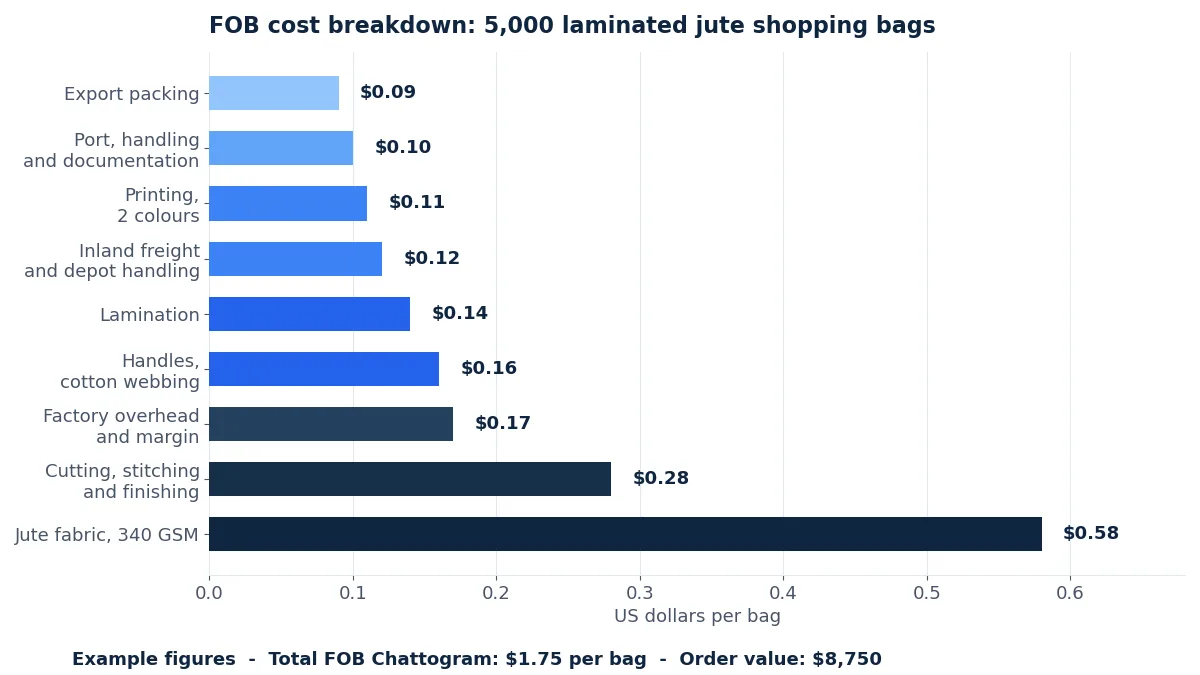
If a seller quotes 1.40 dollars for the same specification, ask which layer is lower: the fabric, the making cost, or the margin.
FOB compared with EXW and CIF
The table below compares the three terms buyers meet most often for jute bags, using the cost split described above.2
Term | Seller pays to | Buyer pays from | Insurance | Risk passes |
|---|---|---|---|---|
EXW, Ex Works | Seller's premises | Factory gate onward | Buyer | At the seller's premises |
FOB, Free On Board | On board the vessel at Chattogram | On board onward | Buyer, optional | On board the vessel |
CIF, Cost, Insurance and Freight | Destination port | Destination port onward | Seller, minimum cover | On board at origin |
Under EXW, the buyer takes the goods at the factory and arranges export clearance and everything after. Under CIF, the seller also pays ocean freight and provides minimum marine insurance. The risk point, however, stays at loading in Chattogram: once the bags are on the vessel, any loss in transit falls on the buyer, not the seller.2 Compare a CIF freight line with a quote from your own forwarder. Our complete buyer guide to importing jute bags walks through the full sequence from order to delivery.
What FOB does not include, and what it changes at destination
An FOB price stops when the goods are on board. Everything after that point is the buyer's cost, and the largest is usually ocean freight, followed by import duty and local taxes.
Duty depends on classification and origin. Jute sacks and bags fall under heading 6305, with subheading 6305.10 for jute fibres and subheading 6305.90 for other textile materials.4 A handled shopping tote that resembles a handbag can fall under heading 4202 instead, which changes the duty, so confirm the classification with your customs broker before the order ships.4 Our HS code guide for jute shopping bags covers the classification in full.
For goods classified under 6305.90, the United States general duty rate is 6.2 per cent, and the European Union standard most-favoured-nation rate is also 6.2 per cent.5 The United Kingdom standard rate is 6.00 per cent, with 20.00 per cent import VAT on top.5
Bangladesh currently benefits from preference schemes that can reduce those rates to zero where the rules of origin are met. Under the European Union Everything But Arms scheme, Bangladesh, the scheme's largest beneficiary, gets duty-free and quota-free access for all products except arms and ammunition.6 Bangladesh's preparation period for graduation from least-developed-country status runs to 24 November 2029, with a transition period after that.6 The FOB price is the same whether or not a preference applies. The landed cost is not.
Two other factors sit outside the FOB price. For shipments between 1 July 2026 and 30 June 2027, diversified jute products receive 10 per cent cash assistance, jute final products receive 5 per cent, and jute yarn and twine receive 3 per cent.7 The European Union Single-Use Plastics Directive, Directive (EU) 2019/904, came into force on 2 July 2021, lists plastic bags among the products in scope, and requires member states to achieve an ambitious and sustained quantitative reduction in consumption of listed single-use plastic products by 2026 compared with a 2022 baseline.8
Reading a quotation line by line
A good quotation for jute shopping bags should answer seven questions without being asked. Use the list below as a checklist when a quotation arrives, and ask the seller to fill any gap before you compare it with another seller's price.
The exact specification: fabric GSM, lamination, dimensions, handles, print, and reinforcements.
The FOB price per bag, the named port, and the Incoterms edition.
How the price changes at 1,000, 5,000, and 10,000 bags.
Which cost layers are included, and are packing, freight, port charges, and documentation shown separately.
How long the quotation is valid, and what happens if the fabric rate moves before production starts.
What is the production lead time, and does it include sampling, print approval, and inspection.
The payment term, and the documents the seller will provide with the shipment.
Common mistakes that inflate the FOB price
The first mistake is comparing quotations with different specifications. The second is ordering too few bags for the specification chosen: a complex bag carries high set-up costs, and ordering 1,000 of them spreads those costs over too few units. The third mistake is changing the specification after the price is agreed, The fourth mistake is treating the FOB price as the landed cost, since freight, duty, and delivery at destination all sit outside FOB. The fifth mistake is ignoring the validity period: fabric prices move with the raw jute market, and port charges in Bangladesh moved sharply in late 2025.3
Next steps on Exportain
Read our wholesale guide for jute shopping bags to compare the price structure in this article with supplier and MOQ context. When you are ready, post a request for quotation on Exportain with the full specification attached, including fabric GSM, lamination, dimensions, handles, print, quantity, and the named port, and ask each seller to break the FOB price into the layers set out here.
Sources
- Jute exports rise 37 per cent as Bangladesh plans to double earnings by 2031. The Financial Express, (accessed )
- FOB Incoterms Explained: A Complete Guide for Importers and Freight Forwarders 2026. GoFreight (accessed )
- Maritime law society serves legal notice, seeks cancellation of new port tariff circular. The Daily Star, (accessed )
- Bag HS Codes Guide: 6305 Breakdown for Importers. FreightAmigo, (accessed )
- HTS 6305.90: Of other textile materials. Check Duty Rates (accessed )
- Bangladesh begins preliminary FTA negotiation with EU. The Financial Express, (accessed )
- FY27: BB retains cash incentive for exports of 43 sectors. Dhaka Tribune, (accessed )
- EU Single Use Plastics Directive FAQs. British Plastics Federation (accessed )
- landed cost
- Jute shopping bags
- FOB price Bangladesh
- jute bags price
- Incoterms FOB
- Bangladesh jute exports
About the author
Sourcing from Bangladesh?
Post a request for quotation and suppliers on Exportain can send you their quotes directly.
Post an RFQ