Best Incoterm for Importing Furniture & Home Decor From Bangladesh
Furniture fills a container by volume, not weight, so the Incoterm decides who pays for the space and who carries the risk. This guide compares FCA, FOB, CIF, CIP and DAP for flat-pack and assembled furniture from Bangladesh, with a worked 40-foot container example.
Short answer
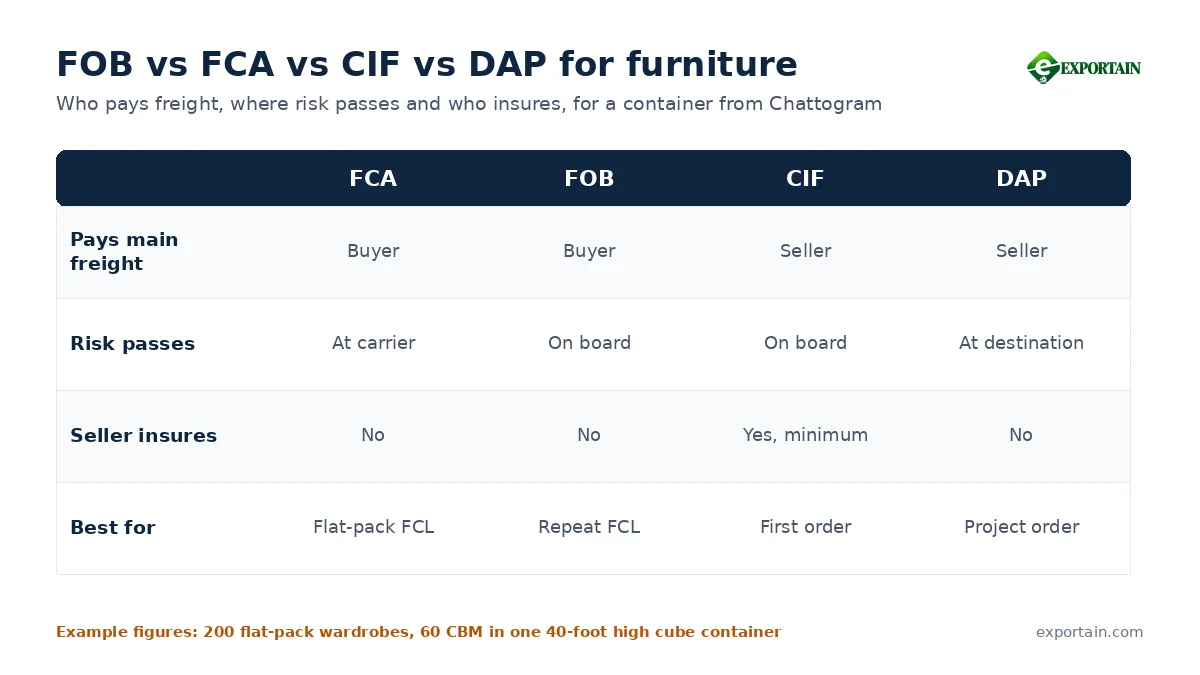
For most furniture imports from Bangladesh, FCA Chattogram is the strongest choice for containerised orders, because risk passes when the container is handed to the carrier and the buyer controls freight. CIF suits a simple first order, but it gives only minimum insurance cover, while DAP suits project orders delivered to a warehouse. FOB works for repeat orders, but it leaves a risk gap while the container waits at the terminal.

On this page
Key takeaways
Furniture freight is charged on volume, so flat-pack loads and carton size decide the landed cost more than the goods price.
FCA suits containerised furniture better than FOB, because risk passes when the container is handed to the carrier, not when it is loaded on board.
CIF gives only minimum insurance cover, while CIP requires all-risks cover, which matters for scuffs, moisture and broken glass.
A 40-foot high cube container holds about 76 CBM, and 200 flat-pack wardrobes at 0.30 CBM each fill about 79 percent of it.
Check the ISPM 15 pallet mark and the furniture's own wood rules separately, and confirm the Chapter 94 HS code before loading.
Furniture is one of the hardest products to price on an Incoterm. A wardrobe, a sofa or a dining set fills a container long before it reaches the weight limit, so freight is charged on volume, and the same shipment is fragile: corners scuff, glass cracks and veneer swells when damp timber sits in a sealed box for weeks. The Incoterm decides who pays for that space, who carries the risk at sea, and who insures it.
This guide is for buyers importing furniture and home decor from Bangladesh, with a worked container example and a decision rule for first, repeat and project orders.
Why does furniture need its own Incoterm decision?
Furniture is bulky for its weight, so carriers price it by the space it takes. A flat-pack wardrobe may weigh 60 kg and take 0.30 CBM, while an assembled sofa can take several CBM and weigh little more. On less-than-container-load (LCL) ocean freight the charge is normally the greater of volume or weight.1
Bangladesh is a small but real source: furniture export earnings were $45.53 million in fiscal year 2024-25, down from a high of $110.36 million in fiscal year 2021-22, according to Export Promotion Bureau data reported in July 2025.2
What do Incoterms 2020 actually decide?
Incoterms 2020 are eleven standard three-letter trade terms published by the International Chamber of Commerce (ICC). They define the delivery point, where risk of loss or damage passes from seller to buyer, who pays which costs, who arranges transport, who handles export and import formalities, and who must insure the goods.3 They do not set the price, the payment method or when ownership passes.4
The eleven rules fall into two families: seven for any mode of transport (EXW, FCA, CPT, CIP, DAP, DPU, DDP) and four for sea and inland waterway only (FAS, FOB, CFR, CIF).3 Risk passes at the same point and time as delivery, except under the C rules, where the seller pays freight to the destination while risk still passes earlier.3 Only CIP and CIF oblige the seller to insure the goods.3
Which Incoterms fit a furniture container?
Most Bangladesh furniture leaves by sea from Chattogram in a 20-foot or 40-foot container, so the realistic shortlist is FCA, FOB, CFR, CIF, CIP, DAP and DDP. EXW is a poor fit for a first-time buyer because the buyer must handle export clearance in Bangladesh.3
| Incoterm | Who pays main freight | Risk passes to buyer | Seller insures | Best fit for furniture | | FCA | Buyer | Handed to the buyer's carrier | No | Flat-pack orders, buyer controls freight | | FOB | Buyer | On board at origin | No | Repeat FCL orders, forwarder at Chattogram | | CIF | Seller | On board at origin | Yes, minimum cover | Simple first orders, cover checked in writing | | CIP | Seller | Handed to the first carrier | Yes, all-risks cover | High-value or upholstered furniture | | DAP | Seller | At destination, ready for unloading | No | Project orders, delivered to a warehouse |
FOB is the term most Bangladesh furniture suppliers quote first, because it is familiar and the seller's duty ends once the goods are on board. FCA is the cleaner choice for containers: FOB, CFR and CIF were written for cargo loaded directly onto a ship, and the ICC Academy notes that these four sea-only rules are not suitable for container shipments in their current form.3 A furniture container is handed to the terminal days before it is loaded, so under FOB the risk stays with the seller during that gap. Under FCA, risk passes when the container is handed to the carrier.4
FOB vs CIF vs DAP: how do they compare for furniture?
FOB gives the buyer control: the buyer books the vessel, chooses the carrier and sees the freight cost as a separate line. Buyers who control their own logistics often save most on FCA or FOB, because seller-arranged terms such as CIF or DDP tend to include a margin on the freight.4
CIF gives the buyer simplicity: the seller books the vessel and buys insurance, and the buyer pays one price to the destination port. The catch is that risk passes to the buyer as soon as the goods are loaded on board at origin, so in a damage claim at sea it is the buyer who is exposed.4 CIF insurance is also minimum cover only, under Institute Cargo Clauses C, while CIP requires all-risks cover under Clauses A.4 For furniture, where the common losses are scuffs, water marks and swollen panels, minimum cover may not respond to the damage a buyer actually suffers.
DAP gives the buyer delivery: the seller carries the goods to the named place, ready for unloading, and bears the risk for the whole journey, while the buyer still handles import clearance and pays duties. DAP suits project orders, such as a hotel fit-out. DDP goes further and puts import duties on the seller, but a Bangladesh furniture seller rarely knows the destination country's duty rules well enough to price that safely, so DDP quotes often carry a wide margin.
How does flat-pack change the maths?
A 40-foot high cube container holds about 76 CBM, against about 66 CBM for a standard 40-foot container, with internal dimensions of roughly 12.05 m by 2.35 m by 2.69 m.5 In practice, cartons, pallets, bracing and gaps mean a buyer should plan on loading about 85 to 90 percent of that nominal volume.5 Ask for final carton dimensions before confirming the order, then compute the CBM per carton and per container.1
Example figures: a buyer orders 200 flat-pack wardrobes from a Dhaka factory. Each carton measures 2.0 m by 0.6 m by 0.25 m, which is 0.30 CBM, so 200 cartons total 60 CBM before gaps, fitting one 40-foot high cube container at about 79 percent of its 76 CBM nominal volume. Shipped assembled, the same 200 wardrobes would need several containers. Under FOB Chattogram at an example factory price of $85 per wardrobe, the buyer pays $17,000 for the goods and books the container separately, so the freight per unit is visible. Under CIF at an example price of $98, the buyer pays $19,600 and the seller books the vessel and minimum-cover insurance. Under DAP at an example price of $112, the buyer pays $22,400 and the seller carries the goods to the buyer's warehouse. Which price is best depends on the buyer's freight rates and insurance, not on the headline per-unit figure alone.
What about moisture, damage and insurance?
Wood and wood-based panels exchange water with the air around them. A container loaded in a humid port that then moves through cooler air can form condensation on its roof and walls, which drips onto cartons, a problem often called container rain. The result is mould spots, swollen panel edges, glue failures and warped timber.1
Moisture is a packing problem before it is an insurance problem. Put a maximum moisture content for timber and panels into the purchase order and ask the factory to record the measurement at packing. Do not load in rain, check that the container floor is dry, and use desiccant as a supplement: it does not rescue damp timber or cartons.1
Most damage is mechanical: corners, edges and faces. A packing specification should cover corner protectors and edge boards, foam or corrugated sleeves between touching surfaces, stretch wrap, and cartons with a stated burst strength. Glass, mirrors and stone tops need rigid protection of their own.1 Ask for photographs of the packing and the loaded container before the doors are sealed.1
Insurance follows the Incoterm. Under FOB or FCA the buyer arranges cargo insurance and should buy a policy that covers moisture and handling damage. Under CIF the seller buys minimum cover, so ask for the certificate and consider topping it up. Under CIP the seller must buy all-risks cover, the stronger of the two seller-insured terms.4
How do pallets, HS codes and wood rules fit in?
Furniture and its packaging are two separate compliance questions. ISPM 15 is the international standard for wood packaging material: pallets, crates, cases, dunnage and bracing. Compliant packaging is heat treated or fumigated and carries the IPPC mark with a country code, producer code and treatment code.1
ISPM 15 says nothing about the furniture itself: a solid timber table in a carton is not wood packaging, so its pallet can be fully compliant while the table is still subject to the destination's rules for wooden goods. Check both separately.1
The customs code is the second check. Furniture falls under Chapter 94 of the Harmonized System: seats sit in heading 9401, other furniture and parts in heading 9403, and mattresses and bedding in heading 9404. Within heading 9403, wooden bedroom furniture is 9403.50 and other wooden furniture, such as dining tables, is 9403.60.6
Destination wood rules are the third check. The United States asks importers for a Lacey Act declaration giving the plant species and the country where the timber was harvested, and furniture has been among the products covered since December 2024.1 The European Union is replacing its Timber Regulation with the Deforestation Regulation, and wooden furniture under certain codes in headings 9401 and 9403 is in scope.1 None of these rules is decided by the Incoterm, but the Incoterm decides who holds the risk if the goods are held or refused at the destination.
Which Incoterm should you choose?
There is no single best term for furniture: the right choice follows the order size, the buyer's experience and who can move the goods more cheaply.
For a first order, CIF or CIP is the simplest starting point, because the seller handles the vessel and the insurance. Choose CIP over CIF for upholstered, glass-topped or high-value pieces, because the all-risks cover is stronger. Keep the order to one container and one product family.
For a repeat full-container order, FCA or FOB usually gives the better landed cost. The buyer books freight through a forwarder who knows the Chattogram lane, sees the freight as a separate line, and arranges their own cargo insurance. FCA is the better of the two for containers, because risk passes when the box is handed to the carrier rather than when it is loaded on board.4
For a project or hospitality order, DAP is the practical choice: the seller delivers to the named warehouse and bears the risk for the whole journey. For a small order, DDP can look attractive, but the price usually carries a wide margin for duties the seller cannot predict.
Whatever term is chosen, write it in full in the contract and the commercial invoice, with the named place and the version: for example, "FCA Chattogram, Incoterms 2020". A bare "FOB" with no port and no version is the most common source of argument when a container is damaged.
Common mistakes with furniture shipments
Using FOB for a container and assuming risk passes when the box leaves the factory is the first mistake: risk passes when the goods are loaded on board, so the days the container sits at the terminal are a gap the buyer should insure or close by using FCA.4 The second is accepting CIF and assuming the insurance covers the damage furniture actually suffers, when CIF cover is minimum cover and moisture and inadequate packing are frequent exclusions.4 The third is pricing on the goods price alone instead of landed cost per unit.
Next steps on Exportain
Start with the furniture sourcing guide to shortlist suppliers, then use the wooden furniture quality control checklist and the HS code guide for wooden furniture to set the inspection and customs code before you agree an Incoterm. For the general rules, see our Incoterms 2020 guide for shipments from Bangladesh, and compare FOB and CIF and CIF and DAP before you sign the order.
Sources
- Shipping Furniture Internationally: Moisture and Damage. CargoLinked, (accessed )
- Furniture exports decline amid rising costs, policy gaps. The Financial Express, (accessed )
- Insider thoughts: Bob Ronai on Incoterms 2020 Rules; What are they about?. International Chamber of Commerce (accessed )
- Incoterms 2020: the 11 rules, who pays and bears the risk. OVRSEA, (accessed )
- Different types and sizes of shipping containers. Mainfreight (accessed )
- HS Nomenclature 2012 - Chapter 94: Lamps and lighting fittings. World Customs Organization (accessed )
About the author
Sourcing from Bangladesh?
Post a request for quotation and suppliers on Exportain can send you their quotes directly.
Post an RFQ