

Quality Control Checklist for Wooden Furniture From Bangladesh
A numbered QC checklist for wooden furniture from Bangladesh: timber species and legality, moisture and stability, dimensions, joinery, finish, function, labels and packing, with fixes for common failures.
Short answer
Use this wooden furniture quality control checklist to check timber species and legality documents, moisture readings, dimensions, joinery, finish, function, labels and packing on wooden furniture from Bangladesh before shipment. Agree the approved sample, tolerances, test methods and acceptance numbers in the purchase order, draw the sample at random, and record actual measurements rather than pass marks alone.

On this page
Key takeaways
Agree the species, moisture target, tolerances, test methods and acceptance numbers before inspection, and draw the sample at random across styles, finishes and cartons.
Check timber identity first, including hidden parts, because species substitution and short grain are found there, not on visible faces.
Record actual moisture readings and measurements per piece, and compare them with the purchase-order target for the destination climate.
Treat finish as the last check, never as a cover: rework open joints, warp and veneer defects before any final coat.
If you buy wooden tables, chairs, beds, wardrobes or shelving from Bangladesh, this checklist gives you a timber-first way to check a shipment before it leaves the factory. Wooden furniture fails differently: the wrong species in a leg, a board dried for one climate and shipped to another, a joint that looks tight until a drawer is loaded, or a finish that hides a split. Check timber, moisture, joints and finish in that order, against the approved sample.
Why this checklist matters
Grain direction decides where a piece will split, moisture decides whether it will warp after delivery, and joinery decides whether it will stay square under load. A freshly finished surface can hide an open joint, a mismatched species or a damp board.
Each point is checked against the approved sample, the purchase order and the packing specification, and recorded as pass, fail or not applicable, with actual measurements where numbers exist. Agree acceptance numbers per defect class before inspection starts.
Before you start
Do not begin until the references are complete: an approved sample per style and finish, the purchase order naming the timber species, the dimensioned drawing, the finish specification, the hardware list, and the packing specification. Agree the sampling plan in advance,1 and draw the sample at random across styles, finishes and cartons, never from pieces the factory sets aside.
Bring a tape measure, a straightedge, a species-corrected moisture meter, and a camera. The USDA Wood Handbook notes that moisture content is one of the most critical parameters affecting wood, and that wood should be fabricated or installed at a moisture content matching the average conditions it will face in service.2
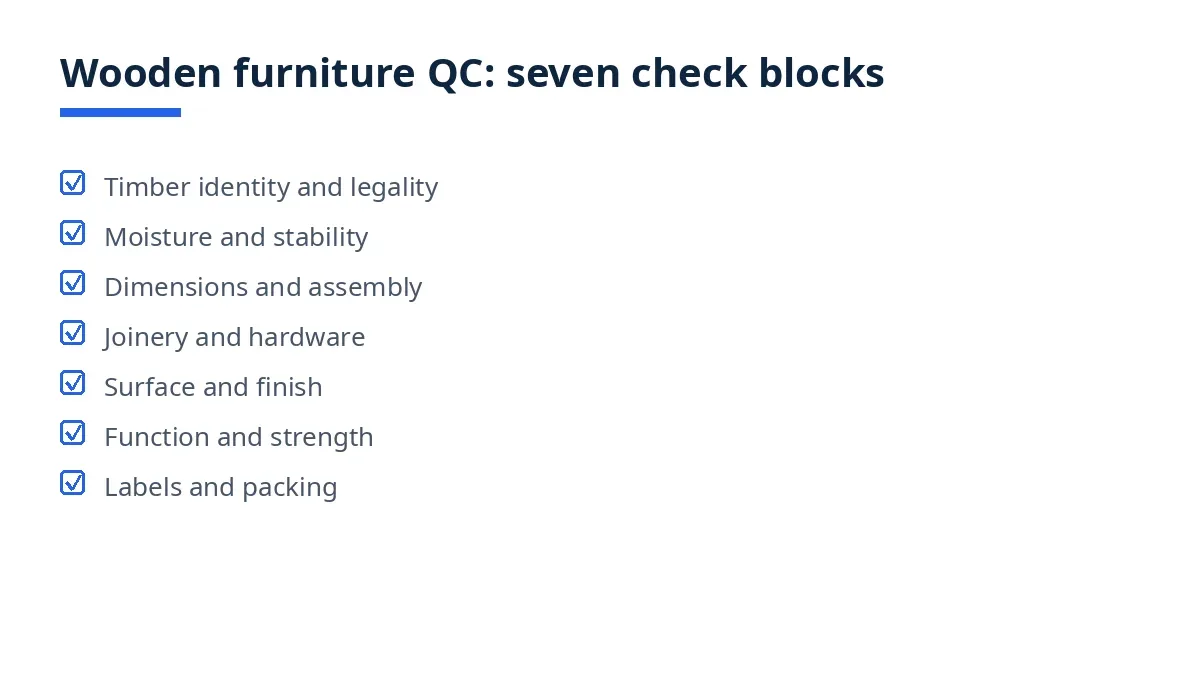
The full checklist (numbered, printable)
Timber identity and legality
Confirm the species on each sampled piece matches the purchase order, checking common and scientific names where given, and compare grain, colour and pore structure with the sample. Flag mixed species within one piece.
Check grain direction on legs, rails, aprons and panels: grain must run along load-bearing parts, and short grain at a joint or leg foot fails.
Check hidden parts, drawer bottoms, back panels, internal frames and stretchers, for species substitution, where cheaper timber is most often used.
Check legality and origin documents for the lot: species, country of harvest, and chain-of-custody claims. FSC chain of custody certification verifies that FSC-certified material has been identified and separated from ineligible material along the supply chain.3
For EU-bound orders, check the supplier can provide the origin information the buyer needs. Under the EU Deforestation Regulation, covered products must be deforestation-free, produced under the law of the country of production, and covered by a due diligence statement, and the regulation applies to wooden furniture.4
Moisture and stability
Take moisture readings on sampled pieces with a species-corrected meter, recording each reading with the piece number. The Wood Handbook warns that readings need species and temperature correction, and that surface readings can mislead when a gradient exists between surface and core.2
Compare readings with the purchase-order target range for the destination climate, and check they are consistent across the sample, not clustered high in one carton.
Check sampled tops, doors and panels for warp, cup, bow, twist and crook with a straightedge.
Check for drying defects: surface checks, end splits, honeycombing at a cut end, and casehardening shown by a cut test piece where the order calls for one.
Check solid-wood panels in frames are free to move where the design requires it, not glued tight on all sides, with edge gaps matching the sample.
Dimensions and assembly
Measure length, width, height and depth on sampled pieces against the drawing, recording actual values rather than pass marks.
Check squareness by measuring both diagonals of tops, frames, doors and drawer fronts: both must match within the drawing tolerance.
Check the piece stands level without rocking, all feet touching the floor at once.
Check symmetry: legs, rails and panels align as drawn, with no racking or twist.
Joinery and hardware
Check each joint type in the drawing, mortise and tenon, dowel, dovetail, tongue and groove, or screwed and glued, for full seating and tight shoulders with no visible gaps.
Check for glue failure: squeeze-out cleaned from visible faces, no starved joints moving under hand pressure, no glue stains under the finish.
Check drawers slide fully without binding, sit flush when closed, and hold shape when pulled open by the handle under a normal load.
Check doors hang level, close without rubbing, gaps are even against the sample, and hinges and catches use the hardware-list screws and plates.
Check shelves sit level on their supports, do not deflect visibly under a normal load, and adjustable shelves fit without forcing.
Check fixings: screws are the specified size and type, driven straight and seated, with no split timber around holes and none missing.
Surface and finish
Check the whole surface by hand and eye for splinters, sharp edges, rough patches, dents, scratches and filler showing through the finish.
Check veneer where used: no bubbling, edge lifting, overlaps or mismatched grain, and edge banding fully adhered, no lifting or overhang.
Check finish consistency: colour, sheen and coverage match the sample across pieces, inside doors and drawers as well as outside, with no runs or missed areas.
Check knots are sound, tight and finished as the sample shows, and record loose, dead or filled knots on visible faces as failures where excluded.
For pieces containing hardwood plywood, medium-density fibreboard or particleboard, check the formaldehyde compliance documents for the market. Under the US EPA rule, finished goods containing regulated composite wood products manufactured in or imported into the US after March 22, 2019 must be certified and labelled TSCA Title VI compliant.5 The EPA emission standards are 0.05 ppm for hardwood plywood, 0.11 ppm for medium-density fibreboard, 0.13 ppm for thin medium-density fibreboard, and 0.09 ppm for particleboard.6
Function and strength
Use each sampled piece as its buyer will: sit on chairs, open and close every door and drawer, extend moving parts, and check nothing loosens or racks out of square.
Where strength or durability evidence is required, confirm the test method and acceptance level in advance. ISO 7170:2021 specifies test methods for the strength, durability and stability of storage units, and states that it specifies test methods only, not requirements.7
Check stability: a tall or narrow piece must not tip under a normal sideways push at the top edge, and castors or glides must roll and lock.
Labels and packing
Check labels carry the information the destination market and the purchase order require: species or material description where specified, care instructions, origin marking and compliance statements, legible and placed correctly.
Check cartons protect the timber: corners, edges and finished faces guarded, pieces separated so finish cannot rub, hardware bagged so nothing loose can dent a surface.
Check carton contents against the packing list: model, finish, quantity and hardware per carton, with markings matching the order.
Check flat-pack pieces carry assembly instructions where the order requires them, and that every part, fixing and tool listed is present in a sampled carton.
Common failures and how to fix them
The most frequent failure is warp after delivery, and it usually traces to moisture. A board dried for a humid factory climate and shipped to a dry, heated home will shrink, cup and open joints. Stop, re-check meter readings across the lot with species correction,2 and hold any carton outside the destination target until the supplier explains the gap.
The next failure is species substitution in hidden parts, found by checking hidden parts against the sample, not visible faces. Segregate affected pieces, re-inspect the lot, and require the supplier to name the species actually used before rework.
Open joints and racking frames usually trace to short grain, starved glue or a joint cut out of square. Re-check the joint against the drawing, test a sample joint by hand, and rework from the joint outward, not by sanding the surface. Finish failures, such as bubbling veneer, point to surface preparation: strip and refinish the area rather than adding another coat over the defect.
Above the agreed acceptance level, options are re-inspection after sorting or rework, documented partial acceptance, or rejection.
Downloadable template / summary table
Copy the checklist into your inspection sheet with the drawing, tolerances, moisture target and acceptance numbers, and record a result per piece.
Section | Checks | Evidence |
|---|---|---|
Timber identity and legality | Species, grain, hidden parts, documents | Sample comparison |
Moisture and stability | Meter readings, warp, drying defects | Readings per piece |
Dimensions and assembly | Measurements, squareness, level | Actual values |
Joinery and hardware | Joints, glue, drawers, doors, fixings | Hand tests |
Surface and finish | Splinters, veneer, finish, knots, formaldehyde | Hand and eye check |
Function and strength | Use tests, stability, agreed test methods | Function check |
Labels and packing | Labels, protection, contents, instructions | Packing list |
How Exportain helps
Exportain is a B2B marketplace connecting buyers with Bangladeshi suppliers of wooden furniture, so species, moisture target and finish can be agreed at the enquiry stage. Browse suppliers, read the furniture sourcing guide and the HS code for wooden furniture guide, and use inspection services when you plan the check. Supplier profiles show document and photo checks recorded, not factory inspections. Exportain is not a party to the goods contract and does not inspect goods.
FAQs
When should this checklist be used?
Use it at final inspection, when goods are finished and largely packed. For larger and first orders, also use it during production, while joints can still be remade and moisture corrected.
Who should complete it?
The buyer, a local agent or an independent inspector can complete it, using the approved sample, the drawing and a randomly drawn sample.
What are the most common failures?
Warp from a moisture mismatch, species substitution in hidden parts, open joints, bubbling veneer and finish defects are the failures buyers find most often.
Can a third party do it?
Yes, if you share the approved sample, the drawing, the moisture target, tolerances and acceptance levels first.
Next steps on Exportain
Before production, agree species, moisture target, tolerances and test methods in writing, then read the pre-shipment inspection guide and the AQL acceptance quality limit explainer, and plan the check with inspection services. You can also post a free RFQ via RFQs and compare quotes from Bangladeshi suppliers.
Sources
- ISO 2859-1:1999 - Sampling procedures for inspection by attributes — Part 1: Sampling schemes indexed by acceptance quality limit (AQL) for lot-by-lot inspection. International Organization for Standardization (accessed )
- Wood Handbook, Chapter 13: Drying and Control of Moisture Content and Dimensional Changes. USDA Forest Service, Forest Products Laboratory (accessed )
- Chain of Custody Certification. Forest Stewardship Council (accessed )
- What is the impact of the EUDR on home decoration?. CBI (Centre for the Promotion of Imports from developing countries) (accessed )
- Formaldehyde Emission Standards for Composite Wood Products. US Environmental Protection Agency (accessed )
- Frequent Questions for Consumers about the Formaldehyde Standards for Composite Wood Products Act. US Environmental Protection Agency (accessed )
- ISO 7170:2021 Furniture — Storage units — Test methods for the determination of strength, durability and stability. Furnitest (accessed )
About the author
Sourcing from Bangladesh?
Post a request for quotation and suppliers on Exportain can send you their quotes directly.
Post an RFQ


