

HS Code for Wooden Furniture: Classification Guide for Importers
Wooden furniture that is not a seat sits in heading 9403 — 9403.30 offices, 9403.40 kitchens, 9403.50 bedrooms, 9403.60 other — while wooden seats take heading 9401 and parts 9403.91. All lines are indicative: verify the national code before filing.
Short answer
Wooden furniture that is not a seat is classified in heading 9403, split by use: 9403.30 for offices, 9403.40 for kitchens, 9403.50 for bedrooms and 9403.60 for other wooden furniture. Wooden seats take heading 9401, and wooden parts take 9403.91. All lines here are indicative only: confirm the full 8-10 digit national code in the destination tariff before filing.
On this page
Key takeaways
Wooden furniture that is not a seat sits in heading 9403, split by intended room: 9403.30 for offices, 9403.40 for kitchens, 9403.50 for bedrooms and 9403.60 for other wooden furniture.
A wooden chair, stool or sofa frame is not 9403 at all: seats fall in heading 9401, and wooden parts shipped on their own take 9403.91.
A desk built for personal household use is generally not office furniture: published US rulings have placed such desks in 9403.50 rather than 9403.30, so construction and intended use decide, not the label.
Only the first six digits are shared worldwide: the EU extends to eight digits and the United States and United Kingdom to ten, so confirm the full national code per piece.
For a borderline piece, apply for a binding decision before shipping: a BTI decision in the EU or an Advance Tariff Ruling in the United Kingdom, generally valid for 3 years.
If you import wooden beds, dining tables, desks or bookcases, the hs code for wooden furniture is the line your customs entry, duty treatment and origin claim all hang on. There is no single code for "wooden furniture" as a whole: heading 9403 splits wooden furniture by the room it is made for, and seats take a different heading altogether. Every code in this guide is indicative — verify the full national code for each piece before you file. The Harmonized System is a multipurpose international product nomenclature developed by the World Customs Organization (WCO), comprising more than 5,000 commodity groups, each identified by a six-digit code, and used by more than 200 countries and economies as a basis for their customs tariffs.1
Quick answer: indicative HS heading (with verify note)
Wooden furniture that is not a seat sits in heading 9403, other furniture and parts thereof, split by use: 9403.30 for offices, 9403.40 for kitchens, 9403.50 for bedrooms and 9403.60 for other wooden furniture.2 A wooden chair, stool or sofa frame is not 9403 at all: seats fall in heading 9401, whether or not convertible into beds.2
Piece | Indicative territory | Why |
|---|---|---|
Wooden bed frame, wardrobe, dresser or nightstand | 9403.50, wooden bedroom furniture | Made for the bedroom |
Wooden office desk built for business use | 9403.30, wooden office furniture | Made for an office |
Wooden kitchen cabinet or kitchen table | 9403.40, wooden kitchen furniture | Made for the kitchen |
Wooden dining table, coffee table, bookcase, sideboard or TV unit | 9403.60, other wooden furniture | None of the office, kitchen or bedroom lines fits |
Wooden dining chair, armchair or sofa frame | Heading 9401, seats | A seat is classified as a seat, not as other furniture |
Wooden table leg, drawer front or frame shipped on its own | 9403.91, parts of wood | Parts take the parts line, not the finished-piece line |
A dining set is not one code by default. Describe the table and the chairs separately: the table points to 9403.60 while the chairs point to heading 9401.2
How HS codes are structured (2-4-6 digits)
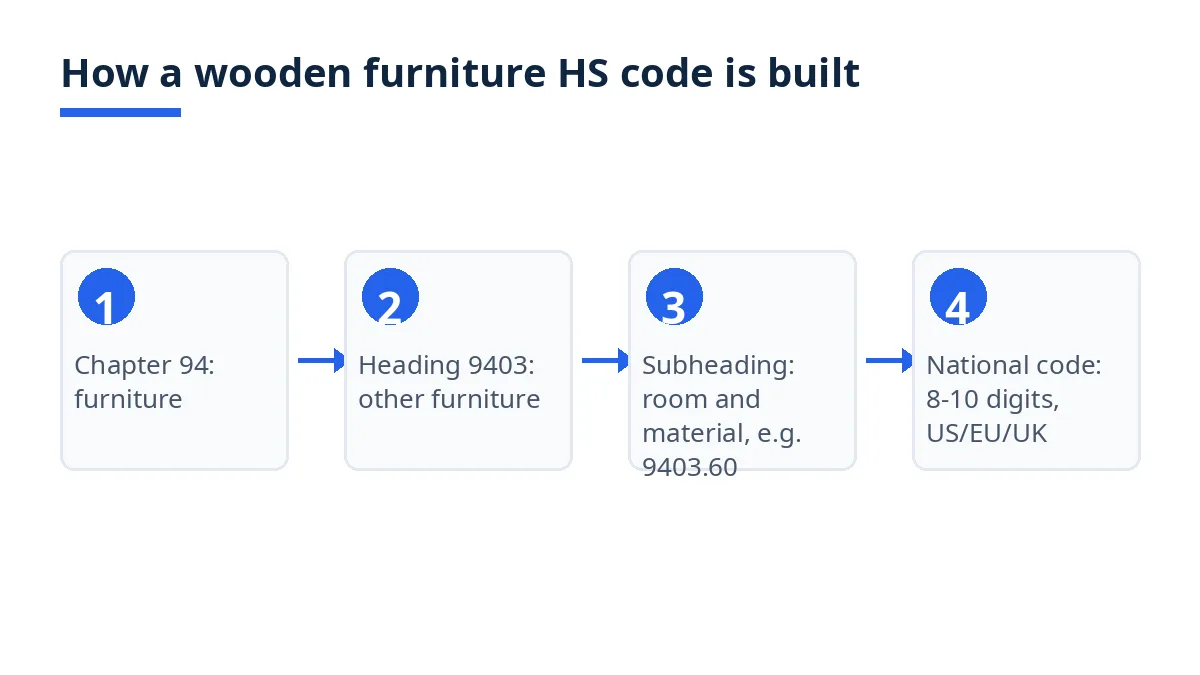
The system is organised in a hierarchy of sections, chapters (2 digits), headings (4 digits) and sub-headings (6 digits), supported by general rules for interpretation.3 Chapter 94 covers furniture, bedding, mattresses, mattress supports and similar furnishings, lamps and lighting fittings, illuminated signs and prefabricated buildings.2 Heading 9403 is the "other furniture" heading inside that chapter, and the six-digit subheading adds the material and use split — for example, 9403.60 for other wooden furniture. Countries then subdivide the six-digit categories into national subheadings for their own tariffs and statistics.3 The current version of the system is HS 2022.3
Factors that decide the code for wooden furniture
Seat or furniture first. Heading 9401 covers seats other than those of heading 9402, whether or not convertible into beds, and parts thereof.2 A wooden-frame upholstered chair sits in the wooden-frame seat lines of 9401, and a plain wooden dining chair in the other-seat lines. If the piece is for sitting on, test 9401 before 9403.
The room it is made for, not the room it ends up in. The wooden lines of 9403 turn on intended use: office, kitchen, bedroom or other. A desk built for business use points to 9403.30, while a desk made mainly for personal household use, without being constructed for a business purpose, is generally not office furniture — in one published US ruling, three such household desks were classified in 9403.50, wooden bedroom furniture, rather than 9403.30.4 Do not let the word "desk" on the order decide; the construction and intended use decide.
Material, and what to do with mixed materials. Wood points to 9403.30–9403.60, metal to 9403.10–9403.20, plastics to 9403.70, and bamboo, rattan or cane to 9403.82–9403.89.2 For a composite piece, such as a wooden table with a metal frame, the general rules test which material or component gives the piece its essential character; a rule that cannot be settled that way falls to the heading that occurs last in numerical order among those that equally merit consideration.5 Record both materials for every piece.
Designed for the floor, with a wall-hung exception. Articles in headings 9401 to 9403 are classified there only if they are designed for placing on the floor or ground — except cupboards, bookcases, other shelved furniture (including single shelves presented with supports for fixing them to the wall) and unit furniture, and seats and beds, which stay in those headings even when hung, fixed to the wall or stacked.2 A wall-mounted wooden bookcase is therefore still furniture of 9403.
Complete piece, part, or unfinished article. Parts of wood take 9403.91 and other parts take 9403.99.2 But the parts lines do not cover sheets or slabs of glass, marble, stone or Chapter 68 or 69 material, even cut to shape, unless combined with other parts.2 An unfinished article that already has the essential character of the finished piece is classified as the finished article, and a complete article presented unassembled is classified as the assembled article.5 A flat-pack wooden bookcase is therefore still a bookcase, not a set of boards.
Bentwood and the exclusions. Each wooden line has its own bentwood split in the US schedule — 9403.30.40, 9403.40.40, 9403.50.40 and 9403.60.40 — so note bentwood construction when it applies.2 Chapter 94 also excludes lookalikes: toy furniture goes to heading 9503, billiard tables and furniture specially constructed for games to heading 9504, lamps and lighting fittings of Chapter 85 stay out, and mattresses and bedding articles go to heading 9404.2 A wooden bed frame is 9403.50; the mattress sold with it is a separate 9404 question.
National codes: US HTS, EU CN/TARIC, UK commodity code
United States: HTS, ten digits. The US schedule runs 9403 to ten digits, with statistical suffixes under the eight-digit lines. Under 9403.60.80, the suffixes separate items such as dining tables from other pieces, and 9403.50.90 separates beds from other bedroom furniture.2 Read the full ten-digit line for each piece and entry date.
European Union: CN at eight digits, TARIC for measures. The Combined Nomenclature uses eight-digit codes, comprising the HS codes with further EU subdivisions.3 At eight digits, 9403.60 subdivides further, so the EU code for a dining or living-room piece differs from the code for other wooden furniture. Read the confirmed line in TARIC for the entry date and origin Bangladesh.
United Kingdom: commodity code. The UK builds its commodity code on the same first six digits, with its own extension after them.3 The UK tariff lists 9403 6090 00 as other wooden furniture, and 9403 6090 as the code for exporting and Intrastat reporting.5 Take the full code from the UK Trade Tariff for your piece and entry date, and check the controls flagged there — the UK page for 9403 6090 00 flags a CITES import control, which matters when the timber species is listed.5
How to confirm the code officially
Write a precise description: piece type, intended room, wood species and main materials, frame construction, dimensions, assembly state (assembled or flat-pack), bentwood or not, and whether any part is a seat.
Start from the official tariff for the destination: the USITC HTS, TARIC or the UK Trade Tariff, and read the heading text and chapter notes, including the floor-standing rule and the exclusions in Chapter 94 note 1.2
Check published rulings for similar pieces. The household-desk ruling above shows how a published ruling settles an office-versus-bedroom borderline.4
For a borderline piece, apply for a binding decision before you ship. In the EU, a Binding Tariff Information decision requires a separate application for each type of product and a detailed description, including images or samples where possible.6 In the United Kingdom, a legally binding decision is generally valid for 3 years, through an Advance Tariff Ruling.7
Give your broker the description and the confirmed code for each piece, and use the same codes throughout the entry, invoice and packing list.
Common classification mistakes
Filing chairs under 9403. A wooden dining chair is a seat of heading 9401, not other furniture of 9403.2 Filing the whole dining set under one 9403 line misclassifies every chair in it.
Filing every desk as office furniture. A desk built for personal household use is generally not office furniture, and published rulings have placed such desks in 9403.50 rather than 9403.30.4
Filing everything as 9403.60. The "other" line is a residual, not a shortcut. A bedroom wardrobe belongs in 9403.50 and a kitchen cabinet in 9403.40; reaching for 9403.60 first skips the more specific line.2
Copying a code from another country. Only the first six digits are shared worldwide. The EU extends to eight digits,3 the United States runs to ten with statistical suffixes,2 and the UK has its own ten-digit commodity code.5 A US ten-digit suffix is not a valid EU or UK code.
Filing loose panels as parts. The parts lines do not cover uncombined sheets or slabs of glass, marble, stone or Chapter 68 or 69 material.2
Filing mattresses, toy furniture or lamps as 9403. Bedding articles sit in 9404, toy furniture in 9503, and lamps and lighting fittings of Chapter 85 are excluded from Chapter 94.2
Related duties and documents
This guide states no duty rates: the code decides which duty line customs applies, and a rate on a bedroom line does not carry to an office or other-furniture line. Read the rate beside your confirmed code for your origin and entry date.
Keep the piece description, wood species and material breakdown, confirmed codes, any binding decision and the origin evidence together in the shipment file, with seats and tables as separate invoice lines. Check timber controls before shipping: the UK tariff page for other wooden furniture flags a CITES control,5 so a listed species needs its control checked even when the code is settled.
FAQs
What is the HS code for wooden furniture?
There is no single code. Wooden furniture that is not a seat sits in heading 9403: 9403.30 for offices, 9403.40 for kitchens, 9403.50 for bedrooms and 9403.60 for other wooden furniture.2 Wooden seats fall in heading 9401, and wooden parts in 9403.91. Every line here is indicative — verify before filing.
Is the HS code the same in every country?
Only the first six digits are harmonised. Beyond six digits, each country adds its own lines: eight digits in the EU Combined Nomenclature,3 ten digits in the United States with statistical suffixes,2 and the UK's own ten-digit commodity code, such as 9403 6090 00 for other wooden furniture.5
How do I confirm the correct code?
Describe each piece precisely, read the heading text and chapter notes in the destination tariff, and check published rulings for similar pieces.4 For a borderline piece, apply for a binding decision before shipping: a BTI decision in the EU, with a separate application per product type,6 or a UK Advance Tariff Ruling, generally valid for 3 years.7
What happens if I use the wrong code?
Duty, licensing and control treatment are worked out from the code on the declaration, so a wrong code brings the wrong treatment. A binding decision in advance helps you calculate the duties and restrictions that will apply.7
Next steps on Exportain
Browse Bangladeshi suppliers on Exportain and post a free RFQ at Exportain RFQs with the confirmed codes stated per piece — table, chairs and parts on separate lines. For the wider system, read the HS code harmonized system guide and the how to classify your product guide. Exportain is not a party to the goods contract and does not inspect goods, book freight or clear customs, so keep your broker and binding decision at the centre of the entry.
Sources
- What is the Harmonized System (HS)?. World Customs Organization (accessed )
- Harmonized Tariff Schedule of the United States, Chapter 94 (2026 Revision 18). U.S. International Trade Commission (accessed )
- Harmonised System. European Commission (accessed )
- Customs Ruling NY N236395 - The tariff classification of wooden desks. U.S. Customs and Border Protection (accessed )
- Commodity code 9403609000: Other wooden furniture - UK Integrated Online Tariff. GOV.UK, HM Revenue and Customs (accessed )
- European Binding Tariff Information (EBTI). European Commission, Taxation and Customs Union, (accessed )
- Check what you'll need to get a legally binding decision on a commodity code. GOV.UK, HM Revenue and Customs (accessed )
- export documents
- HS Codes
- Customs Classification
- importing from Bangladesh
- Bangladesh sourcing
- tariff codes
About the author
Sourcing from Bangladesh?
Post a request for quotation and suppliers on Exportain can send you their quotes directly.
Post an RFQ


