

HS Code for Jute Geotextiles: Classification Guide for Importers
A woven jute geotextile roll points to indicative heading 5310 as fabric in the piece, or to chapter 63 where it is a made-up article, with coating, mesh, and end use tested as description facts and the full national code confirmed for the entry date.
Short answer
A woven jute geotextile in the piece is examined under indicative heading 5310, at 5310.10 for unbleached fabric and 5310.90 for other fabric, while a made-up packing article is a different question under heading 6305. Coating, mesh, and civil-engineering use do not by themselves settle the heading. Confirm the full national code in the destination tariff for the entry date.
On this page
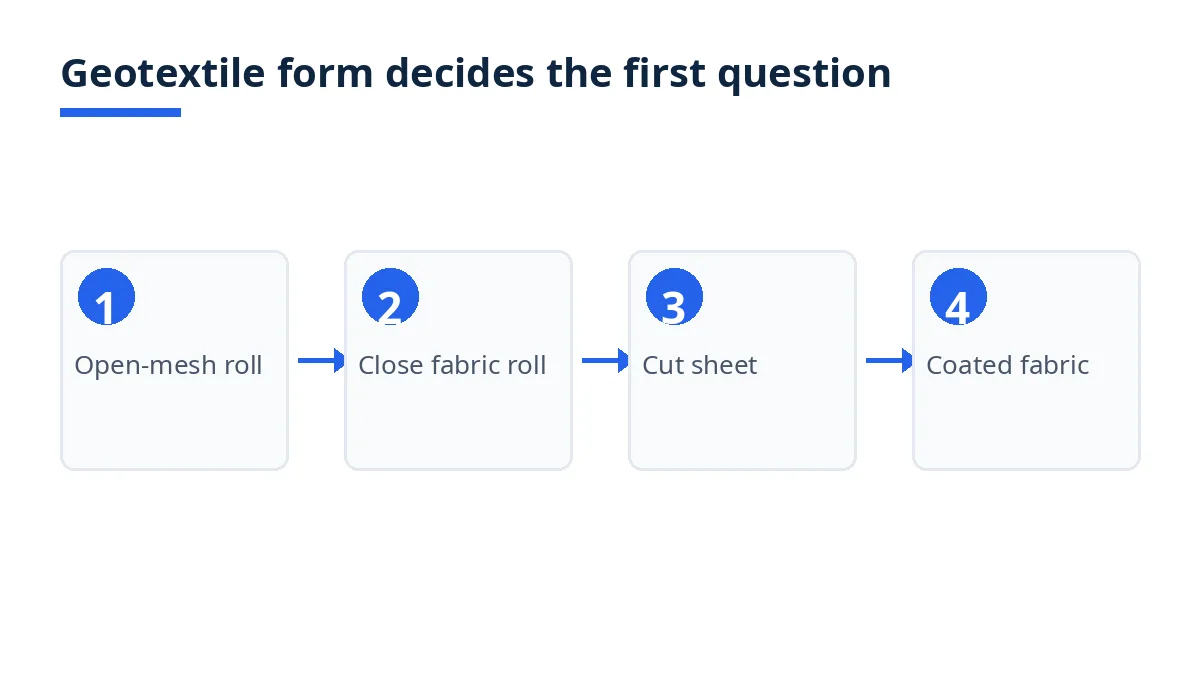
A roll of open-mesh jute is unrolled down a slope, pinned in place, and left to hold soil while plants take root. A second roll, close woven and stiff, goes under a road base. Both are sold as jute geotextiles, and both raise the same question: is the shipment a woven jute fabric, or a made-up textile article.
Verify note: every heading and code named here is indicative only. Confirm the six-digit subheading and the full national code in the destination tariff for the entry date, and put a doubtful geotextile to a broker or to the binding ruling route before filing.
Quick answer: indicative HS heading (with verify note)
Start with form, not with use. Heading 5310 covers woven fabrics of jute or of other textile bast fibers of heading 5303.1 Its shared six-digit split is 5310.10 for unbleached fabric and 5310.90 for other fabric.1 2 A roll of woven jute fabric is examined under heading 5310 first.
Heading 6305 covers sacks and bags of a kind used for the packing of goods, and the United States text opened here shows the jute line as 6305.10.00.3 A geotextile sheet or roll is not a packing sack only because it will hold soil on a slope. Heading 6305 applies only when the article itself is a sack or bag of a kind used for packing goods, such as a container made to be filled with soil or sand.
Civil-engineering use and erosion-control use do not themselves decide the heading. The words geotextile, erosion control, and road base describe a job, while the Harmonized System classifies goods by what they are, by material and construction, and by the heading texts and notes.
Form as presented | First question | Indicative area, with caution |
|---|---|---|
Open-mesh woven jute roll, unhemmed, uncoated | Woven fabric in the piece | 5310 area; 5310.10 if unbleached, 5310.90 if other |
Cut geotextile sheet with finished edges | Fabric, or made-up article | Classification question: test the made-up question first |
Coated woven jute roll for a road base | Coated fabric, or fabric of heading 5310 | Classification question: record the coating, test chapter 59 |
Sewn geotextile panel or container made to hold fill | Made-up article, and whether it is a packing article | Classification question: test 6305 only if a packing sack or bag |
How HS codes are structured (2-4-6 digits)
The code narrows in stages. The first two digits are the chapter: chapter 53 covers other vegetable textile fibers and woven fabrics of paper yarn, and chapter 63 covers other made-up textile articles.1 3 The next two digits make the heading, such as 5310 or 6305. The final two digits make the subheading, such as 5310.10 for unbleached woven jute fabric and 5310.90 for other woven jute fabric.2
Only the first six digits are internationally shared. Beyond them, each destination adds its own digits, so the same roll can carry a different full code in the United States, the European Union, and the United Kingdom. A code quoted without the national extension is unfinished for an entry.
Factors that decide the code for jute geotextiles
First, test fabric against made-up article. Subchapter 1 of chapter 63 applies only to made-up articles, of any textile fabric.4 A roll that has not been made into an article stays on the fabric side, while a finished piece with the character of a made-up article moves to the chapter 63 side. Record whether the piece is a roll, a length cut to size, or a finished panel, and its finishing.
Second, test open mesh against close fabric as description, not as a heading. Heading 5310 covers woven fabrics of jute without a mesh split at six digits in the texts opened here.1 Both an open-mesh erosion-control fabric and a close woven road-base fabric start in heading 5310 when they are fabric in the piece.
Third, test bleached against unbleached for the six-digit line. The split inside heading 5310 is 5310.10 for unbleached and 5310.90 for other fabric.2 The Canadian tariff text opened here shows the same pattern at national length.5 Bleaching, dyeing, and printing therefore matter at six digits, while mesh and end use do not.
Fourth, treat coating, impregnation, and lamination as facts to test, not as a new six-digit line. The six-digit splits in heading 5310 turn on bleaching, not on coating, in the texts opened here. The chapter 59 note for heading 5911 states that heading 5911 applies to goods which do not fall in any other heading of Section XI.6 A fabric that already falls in heading 5310 is therefore not moved to heading 5911 by technical use alone. Test whether the coating itself brings the goods within a chapter 59 heading.
Fifth, test blends by weight share. For a mixed-fiber geotextile, record each fiber share by weight. The Section XI subheading note for chapters 56 to 63 provides that products containing two or more textile materials are regarded as consisting wholly of the material selected under the note for chapters 50 to 55 products of the same materials, which turns on predominance.7 A jute-predominant fabric stays on the 5310 side.
Sixth, test how the goods travel and how they will be installed. Rolls, folded lengths, cut sheets, and sewn panels are different presentations.
Worked geotextile description | Deciding factor | Indicative treatment, with caution |
|---|---|---|
Open-mesh erosion-control roll, unbleached, unhemmed | Woven fabric in the piece; unbleached split | 5310.10 area; confirm the national line |
Coated road-base fabric roll, woven jute base | Coating test and the chapter 59 exclusion | Classification question: test chapter 59 on the coating |
Cut geotextile sheet, hemmed edges, no seams | Made-up question on a finished piece | Classification question: weigh finishing against the fabric side |
Sewn geotextile panel with loops, made to be anchored | Made-up article character | Classification question: chapter 63 side; test 6305 only if a packing sack |
National codes: US HTS, EU CN/TARIC, UK commodity code
In the United States, the Harmonized Tariff Schedule extends the six-digit subheading to a 10-digit import number. The text opened here shows the packing side: the jute line under heading 6305 is 6305.10.00.3 For a fabric-side geotextile, work from the shared 5310.10 and 5310.90 lines outward to the current United States line, and confirm that line for the entry date.
In the European Union, the Combined Nomenclature builds on the six-digit subheading with two further digits, and TARIC adds further digits for the import declaration. Read the entry-date line under 5310.10 or 5310.90 for a fabric-side geotextile, or under 6305.10 for a packing-side article. The Canadian pattern is not a European line and must not be filed as one.5
In the United Kingdom, the commodity code is also built on the shared six-digit foundation with national extensions to 10 digits. No Great Britain numeric line is stated here, because the United Kingdom tariff heading page returned an access refusal in this session and was not used as a source.
How to confirm the code officially
Start with the destination tariff text, not a supplier invoice, a marketplace listing, or a code for another country. Open the current chapter 53 and chapter 63 texts, read the heading wording and the notes, and work down from the heading to the subheading and then to the national line.
Next, build a classification file for each geotextile style: fiber and weight shares, weave and mesh opening, finish, coating and its material, form as presented, edge finish and any sewing or fastenings, and dimensions. Add the supplier specification in writing and photographs of face, back, and edges.
Where the answer is still doubtful, seek a binding decision before shipping. For Great Britain, an Advance Tariff Ruling must be applied for before all customs procedures have been completed, and a separate application is needed for each type of goods.8 For Northern Ireland and the European Union, a Binding Tariff Information decision is applied for through the EU Customs Trader Portal, with a separate application for each type of goods.9 A binding decision covers only the goods described in it.
Common classification mistakes
The first mistake is quoting the fiber heading for the fabric. Heading 5310 refers to fibers of heading 5303 as its material, which shows that fiber and fabric are different levels.1
The second mistake is letting end use decide the heading. Erosion control, slope protection, drainage, and road-base work describe where the goods will be used, and use alone does not place a woven fabric in a made-up heading.
The third mistake is treating every geotextile article as a packing sack. A sheet, a roll, and a panel are not packing goods on the heading 6305 wording.3 Only an article that is itself a packing sack or bag, such as a container made to be filled, earns the 6305 test.
The fourth mistake is letting a coating decide the code from the trade name. A coated fabric may raise a chapter 59 question, but the heading 5911 note excludes goods that already fall in another Section XI heading.6 Record the coating material and method, and seek a ruling where the texts leave the answer open.
The fifth mistake is copying a full national code from another country or from an older edition. Only the first six digits are shared. Confirm the full line, for the entry date, in the tariff of the country where the goods will be declared.
Related duties and documents
Duty treatment follows the final code, and it is read in the destination tariff for the entry date. This guide states no duty figure, because duty treatment is national, changes over time, and depends on facts outside the heading, such as origin and any preference that applies to the entry.
Keep the documents a broker or a ruling authority will ask for with the classification file: the commercial invoice and packing list, the supplier specification sheet with fiber shares, weave, mesh, finish, coating, and dimensions, and photographs of face, back, and edges. Where a preference is claimed, keep the origin document with the same file.
FAQs
What is the HS code for jute geotextiles?
There is no single settled code for every jute geotextile. A woven jute fabric in the piece is examined under indicative heading 5310, at 5310.10 for unbleached fabric and 5310.90 for other fabric, while a made-up packing article is a different question under heading 6305.1 2 3 Confirm the full national code for the form you are shipping.
Is the HS code the same in every country?
The first six digits are shared, but the full code is not the same in every country. Each destination adds its own digits after the six, so each form needs its full national line read in the destination tariff.
How do I confirm the correct code?
Work from the destination tariff text through heading, subheading, and national line, build a classification file with fiber shares, weave, mesh, finish, coating, form, and edge finish, and put a doubtful case to a broker or a binding ruling before shipping. For Great Britain, apply for an Advance Tariff Ruling before customs procedures are completed; for Northern Ireland and the European Union, apply for a Binding Tariff Information decision.8 9
What happens if I use the wrong code?
Customs can reclassify the goods, reassess the duty and taxes on the corrected code, delay clearance, and apply penalties under national rules. Tell a broker promptly if an error is found, and keep the classification file.
Next steps on Exportain
For background, read HS Code: Harmonized System Explained and HS Codes: How to Classify Your Product. When you are ready to source, browse suppliers on Exportain and compare geotextile weave, mesh, finish, and form before asking for a quotation.
Sources
- HS, 2012 - Code 5310: Woven fabrics of jute, other textile bast fibres of heading no. 5303. United Nations Statistics Division (accessed )
- HS, 2012 - Code 531010: Woven fabrics of jute or of other textile bast fibres of heading no. 5303, unbleached. United Nations Statistics Division (accessed )
- Harmonized Tariff Schedule of the United States Revision 15 (2026), Chapter 63: Other made-up textile articles. United States International Trade Commission (accessed )
- Harmonized Tariff Schedule of the United States (2000) Supplement 1, Chapter 63: Other made-up textile articles. United States International Trade Commission (accessed )
- Chapter 53 - Other vegetable textile fibres; paper yarn and woven fabrics of paper yarn. Government of Canada (accessed )
- Harmonized Tariff Schedule of the United States Revision 7 (2025), Chapter 59: Impregnated, coated, covered or laminated textile fabrics. United States International Trade Commission (accessed )
- Combined Nomenclature, Section XI: Subheading notes for Chapters 56 to 63 (products containing two or more textile materials). European Union (accessed )
- Apply for an Advance Tariff Ruling. HM Revenue & Customs (GOV.UK), (accessed )
- Apply for a Binding Tariff Information decision. GOV.UK (accessed )
About the author
Sourcing from Bangladesh?
Post a request for quotation and suppliers on Exportain can send you their quotes directly.
Post an RFQ


