HS Code for Mangoes: Classification Guide for Importers
Fresh or dried mangoes point indicatively to heading 0804, but frozen, prepared, and juice mango products fall under different headings. This guide works through the deciding factors and how to confirm the full national code.
Short answer
The indicative heading for mangoes, fresh or dried, is 0804, with subheading 080450 for guavas, mangoes and mangosteens. Frozen mango points indicatively to 081190, mango pulp or puree prepared or preserved points indicatively to 200899, and mango juice points indicatively to heading 2009. Every heading here is indicative: verify the full national code in the destination tariff for the entry date before filing.
On this page
If you import mangoes, the hs code for mangoes is not one settled number for every mango product. A fresh mango, a dried slice, a frozen chunk, a pulp, and a juice can point to different headings. The deciding facts are the state of the goods on arrival and what was done to them before shipment, and every heading here is indicative until you confirm the full national code for the entry date.
Quick answer: indicative HS heading
The indicative heading for mangoes, fresh or dried, is 0804. The United Nations Statistics Division classification shows heading 0804 as dates, figs, pineapples, avocados, guavas, mangoes and mangosteens, fresh or dried, with subheading 080450 for guavas, mangoes and mangosteens, fresh or dried.1 Treat 0804 as indicative only: it does not cover frozen mango, prepared mango, or mango juice.
Product state on arrival | Indicative heading | Indicative subheading | Verify note |
|---|---|---|---|
Fresh mango, not frozen or prepared | 0804 | 080450 | Verify national line and entry period |
Dried mango slices, plain dried | 0804 | 080450 | Verify no sugar steeping or other preparation |
Frozen mango chunks, uncooked or cooked only by steaming or boiling in water | 0811 | 081190 | Verify no frying, coating, or other preparation |
Mango pulp or puree, otherwise prepared or preserved | 2008 | 200899 | Verify cooked puree or paste wording |
Mango juice, unfermented, not containing added spirit | 2009 | Verify subheading | Verify single-fruit or mixture line |
Confirm every national line on the entry date.
How HS codes are structured
The Harmonized System is a multipurpose international product nomenclature developed by the World Customs Organization, used by more than 200 countries and economies as a basis for customs tariffs and for the collection of trade statistics.2 Only the first six digits are shared internationally.
Level | Digits | For mangoes |
|---|---|---|
Chapter | 2 digits (08) | Edible fruit and nuts; peel of citrus fruit or melons |
Heading | 4 digits (0804, 0811, 2008, 2009) | The product group, such as mangoes, fresh or dried |
Subheading | 6 digits (080450, 081190, 200899) | International detail, such as guavas, mangoes and mangosteens, fresh or dried |
National extension | 8 to 10 digits | Set by the importing country |
Chapter 08 covers edible fruit and nuts, while Chapter 20 covers preparations of vegetables, fruit, nuts, or other parts of plants.3 That chapter change is where a mango stops being a fresh or dried fruit and becomes a prepared product. Chilled fruit and nuts are classified in the same headings as the corresponding fresh fruit and nuts, and dried fruit of Chapter 08 may be partially rehydrated or treated for preservation or appearance, provided it retains the character of dried fruit.4 Read the heading text and chapter notes before the subheading.
Factors that decide the code for mangoes
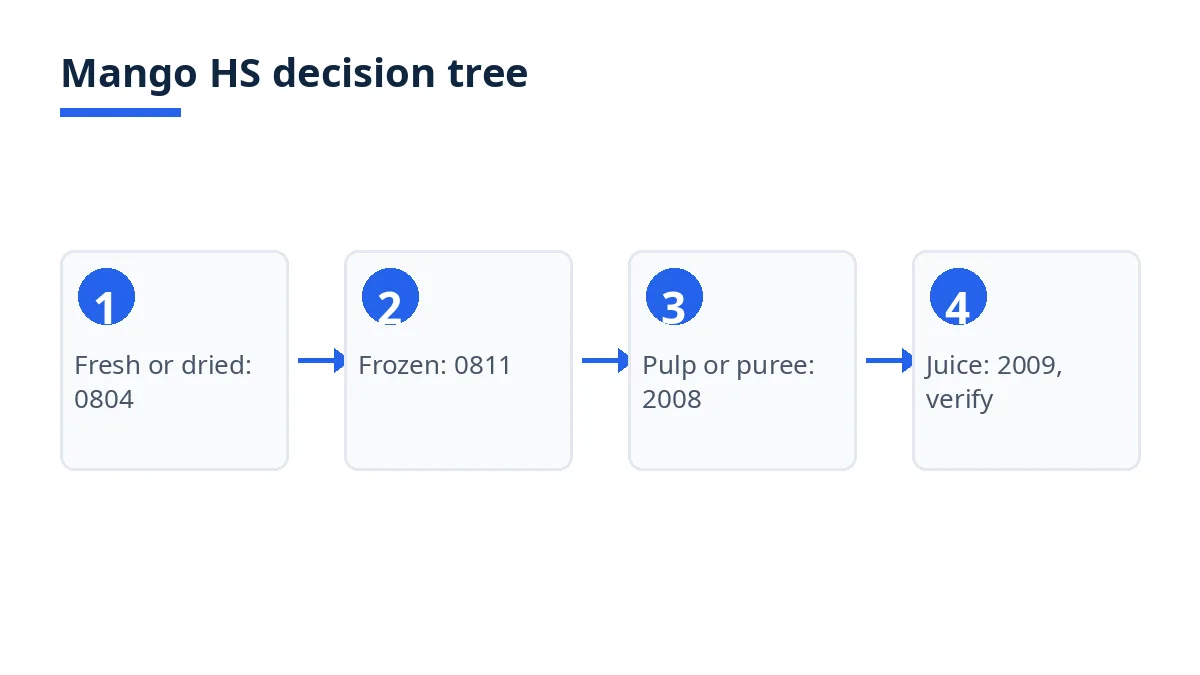
Classification follows the heading wording and chapter notes, not the seller's product name. Check state first, then preparation, then form: fresh or dried points to 0804, frozen points to 0811, and a prepared product points to Chapter 20.
Fresh mango: is this mango fresh, or has it been frozen or prepared?
Deciding factor: fresh state on arrival, with no freezing and no preparation beyond the fresh fruit itself. Indicative subheading 080450.1 The United States tariff splits fresh guavas, mangoes, and mangosteens by entry period, with separate lines for entry from September 1 to the following May 31 and for entry at any other time.4
Dried mango slices: are these plain dried slices, or a prepared mango product?
Deciding factor: whether the slices are plain dried mango retaining dried-fruit character, or mango prepared beyond drying. Plain dried slices point indicatively to 080450, because heading 0804 covers mangoes, fresh or dried.1 The United States tariff carries a separate dried line under 0804.50.4 By contrast, a published United Kingdom ruling for diced mango blanched, treated with sulphur dioxide, steeped in sugar syrup, and dehydrated classified that product in heading 2008 and subheading 200899, not in heading 0804.5
Frozen mango chunks: were these chunks frozen uncooked, or cooked only by steaming or boiling in water?
Deciding factor: freezing method and any cooking before freezing. Heading 0811 covers fruit and nuts, uncooked or cooked by steaming or boiling in water, frozen, whether or not containing added sugar or other sweetening matter, with subheading 081190 for fruit and nuts not elsewhere specified in that heading.6 Frozen chunks that meet that wording point indicatively to 081190; the United States tariff carries a mango line under 0811.90.4 Fried, coated, or otherwise prepared chunks need a prepared-product check first.
Mango pulp or puree: is this a prepared pulp, or a cooked puree or paste?
Deciding factor: the preparation method. Heading 2008 covers fruit, nuts, and other edible parts of plants, otherwise prepared or preserved, whether or not containing added sugar or other sweetening matter or spirit, not elsewhere specified or included.3 Mango pulp or puree prepared in that sense points indicatively to heading 2008, with subheading 200899.7 Before filing, check heading 2007, which covers jams, fruit jellies, marmalades, and fruit or nut puree and fruit or nut pastes, being cooked preparations.3 A cooked puree or paste may raise heading 2007, and the distinction turns on the production description.
Mango juice: is this juice, or a pulp, a nectar, or a drink made from mango?
Deciding factor: whether the product is juice within heading 2009, rather than a pulp or prepared fruit product. Heading 2009 covers fruit juices, including grape must, and vegetable juices, unfermented, not containing added spirit, whether or not containing added sugar or other sweetening matter.3 A mango juice that meets that wording points indicatively to heading 2009, with the subheading to verify. This guide does not assert a mango-juice subheading, because no mango-specific juice subheading was opened for this guide. A pulp, nectar, or mixed drink may fail the heading 2009 wording, so check composition and production method before filing.
National codes: US HTS, EU CN/TARIC, UK commodity code
Only the first six digits are harmonized. Confirm each line below on the entry date.
United States: HTS, ten digits. The United States tariff splits fresh guavas, mangoes, and mangosteens by entry period, with 0804.50.40 for entry from September 1 to the following May 31 and 0804.50.60 for entry at any other time, and it carries dried mango at 0804.50.80 and frozen mango at 0811.90.52.4 Check the current HTS revision for the entry date.
European Union: CN at eight digits, TARIC for the import code and measures. The Combined Nomenclature base for mangoes is 0804 50 00, extended in TARIC. The Northern Ireland tariff page for heading 0804 lists Mango (Mangifera indica) at 0804 5000 40, with other guavas, mangoes, and mangosteens at 0804 5000 89.8 Check the full import code and measures for the entry date in TARIC.
United Kingdom: commodity code. The Northern Ireland page for heading 0804 lists mango at 0804 5000 40.8 For Great Britain, confirm the commodity code in the United Kingdom Integrated Online Tariff for the entry date.
How to confirm the code officially
Use this sequence for each distinct mango product.
Write a precise product description: state on arrival, form and cut, fresh, dried, frozen, pulp, or juice character, cooking, drying, freezing, or preparation method, and any added sugar or spirit.
Start from the official tariff for the destination: the United States International Trade Commission HTS, the Combined Nomenclature and TARIC for the European Union, and the United Kingdom Trade Tariff. Read the heading text and chapter notes. Classification follows the heading terms and any relative notes, and subheading classification compares only subheadings at the same level.8
Check published rulings for similar goods. Another trader's ruling is not a decision about your goods, but the sugar-steeped diced mango ruling shows how preparation can move a mango product to heading 2008.5
For a borderline product, apply for a binding decision before you ship. In the United Kingdom, an Advance Tariff Ruling must be applied for before all customs procedures have been completed, with a separate application for each type of goods, and a reply in 30 to 120 days.9 For Northern Ireland or the European Union, apply for a Binding Tariff Information decision instead, with a separate application for each type of goods, and a reply aimed at within 120 days.10
Give your broker the full description and confirmed code, and use the same code on the commercial invoice, packing list, and import declaration.
Common classification mistakes
Using 0804 for every mango product. Frozen mango points to 0811, prepared mango points to Chapter 20, and juice points to 2009.
Calling sugar-steeped dried mango plain dried mango. The published ruling for diced mango blanched, treated with sulphur dioxide, steeped in sugar syrup, and dehydrated was classified in heading 2008, not heading 0804.5
Calling a pulp a frozen fruit. A prepared pulp is a Chapter 20 question, even if it arrives frozen. Check heading 2008 and the cooked puree wording in heading 2007 before filing.3 7
Calling a drink mango juice. Heading 2009 covers fruit juices, unfermented, not containing added spirit.3 A pulp, a nectar, or a mixed drink may fail that wording.
Copying a code from another product or country. A six-digit match does not mean the national code also matches.4
Treating a mixed fruit product as mango alone. State every component and check which one gives the product its essential character.
Leaving the description vague. An invoice that says only mango forces a broker to guess state, form, and preparation method.
Treating the code as permanent. Recheck the code when the specification, the tariff edition, or the destination changes.
Related duties and documents
This guide states no duty rate for any mango product. The code decides which duty line and measures customs applies, but rates, preferences, and additional measures depend on the destination, origin, tariff edition, and entry date, and they change. Read the rate and measures beside the confirmed code in the official tariff for your entry date. Keep the same code on the commercial invoice, packing list, and any origin declaration, with the tariff printout or ruling reference and the supplier specification, and recheck the code if any fact changes.
FAQs
What is the HS code for mangoes?
There is no single HS code for all mango products. Mangoes, fresh or dried, point indicatively to heading 0804, with subheading 080450 for guavas, mangoes, and mangosteens, fresh or dried.1 Frozen mango points indicatively to 081190, mango pulp or puree prepared or preserved points indicatively to 200899, and mango juice points indicatively to heading 2009, with the subheading to verify.6 7 3
Is the HS code the same in every country?
The first six digits are shared internationally, because the Harmonized System is used by more than 200 countries and economies as a basis for customs tariffs and trade statistics.2 Each country adds its own digits, so confirm the full code in the destination tariff.4 8
How do I confirm the correct code?
Write a precise description covering state, form, cooking, drying, freezing, and preparation method. Read the heading text and chapter notes in the destination tariff, check rulings for similar goods, and for a borderline product apply for a binding decision before you ship.9 10
What happens if I use the wrong code?
Customs may reclassify the goods and apply the duty line and measures for the correct code, which can delay clearance and change the amount payable.9 10
Next steps on Exportain
Start with the HS code explainer for the structure of the code, then how to classify your product for the method. When ready to source, browse suppliers and ask each supplier for the written specification this guide lists.
Sources
- Classification Detail: HS 2017, Code 080450. United Nations Statistics Division (accessed )
- What is the Harmonized System (HS)?. World Customs Organization (accessed )
- Classification Detail: HS 2017, Code 20. United Nations Statistics Division (accessed )
- Harmonized Tariff Schedule of the United States Revision 16 (2026), Chapter 8. U.S. International Trade Commission (accessed )
- Information for ruling 600005639 - Diced mango. GOV.UK, HM Revenue and Customs (accessed )
- Classification Detail: HS 2012, Code 0811. United Nations Statistics Division (accessed )
- Classification Detail: HS 2017, Code 200899. United Nations Statistics Division (accessed )
- Dates, figs, pineapples, avocados, guavas, mangoes and mangosteens, fresh or dried - Northern Ireland Online Tariff. GOV.UK, HM Revenue and Customs (accessed )
- Apply for an Advance Tariff Ruling. HM Revenue & Customs (GOV.UK), (accessed )
- Apply for a Binding Tariff Information decision. GOV.UK (accessed )
About the author
Sourcing from Bangladesh?
Post a request for quotation and suppliers on Exportain can send you their quotes directly.
Post an RFQ