

Can You Use CIF for Air Freight? Rules, Alternatives and Examples
CIF cannot be used for air freight: it is a sea-only Incoterms rule. Learn why the delivery point fails on a flight, what a wrong CIF airport term risks, and how CIP, FCA, DAP and DDP replace it.
Short answer
No. CIF (Cost, Insurance and Freight) applies only to sea and inland waterway transport under Incoterms 2020, because delivery happens when goods are loaded on board the vessel. Air freight has no vessel, so CIF cannot be used for flights or courier shipments. Use CIP instead when the seller should pay carriage and insurance to the named airport, FCA when the buyer arranges carriage, and DAP or DDP for a delivered price.
On this page
Key takeaways
CIF applies only to sea and inland waterway transport, so it cannot be used for air freight or courier shipments.
The CIF delivery point is on board the vessel, and an aircraft has no equivalent moment.
CIP is the direct air-freight replacement when the seller should pay carriage and broader Clause (A) insurance.
Under CIP, risk passes at handover to the first carrier even though the seller pays freight and insurance to the destination.
Write the term, the named airport and the edition on every document, and use an air waybill, not a bill of lading.
No. You cannot use CIF for air freight. Searches for cif for air freight rest on a fair assumption: CIF sounds like a general promise that the seller pays the cost, the insurance and the freight. Under Incoterms 2020, CIF is not general. It applies only to sea and inland waterway transport, and its delivery point is on board a vessel. An aircraft has no vessel and no on-board moment that matches the rule.
For most air shipments from Bangladesh, the direct replacement is CIP (Carriage and Insurance Paid To). FCA fits when the buyer arranges the main carriage, and DAP or DDP fits when the buyer wants a delivered price. This guide explains the mismatch, what "CIF Dhaka airport" does to a contract, and which term to write instead.
Why CIF cannot board a plane
CIF stands for cost, insurance and freight. The seller clears the goods for export, pays carriage to the named destination port, and buys minimum insurance for the buyer, while the buyer clears import and pays duties. That division suits sea trade. None of it transfers to air freight, because the rule is written for ships.
Incoterms 2020 contains 11 rules with a clear allocation of cost, risk and obligations, and different insurance levels for the CIF and CIP rules.1 Seven rules work for any mode of transport; four, including CIF with FAS, FOB and CFR, are meant only for sea and inland waterway transport.2 Under CIF, the seller delivers when the goods are loaded on board the vessel.2 Goods flown from Bangladesh are handed to a carrier, handler or terminal before departure, and the aircraft is never the named delivery point.
The cif airfreight incoterm does not exist as a separate rule. A cif air shipment has no vessel, so a contract that names CIF for a flight names a delivery point that cannot occur.
What should I know first about CIF?
CIF is a sea and inland waterway rule only. Risk passes when the goods are loaded on board the vessel, even though the seller pays freight and minimum insurance to the destination port.2 For air freight, use CIP, FCA, or DAP/DDP. Always write the rule, the named place and the edition, for example "CIP London Heathrow Airport, Incoterms 2020".
What "CIF Dhaka airport" does to a contract
A contract that reads "CIF Dhaka airport" does not become a valid air term by naming an airport. The named place in a CIF contract is a destination port, and delivery stays on board the vessel at the port of loading. Without a vessel, the risk point is left to guesswork.
The insurance gap is the practical consequence. Under CIF, the ICC keeps Institute Cargo Clauses (C) as the default, a more limited level.1 Under CIP, the seller must provide Clause (A) cover, which is broader.1 The seller pays freight to the destination but risk passes much earlier, at handover or loading at origin.2
Payment terms add a second layer of risk. Incoterms rules do not set the price or payment method, do not say when ownership passes, and do not cover breach remedies.2 A letter of credit expecting a bill of lading will look for the sea document, while an air shipment produces an air waybill instead.
The same answer applies to a cif courier booking. A courier shipment still travels by air, road or a mix of the two. Writing CIF on a courier booking does not make the courier the vessel. If the seller should pay the courier charge and the insurance, write CIP. If the buyer should pay the courier, write FCA. If the price should include delivery to the door, write DAP or DDP.
Choosing the replacement for cif for air freight
CIP, FCA, DAP and DDP work for any mode of transport; CIF works only for sea and inland waterway transport.2
Term | Seller pays | Risk passes to the buyer | Insurance | Use it when |
|---|---|---|---|---|
CIP | Carriage and insurance to destination | Handover to first carrier | Seller buys Clause (A) cover | Seller arranges flight and insurance |
FCA | Nothing for main carriage | Handover to buyer's carrier | Buyer arranges it | Buyer has its own freight contract |
DAP | Carriage to destination | At destination, ready for unloading | Not required | Delivered price, buyer clears import |
DDP | Carriage, import clearance and duties | At destination, cleared for import | Not required | Seller can act as importer |
CIF | Carriage and insurance to destination port | On board the vessel | Seller buys Clause (C) cover | Sea or inland waterway only |
CIP is the closest replacement for the bargain most buyers mean by "CIF for air": the seller pays carriage to the named destination and buys the broader Clause (A) insurance, while risk passes at handover to the first carrier.2 CIP is not a delivered term; DAP is the term to compare when the buyer wants the seller to carry risk to the destination.
FCA suits a buyer with its own freight arrangements: the seller clears the goods for export and hands them to the buyer's carrier, and the buyer pays the main carriage and arranges any insurance.2 DAP and DDP suit a buyer who wants one delivered price: under DAP the seller carries risk until the goods arrive ready for unloading, while under DDP the seller also clears the goods for import and pays duties.2 Write the term in full on every document: "CIP London Heathrow Airport, Incoterms 2020" states the rule, the named place and the edition, while "CIF air" states none of them.
Step-by-step: how a CIP air shipment works
A CIP air shipment follows the same commercial order as any export sale, with the air documents and the insurance fitted to the flight instead of a sailing. FCA follows the same steps except that the buyer, not the seller, books the main carriage and the insurance.
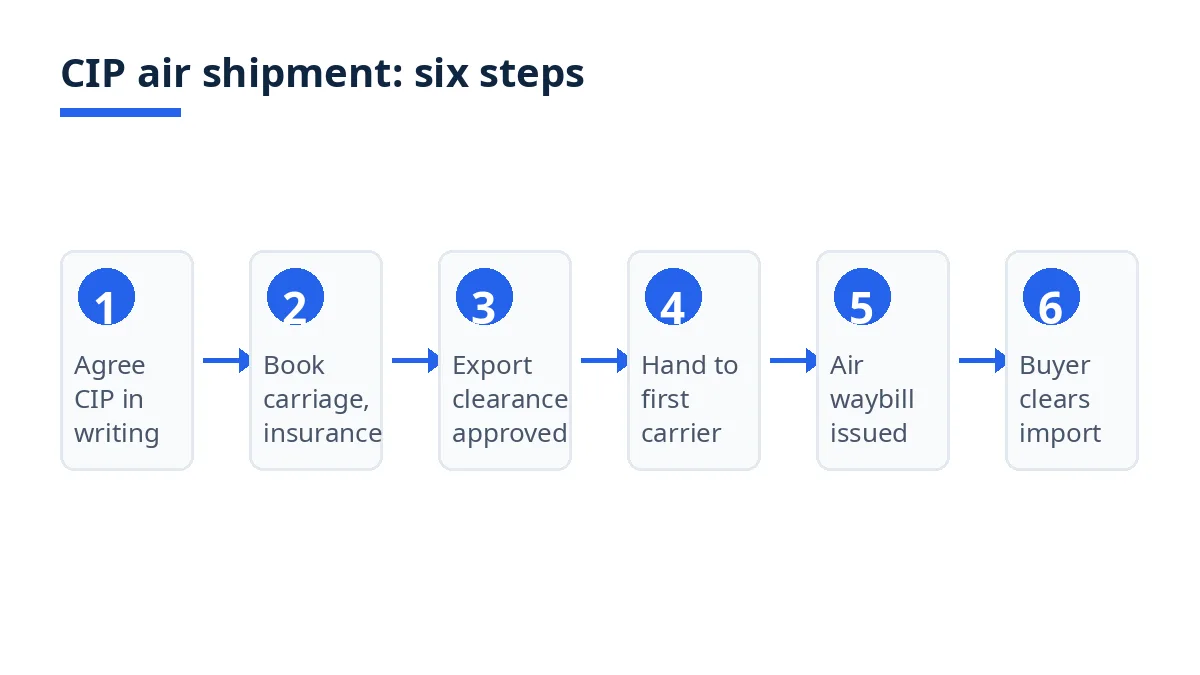
Agree the term, the airport and the insurance in writing. State "CIP [destination airport], Incoterms 2020", the departure airport, who buys insurance, and the level of cover.
Confirm the goods, the packing and the flight requirements. Confirm pieces, gross weight, dimensions and any special handling before the seller books. Packing must survive handling at two airports and any transfer between flights.
Seller books carriage and buys insurance. Under CIP, the seller contracts carriage to the named destination and procures insurance compliant with Institute Cargo Clauses (A).1 Ask for the certificate details before departure.
Complete export clearance in Bangladesh. Goods must not be loaded unless an export declaration, known as the Bill of Export or Shipping Bill, is submitted to Customs and approved.3 Enclosed documents include the export contract, commercial invoice, packing list, EXP form, and certificate of origin.3
Hand the goods to the first carrier and take the air waybill. Risk passes at handover. Check the shipper, consignee, airports, pieces, weight and description on the air waybill.
Buyer clears import and takes delivery. Under every rule except DDP, the buyer handles import clearance and pays import duties.2 The buyer, or its broker, presents the import declaration, pays the assessed duties and taxes, and collects the goods at the destination airport.
Costs, timelines and documents
What are the typical costs and timelines?
There are no typical costs or timelines a guide can state as fact for air freight from Bangladesh. Freight depends on route, airline, chargeable weight, season and handling; insurance depends on value, route and cover. Ask for each charge as a separate line, and ask which party pays it.
Timelines work the same way: a missed cut-off moves the shipment to a later flight. Airlines transport over 62 million tonnes of cargo a year, more than 33 percent of global trade by value but less than 1 percent by volume.4
Example figures: goods USD 10,000, freight USD 900, insurance USD 60, handling USD 120. Under CIP the seller pays freight and insurance; under FCA the buyer pays freight. Illustrative only.
Which documents are needed?
The transport document is the decisive difference: a sea shipment travels under a bill of lading; an air shipment travels under an air waybill. Bangladesh Customs lists the bill of lading, the air waybill, the truck receipt and the railway receipt as the transport documents for their modes.3 Do not ask for a bill of lading for goods that fly.
Document | Who provides it | What it does |
|---|---|---|
Commercial invoice | Seller | Goods, value, parties, and the Incoterm with named place and edition |
Packing list | Seller | Quantity, weight and packing information3 |
Air waybill | Carrier or its agent | Evidence of the air carriage contract and receipt for the goods |
Bill of Export or Shipping Bill | Seller, approved by Customs | Export declaration approved before loading3 |
EXP form | Seller, certified by an authorized dealer | Supports the realisation of export proceeds3 |
Certificate of origin | EPB or a Chamber of Commerce and Industry | Certifies the origin of the goods3 |
Insurance certificate | Seller under CIP, buyer under FCA | Proves the cover agreed and the claims route |
Import declaration | Buyer or its broker, except under DDP | Declares the goods for import clearance |
Bangladesh-specific rules and tips
Dhaka is the air gateway for most export air freight from Bangladesh. Hazrat Shahjalal International Airport in Dhaka is where export cargo is handed to airlines, and the named place should name the airport or its cargo terminal. A named place that only says "Dhaka" leaves the handover point open.
Export clearance follows the same declaration for air and sea.3 Once the declaration is approved, goods are loaded into the ship, aircraft or truck, and export is complete once the ship, truck or airline leaves the port.3 For air, the declaration, screening and handover must be complete before the flight.
Product rules still apply by air. Bangladesh Customs notes product-wise additional certification for some categories, including the Export Registration Certificate for jute, jute goods and tea.3 Confirm the product documents with the buyer before booking.
For buyers in the United States, the United Kingdom, the European Union and the United Arab Emirates, the same CIP wording works, with the destination airport adjusted to the market. The buyer handles import clearance under CIP, FCA and DAP, and pays the duties assessed at destination, unless DDP was agreed.2
Mistakes and red flags
What are the most common mistakes?
Writing CIF on an air quotation. The term cannot attach to a flight, so the risk point, the insurance and the transport document all start unclear. Replace it with CIP, FCA, DAP or DDP before the quotation is accepted.
Treating CIP as a delivered term. Under CIP, risk passes at handover to the first carrier while the seller pays carriage and insurance to the destination.2 A buyer that expects the seller to carry risk to the destination airport should agree DAP instead.
Accepting insurance without reading it. CIF keeps Clause (C) as the default and CIP requires Clause (A) cover.1 Read the cover, exclusions and claims route before shipment.
Comparing quotations on different terms. A CIP price that includes freight and insurance cannot be compared with an FCA price that excludes both. Compare only quotations that state the same term, named place, edition and document set. The CIF guide explains the sea bargain, and the Incoterms guide compares all 11 rules.
Checklist
Before the goods leave Bangladesh by air, every line below should be answered in writing.
Term agreed: CIP, FCA, DAP or DDP, with the named place and "Incoterms 2020" on every document. No CIF wording remains.
Named place names the airport or delivery place, not only a city or a port.
Insurance agreed: buyer, cover, exclusions and claims contact, with the certificate checked before departure.
Flight requirements confirmed: pieces, weight, dimensions, handling needs and cut-off.
Export set complete: Bill of Export, invoice, packing list, EXP form and certificate of origin.3
Air waybill checked against the invoice and packing list.
Import side agreed: who clears, who pays duties, and who collects at destination.
Payment terms list the air waybill, not a bill of lading.
Quotations compared on the same term and named place, with charges shown separately.
How Exportain helps
On Exportain, post a request for quotation (RFQ) that states the term, the destination airport and the document set, so suppliers quote against the same bargain. An RFQ states quantity, target price, destination, Incoterm, certifications and deadline, and suppliers in that category can view it and quote against it.5 State "CIP [destination airport], Incoterms 2020" in the RFQ itself, and ask each reply to confirm the insurance cover and the transport document. Every quotation is versioned with unit price, MOQ, lead time, Incoterm, payment terms and validity, and accepting creates an order record with those terms.5
Read badges for what they record. Verification is a document and photo review, not a factory inspection, and membership plans never grant a trust badge.6 A badge does not inspect goods, book freight or clear customs. See how to buy on Exportain and the landed cost guide.
FAQs
What should I know first about CIF?
CIF is a sea and inland waterway rule only: risk passes when the goods are loaded on board the vessel, while the seller pays freight and minimum insurance to the destination port.2 It cannot be used for air freight or courier shipments. Use CIP, FCA, or DAP/DDP instead.
What are the typical costs and timelines?
There are no typical air freight costs or timelines a guide can state as fact. Freight depends on the route, airline, chargeable weight and handling, and the timeline depends on clearance, screening, cut-offs, transfers and import clearance. Ask for charges and dates as separate lines.
Which documents are needed?
The export set is the Bill of Export, invoice, packing list, EXP form and certificate of origin.3 The transport document is the air waybill, not a bill of lading. The Incoterm must be identical on each document.
What are the most common mistakes?
The most common mistakes are writing CIF on an air quotation, treating CIP as a delivered term, accepting insurance without reading the cover, and comparing quotations on different terms.1 2 Fix each one before shipment by writing the correct term, named airport and edition on every document.
Next steps on Exportain
Post an RFQ that states "CIP [destination airport], Incoterms 2020", the insurance cover you require and the air waybill as the transport document. Before you confirm, read the CIF guide and how to buy on Exportain.
Sources
- Incoterms® 2020. International Chamber of Commerce (ICC) (accessed )
- Incoterms 2020 Explained: A Guide for US Exporters. World Trade Center Northern California, (accessed )
- Customs Clearance Procedures for Export. Bangladesh Customs, National Board of Revenue (accessed )
- IATA - Cargo. International Air Transport Association (accessed )
- How to source and buy from Bangladesh. Exportain (accessed )
- Supplier verification: Earn trust badges buyers can see. Exportain (accessed )
About the author
Sourcing from Bangladesh?
Post a request for quotation and suppliers on Exportain can send you their quotes directly.
Post an RFQ


