Quality Control Checklist for Mangoes From Bangladesh
Product-specific QC checklist for mangoes: size and weight grade, maturity and firmness, skin blemish and sap burn, chilling injury signs, carton ventilation and stacking checks before shipment.
Short answer
This mangoes quality control checklist covers variety, size and weight grade, maturity and firmness, skin blemish and sap burn, chilling injury signs, cut internal checks, buyer-specified laboratory items, and carton ventilation, stacking, marking, and loading, with a numbered checklist, failure fixes, a summary table, and a published-table sampling example for buyers ordering from Bangladesh.

On this page
A mango carton can look neat outside and still fail at destination. The faults that matter most are easy to miss: fruit picked before it can ripen correctly, skin damage from sap at the stem, bruising hidden under the peel, or a carton packed so tightly that air cannot move. Checking only the outside of the carton checks the packing, not the mango.
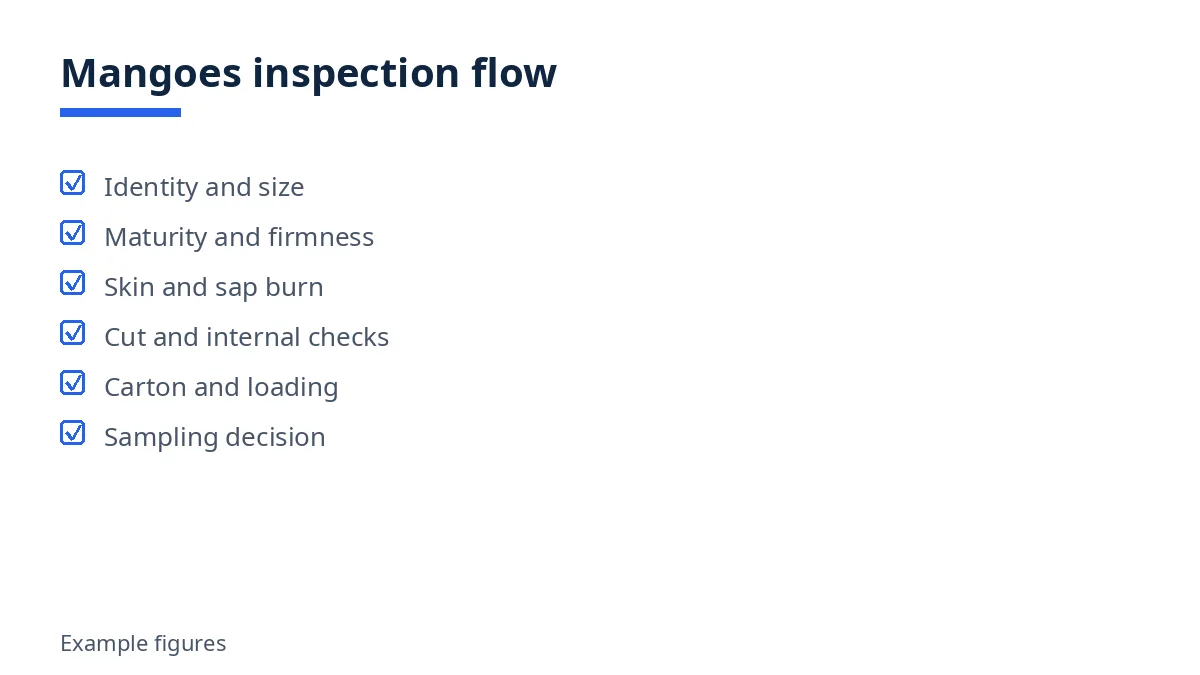
This guide checks mangoes in order: identity and size, maturity and firmness, the skin, a cut look inside, buyer-specified laboratory items, then carton ventilation, marking, and loading. Every laboratory item names its method, and the result is recorded against the order value. No item here carries a universal pass mark. A pre-shipment inspection samples finished, mostly packed goods, not every piece, and is not a guarantee.1 AQL, defined in ISO 2859-1, sets how many units to sample and how many defective units can be found before rejection.2
Why this checklist matters
Maturity at harvest decides much of what follows. Fruit picked too early may never ripen correctly, while fruit picked too late softens fast and bruises in the carton. Published US mango grades are built on fruit that is mature, clean, and well formed, and free from decay, overripe fruit, freezing, and internal discoloration.3 Harvest date, variety, and ripeness stage at packing therefore belong in the report.
A second risk is the skin. Mangoes bruise, rub, and burn easily, and sap from the cut stem can stain the peel in dark trails. Sapburn is dark-brown to black skin discoloration caused by exudate from the cut stem, and abrasions from fruit rubbing against rough surfaces or each other cause discoloration and faster water loss.4
The third risk is temperature history. Chilling injury shows as uneven ripening, poor color and flavor, surface pitting, grayish scald-like skin discoloration, and greater susceptibility to decay, and its incidence and severity depend on cultivar, ripeness stage, and temperature and duration of exposure.4
Before you start
Freeze the reference set before inspection: one sealed approved sample, the purchase order, the mango specification, the size and weight grades ordered, the defect list by class, the sampling plan, and the carton, ventilation, and marking specifications. Published mango standards start from similar minimum requirements in every class: fruit that is whole, sound, clean, practically free of visible foreign matter and pest damage, free of abnormal external moisture, foreign smell or taste, low-temperature damage, black necrotic stains or trails, and marked bruising, firm and fresh in appearance, with satisfactory ripeness.5
Agree seven things in writing in the purchase order: variety and expected color and shape; size and weight grades, with the measuring method; maturity and ripeness stage at packing, with the judging method; defect list and defect classes, with reference photographs; sampling plan, including standard, level, and acceptance and rejection numbers per class; each buyer-specified test, named with method and result; and the carton, ventilation, pallet, and marking specification. Pass harvest and storage history to the inspector too.
The full checklist (numbered, printable)
Tick each item Pass, Fail, or Not applicable. Record carton and pallet numbers.
Approved sample. One sealed approved sample per variety and ripeness stage.
Variety against the order. Variety checked carton by carton against the order and the approved sample, with no mixed variety in one carton unless allowed. Bangladesh grows Langra, Khirsapat, Haribhanga, Fazli, and Amrapali among its commercial varieties.6
Shape and color for the variety. Shape and peel color checked against the variety and the approved sample.
Size and weight grade, buyer-spec item. Size measured by the ordered method, weight as the standard method for mangoes, result recorded against the ordered grade only.5
Uniformity within the carton. Fruit in one carton checked for a spread of sizes that would make the carton read as mixed.
Count per carton. Fruit count per carton checked against the packing list, with no short or overfilled carton.
Maturity stage, buyer-spec item. Maturity judged by the ordered method, such as shoulder development, peel color, flesh color, or soluble solids, result recorded against the ordered stage only.
Ripeness stage at packing, buyer-spec item. Ripeness stage recorded per carton against the ordered stage, so different stages are not mixed in one carton.
Firmness, buyer-spec item. Firmness checked by hand pressure, stage recorded against the ordered stage only, from hard to ripe fruit.
Cleanliness and foreign matter. Sampled fruit and cartons checked for dirt, leaves, stems, and foreign matter, and for foreign smell or taste.5
Stem and peduncle. Stem end checked for a clean cut, sap residue, and stem length, result recorded against the order.
Skin blemish. Skin checked all around for rubbing, sunburn, healed bruises, and surface marks, affected area described and photographed.
Sap burn. Skin checked for dark trails and stains from stem sap, noting that sapburn is discoloration caused by exudate from the cut stem.4
Lenticels and rust spots. Scattered suberized rusty lenticels checked and described, noting any sign of necrosis.
Bruising and mechanical damage. Bruising, dents, cuts, and handling damage checked across the surface, depth and area described.
Sunken spots and black stains. Sunken discolored areas and black necrotic stains or trails checked; published mango standards require fruit to be free of black necrotic stains or trails.5
Pest and disease damage. Insect feeding, larva damage, scab, and other disease marks checked; published mango grades require fruit to be free from decay, insects, larva, and insect or larva feeding damage.3
Shriveling and water loss. Shriveling, soft spots, and loss of fresh appearance checked, affected fruit separated for a closer look.
Decay and rot. Rot, mold, and soft breakdown checked in whole fruit, any wet, soft, or foul-smelling fruit held and photographed.
Chilling injury signs. Skin checked for surface pitting, grayish scald-like discoloration, and uneven ripening, storage temperature history and duration recorded alongside.4
Heat injury signs. Skin checked for mottled color and uneven ripening after heat exposure, treatment and storage history recorded alongside.
Cut inspection, internal discoloration. Cut fruit checked for internal discoloration and flesh browning, cut face photographed.
Internal breakdown and cavities. Cut fruit checked for flesh breakdown and internal cavities between seed and stem, a disorder more prevalent in tree-ripened mangoes.4
Jelly seed and soft nose. Cut fruit checked for jelly-like disintegration of flesh around the seed and for softening at the apex.
Flesh color and texture, buyer-spec item. Flesh color and texture of cut fruit recorded against the ordered variety and ripeness stage only.
Soluble solids, buyer-spec item. Soluble solids method and result recorded against the order value only, where ordered as a maturity check.
Treatment record, buyer-spec item. Any post-harvest treatment, such as hot water treatment where ordered, recorded with method and result against the order only.
Carton weight and count. Carton weight and fruit count per carton checked against the packing list.
Carton ventilation. Carton vents, liners, and dividers checked against the order, noting cartons that block airflow or trap moisture.
Carton stacking and pallet condition. Cartons checked for crushing, stacking that blocks vents, and pallet damage; loading checked for ventilation, condensation, and heat exposure.
Labels on each carton. Each label shows variety, size and weight grade, count, net weight, carton number, and lot identification.
Sampling decision on the finished, packed lot. As a published-table example only, a lot of 151 to 280 mango cartons at General Inspection Level II gives code letter G and a sample of 32 cartons.2 With buyer-specified AQL 1.5 for major and AQL 6.5 for minor defects, the published table gives 1 and 2 for major defects and 5 and 6 for minor defects.2 Those are buyer-agreed order values, not standard-mandated values.
Common failures and how to fix them
Mixed variety or size grade. Hold the pallet and re-sort carton by carton against the approved sample.
Mixed ripeness stages. Hold the lot, separate cartons by ripeness stage, and check harvest dates before accepting a re-sort.
Sap burn. Hold the lot, check desapping and handling at harvest, and re-sort with attention to the stem end.
Skin blemish and bruising. Hold the lot, check handling from picking to packing, then re-grade with a fresh sample.
Chilling injury signs. Hold the lot, record the full temperature and storage history, and cut fruit from more cartons.
Decay or rot. Hold the affected cartons, cut a wider set of fruit, and check whether decay is isolated or spreading.
Blocked airflow. Hold the shipment, separate cartons with blocked vents or crushed sides, and check stacking before release.
Wrong or missing label. Hold the pallet and re-pack or re-label against the packing list.
Downloadable template / summary table
Group | What to record | Result |
|---|---|---|
Reference and identity | Approved sample, variety, carton numbers | Pass/fail |
Size and grade | Size and weight grade, method, uniformity, count | Pass/fail |
Maturity and firmness | Maturity method, ripeness, firmness | Pass/fail |
Skin condition | Blemish, sap burn, bruising, black stains, pest damage | Pass/fail |
Internal condition | Cut face, discoloration, cavities, jelly seed, soft nose | Pass/fail |
Laboratory items | Flesh color, soluble solids, treatment, methods | Pass/fail |
Carton and loading | Carton weight, ventilation, stacking, labels, loading | Pass/fail |
Sampling decision | Lot, level, code, sample, Ac/Re | Pass/fail |
Copy the table into the inspection report with lot number, date, and inspector name, and attach photographs of failures.5
How Exportain helps
Exportain does not inspect goods itself. A buyer can use this checklist to write the inspection into the purchase order, book an independent inspector, and compare the report with the order value for each item.
FAQs
When should this checklist be used?
Use it at final inspection, when grading and packing are complete and cartons are mostly palletized, and again after any rework, with a fresh sample.
Who should complete it?
The buyer's inspector, a third-party inspector, or the supplier quality team can each complete it, but roles must stay separate.1
What are the most common failures?
The failures that recur here are mixed variety or size grade, mixed ripeness stages, sap burn, skin blemish and bruising, chilling injury signs, decay, cartons that block airflow, and wrong or missing labels.
Can a third party do it?
Yes. A pre-shipment inspection is usually arranged through an independent third-party firm, and the buyer sends that firm the purchase order, specification, approved sample details, and carton requirements.1
Next steps on Exportain
Read the AQL acceptance quality limit guide before fixing the sampling plan, then the pre-shipment inspection guide for booking and re-inspection.
Sources
- During Production vs Pre-Shipment Inspection. ECQA (accessed )
- AQL Calculator | Sample Size and ISO 2859-1 Tool. AQMBD (accessed )
- United States Standards for Grades of Mangos. USDA (accessed )
- Mango: Postharvest Research and Extension Center Produce Facts. University of California Davis (accessed )
- Codex Standard for Mangoes (CODEX STAN 184). FAO (accessed )
- Bangladesh Mango Varieties and Seasons. Department of Agricultural Extension (accessed )
About the author
Sourcing from Bangladesh?
Post a request for quotation and suppliers on Exportain can send you their quotes directly.
Post an RFQ