Wholesale Jute Geotextiles From Bangladesh: Prices, MOQ and Reliable Suppliers
A wholesale buying guide to jute geotextiles from Bangladesh: listed prices by variant, MOQ bands, supplier types, payment terms and a worked example for a 10,000 square metre order.
Short answer
Wholesale jute geotextiles from Bangladesh are open-mesh, woven or nonwoven jute fabrics sold by the square metre, square yard, kilogram or roll for erosion control and slope work. Listed prices in November 2026 included $2.50 to $5.00 per kilogram for export-grade soil saver, with minimum orders from 1,000 kilograms to 5,000 square metres depending on the seller. Compare quotations on GSM, tensile strength, width and Incoterm before judging price.
On this page
Key takeaways
Listed prices in November 2026 included $2.50-5.00 per kilogram for export-grade soil saver from Bangladesh.
Minimum orders run from 1,000-kilogram trial lots to 5,000-square-metre orders and 225-roll orders.
Compare quotations on GSM, tensile strength, width and Incoterm, not on the headline price alone.
An LC pays against complying documents, not inspected goods, so add an inspection certificate for quality.
What is a wholesale jute geotextile order?
A wholesale jute geotextile order is a bulk purchase of jute fabric made for ground engineering, not packaging. The fabric is laid over bare soil to hold it in place while vegetation establishes, then it breaks down into the soil. Buyers order by the square metre, the square yard or the roll, and the specification matters more than the product name: two rolls both called "jute geotextile" can differ widely in weight and strength.
Jute geotextiles, often shortened to JGT, come in three main forms. A jute geotextile is a permeable textile fabric, available in woven or nonwoven form, used in or on soil to improve its engineering performance.1 Open-mesh fabric is a net-like weave with gaps that let grass grow through while the mesh holds the soil surface. Woven fabric is tighter and stronger, and nonwoven fabric is a felt-like sheet used where mulching and weed suppression matter more than strength.1
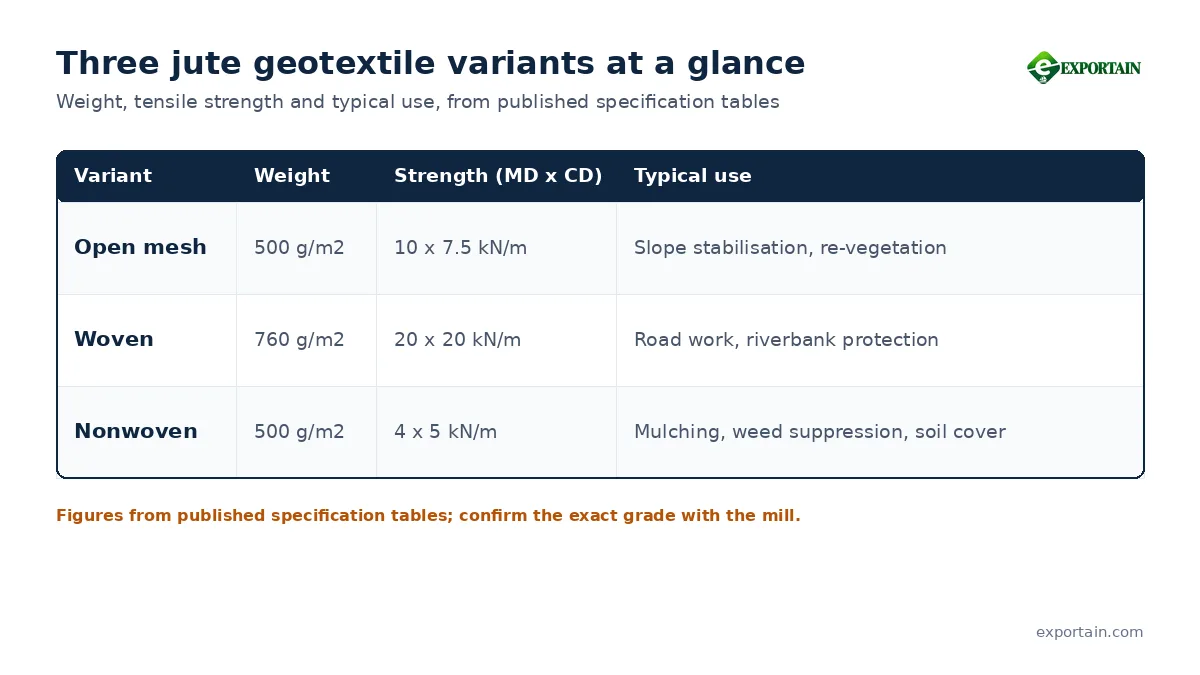
| Variant | Weight | Tensile strength (MD x CD) | Typical use | | Open mesh | 500 g/m2 | 10 x 7.5 kN/m | Slope stabilisation, re-vegetation | | Woven | 760 g/m2 | 20 x 20 kN/m | Road work, riverbank protection | | Nonwoven | 500 g/m2 | 4 x 5 kN/m | Mulching, weed suppression, soil cover |
The figures above come from a published specification table for widely used jute geotextiles.1 Standard grades run from about 292 to 1,000 GSM.2 Bangladesh has a national classification for open-weave jute geotextiles for hill slope management, BDS 1909:2019.3
Common uses are slope and embankment stabilisation, riverbank protection, landfill capping, landscaping and mulching.2 Jute geotextiles are fully biodegradable, and untreated fabric performs for around one to three years before it breaks down.2 4
How much do wholesale jute geotextiles cost?
There is no single wholesale price for jute geotextiles, because sellers quote in different units: per kilogram, per square yard, per square metre or per roll. The listings below are B2B marketplace listings for Bangladeshi sellers, viewed November 2026. They show the range a buyer meets in practice, not a fixed price list.
| Listing | Listed price | Minimum order | Seller location | | Jute mesh soil saver, export grade | $2.50-5.00 per kg | 1,000 kg | Bangladesh | | 292 GSM woven geotextile soil saver | $0.40-0.47 per sq m | 5,000 sq m | India | | 730 GSM jute mesh, 122 cm wide | $59-60 per roll | 225 rolls | Bangladesh |
These listed prices move with raw jute prices, order size and specification.5 A per-kilogram price cannot be compared with a per-square-yard price until both are converted to the same unit, using the fabric weight: a 500 GSM fabric weighs 500 grams per square metre, so one kilogram covers about two square metres.
What pushes the unit price up or down?
Weight is the first driver: a 730 GSM soil saver uses more jute yarn per square metre than a 292 GSM one, so it costs more per square metre.2 Width is the second: rolls are commonly about 1 to 1.2 metres wide.2 Treatment is the third: natural fabric is cheapest, while rot-retarded or bitumen-treated fabric costs more and lasts longer in wet conditions.1 2
Order size is the fourth driver: unit prices fall as the order grows toward a full mill run.5 The fifth is the delivery term: a FOB price covers the goods loaded on the vessel at Chattogram, while a CIF price also includes ocean freight and marine insurance to the destination port.6
What MOQ should you expect from a Bangladeshi supplier?
Minimum order quantity, or MOQ, is the smallest order a seller will accept, and for jute geotextiles it is set by the mill run, not by the buyer. The listings viewed in November 2026 show three MOQ bands.5
| MOQ band | Observed minimum | Who it suits | | Trial lot | 1,000 kg | A buyer testing a new supplier or grade | | Mid-size order | 5,000 sq m | A contractor ordering for one project | | Roll order | 225 rolls | A buyer ordering by the roll for a defined site |
A trial lot of 1,000 kilograms checks quality and handling, but the unit price is higher than on a full order.5 A mid-size order of 5,000 square metres is where better per-unit prices appear, because the mill can set up the looms once and weave continuously.5
MOQ also varies by supplier type: a mill sets its MOQ by loom time, while a trading house that holds stock can sometimes sell smaller lots at a higher unit price. If a seller quotes an MOQ far below the bands above, ask whether the fabric is stock, a different grade, or a shorter roll length. The MOQ guide explains how minimum quantities are set.
Which type of supplier fits your order?
Bangladesh has three kinds of jute geotextile seller, and the right one depends on order size, specification control and how much support the buyer needs. Jute mills in the country produce jute geotextiles, and the material is also sold through trading houses and marketplace sellers.4
| Supplier type | Strengths | Watch for | | Integrated jute mill | Direct control of weight, weave and width; best price on large runs | Higher MOQ; slower on small or mixed orders | | Trading house or exporter | Smaller lots, mixed grades, documents handled | Less control over the weave; ask which mill supplies it | | Marketplace seller | Fast quotes, visible listed prices and MOQs | Listings vary in grade; confirm the specification in writing |
Mills suit buyers who know their specification and order in volume: a mill can weave to a stated GSM, aperture and width, and supply test data for the grade.2 Trading houses suit buyers who need a smaller lot, a mix of grades, or help with documents. Marketplace sellers suit buyers comparing listed prices quickly, but a listing title is not a specification.
Whatever the type, ask for the same evidence: a specification sheet, a test report for the grade, and a pre-production sample. Our guide to jute geotextile manufacturers covers how to find and check mills, and the quality control checklist lists what to inspect before the balance is paid.
How do payment terms and Incoterms change the total price?
The unit price is only part of the cost. The delivery term and the payment method change what the buyer pays, when the buyer pays, and who carries the risk at sea.
Under FOB, the seller delivers the goods loaded on the vessel at the port of shipment, and the buyer arranges and pays for ocean freight, marine insurance and import clearance.6 Under CIF, the seller pays freight and marine insurance to the destination port, but risk still passes to the buyer when the goods are loaded on board, not when they arrive.6 A CIF quotation therefore looks higher than an FOB quotation for the same fabric, and the difference is freight and insurance, not the goods. Compare quotations only on the same Incoterm.
For payment, a letter of credit (LC) is a bank's undertaking to pay the seller a stated amount, provided the seller presents documents that comply exactly with the terms of the credit.7 An LC at sight pays after the bank determines the documents comply; a usance LC pays at a stated maturity after shipment.7 A telegraphic transfer (TT) is a direct bank payment, often a deposit before production and the balance against shipment documents. It is simpler and cheaper than an LC, but carries more risk for the buyer on the deposit.7
An LC protects payment discipline, not product quality: banks deal with documents, not goods. If quality matters, require an independent pre-shipment inspection certificate as an LC document.7 For samples or a repeat order with a proven supplier, TT is common; for a first substantial order with a new supplier, an LC is often worth the cost.7
How do you compare quotations like for like?
Quotations for jute geotextiles are easy to misread, because sellers quote different grades in different units under different terms.
Convert every price to one unit, such as dollars per square metre, using the stated GSM.
Check the grade: GSM, tensile strength in both directions, aperture or pore size, width and roll length.
Check the finish: natural, rot-retarded or bitumen-treated, and the expected service life.
Ask for test data for GSM, tensile strength and aperture before ordering.2
Confirm the Incoterm and the named port, and whether freight and insurance are included.
Confirm the payment term, the sample cost and whether the sample price is credited against the bulk order.
Confirm the HS code and the documents supplied with the shipment. The HS code reference for jute geotextiles explains classification, and the landed cost guide shows how to add freight, insurance and duty.
Volume discounts are structured as price breaks: one price for a trial lot, a lower price for a mid-size order, and a lower price again for a repeat order. One marketplace guide notes price reductions of 15 to 30 percent for orders above 5,000 square metres or 1,000 kilograms.5 Ask for the breaks in writing. Our RFQ writing guide shows how to ask for tiered pricing in a way sellers can answer clearly.
A worked example: pricing a 10,000 square metre order
Example figures. A landscaping contractor needs 10,000 square metres of 500 GSM open-mesh jute geotextile for a slope project, quoted FOB Chattogram. The example uses an illustrative unit price, not a market price, and excludes freight, insurance and duty.
| Item | Example figures | | Area ordered | 10,000 sq m | | Illustrative unit price | $0.50 per sq m | | Goods value FOB | $5,000 | | Pre-production samples | $120, credited against the bulk order | | Total goods and sample cost | $5,120 |
At the illustrative price of $0.50 per square metre, 10,000 square metres cost $5,000, and the illustrative $120 sample cost is credited against the bulk order, so the buyer pays $5,120 before freight. A listed 292 GSM woven soil saver was priced at $0.40-0.47 per square metre, and a Bangladeshi export-grade soil saver at $2.50-5.00 per kilogram.5
Which buying errors should you avoid?
The first error is comparing prices in different units. A per-kilogram, per-square-yard and per-roll price cannot be ranked until all three are converted to dollars per square metre at the stated GSM. The second error is ordering without a sample: grades look alike in a photograph, and only a physical sample shows the aperture and weave.
The third error is ignoring service life. Untreated jute geotextile performs for around one to three years before it biodegrades, which suits surface erosion control where vegetation takes over, but not permanent reinforcement below ground.2 The fourth error is choosing on price alone without test data: ask for the GSM, tensile strength and aperture figures.1
The fifth mistake is treating the jute market as a single price. Bangladesh earned $820.16 million from jute and jute goods in fiscal year 2024-25, down 4.10 percent from $855.23 million the year before.8 Get fresh quotations for each order, and confirm price, MOQ and shipment date in the same document.
Next steps on Exportain
Start by reading the jute geotextile manufacturers guide to shortlist mills, then use the quality control checklist to set the inspection points. When you are ready to buy, post an RFQ on Exportain with the GSM, width, quantity and Incoterm stated, and compare quotations on the same unit and delivery term. The jute products sourcing guide covers the wider jute range if your project also needs yarn, hessian or sacks.
Sources
- Application of Jute Geotextile in Civil Engineering, Agrihorticulture and Forestry. Sahapedia (accessed )
- Jute Geotextiles (JGT): The Complete Guide to Erosion Control. Wahab Jute Mills, (accessed )
- Development of New Open Weave Jute Geotextiles to Use for Rain Water Erosion Control in Road, Railway Embankment and Hill Slopes. International Journal of Research and Scientific Innovation, (accessed )
- Jute geo-textile export can fetch billions, say officials. The Financial Express, (accessed )
- Jute Mesh Soil Saver: Erosion Control & Sustainable Landscaping. Accio (accessed )
- Incoterms 2020 Explained | FOB, CIF, EXW & DDP. Transifly (accessed )
- LC Meaning (Letter of Credit). Exportain (accessed )
- Exports of jute and jute goods keep falling. The Financial Express, (accessed )
About the author
Sourcing from Bangladesh?
Post a request for quotation and suppliers on Exportain can send you their quotes directly.
Post an RFQ