

Sustainable Clothing Manufacturers Bangladesh: 2026 Buyer's Guide
How to shortlist sustainable clothing manufacturers in Bangladesh: define the claim first, check what each certificate covers, verify export documents, approve a sample in bulk fabric, and inspect before shipment.
Short answer
Sustainable clothing manufacturers in Bangladesh are garment factories whose environmental and social claims can be checked against current documents, not taken from a label alone. To shortlist one, define your sustainability requirements in the brief, compare factories on the same specification, check what each certificate actually covers and whether it is in date, approve a sample made in bulk fabric, and inspect packed goods before shipment.
On this page
Key takeaways
Ready-made garment exports were $38.70 billion in fiscal year 2025-26, per Export Promotion Bureau data reported by UNB.
Bangladesh had 290 LEED-certified garment factories, but a LEED certificate rates a building, not a garment or a production run.
GOTS-certified products must contain at least 70 percent certified organic fibres, with the Organic label grade at at least 95 percent.
OEKO-TEX STANDARD 100 tests a finished article for harmful substances and does not certify organic or recycled content.
Check every certificate for holder, scope and expiry date, approve a sample in bulk fabric, and inspect packed goods before shipment.
Finding sustainable clothing manufacturers bangladesh buyers can rely on starts with evidence, not with a label on a brochure. This guide is for importers in the United States, the United Kingdom, the European Union and the United Arab Emirates who need a shortlist they can defend: how to define what sustainable means for your order, how to check a certificate, and which documents to keep.
A factory can hold a genuine certificate and still be the wrong factory for your product, and a certificate can be genuine and still not cover the fabric or process your order depends on. Check scope before price.
Why this matters for buyers and sellers
Ready-made garment exports totalled $38.70 billion in fiscal year 2025-26, down 1.64 percent from $39.34 billion in fiscal year 2024-25, according to Export Promotion Bureau data reported by UNB.1 The European Union took $19.06 billion of those shipments, the United States $7.74 billion and the United Kingdom $4.39 billion.1
Bangladesh had 290 LEED-certified ready-made garment factories, including 125 Platinum-rated and 145 Gold-rated facilities, after four more factories were certified, The Financial Express reported.2 A LEED certificate rates a building. It does not certify a garment, a fabric or a production run, so treat it as evidence about the site, not proof that a specific order is sustainable. For a seller, clear evidence shortens the buyer's decision: state your range, materials, and certificates with scope and expiry dates.
What the main certificates actually cover
Certificates answer different questions. Mixing them up is the most common reason a claim fails later, at labelling or at a retailer audit.
Evidence | What it covers | What it does not prove |
|---|---|---|
GOTS | Organic fibres, with environmental and social criteria across processing | That a non-organic product is sustainable |
OEKO-TEX STANDARD 100 | A textile article tested for harmful substances | Organic content, recycled content or factory emissions |
Global Recycled Standard (GRS) | Recycled content tracked through the supply chain | Organic content, or that the whole garment is recycled |
LEED | The environmental performance of a factory building | The fibre or chemicals behind a specific order |
GOTS-certified products must contain a minimum of 70 percent certified organic fibres, with two label grades: Organic at at least 95 percent, and Made with Organic Materials at at least 70 percent.3 GOTS applies environmental criteria including wastewater treatment and chemical restrictions, and social criteria covering safe working conditions and a prohibition on child labour and forced labour, verified by accredited bodies through on-site audits.3
OEKO-TEX STANDARD 100 is a label for textiles tested for harmful substances: every thread, button and accessory on a certified article has been tested against a list of over 1,000 harmful substances, with stricter requirements where skin contact is more intensive.4 Limit values are reviewed at least once a year, and a certificate is issued for one year.4 The test covers the finished article's safety, not how the fibre was grown.
The Global Recycled Standard verifies and tracks recycled raw materials through the supply chain, includes processing criteria on hazardous chemicals, and verifies social or environmental production at facilities, using the chain of custody requirements of the Content Claim Standard.5 Textile Exchange states that the GRS can be used as a business-to-business tool for products with at least 20 percent recycled content, while consumer-facing labelling requires at least 50 percent.6
Step-by-step: how it works
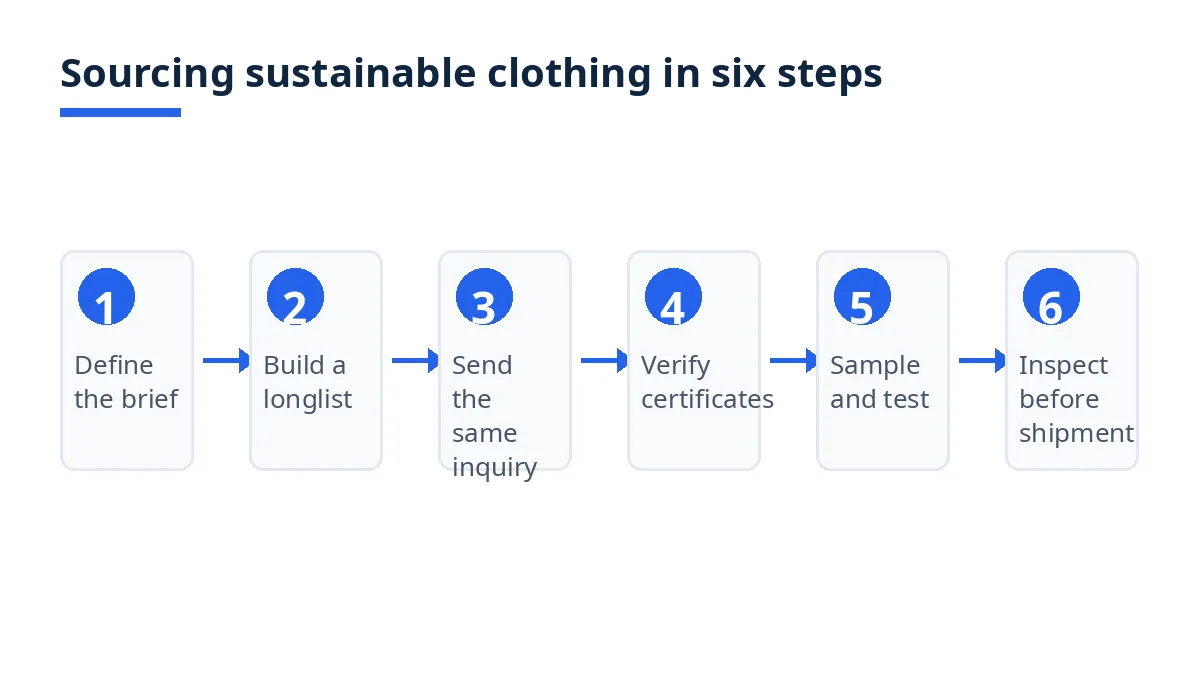
Step 1: Write a clear product and sustainability brief
Specify the product type, fabric composition and weight, construction, size range, colours, labelling, packaging and destination. Add your sustainability requirements and separate must-haves from preferences: certified organic or recycled fibres, chemical restrictions, or wastewater evidence. Be precise about any claim you plan to make to your customers, because the fibre, the chain-of-custody documents and the label wording all have to support it.
Step 2: Build a longlist from factories that make your product
Search by product category first. Knitwear, woven garments and denim use different machines and finishing processes, and strength in one category does not transfer to another. Start from clothing manufacturers in Bangladesh and finding suppliers in Bangladesh, and read sustainable knitwear in Bangladesh if knitwear is your category.
Step 3: Send the same enquiry to every factory
Give each factory the identical specification, quantity breakdown, destination, and delivery term you want quoted. Ask each to state what the price includes and excludes, which certified materials it can source, and what testing it can arrange. The guide to how to write an RFQ lists the fields a complete enquiry needs. Identical enquiries produce comparable answers.
Step 4: Verify claims and documents
Match every claim to a current document and check three things: the holder's name, the scope, and the expiry date. A certificate issued to a different company, address or product group does not cover your order. Where a scheme offers a public check, use it rather than accepting a logo.
Check the business at the same time. Getting an Export Registration Certificate (ERC) from the Office of the Chief Controller of Imports and Exports (CCI&E) is step one of the export process in the Export Policy 2024-27, and Bangladesh Customs lists the ERC among its general export documents, alongside the sales contract or letter of credit, the EXP form, the invoice, the packing list, the transport document and the certificate of origin.7 Read the ERC certificate guide before you rely on it.
Step 5: Sample, test, and approve before bulk production
Order samples made with the actual fabric and trims intended for bulk, not a substitute. Check fit, stitching, colour, labelling and packaging, and arrange testing where your market or claim requires it. Approve one sample in writing and keep a sealed reference: that sample is the standard for production and inspection.
Step 6: Agree terms, timeline, and quality checks in writing
Confirm the specification, an itemised price, payment stages, milestones, inspection arrangements, packing and shipping responsibilities in a purchase order both sides accept. Agree how defects are defined and what happens if goods fail inspection. Record any later change, and its effect on price or timing, in writing.
Step 7: Monitor production and inspect before shipment
Ask for updates at agreed milestones: fabric in-house, cutting, sewing, finishing and packing. Arrange a pre-shipment inspection and review the report before you authorise shipment. See pre-shipment inspection. For the sampling method, ISO 2859-1 is the international standard for sampling procedures for inspection by attributes, and it uses the acceptance quality limit (AQL) to set sample sizes and acceptance and rejection thresholds for a lot.8 See AQL.
Costs, timelines and documents
What does a quotation actually cover?
There is no single reliable price for sustainable clothing production. Costs are built from fabric and trims, cutting and sewing, dyeing, washing and finishing, labels and packing, testing and inspection, inland transport, and freight where the delivery term puts it on the seller. Certified fibres can change the fabric cost, but the difference depends on the material and supplier, so ask for an itemised breakdown on the same specification from every factory.
Delivery terms decide who pays for which leg, so quotations on different terms are not comparable until you adjust them. The ICC Incoterms rules are eleven three-letter trade terms that clarify the tasks, costs and risks involved in delivering goods from sellers to buyers, and Incoterms 2020 entered into force on 1 January 2020.9 Use landed cost for imports from Bangladesh to add the missing legs.
Cost element | What to confirm in writing |
|---|---|
Fabric and trims | Composition, weight, certified content, and any substitute allowed |
Cutting and sewing | Construction details and what the unit price includes |
Dyeing, washing, print or embroidery | In-house or by another unit, and where |
Labels and packing | Exact label wording, piece packing and carton marks |
Sampling, testing and inspection | Charge per sample, which tests apply, who pays for re-testing |
Transport, freight and insurance | Where the seller's responsibility ends, and the level of cover |
Example figures: two factories quote for the same organic cotton T-shirt, one at $3.90 per piece EXW and one at $4.30 per piece FOB. Adding inland transport, export handling and loading of $0.34 per piece to the EXW quote gives a like-for-like FOB cost of $4.24 per piece, so the gap is $0.06, not $0.40. Minimum order quantity also shapes cost: a quantity below a factory's minimum per style or colour changes the unit price or is refused. See MOQ.
How long does an order take?
A timeline is a sequence: enquiry and verification, sampling, fabric sourcing, bulk production, testing and inspection, then shipment. Certified materials can add sourcing time when a specific fibre or document has to be arranged. Ask for a stage-by-stage schedule, confirm it in the purchase order, and build in time for a second sampling round.
Which documents should you keep together?
Keep three groups in one order file. First, verification documents: business registration, the ERC, and the certificates behind each claim, with scope and expiry dates. Second, material documents: fibre details and chain-of-custody documents for any organic or recycled claim. Third, order and shipment documents: tech pack, sample approval, purchase order, test and inspection reports, invoice, packing list and transport document. See export documents from Bangladesh.
Bangladesh-specific rules and tips
Ask where each wet process happens. Dyeing, washing and finishing use water, energy and chemicals, so they carry much of a garment's footprint. If a process is outsourced, that facility is part of your record too: name it in the order documents and ask how its wastewater is treated.
Association membership is a sorting signal, not a substitute for your own checks. See BGMEA and BKMEA. Names, addresses and certificate holders should match across documents, and any difference should have a written explanation. Plan the inland leg early: Chattogram Port handles nearly 98 percent of Bangladesh's containerised trade, so port timing affects most sea shipments.7
Work to your destination's rules. In the European Union, Regulation (EU) No 1007/2011 sets the rules on textile fibre names and the related labelling and marking of the fibre composition of textile products, with the aim of providing accurate information to consumers.10 Requirements differ in the United States, the United Kingdom and the United Arab Emirates. Confirm the exact label wording before labels are printed, because a garment with the wrong fibre description is not saleable.
Mistakes and red flags
The most common mistake is treating sustainability as a line added after the price is agreed. If the fabric, the evidence and the labelling do not support the claim, the lowest price becomes expensive when goods are rejected or relabelled. Sending different specifications to different factories also makes quotations impossible to compare.
Watch for these warning signs during sourcing:
Claims with no documents, expired certificates, or certificates naming a different company, address or scope.
A building certificate presented as proof that a garment or fabric is certified.
An organic or recycled claim with no chain-of-custody documents behind it.
Refusal to sample in the actual bulk fabric, or pressure to skip sampling, testing or inspection.
Payment requested to a personal account, or to a name that does not match the business documents.
Vague answers about where dyeing, washing, printing or embroidery takes place.
A quotation far below comparable quotes with no itemised explanation.
Avoid repeated specification changes after sampling without accepting that cost and timeline may change, and avoid approving samples verbally. Written approvals and a retained reference sample prevent most disputes.
Checklist
Product brief completed, with specification, materials, labelling, packaging and destination in writing.
Sustainability requirements listed as must-haves and preferences, with evidence expected for each claim.
Longlist built from factories that make your specific product category.
Same enquiry sent to every factory, covering materials, processes, testing and documents.
Each certificate checked for holder, scope and expiry against the factory and product it covers.
Business identity confirmed, with export registration checked against current documents.
Samples in bulk fabric and trims checked, tested where required, and approved in writing.
Itemised quotation reviewed, with testing, inspection, packaging and freight separated.
Written purchase order covering specification, payment stages, timeline, inspection and defect handling.
Destination labelling requirements confirmed before labels are printed.
Pre-shipment inspection arranged, with the report reviewed before dispatch.
Order file assembled: approvals, certificates, material documents, test and inspection reports, invoice, packing list and transport document.
If several items cannot be ticked, the order is not ready.
How Exportain helps
Exportain is a marketplace where buyers find Bangladeshi suppliers, post requests for quotation and compare replies in one place. Browse suppliers by category and use the verification information shown for a supplier to see which document and photo checks have been recorded. Those checks are reviews of documents and photos, not factory inspections. They do not certify a product and do not replace your own checks, sampling, testing or inspection. Exportain is not a party to your contract for goods, and it does not inspect goods, book freight or clear customs. See the Trust Center and the how to buy guide.
FAQs
What should I know first about Sustainable Clothing Manufacturers Bangladesh?
Sustainable is not a single standard. It can cover fibres, chemicals, water and energy use, worker welfare, building performance, waste and packaging, and factories are strong in different areas. Define which matter for your product, write them into your brief, and verify each claim with a current document covering the specific factory and process. Start with product fit, then compare evidence.
What are the typical costs and timelines?
Costs vary with fabric and certified content, complexity, trims, finishing, testing, packaging, quantity and freight, so there is no dependable single figure. Ask each factory for an itemised quotation on an identical specification and delivery term. Timelines vary with fabric availability, sampling rounds, capacity, testing, inspection and shipping route. Ask for a stage-by-stage written schedule before you commit to a launch date.
Which documents are needed?
You need verification documents (business registration and export registrations including the ERC, with consistent names and addresses), certificates supporting each claim with scope and expiry dates, chain-of-custody documents for organic or recycled fibres, and test reports for your product and market. For the shipment, expect a commercial invoice, packing list and transport document, plus any origin paperwork your broker requires.
What are the most common mistakes?
Choosing only on price, using different specifications when requesting quotes, accepting a certificate logo without checking holder, scope and expiry, and presenting a building certificate as product certification. Buyers also run into problems when they skip samples, testing or inspection, or make claims beyond the documents they hold.
Next steps on Exportain
Browse Bangladeshi suppliers by category and note the factories whose range and evidence match your brief, then read the how to buy guide. When your specification is written, post an RFQ so suppliers reply against the same requirements, and use the guide to importing from Bangladesh to plan shipment and clearance.
Sources
- EU share erodes as Bangladesh RMG exports slip 1.64% to $38.70 billion in FY26. United News of Bangladesh (accessed )
- Bangladesh adds four more LEED-certified RMG factories. The Financial Express, (accessed )
- Key Features of GOTS. Global Organic Textile Standard, (accessed )
- OEKO-TEX Standard 100. OEKO-TEX (accessed )
- What is the Global Recycled Standard (GRS)?. Textile Exchange (accessed )
- In the GRS, it mentions that the minimum content percentage is 20%, but in the Standards Claims Policy, it says the minimum is 50%. What does this mean?. Textile Exchange (accessed )
- Start an Export Business in Bangladesh (2026 Guide). Entrepreneurs.bd (accessed )
- ISO 2859-1:2026 - Sampling procedures for inspection by attributes — Part 1: Sampling schemes indexed by acceptance quality limit (AQL) for lot-by-lot inspection. International Organization for Standardization (accessed )
- Incoterms® rules. International Chamber of Commerce (ICC) (accessed )
- Regulation (EU) No 1007/2011 on textile fibre names and related labelling and marking of the fibre composition of textile products. European Union, (accessed )
About the author
Sourcing from Bangladesh?
Post a request for quotation and suppliers on Exportain can send you their quotes directly.
Post an RFQ


