

How to Import Frozen Fish Fillets From Bangladesh in 2026: Complete Buyer Guide
How to import frozen fish fillets from Bangladesh: fillet specification, supplier checks, samples, HS 0304 duty, reefer shipping and landed cost for buyers.
Short answer
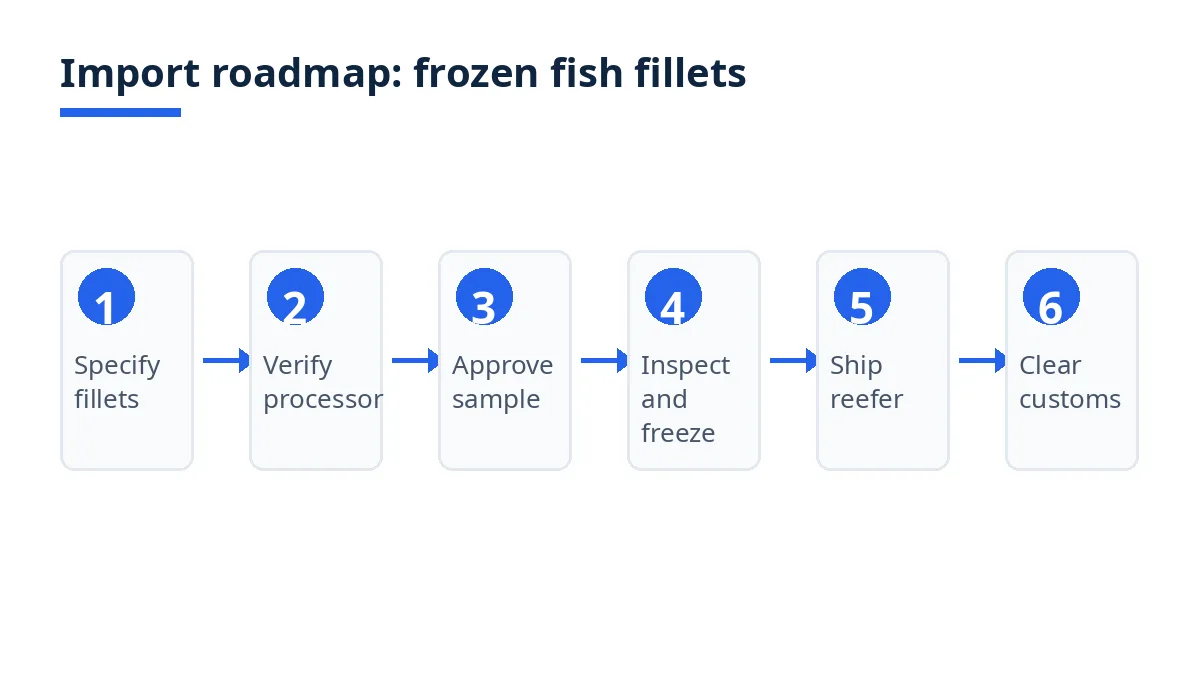
To import frozen fish fillets from Bangladesh, write a fillet-by-fillet specification that fixes species by scientific name, skin-on or skinless presentation, pin-bone and trimming standard, size grade and deglazed net weight, then shortlist processors that already cut and freeze that species. Verify the processor and its health certificate route, approve a pre-shipment sample from actual production, classify each line in heading 0304, agree the reefer and inspection plan, and build the landed cost before you contract.
On this page
Key takeaways
Frozen fillets are classified in heading 0304, in the blocks 0304.61 to 0304.69, 0304.71 to 0304.79 and 0304.81 to 0304.89, separate from whole frozen fish in heading 0303 and from other fish meat in 0304.91 to 0304.99.
In the United States schedule opened for this guide, Revision 16 (2026), the general rate is Free on every frozen fillet line, while other frozen fish meat carries 6 percent on the 0304.91.90 to 0304.99.91 lines, so a fillet entered as fish meat can attract duty the fillet line does not.
Codex CXS 190-1995 defines a fillet as slices cut parallel to the backbone from the same species, allows a boneless presentation only where pin-bones have been removed, and requires net contents to be declared exclusive of glaze, tested on the deglazed weight.
There is no single typical MOQ, price or transit time for frozen fish fillets, so confirm each one in writing for your exact species, presentation, trim, size grade, glaze basis, route and shipment date.
Certification is market-specific: the EU requires an authorised country, an approved establishment and a health certificate, the United States requires processor HACCP controls and importer verification records, and Singapore runs fillets through its Fish and Fish Products steps.
To import frozen fish fillets from Bangladesh, start with the fillet itself, not with a price per kilogram. A fillet order can combine pangasius, tilapia, carp and marine species, each skin-on or skinless, pin-bone in or removed, trimmed to a different standard and glazed to a different level, and each combination is its own product with its own tariff line.
The Harmonised System is an international commodity classification of approximately 5,000 six-digit product categories, organised by chapters, headings and sub-headings, and countries subdivide the six-digit categories further for their own tariffs.1 In the United States schedule, heading 0304 covers fish fillets and other fish meat, whether or not minced, fresh, chilled or frozen, and frozen fillets sit in their own blocks inside that heading, separate from whole frozen fish in heading 0303 and from the other fish meat lines at the end of 0304.2 The Codex standard for quick frozen fish fillets defines fillets as slices of fish removed from the carcass of the same species by cuts made parallel to the backbone.3 That definition is the buying problem in one line: you are buying a cut, a trim and a freezing job, not a whole fish.
This guide is for importers, wholesalers, food-service distributors and retail buyers in the United States, the United Kingdom, the European Union and the United Arab Emirates who buy fillets rather than whole fish. It states no typical minimum, price or transit time, because none has a single figure across species, trims and destinations. For the wider frozen trade, see how to import frozen fish from Bangladesh.
Why source frozen fish fillets from Bangladesh
A fillet order moves the cutting work to origin. Instead of importing whole fish and paying for filleting, trimming and waste disposal at destination, you buy the finished cut: a graded, trimmed, frozen fillet packed to your size range. Compare fillet against fillet on the same trim specification, never a fillet price against a whole-fish price, because the yield difference sits between the two.
The species base cuts across farmed and marine supply. The first frozen fillet group in the United States schedule is built around tilapias, catfish including Pangasius spp., carp, eels, Nile perch and snakeheads,2 the freshwater and farmed species a Bangladeshi processor is most likely to offer as a standard fillet line. Name the species by scientific name on every line, because a trade name can cover more than one species, and classification, label and price all follow the species.
Fillets also concentrate quality risk in the processing plant. Two lots of the same species can differ in trim, in how completely pin-bones were removed, in size grading, and in how much of the packed weight is ice glaze rather than fish. Those differences are created at the cutting table and the glazing line, so the checks in this guide are fillet checks, not a repeat of the general frozen fish checklist.
Find and verify suppliers
Where should you start the search?
Start with a fillet specification, not with processor names. Write down every line first: common and scientific name, skin-on or skinless, pin-bone in or removed, trim standard in words a cutter can follow, size grade, glazing level, net weight basis, freezing format, packing, labelling and destination port. Then shortlist processors whose current production already includes that species cut to that presentation. A whole-fish freezing plant is not a substitute, because filleting, trimming, pin-bone removal and grading are different operations from freezing whole fish.
Send every candidate the identical specification and ask for the same reply format: species and presentation assumed, trim standard, size grade, glaze basis, price inclusions and minimum per species and per grade. Browse suppliers on Exportain, read finding suppliers in Bangladesh, and compare your approach with the frozen seafood sourcing guide.
How do you verify a supplier before you pay?
Verification has three layers. The first is company documents: trade licence, export registration and association membership where applicable, checked so that name, address and bank account name agree across every document. The processor also works through the Department of Fisheries, whose e-certification system covers licences, health certificates and additional health certificates as per the importing country's requirements, together with sample collection, inspection and test reports.4 Check that the establishment named on the health certificate is the plant that will cut and freeze your order, not a separate trading office.
The second layer is fillet capability: species cut, filleting and freezing capacity by presentation, trimming and pin-bone removal method, grading practice, glazing line and cold store condition. A tray of fillets from current production shows more than a catalogue photograph: trim consistency, skin finish and how evenly the size grade holds.
The third layer is payment discipline. Keep payments to the company account named in the documents, never to a personal account, and verify any change of bank details separately. Read how supplier verification works on Exportain for what document and photo checks cover. On Exportain, supplier profiles carry document and photo review badges. A badge is a review of documents and photos, not a factory inspection or a guarantee, and Exportain is not a party to the goods contract.
MOQ, pricing and samples
What is the typical MOQ for frozen fish fillets from Bangladesh?
There is no single typical minimum order quantity for frozen fish fillets from Bangladesh. The minimum is set per species, per presentation and usually per size grade, because each combination is cut, graded and frozen as its own production run. Ask each supplier how its minimum splits by species, presentation, size grade and packing, and whether mixed-species loads are accepted.
How is the price built, and how should you compare quotes?
Raw fish is usually the largest cost element in a fillet, followed by filleting and trimming labour, pin-bone removal where specified, grading, glazing, freezing, testing and packing. Yield drives the comparison: a kilogram of trimmed skinless fillet starts from more than a kilogram of whole fish, and a tighter trim removes more saleable flesh. Glaze changes the arithmetic again, because glaze is water, not fish.
Compare quotes on the deglazed net weight basis. The Codex fillet standard states that where the food has been glazed, the declaration of net contents shall be exclusive of the glaze,3 so a quote priced on gross glazed weight and a quote priced on deglazed net weight are not the same price. Ask each supplier to state the glaze percentage, the weight basis and what is excluded, and to quote on the identical species, presentation, trim, size grade, delivery term and packing.
Which samples do you need, and how do you approve them?
Work in stages. A development sample shows whether the plant can cut your species to your presentation and trim. A pre-shipment sample, drawn from the actual production packed for your order, is the sample you approve before dispatch. Test the samples as your customers will use them: thaw under your own protocol and cook a portion, checking texture, flavour and odour after cooking, not only in the frozen state. Run a pin-bone check by hand and by mouth on the cooked sample where the presentation is sold as boneless, check skin finish and remaining scales where skin-on is specified, and weigh fillets against the declared size grade across the whole sample. Then run the deglazed net weight test set out in the quality section below. Approve in writing and keep one sealed counter-sample of each line.
Quality control and certifications needed
Which quality checks are specific to frozen fillets?
Run the fillet-specific checks below against the approved sample and specification. The general frozen fish checks on temperature, packing and cold chain sit in the frozen fish quality control checklist and are not repeated here.
Fillet check | What the standard or specification says |
|---|---|
Fillet identity | Fillets are slices removed from the carcass of the same species by cuts parallel to the backbone, so a pack is one species, not a mix.3 |
Boneless claim | Fillets may be presented as boneless only where boning has been completed, including removal of pin-bones.3 |
Bones in boneless packs | A sample unit is defective where it holds more than one bone per kilogram at or over 10 mm in length, or at or over 1 mm in diameter, within the small-bone limits the standard sets.3 |
Glaze and net weight | Net contents are declared exclusive of glaze. Deglazed weight is found by spraying the frozen contents under cold water until all glaze that can be seen or felt is removed, then weighing.3 |
Freezing and storage | Quick freezing is complete only when the product reaches -18 degrees C or colder at the thermal centre, and the label states storage at -18 degrees C or colder.3 |
Parasites in skinless fillets | Skinless fillets are examined by candling under the standard's Type 1 method: thawed portions on a translucent sheet, lit from above.3 |
Dehydration | A sample unit is defective where more than 10 percent of its surface shows excessive moisture loss masking the colour of the flesh and penetrating below the surface.3 |
Trimming is the check with no Codex number behind it, so your specification has to carry it. State in writing what the trim removes: belly flap on or off, tail piece standard, dark meat or bloodline treatment, collar trim, and the tolerance for torn, gaping or undersized fillets in a grade. Photograph the approved trim on the counter-sample, because a trim dispute is settled against the sample and the written standard, not against a trade name.
Agree the inspection method and defect limits before production. The FDA hazards and controls guidance assists processors in developing their HACCP plans, and its contents include chapters on scombrotoxin formation and on pathogenic bacteria growth from time and temperature abuse,5 a processing control for fillets because cut flesh presents more exposed surface than a whole fish. Inspect in stages: an inline check at cutting and grading, and a final random inspection on packed cartons for quantity, presentation, size grade, labels and deglazed net weight.
Which certifications do you actually need?
No single certificate covers every fillet order, and the requirement follows your destination market:
Market | What the route requires, in brief |
|---|---|
European Union | Health approval by an authorised country, an approved establishment, health certificates and health control for fishery products for human consumption.6 |
United States | No health certificate with each shipment and no approved-processor list. HACCP controls are required for foreign processors, and the importer must verify its foreign suppliers.7 |
Singapore | Frozen fillets fall in the Fish and Fish Products category: check high-risk status, check CITES, comply with the high-risk requirements where they apply, and keep labels accurate and complete.8 |
Private schemes sit on top of these market rules, not in place of them: name any scheme your customer requires, and check its scope, product covered, site address and date. A certificate for whole fish or a different establishment does not cover your fillet consignment.
Incoterms, shipping and transit time
Which delivery term should a first order use?
The Incoterms 2020 rules set out, for each rule, where delivery takes place, and risk passes from seller to buyer at the same point and time as delivery.9 Under FOB, CFR and CIF the seller must place the goods on board the vessel.9 On customs, in all rules but EXW the seller must carry out export formalities, and in all rules but DDP the buyer must carry out import formalities.9 The same ICC Academy summary notes that the four sea rules, FAS, FOB, CFR and CIF, are only intended for port-to-port bulk or break-bulk shipments and are not suitable for container shipments.9
Frozen fillets move in reefer containers, so for a first order weigh FOB at the Bangladeshi port against FCA at the named terminal, where delivery happens when the goods are handed to your carrier. The delivery term alone does not settle the cold chain, so write it into the order separately: container temperature setting, a temperature record for the voyage, and the point at which an excursion becomes a claim. See the best Incoterm for importing frozen seafood from Bangladesh.
How long does shipping take?
There is no single typical transit time for frozen fish fillets from Bangladesh. Sea freight in a reefer container is the standard route for bulk orders and it takes weeks rather than days, varying by port, routing, transshipment and season. Plan from your forwarder's current sailing schedule, and add clearance and delivery. Keep production time separate: an order is ready only when cutting, trimming, grading, freezing, inspection and packing are complete.
Import duty, taxes and documents
How are frozen fish fillets classified for duty?
Duty follows the classification of each line in your destination tariff, not the supplier's product name. Heading 0304 covers fish fillets and other fish meat, whether or not minced, fresh, chilled or frozen.2 Its frozen fillet blocks split by species group: 0304.61 for tilapias, 0304.62 for catfish including Pangasius spp., 0304.63 for Nile perch and 0304.69 for the other species in the tilapia, catfish, carp, eel and snakehead group;2 the cod families, from 0304.71 for cod through 0304.79; and other fish, from 0304.81 for salmon through 0304.89.2
Skin is handled narrowly in the schedule, not as a general skin-on and skinless split. In the cod-family and other-fish blocks, several subheadings divide into a .10 line for skinned fillets frozen into blocks over 4.5 kg and imported to be minced, ground or cut into uniform pieces, and a .50 line for other fillets.2 The first block carries no such split.2 State the presentation exactly as packed and let your broker place it, because block form and end use, not the word skinless alone, select between the .10 and .50 lines. Two neighbouring classifications are not fillet lines: whole frozen fish sits in heading 0303, subheadings 0304.91 to 0304.99 are other frozen fish meat, and fresh or chilled fillets sit in 0304.31 to 0304.49.2 Confirm the full national code for each line before you price or ship.
What import duty applies?
Your rate depends on your market, each line's subheading, the origin and any preference in force on the entry date. In the United States schedule opened for this guide, Revision 16 (2026), the general rate is Free on every frozen fillet line named above, from 0304.61.00 through 0304.89.50, including the .10 and .50 lines under 0304.71 to 0304.79 and under 0304.81, 0304.82 and 0304.83.2 The contrast with the neighbouring block is the point worth money: in the same schedule, the general rate on other frozen fish meat is Free on the bulk lines 0304.91.10, 0304.92.10, 0304.93.10, 0304.94.10, 0304.95.10 and 0304.99.11, and 6 percent on 0304.91.90, 0304.92.90, 0304.93.90, 0304.94.90, 0304.95.90, 0304.96.00, 0304.97.00 and 0304.99.91.2 A fillet consignment entered on a fish meat line can therefore carry duty that the fillet line does not. Read those figures as schedule lines in that revision, and confirm the current rate for your entry date with your broker.
In the European Union, the Everything But Arms scheme grants full duty-free and quota-free access for least developed countries for all products except arms and ammunition.10 In the United Kingdom, the Developing Countries Trading Scheme lists Bangladesh in the Comprehensive Preferences tier, with 0 percent import tariffs on 99.8 percent of products.11 Both are described here as schemes only, and no United Kingdom third country rate is stated for these lines in this guide: a preference depends on origin rules, so agree the proof of origin at order stage and have your broker confirm the preferential and standard rates on your exact code. For any market whose schedule was not opened for this guide, state no rate until your broker confirms it. Import VAT or sales tax is separate from duty.
Which documents do you need for clearance?
The standard import set is the commercial invoice, packing list, bill of lading or air waybill, and proof of origin where a preference is claimed. For the European Union, add the health certificate and confirm the establishment is approved for that market before shipment.6 For the United States, your importer verification records must be complete and available, even though no health certificate travels with the shipment.7 The invoice should name each line plainly, for example skinless pin-bone-removed pangasius fillets, with common and scientific name, presentation, trim, size grade, glaze basis, quantities, unit prices and delivery term, on its own line, because a mixed invoice line cannot be split across two subheadings at clearance.
Landed cost example
A landed cost is the full cost of one kilogram of frozen fillets, ready to sell. Every number below is an example figure only, not a quote.
Example figures: 10,000 kg of frozen skinless pangasius fillets, FOB Chattogram, sea freight to a United States port, duty at the Free general rate on the fillet lines above.
Cost element | Example figures (per kg) | How to obtain your figure |
|---|---|---|
Product price, FOB | $8.20 | Confirmed pro forma invoice |
International freight | $0.95 | Forwarder quote divided by kilograms shipped |
Insurance | $0.06 | Policy or forwarder quote |
Duty | $0.00 | Broker calculation from confirmed codes and rates |
Port, clearance and broker fees | $0.34 | Broker invoices divided by kilograms |
Local delivery to warehouse | $0.21 | Local carrier quote divided by kilograms |
Total landed cost | $9.76 | Sum of all lines above |
Import VAT or sales tax is not included, because its treatment depends on your market and tax position. Work the calculation on the deglazed net weight you will actually sell, not on the glazed shipping weight, and work it twice: at quote stage and again after shipment. See landed cost for imports from Bangladesh for the full method.
Step-by-step import checklist
Write the fillet specification line by line: common and scientific name, skin-on or skinless, pin-bone in or removed, trim standard, size grade, glaze percentage, deglazed net weight basis, freezing format, labelling and packing.
Classify every line, from heading 0304, through the frozen fillet blocks 0304.61 to 0304.69, 0304.71 to 0304.79 and 0304.81 to 0304.89, keeping whole fish in 0303 and other fish meat in 0304.91 to 0304.99 separate, and confirm each code, duty and market requirement with your broker.
Confirm the market route before you shortlist: approved establishment and health certificate for the EU, HACCP verification records for the United States, or the Fish and Fish Products steps for Singapore.
Shortlist processors whose current production includes your species in your presentation, and request comparable quotes on the identical specification and deglazed net weight basis.
Verify the chosen supplier: company documents, the health certificate route through the Department of Fisheries,4 filleting and trimming capacity, pin-bone removal method and cold store condition.
Order samples in stages, thaw and cook them, run the pin-bone, trim, size grade and deglazed net weight checks, then approve a pre-shipment sample from the actual production.
Confirm the order in writing: purchase order, pro forma invoice, delivery and payment terms, inspection plan, laboratory tests, labelling, packing and shipment date. Agree the inspection method before production: ISO 2859-1:2026 defines acceptance sampling plans indexed by acceptance quality limit (AQL), the maximum average percentage of defective items considered acceptable during random sampling.12 See the acceptance quality limit and pre-shipment inspection guides.
Inspect during cutting and freezing and again on packed cartons against the approved sample, including deglazed net weight, size grade consistency and temperature at loading.
Ship in a reefer container at the agreed setting, clear customs with the confirmed fillet code for each line and the health certificate where your market requires one, and reconcile the actual landed cost.
How Exportain helps
Browse suppliers for Bangladeshi seafood exporters and compare their ranges against your species and presentation list. Then post your specification as an RFQ and compare replies on the same terms before you choose a processor for sampling. Exportain is a B2B marketplace where buyers post RFQs, receive quotations and message suppliers. It does not inspect goods, book freight or clear customs.
FAQs
What is the typical MOQ for frozen fish fillets from Bangladesh?
There is no single typical minimum. It is set per species, per presentation and usually per size grade, because each combination is cut, graded and frozen as its own production run.
How long does shipping take?
Production time and transit time are separate, and neither has a single typical figure. Sea transit in a reefer container takes weeks rather than days and varies by port, routing and season.
What import duty applies?
Duty follows the confirmed classification of each line, the destination and the origin. Frozen fillets sit in heading 0304, in the blocks 0304.61 to 0304.69, 0304.71 to 0304.79 and 0304.81 to 0304.89.2 In the United States schedule opened for this guide, Revision 16 (2026), the general rate on those fillet lines is Free.2 Bangladesh benefits from Everything But Arms duty-free access in the European Union and Comprehensive Preferences in the United Kingdom, subject to origin rules.10 11 For other markets, confirm the rate with your broker.
How do I verify a supplier?
Check company documents first, so that name, address and bank account agree across every document. Then check the certification route through the Department of Fisheries system,4 and fillet capability: species cut, trimming and pin-bone removal, grading practice and cold store condition. Keep payments to the company account named in the documents, and approve a pre-shipment sample before bulk orders.
Next steps on Exportain
Read how to import from Bangladesh for the full process, then use how to write an RFQ to set out your species, presentation and trim list. When ready, post a free RFQ on Exportain and compare quotes on the same terms.
Sources
- Harmonised System. European Commission (accessed )
- Harmonized Tariff Schedule of the United States, Chapter 3. United States International Trade Commission (accessed )
- Standard for Quick Frozen Fish Fillets (CXS 190-1995). Food and Agriculture Organization of the United Nations (accessed )
- Bangladesh rolls out online certification system to simplify fish and seafood trade. International Collective in Support of Fishworkers (ICSF) (accessed )
- Fish and Fishery Products Hazards and Controls. U.S. Food and Drug Administration (accessed )
- Health and consumer protection for animal and plant product. European Commission, Access2Markets (accessed )
- A Summary of the United States Food and Drug Administration's Food Safety Program for Imported Seafood; One Country's Approach. PubMed Central (accessed )
- Import Requirements for Food & Food Products. Singapore Food Agency (accessed )
- Insider thoughts: Bob Ronai on Incoterms 2020 Rules; What are they about?. International Chamber of Commerce (accessed )
- Trade arrangements. European Commission, Access2Markets (accessed )
- Preference tiers under the Developing Countries Trading Scheme. GOV.UK (Department for Business and Trade), (accessed )
- ISO 2859-1:2026 - Sampling procedures for inspection by attributes — Part 1: Sampling schemes indexed by acceptance quality limit (AQL) for lot-by-lot inspection. International Organization for Standardization (accessed )
About the author
Sourcing from Bangladesh?
Post a request for quotation and suppliers on Exportain can send you their quotes directly.
Post an RFQ


