How to Import Black Tiger Shrimp From Bangladesh in 2026: Complete Buyer Guide
How to import black tiger shrimp from Bangladesh: species, count sizes, supplier and hatchery checks, samples, HS 0306 duty, reefer shipping and landed cost for buyers.
Short answer
To import black tiger shrimp (Penaeus monodon) from Bangladesh, write a line-by-line specification that fixes form, count size and its weight basis, freezing method and net weight basis, then shortlist processors that already pack that form. Verify the plant, its farm and hatchery supply chain and its market status, approve a pre-shipment sample from the actual production, classify each line in 0306.17, and build the landed cost before the container is sealed.
On this page
Key takeaways
Frozen black tiger shrimp (Penaeus monodon) from Bangladesh is classified in heading 0306, in subheading 0306.17 for other shrimps and prawns, and the United States schedule records shell-on farmed product by count size on a headless weight basis, from under 33 per kg (15s) to more than 154 per kg (70s).
There is no single typical MOQ, price or transit time for black tiger shrimp, so confirm each one in writing for your exact form, count size and weight basis, net weight basis, route and shipment date.
Certification is market-specific: the EU requires an authorised country, an approved establishment and a health certificate, while the United States requires processor HACCP controls and importer verification records instead of a per-shipment health certificate.
In the United States schedule opened for this guide, Revision 16 (2026), the general rate for 0306.17.00 is Free, and Bangladesh has duty-free access to the EU under Everything But Arms and 0 percent tariffs on 99.8 percent of products in the UK under DCTS Comprehensive Preferences, subject to origin rules.
To import black tiger shrimp from Bangladesh, start with the species, not with a shrimp price. Black tiger shrimp is one species, Penaeus monodon, known in Bangladesh as bagda, and an order can still combine head-on and headless forms, shell-on and peeled lines, several count sizes, and block-frozen or individually quick frozen packing, each with its own grade and yield.
The Harmonised System is an international commodity classification of approximately 5,000 six-digit product categories, organised by chapters, headings and sub-headings, and countries subdivide the six-digit categories further for their own tariffs.1 In the United States schedule, frozen shrimps and prawns sit in heading 0306, and black tiger shrimp falls in subheading 0306.17, other shrimps and prawns, because it is not a cold-water species.2
This guide is for importers, wholesalers, retailers and food-service buyers in the United States, the United Kingdom, the European Union and the United Arab Emirates. For the wider product group, see the frozen seafood industry in Bangladesh.
Why source black tiger shrimp from Bangladesh
Black tiger shrimp is commercially cultured only in earthen ponds, and extensive grow-out in tidal areas is commonly found in Bangladesh.3 In extensive ponds, seed is stocked at low density, and due to the low stocking densities, larger sized shrimp, over 50 g, are commonly harvested.3 The commercial point of Bangladeshi bagda is therefore size: low-density ponds grow a large monodon for the large count bands.
Sector reporting describes the southwestern coastal belt of Bagerhat, Khulna and Satkhira as the heartland of Bangladesh shrimp production, supplying the bulk of the high-value bagda shrimp.4 Ask where the raw material is farmed and collected, not only where it is frozen.
Seed is the second sourcing point. Most Penaeus monodon grow-out farms now rely solely on hatchery-produced seeds, after wild seed use reduced due to overfishing and white spot disease.3 The Polymerase Chain Reaction (PCR) test for white spot disease is widely used for screening of broodstock, nauplii, and late postlarvae before stocking.3 Seed screening records are the start of your traceability file.
Keep the species separate in every comparison. The primary raw materials for shrimp processors in Bangladesh are black tiger shrimp, bagda, and freshwater shrimp, golda.5 Bagda is a brackish-water species, golda is a freshwater prawn, and vannamei is a third product again. Compare a monodon quote only against the same species, form and count size.
Find and verify suppliers
Where should you start the search?
Start with a specification, not with plant names. Write down every line first: species as Penaeus monodon, raw or cooked, form (head-on shell-on, headless shell-on, peeled and deveined, peeled deveined tail-on, or another form you name), count size and its weight basis, freezing method, glaze and net weight basis, test limits, packing, labelling and destination port. Then shortlist processors that already pack that form.
Send every candidate the identical specification. Browse suppliers on Exportain, read finding suppliers in Bangladesh, and compare your approach with the frozen seafood sourcing guide.
How do you verify a supplier before you pay?
Verification has three layers. The first is company documents: trade licence, export registration and association membership where applicable, checked so that name, address and bank account name agree across every document. The plant also works through the Department of Fisheries, whose e-certification system covers licences, health certificates and additional health certificates as per the importing country's requirements, together with sample collection, inspection and test reports.6
The second layer is the supply chain: which farms and hatcheries supplied recent monodon lots, whether seed screening records exist for those lots, and packing and cold store capacity by form. A plant that cannot connect a carton to a production date and a raw material batch cannot support a recall.
The third layer is payment discipline. Keep payments to the company account named in the documents, never to a personal account, and verify any change of bank details separately. Read how supplier verification works on Exportain for what document and photo checks cover. A badge is a review of documents and photos, not a factory inspection or a guarantee, and Exportain is not a party to the goods contract.
MOQ, pricing and samples
What is the typical MOQ for black tiger shrimp from Bangladesh?
There is no single typical minimum order quantity for black tiger shrimp from Bangladesh. The minimum is set per form and usually per count size, because each combination is packed as its own production run and large counts are limited by the large raw material the farms deliver in a season. Ask how the minimum splits by form and count size.
How are black tiger shrimp grades and count sizes quoted?
Count size is the trade language of a monodon order. The United States schedule records frozen shell-on farmed shrimp by count size on a headless weight basis, in bands that pair pieces per kilogram with the count label quoted per pound.2
Count size (headless weight) | Count label |
|---|---|
Less than 33 per kg | 15s |
33 to 45 per kg | 15-20s |
46 to 55 per kg | 21-25s |
56 to 66 per kg | 26-30s |
67 to 88 per kg | 31-40s |
89 to 110 per kg | 41-50s |
111 to 132 per kg | 51-60s |
133 to 154 per kg | 61-70s |
More than 154 per kg | 70s |
Three rules follow. First, the lower the count, the larger the shrimp, so a 16/20 line is a different product from a 31/40 line. Second, the basis decides the number: the schedule counts shell-on shrimp on headless weight, so head-on, headless and peeled quotes for the same shrimp do not carry the same count. Third, names such as jumbo or colossal are not the specification: buy on the numeric band, and check the delivered count at inspection.
How is the price built, and how should you compare quotes?
Raw material is usually the largest cost element, followed by processing, grading, freezing, glazing, testing and packing. Count size changes the raw material price itself, because large monodon come from longer grow-out at low density. Form changes the yield: a kilogram of head-on shrimp and a kilogram of peeled shrimp start from different raw material quantities, so the two prices are not comparable per kilogram. Glaze changes the comparison again, because glazed and net weight prices describe different amounts of shrimp.
Compare quotes on the same basis: same species, form, count size and weight basis, net weight basis, glaze, delivery term and packing. Ask what each quote excludes.
Which samples do you need, and how do you approve them?
Work in stages. A first sample shows whether the plant can grade and freeze your form to the count size specified. A pre-shipment sample from the actual production is the sample you approve before the container is sealed.
Test the samples as your customers will use them: thaw under your own protocol, count the shrimp per unit weight against the declared count, weigh the thawed product against the declared net weight, and check colour, black spot and odour. Approve in writing, tied to the count band and form.
Quality control and certifications needed
Which quality checks are specific to black tiger shrimp?
Against the approved sample, check species, form, count size and count uniformity, net weight and glaze, and consistency across cartons. The sensory profile for frozen black tiger shrimp describes passable product as firm and translucent, with a fresh, sweet, neutral or grassy seaweedy odour and uniform colour typical of the species, while black spots appear in the borderline-fail profile for headless shrimp, alongside bleached colour and dehydrated texture.7 Check sampled cartons for black spot, broken pieces, dehydration and foreign matter, and record product and container temperature at loading and on arrival.
Black spot needs its own line in the specification. Shrimp melanosis, commonly known as blackspot, is a harmless but objectionable surface discoloration caused by polyphenoloxidase enzyme systems which remain active during refrigeration or ice storage, and sulfiting agents were introduced to prevent or inhibit it.8 Melanosis is a grade defect, not by itself proof of spoilage, but spreading black spot can fail a sensory inspection. Agree the treatment the plant may use and the label declaration wording at specification stage, because sulfite use carries allergen labelling consequences in many markets.
Name the laboratory tests your market requires, including residue testing for farmed shrimp, and agree that results are available before shipment. The Department of Fisheries e-certification route includes sample collection, inspection and test reports alongside the health certificate,6 so align your private testing with the official sampling.
Agree the inspection method and defect limits before production. ISO 2859-1:2026 defines a system of acceptance sampling plans for inspection by attributes, and its summary states that AQL stands for acceptance quality limit, the maximum average percentage of defective items considered acceptable during random sampling, used to determine sample sizes and acceptance and rejection thresholds.9 Inspect in stages, during processing and on packed cartons. See the acceptance quality limit and pre-shipment inspection guides.
Which certifications do you actually need?
No single certificate covers every black tiger shrimp order. The requirement follows your destination market. For the European Union, imports of fishery and aquaculture products for human consumption must comply with general health requirements related to health approval by an authorised country, an approved establishment, health certificates, and health control.10 Your plant must therefore be an approved establishment for the EU market, with the health certificate arranged through the Department of Fisheries route.6
For the United States, the structure is different. The United States Food and Drug Administration does not require a processor or exporter of seafood to obtain or include health certificates with each shipment, and it does not maintain a list of processors for that market in the way the EU system does.11 Instead, HACCP controls are required for foreign processors of fish and fishery products intended for the United States market, and United States importers must take steps to verify that their foreign suppliers meet the requirements of the regulation.11 The FDA guidance on fish and fishery products hazards and controls is intended to assist processors in developing their Hazard Analysis Critical Control Point (HACCP) plans, by helping them identify the hazards associated with their products and formulate control strategies.12 Your verification file is therefore the compliance document: the processor's HACCP plan, its written guarantee, and inspection or lot certification records.
Private schemes sit on top of these market rules. A retailer may name a specific scheme or audit in its supplier manual, sometimes including farm-level requirements that reach back to hatchery seed. Name it in the specification, and check the certificate's scope, species, site and date: a certificate for a different plant or species does not cover your consignment. Crustaceans are also an allergen in many markets, so agree the allergen and sulfite declaration wording at sampling stage.
Incoterms, shipping and transit time
Which delivery term should a first order use?
The Incoterms 2020 rules set out, for each rule, where delivery takes place, and risk passes from seller to buyer at the same point and time as delivery.13 Under FOB, CFR and CIF the seller must place the goods on board the vessel.13 On customs, in all rules but EXW the seller must carry out export formalities, and in all rules but DDP the buyer must carry out import formalities.13 The same ICC Academy summary notes that the four sea rules are only intended for port-to-port bulk or break-bulk shipments and are not suitable for container shipments, because a container is handed to the carrier before it is on board.13
Black tiger shrimp moves in reefer containers, so for a first order weigh FOB at the Bangladeshi port against FCA at the named terminal, where delivery happens when the goods are handed to your carrier. Write the reefer set point, pre-cooling and temperature recording into the order, because the delivery term alone does not settle cold-chain handling. See the best Incoterm for importing frozen seafood from Bangladesh.
How long does shipping take?
There is no single typical transit time for black tiger shrimp from Bangladesh. Reefer sea freight takes weeks rather than days, varying by port, routing, transshipment and season. Plan from your forwarder's current sailing schedule.
Import duty, taxes and documents
How is black tiger shrimp classified for duty?
Duty follows the classification of each line in your destination tariff, not the local name bagda. Frozen shrimps and prawns sit in heading 0306: cold-water shrimps and prawns in 0306.16, and other shrimps and prawns in 0306.17.2 Bagda is not a cold-water species, so a frozen black tiger line is classified in 0306.17, where United States statistical reporting splits shell-on product by farmed or not farmed and by count size.2 Confirm the full national code before you price or ship.
What import duty applies?
Your rate depends on your market, each line's subheading, the origin and any preference in force on the entry date. In the United States schedule opened for this guide, Revision 16 (2026), the general rate for both 0306.16.00 and 0306.17.00 is Free.2 Confirm the current rate and any additional measures for your entry date with your broker before you price.
In the European Union, the Everything But Arms scheme grants full duty-free and quota-free access for least developed countries for all products except arms and ammunition.14 In the United Kingdom, the Developing Countries Trading Scheme guidance lists Bangladesh in the Comprehensive Preferences tier, with 0 percent import tariffs on 99.8 percent of products.15 A preference depends on meeting the scheme's origin rules, so agree the proof of origin at order stage. Import VAT is separate from duty. For other markets, including the United Arab Emirates, confirm the rate and health certificate wording with your broker.
Which documents do you need for clearance?
The standard import set is the commercial invoice, packing list, bill of lading, and proof of origin where a preference is claimed. For the European Union, add the health certificate and confirm that the establishment is approved for that market before shipment.10 For the United States, the FDA does not require a health certificate with each shipment,11 but your importer verification records must be complete. The invoice should name each line plainly, for example frozen raw headless shell-on black tiger shrimp (Penaeus monodon), with form, count size, quantities and unit prices, on its own line. The Netherlands Chamber of Commerce (KVK) makes the general point: customs classifies products using HS codes and commodity codes, each code is unique, and using the correct code matters because it determines which import duties apply and whether you need permits or certificates.16
Landed cost example
A landed cost is the full cost of one kilogram of black tiger shrimp, ready to sell. Every number below is an example figure only.
Example figures: 12,000 kg of frozen headless shell-on black tiger shrimp, 21-25 count, FOB Chattogram, reefer freight to a United States port, duty at the Free general rate above.
Cost element | Example figures (per kg) | How to obtain your figure |
|---|---|---|
Product price, FOB | $9.20 | Confirmed pro forma invoice |
International reefer freight | $0.95 | Forwarder quote divided by kilograms shipped |
Insurance | $0.07 | Policy or forwarder quote |
Duty | $0.00 | Broker calculation from confirmed codes and rates |
Port, clearance and broker fees | $0.31 | Broker invoices divided by kilograms |
Local delivery to cold store | $0.18 | Local carrier quote divided by kilograms |
Total landed cost | $10.71 | Sum of all lines above |
Import VAT or sales tax is not included, because its treatment depends on your market and tax position. Work the calculation twice, at quote stage and after shipment, count band by count band. See landed cost for imports from Bangladesh for the full method.
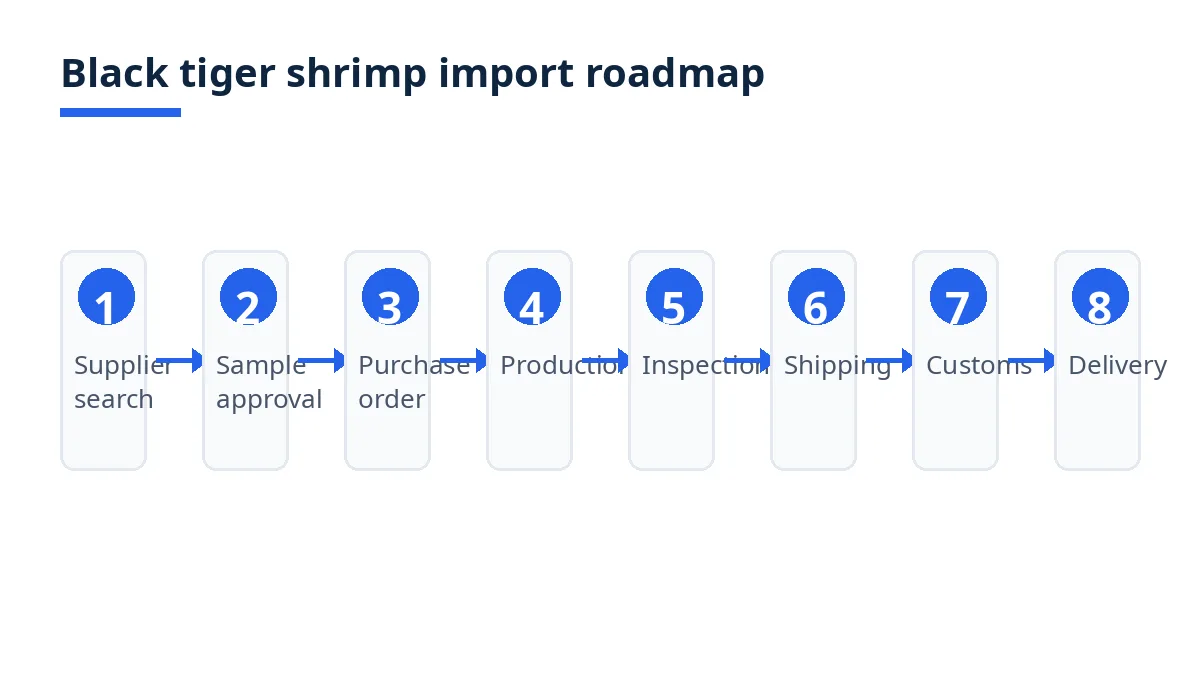
Step-by-step import checklist: how to import black tiger shrimp from Bangladesh
Write the specification line by line: species as Penaeus monodon, form, count size and its weight basis, freezing method, glaze and net weight basis, black spot tolerance, test requirements, labelling and packing.
Classify every line from heading 0306, in 0306.17 for black tiger shrimp, and confirm each full code and duty with your broker.2
Confirm the market route first: approved establishment and health certificate for the European Union,10 or HACCP verification records for the United States.11
Shortlist processors that already pack black tiger shrimp in your form, and request comparable quotes on the identical specification.
Verify the chosen supplier: company documents, plant approval status for your market, farm and hatchery supply chain including seed screening records, and cold store capacity.
Order samples in stages, thaw and test them for count, net weight, glaze and black spot, then approve a pre-shipment sample.
Confirm the order in writing: purchase order, pro forma invoice, payment terms, inspection plan with AQL limits, laboratory tests, reefer set point and packing.
Inspect during processing and again on packed cartons, checking count uniformity, black spot, glaze, weights and labels.
Ship with the temperature record running, clear customs with the confirmed code for each line, and reconcile the actual landed cost by count band.
How Exportain helps
Browse suppliers for Bangladeshi frozen seafood exporters, then post your black tiger specification, with form and count bands, as an RFQ and compare replies on the same terms. Exportain is a B2B marketplace where buyers post RFQs, receive quotations and message suppliers. It does not inspect goods, book freight or clear customs.
FAQs
What is the typical MOQ for black tiger shrimp from Bangladesh?
There is no single typical minimum. It is set per form and usually per count size, because each combination is packed as its own production run.
How long does shipping take?
Production time and transit time are separate, and neither has a single typical figure. Reefer sea transit takes weeks rather than days.
What import duty applies?
Duty follows the confirmed classification of each line, the destination and the origin. Frozen black tiger shrimp sits in 0306.17, other shrimps and prawns.2 In the United States schedule opened for this guide, Revision 16 (2026), that line carries a Free general rate.2 In the European Union, Bangladesh benefits from Everything But Arms duty-free access, subject to origin rules.14 In the United Kingdom, Bangladesh is listed under Comprehensive Preferences, with 0 percent tariffs on 99.8 percent of products.15
How do I verify a supplier?
Check company documents first, so that name, address and bank account agree across every document. Then check market status and the supply chain: establishment approval where your market requires it, the health certificate route through the Department of Fisheries,6 and the farms and hatcheries supplying monodon. Keep payments to the company account named in the documents.
Next steps on Exportain
Read how to import from Bangladesh for the full process, then use how to write an RFQ to set out your species, form and count bands, and post a free RFQ on Exportain.
Sources
- Harmonised System. European Commission (accessed )
- Harmonized Tariff Schedule of the United States, Chapter 3. United States International Trade Commission (accessed )
- FAO - Penaeus monodon Fabricius. Food and Agriculture Organization of the United Nations (accessed )
- Reviving Bangladesh's shrimp sector. The Financial Express, (accessed )
- Bangladesh: Most shrimp factories shut as exports from Bangladesh halve in 7 years. International Collective in Support of Fishworkers (ICSF) (accessed )
- Bangladesh rolls out online certification system to simplify fish and seafood trade. International Collective in Support of Fishworkers (ICSF) (accessed )
- Sensory Assessment of Black Tiger Shrimp (Penaeus Monodon). Southeast Asian Fisheries Development Center (accessed )
- Studies on the use of sulfites to control shrimp melanosis (Blackspot). University of Florida (accessed )
- ISO 2859-1:2026 - Sampling procedures for inspection by attributes — Part 1: Sampling schemes indexed by acceptance quality limit (AQL) for lot-by-lot inspection. International Organization for Standardization (accessed )
- Health and consumer protection for animal and plant product. European Commission, Access2Markets (accessed )
- A Summary of the United States Food and Drug Administration's Food Safety Program for Imported Seafood; One Country's Approach. PubMed Central (accessed )
- Fish and Fishery Products Hazards and Controls. U.S. Food and Drug Administration (accessed )
- Insider thoughts: Bob Ronai on Incoterms 2020 Rules; What are they about?. International Chamber of Commerce (accessed )
- Trade arrangements. European Commission, Access2Markets (accessed )
- Preference tiers under the Developing Countries Trading Scheme. GOV.UK (Department for Business and Trade), (accessed )
- Why do you use a commodity code when importing?. Netherlands Chamber of Commerce (KVK), (accessed )
About the author
Sourcing from Bangladesh?
Post a request for quotation and suppliers on Exportain can send you their quotes directly.
Post an RFQ