How to Choose the Named Place for FAS Correctly
How to name the FAS place so the seller can deliver beside the vessel: port, berth or quay, and vessel name, with Chattogram terminal traps and wording examples for buyers.
Short answer
Under FAS (Free Alongside Ship), the named place is the named port of shipment plus the point beside the buyer's nominated vessel, such as a berth, quay, or barge position, where the seller places the goods, cleared for export. Risk passes to the buyer at that point, and the buyer pays for loading and main carriage. Name the port, point, and vessel in the clause, and confirm the point with the carrier before signing.
On this page
Key takeaways
The FAS named place is a port of shipment plus the point beside a named vessel, such as a berth, quay, or barge position, where risk passes to the buyer.
The buyer must give the vessel name and the specific place and point in time; late notice can pass risk and added costs to the buyer before delivery.
Container terminal names do not meet the FAS test: containerised cargo held at a terminal has not been placed alongside a vessel, so FCA usually fits that pattern.
Use the same port, point, and vessel wording in the contract, booking, invoice, packing list, and transport instructions, and clear the goods for export before the delivery date.
Under FAS, one line in the sales contract decides where the seller stops and the buyer starts: the named place. It is not a city, a terminal name, or a port in general. It is a named port of shipment plus the point beside a named vessel where the goods are placed alongside the ship, cleared for export, and risk passes to the buyer.
This guide covers that line only: what counts as a correct FAS named place, and what goes wrong when the place names a terminal, a city, or an airport instead of the point beside the vessel.
What the FAS named place means: port, vessel and the point beside the ship
FAS (Free Alongside Ship) is one of the rules for sea and inland waterway transport only under Incoterms 2020, the current edition of the rules published by the International Chamber of Commerce (ICC).1 Under FAS, the seller delivers the goods when they are placed alongside the vessel nominated by the buyer at the named port of shipment, for example on a quay or a barge, and risk passes from seller to buyer at that point.2 The seller clears the goods for export; the buyer contracts the carrier, pays the freight and loading, and handles import formalities.3
Three parts must work together: the port, the vessel, and the point inside the port, such as a named berth or quay, where the goods are to lie beside that vessel.
Rule | Named place | Delivery point | Who loads the vessel |
|---|---|---|---|
FAS | Named port of shipment | Alongside the nominated vessel | Buyer |
FOB | Named port of shipment | On board the nominated vessel | Seller |
FCA | Named place | Handed to the buyer's carrier | Depends on the place |
FAS and FOB both end at the port of shipment, with the seller clearing the goods for export and the buyer paying port-to-port transport.3 The difference is the last step: FAS ends alongside the ship, FOB ends on board.3 See the Incoterms guide for shipments from Bangladesh and the FAS risk transfer guide.
What does the buyer have to tell the seller before delivery?
The buyer must notify the seller in time of the vessel name and the specific place and point of delivery within the port.3 If the buyer fails to give that notice in time, risk and added costs can pass to the buyer from the moment of non-compliance, including where the vessel has closed for cargo.3 If the buyer fails to specify the place and point at all, the seller may choose a suitable delivery point.3 Do not rely on that fallback.
Why a port name alone fails: berths, quays and vessel movements
A port has more than one berth, quay, terminal, and anchorage, and vessels move between them. A clause that says only "FAS Chattogram" names the port but not the berth, the quay, or whether the goods go by barge.
The ICC Academy warns that vague delivery wording leads to disputes over delays and delivery location, and gives the example of a port with different sub-ports and different land transport costs between them.2 The same warning applies inside one Bangladesh port. The ICC Academy guidance is direct: specify the place and point precisely, and avoid vague expressions such as "destination port" or "designated location".2
Is naming a city or a country ever enough?
No. "FAS Bangladesh" does not name a port of shipment. Write the port, the point, and the vessel, or write the clause so the vessel and point are supplied by a dated notice agreed in writing before the delivery period opens.
Choose the point in five checks
Work through these checks in order. The first two decide whether FAS fits. The last three decide whether the wording will hold up on the day.
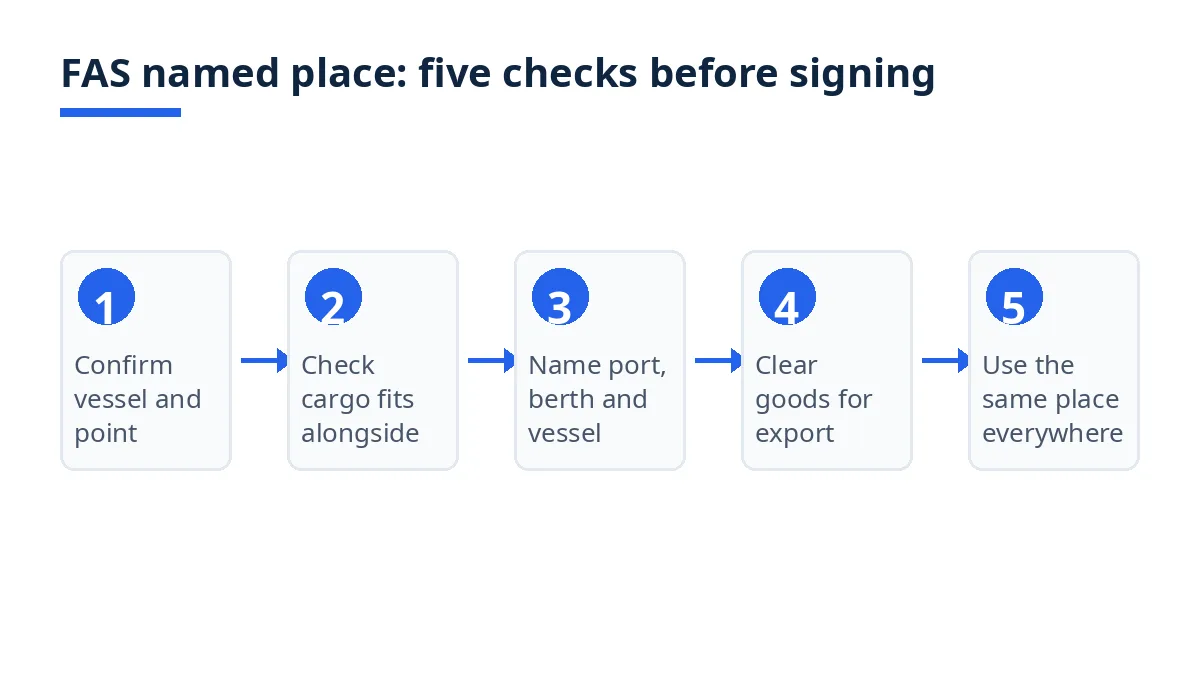
Confirm the vessel and the point with the buyer. Get the vessel name, berth or quay, and delivery period in writing. Record who gives the vessel notice and by what date.
Check the cargo can be placed alongside the vessel. FAS fits cargo delivered directly beside the ship, such as bulk cargo, breakbulk cargo, and vehicles. When goods are containerized, sellers typically deliver them to a container terminal, and the FCA rule is more appropriate.3
Name the port, the point, and the vessel. Use "FAS [named port of shipment], [berth or quay and point], [vessel name], Incoterms 2020", with the bracketed parts filled in or supplied by an agreed dated notice.
Clear the goods for export before the delivery date. The export declaration must be approved before the goods are loaded or stuffed for export.4
Carry the same place into every document. The contract, carrier booking, commercial invoice, packing list, and transport instructions must carry the same port, point, and vessel wording.
The examples below use bracketed placeholders, not real vessel or berth names.
Wording | Result |
|---|---|
FAS [port], Berth [number], alongside MV [vessel name], Incoterms 2020 | Correct pattern. |
FAS Chattogram, Incoterms 2020 | Incomplete. No berth or vessel named. |
FAS Chattogram Container Terminal, Incoterms 2020, for bulk cargo to go alongside a vessel | Wrong point. A terminal handover is not delivery alongside a vessel. |
FAS Dhaka airport, Incoterms 2020 | Not an FAS place. FAS applies only to sea and inland waterway transport.5 |
Costs, documents and timing around the alongside point
Who pays what up to and after the alongside point?
The FAS allocation turns on the alongside point.1 The seller bears costs and risks up to placing the goods alongside the vessel, cleared for export. From that point the buyer bears all costs and risks, including loading.3 The table is a guide to who pays, not a price list.
Cost or task | Seller | Buyer |
|---|---|---|
Inland transport to the named port | Yes, up to the alongside point | No |
Export clearance | Yes | No |
Placing the goods alongside the vessel | Yes | No |
Loading onto the vessel | No | Yes |
Main carriage | No | Yes |
Insurance for the main carriage | No obligation under FAS | Buyer arranges cover if wanted |
Import clearance, duties, and taxes | No | Yes |
DSV states the same split in shorter form: the seller delivers the goods, cleared for export, alongside the vessel at the named port, risk transfers to the buyer there, and the buyer is responsible for loading and all costs that follow.5 State insurance separately in the contract: who insures the goods while they wait alongside the vessel, during loading, and during the main carriage.
Which documents are needed?
For export clearance in Bangladesh, goods must not be loaded or stuffed for export unless an export declaration, known as the Bill of Export or Shipping Bill, is submitted to Customs and approved.4 The documents enclosed with the Bill of Export include the export letter of credit or, where there is none, the export contract, purchase order, or export guarantee approved by the negotiating bank; the commercial invoice; the packing list; the EXP form certified by authorized dealers; the certificate of origin issued by the Export Promotion Bureau or a Chamber of Commerce and Industry; the VAT registration certificate; and the taxpayer identification number.4
Put the full FAS clause on the contract or purchase order enclosed with the Bill of Export, so the clearance papers and the sale papers name the same place. Ask the seller to give prompt notice of delivery alongside the vessel.3
What timing must the named place allow for?
The named place must allow for the seller's inland transport and export clearance, the vessel's berthing and loading window, and the buyer's notice of vessel and point, all at once. The FAS rule places the cost of late buyer notice on the buyer, but a contract that never states notice dates, berthing details, or a fallback point invites the dispute the rule is meant to avoid.3
Example figures: take a single bulk lot that must lie alongside one named vessel on one call. If the buyer names the vessel late, the seller may reach the port on time and find no agreed berth, and the lot waits while the vessel sails. The waiting, storage, and re-delivery costs are not fixed by the Incoterms rule; they follow the contract, the port terms, and the carrier terms.
Chattogram and other Bangladesh loading points: the terminal trap
Chattogram Port currently has four operational facilities handling containers: the New Mooring Container Terminal (NCT), the Chattogram Container Terminal (CCT), the General Cargo Berth (GCB), and the Patenga Container Terminal (PCT). NCT, CCT, and PCT are dedicated container terminals, while GCB is primarily a general-cargo facility that also handles a large volume of containers.6 In 2025, NCT handled around 44 percent of the port's total container volume, GCB around 36 percent, CCT 16 percent, and PCT nearly 4 percent, according to port data reported by The Business Standard.6
Those figures describe container handling. They do not make any one facility the FAS delivery point. For containerized cargo, use FCA, with the terminal as the FCA named place, rather than FAS.3 5 For bulk or breakbulk cargo, name the berth or quay the nominated vessel will actually use, and confirm with the carrier and the port whether the vessel will lie there and whether the cargo can be placed alongside it.
The same test applies at any other Bangladesh seaport or inland waterway port. If the port confirms only a terminal gate or a container yard, the place confirmed is a handover point, not an FAS alongside point. FAS also has no airport form: the four sea and inland waterway rules are FAS, FOB, CFR, and CIF, while the other seven rules apply to any mode or modes of transport.5 For air cargo, name an FCA place instead.
Mistakes that move risk at the wrong moment
Naming a terminal instead of the point beside the vessel. Risk may not have passed when the parties think it has.
Naming a port without a berth, quay, or vessel. Add the point and the vessel, or add a dated notice mechanism that supplies them.
Assuming the seller loads the vessel. Under FAS the buyer pays for loading and bears the risk from the alongside point.3 Compare the FAS contract clause guide wording with the quotation.
Using FAS for containerized cargo by habit. Containers delivered to a terminal and held there do not reach the alongside point on delivery to the terminal.3 Choose FCA for that pattern.
Giving the vessel notice late or not at all. Late notice can pass risk and added costs to the buyer before the goods are alongside the vessel.3
Carrying different places in different documents. Align the contract, booking, invoice, and packing list.
Clearing export after the delivery date. The Bill of Export must be approved before loading.4 A place that depends on clearance granted after the vessel sails is not a delivery point the seller can use.
Checklist before you sign the FAS clause
Port of shipment named in full.
Berth, quay, or barge point named inside the port, confirmed with the carrier for the nominated vessel.
Vessel name stated, or a dated notice mechanism stated, with a fallback point if the vessel changes berth.
Cargo form checked: the goods can be placed alongside the vessel.
Loading duty and cost assigned to the buyer, and insurance cover stated.
Export clearance plan agreed, with the Bill of Export, commercial invoice, packing list, EXP form, and certificate of origin ready before the delivery date.4
Notice duties stated: buyer notice of vessel and point, and seller notice of delivery.3
Same port, point, and vessel wording in the contract, booking, invoice, packing list, and transport instructions.
Air, inland depot, or factory-gate wording removed: if no vessel is named, the term is not FAS.
How Exportain helps
On Exportain, state the full FAS clause in the request for quotation (RFQ), including the port, the berth or quay, and the vessel notice arrangement, so suppliers quote against the same delivery point. The buying guide lists the RFQ contents as quantity and unit, target price, destination, Incoterm, required certifications, and deadline, and quotations are versioned with unit price, MOQ, lead time, Incoterm, payment terms, and validity.7 Ask each reply to confirm in writing that it can deliver alongside the nominated vessel at the named point.
Read the badges on a supplier profile for what they record. Verification on Exportain is a document and photo review by staff, not a factory inspection, and membership plans never grant a trust badge.8 A badge does not prove that a supplier can reach a particular berth with a particular cargo form.
FAQs
What should I know first about the FAS named place?
The FAS named place is a port of shipment plus the point beside a named vessel where the seller places the goods, cleared for export, and risk passes to the buyer.2 3 A port name alone, a terminal name, or an airport name does not meet that test.
What are the typical costs and timelines?
There are no typical FAS costs or timelines that hold across shipments. The cost split is fixed: the seller pays up to the alongside point, and the buyer pays loading, main carriage, and import costs from that point.3
Which documents are needed?
The sale papers are the contract or purchase order carrying the full FAS clause, the commercial invoice, and the packing list, all naming the same port, point, and vessel. The export set for Bangladesh clearance is the Bill of Export or Shipping Bill with the export letter of credit or contract, commercial invoice, packing list, EXP form, certificate of origin, VAT registration certificate, and taxpayer identification number.4 The seller should also give written notice of delivery alongside the vessel.3
What are the most common mistakes with the FAS named place?
The most common mistakes are naming a container terminal instead of the point beside the vessel, naming a port without a berth or vessel, assuming the seller loads the vessel, using FAS for containerized cargo, giving the vessel notice late, and carrying different places in the contract and the booking.3 See the FCA named place guide for the carrier-handover version of the same naming problem, and the FOB guide for the on-board version.
Next steps on Exportain
Browse suppliers, then post your FAS clause, with the port, berth or quay, and vessel notice arrangement, on the RFQ board so suppliers confirm in writing that they can deliver alongside the nominated vessel. Before you confirm a quotation, read the FAS shipping guide from Bangladesh.
Sources
- Incoterms® 2020. International Chamber of Commerce (ICC) (accessed )
- Place of delivery & risk transfer in trade contracts. ICC Academy (accessed )
- FOB & FAS Incoterms® 2020 explained: Key differences. ICC Academy (accessed )
- Customs Clearance Procedures for Export. Bangladesh Customs, National Board of Revenue (accessed )
- What are the rules for Incoterms 2020?. DSV (accessed )
- How many container terminals does Chattogram Port actually have? What is their status?. The Business Standard, (accessed )
- How to source and buy from Bangladesh. Exportain (accessed )
- Supplier verification: Earn trust badges buyers can see. Exportain (accessed )
About the author
Sourcing from Bangladesh?
Post a request for quotation and suppliers on Exportain can send you their quotes directly.
Post an RFQ