How to Write an FAS Clause in Your Sales Contract (Template Included)
An FAS clause that names the port and point, states Incoterms 2020, and fixes alongside delivery, risk transfer, and the clearance split, with a copy-ready template table and a Chattogram filled example.
Short answer
An FAS contract clause names the port of shipment and the point inside it, states Incoterms 2020, and requires the buyer to nominate the vessel. Delivery occurs when the goods are placed alongside the vessel, and risk and costs pass to the buyer at that point. The seller completes export clearance, while the buyer pays for loading, onward carriage, import clearance, and any insurance.
On this page
FAS ends the seller's delivery job at the quayside, not on board the ship. That single point decides who pays for loading, who carries the risk while the goods wait beside the vessel, and who books the main sea journey. This template is drafting guidance, not legal advice. Have counsel review the final clause before signing.
What the document is for
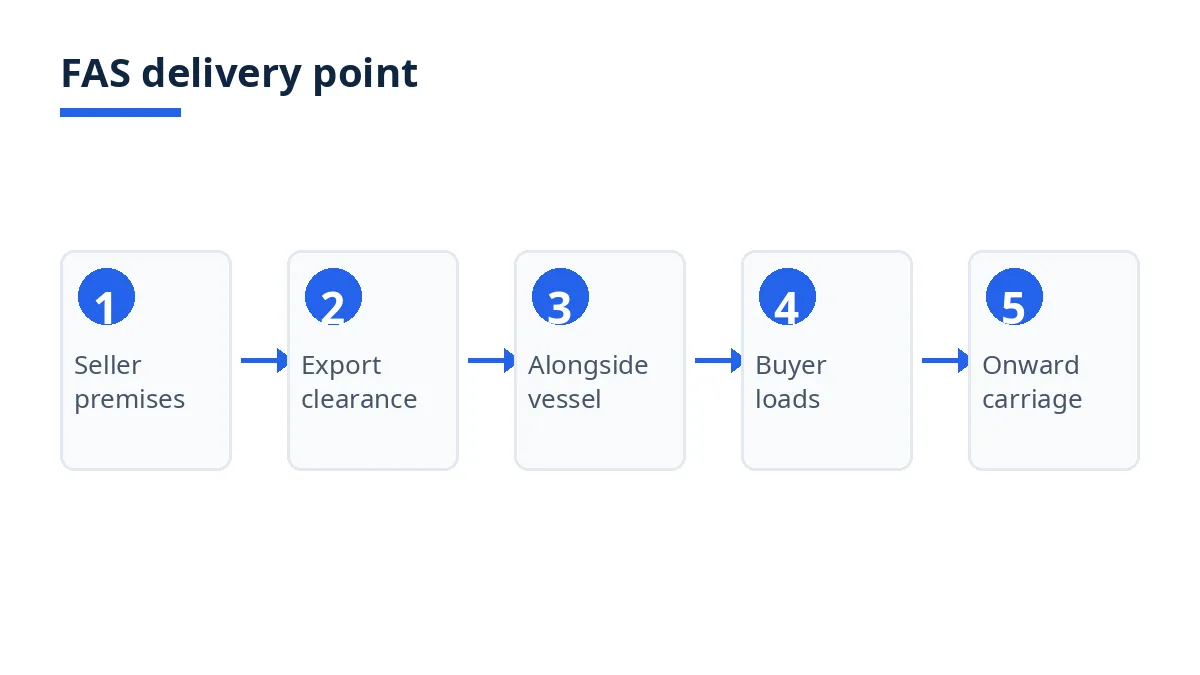
The FAS clause is the delivery section inside a sales contract. FAS means Free Alongside Ship. Under Incoterms 2020, the seller delivers the goods alongside the vessel nominated by the buyer at the named port of shipment, and risk of loss or damage transfers to the buyer at that delivery point.1 The seller is responsible for transporting the goods to the port and completing any export formalities.1 FAS applies only to sea or inland waterway transport.1
From that point, the buyer takes over: appointing the carrier and paying freight, covering loading costs at the port, and handling import formalities and any required transit customs.1 The buyer bears all costs from the moment the goods are alongside the ship.2 Under FAS, there is no obligation to make a contract of insurance, so either party that wants cover must arrange it separately.3
The clause turns that rule into a usable term: a named port and point, a vessel nomination duty, a delivery window, and one risk sentence. It does not put the goods on board, book the sea carriage, or insure the cargo.
Required fields explained
Work through each field in order; leave no row blank.
Named port and point. The port in full, plus the point inside it where the goods will sit alongside the vessel, such as a quay, berth, or barge position. "FAS Bangladesh" names a country, not a port. The buyer must notify the seller in time of the vessel's name and delivery point within the port.1
Vessel nomination and notice deadline. The vessel name, or who nominates it and by what date. Under FAS the vessel is the one nominated by the buyer.2 Add a deadline tied to the delivery window, plus a contact and method.
Incoterms version. "Incoterms 2020" in full, in the same sentence as the rule and the named port: "FAS (named port of shipment) Incoterms 2020".
Delivery and risk wording. Delivery occurs when the goods are placed alongside the vessel at the named port of shipment, for example on a quay or in a barge.2 Risk transfers at that point, and the buyer bears all costs from that moment onward.2 No second risk point, and no on-board wording.
Export clearance. An express statement that the seller will complete export clearance, as the seller is responsible for completing any export formalities under FAS.1 List the documents supplied, such as the commercial invoice.
Loading, onward carriage, and import clearance. An express statement that these are for the buyer: the buyer covers loading costs, contracts the carrier, and handles import formalities and any transit customs.1 Any agreed change needs its own row.
Insurance position. A written statement of cover, even though FAS imposes no insurance duty: under FAS there is no obligation to make a contract of insurance.3 If the buyer wants cover, say who arranges it, for what value, and from what point.
Delivery window, notice, and goods identification. The date or short window for alongside delivery, and how the seller will notify the buyer. The seller must promptly notify the buyer when goods are delivered.1 Name the goods, quantity, and marks, cross-referred to the order number or packing list.
Template (table or downloadable)
Copy the table into the contract and fill in every row, replacing bracketed text.
Clause element | Wording to use | What to fill in |
|---|---|---|
Delivery term | Delivery is FAS (named port) Incoterms 2020. | Port name and point. |
Named port and point | The seller will place the goods alongside the vessel at the named quay, berth, or barge position. | Quay, berth, or barge position. |
Vessel nomination | The buyer will nominate the vessel and give notice of its name and delivery point by the date in this clause. | Vessel name or deadline, contact, method. |
Delivery event | Delivery occurs when the goods are placed alongside the vessel at the named port. | No on-board wording. |
Risk transfer | Risk passes to the buyer when the goods are alongside the vessel; the buyer bears all costs from that moment. | No second risk point. |
Export clearance | The seller will complete export clearance and supply the documents listed in this clause. | Documents; payer for any extra charge. |
Loading and onward carriage | The buyer will pay for loading and will contract and pay for onward carriage. | Carrier, if known. |
Import clearance | The buyer will handle import clearance and any transit customs. | Note any agreed change. |
Insurance | No insurance is required under FAS; any cover is as stated in this row. | Arranger, value, start point, if agreed. |
Delivery window and notice | The seller will notify the buyer when the goods are alongside the vessel, within the delivery window. | Dates, contact, method. |
Goods covered | This clause covers the goods, quantity, and order in the contract. | Order number, description, marks. |
If either side must still ask which quay, vessel, loader, or insurer applies, the clause is not finished.
Filled example
All figures, names, and dates below are examples only; adapt every entry, and have counsel review the final clause.
Example clause. Delivery is FAS alongside the vessel at the quay at Chattogram, Bangladesh, Incoterms 2020. The seller will place 800 bales of raw jute, order number EX-2041, export cleared, alongside the buyer's nominated vessel MV Bay Trader at that quay, on or between 12 and 14 November. The buyer will nominate the vessel and give notice of its name and the quay position by 5 November. The seller will notify the buyer by email on the day the goods are placed alongside the vessel. Delivery occurs, and risk passes to the buyer, when the goods are alongside the vessel. Loading onto the vessel, onward carriage, import clearance, and any insurance from that point are for the buyer's account.
The example stops at the vessel's side on purpose. The seller does not load the jute, book the sea journey, or insure the cargo after delivery. For a deal where the seller must load, FAS is the wrong rule.
Common errors
Using FAS for air, road, or rail shipments. FAS applies only to sea or inland waterway transport.1
Naming a country or a city instead of a port and point. A country contains many ports, and a port contains many quays; write the port and the point inside it.
Confusing FAS with FOB loading. Under FOB the seller delivers loaded on board, while under FAS the seller delivers alongside the vessel.1
Omitting the Incoterms version. Without "Incoterms 2020", the parties have not fixed which edition governs delivery, notice duties, and the risk point.
Assuming the seller insures the cargo. FAS imposes no insurance obligation.3 A buyer who wants cover must arrange or agree it expressly.
Assuming the seller books the main carriage. Under FAS the buyer contracts the carrier and pays port-to-port transport costs.1
Using FAS for container cargo handed to a terminal. When goods are containerized, sellers typically deliver them to a container terminal, not alongside the ship, and FCA is more appropriate.1
Giving late vessel notice, or none at all. The buyer must notify the seller in time of the vessel's name and delivery point.1 Late notice can shift risk and costs to the buyer early.
Copying the example without adapting it. A row left with the example port, vessel, order number, or dates intact points at the wrong shipment.
FAQs
Who drafts this clause?
No single authority drafts or issues an FAS clause. The buyer and seller agree it together as part of their sales contract, and it takes effect when that contract is signed. Incoterms 2020 supplies the meaning of FAS.
Which fields are mandatory in an FAS clause?
The named port and point, version, vessel nomination, alongside delivery and risk wording, and clearance split are the minimum. The delivery window, notice method, insurance position, and goods identification are also needed in practice.
Can the clause sit in a digital contract?
A clause can sit inside a contract in electronic form, provided it meets the form, signature, and record requirements of its governing law. Documents under FAS can be provided in paper or electronic form,3 but the governing-law check decides whether the electronic contract holds.
What errors cause disputes or delays?
A wrong transport mode, a vague port or point, an unnamed vessel, a missing Incoterms version, and confusion between alongside delivery and on-board loading cause most disputes and delays. Each leaves a delivery-day question unanswered: where, which ship, who loads, and which edition governs.
Next steps on Exportain
Compare FAS with the other sea and any-mode rules in Incoterms for Shipments From Bangladesh, see how insurance changes the sea bargain in the CIF rule, and follow the buying steps around the contract in How to Source and Buy from Bangladesh.
Sources
- FOB & FAS Incoterms® 2020 explained: Key differences. ICC Academy (accessed )
- Incoterms. DHL Global Forwarding (accessed )
- Incoterms 2020 FAS. ShipHub (accessed )
About the author
Sourcing from Bangladesh?
Post a request for quotation and suppliers on Exportain can send you their quotes directly.
Post an RFQ