How to Choose the Named Place for FCA Correctly
How to name the FCA delivery point so a carrier can act on it: factory gate versus terminal or depot, the loading rule for each, and worked examples of correct and incorrect named places for shipments from Bangladesh.
Short answer
Under FCA (Incoterms 2020), the named place is the point where the seller hands goods to the buyer's carrier and risk passes to the buyer. Name the seller's premises when the carrier collects there and the seller can load the vehicle; name a terminal, depot or cargo facility when the carrier accepts goods only there or the shipment is consolidated. Write the facility and its address, confirm it with the carrier, and carry the same place in shipping documents.
On this page
Key takeaways
The FCA named place is the delivery point: it fixes where risk passes and whether the seller loads the goods or only delivers them ready for unloading.
At the seller's premises the seller loads the buyer's collecting vehicle; at any other named place the seller delivers the goods ready for unloading and does not unload them.
Choose by carrier acceptance point first, then factory loading ability and consolidation needs, and confirm the exact place with the carrier before signing.
Write the facility and its full address, and the receiving point inside a large terminal, so no driver or gate officer can take the wording to the wrong place.
Carry the same named place in the contract, the carrier booking, the invoice and the transport instructions, or the collection will fail at the gate.
Under FCA (Free Carrier), one line in the contract carries more weight than most buyers expect: the named place. It fixes the exact point where the seller hands the goods over, where risk passes to the buyer, and whether the seller loads the goods or only delivers them ready for unloading. Get that line right and collection, loading and risk all line up. Get it vague and the same shipment can produce a loading dispute, a carrier sent to the wrong gate, and a gap in which neither side is sure who bears a loss.
This guide is about that one line only: how to choose the named place for an FCA order from Bangladesh, how to write it so it cannot be misread, and what goes wrong when it is vague or wrong. It assumes you have already chosen FCA itself.
Why the named place decides the deal
FCA is one of the 11 Incoterms rules published by the International Chamber of Commerce (ICC), and the current version is Incoterms 2020.1 Under FCA, the seller delivers the goods, cleared for export, to a carrier nominated by the buyer at an agreed named place, and the buyer takes responsibility from that point forward.2 That named place is the delivery point itself.
Three consequences follow directly from the place you name. First, it sets the risk transfer point: risk passes when the goods are handed over at the named place, not when they leave Bangladesh and not when they arrive at the destination.2 Second, it decides the loading question: at the seller's premises the seller loads the buyer's collecting vehicle, while at any other named place the seller delivers the goods ready for unloading and does not unload them.2 Third, it tells the buyer's carrier where to go. A carrier booking that names a different place from the contract creates a failed collection even when both sides acted in good faith.
The two named-place families
Every FCA named place falls into one of two families, and the family decides who loads.
Family A: the seller's premises
When the named place is the seller's factory, warehouse or other premises, delivery happens when the goods have been loaded onto the buyer's collecting vehicle, and loading is the seller's job.2 This family suits a buyer whose carrier can collect directly from the factory, a seller with proper loading equipment and vehicle access, and a shipment that does not need consolidation with other suppliers first.
The buyer still nominates the carrier and gives the seller the carrier details and collection timing in good time. A factory named place therefore needs a firm collection plan: vehicle type, date window and a contact at the gate.
Family B: somewhere other than the seller's premises
When the named place is anywhere else, such as a forwarder's warehouse, a container freight station, a container yard, an inland container depot or a terminal, the goods are considered delivered when they arrive ready for unloading from the seller's vehicle, and the seller does not unload them.2 Flexport gives the same split in short form: at the seller's premises the seller bears the cost and risk of loading onto the buyer's transport, while at another named location the seller makes the goods ready for unloading but does not unload them.3
This family suits a buyer whose carrier accepts goods only at its own terminal or depot, a shipment consolidated from several suppliers, and a seller whose premises cannot take the buyer's vehicle. The seller must move the goods to the named place, so the buyer should check that the seller can reach that place and that the carrier will accept the goods there.
Named-place family | Delivery happens when | Who loads or unloads |
|---|---|---|
Seller's premises | Goods are loaded onto the buyer's collecting vehicle | Seller loads |
Any other named place | Goods arrive ready for unloading from the seller's vehicle | Carrier unloads; seller does not unload |
How to choose: a decision sequence
Choose the named place by working through five questions in order.
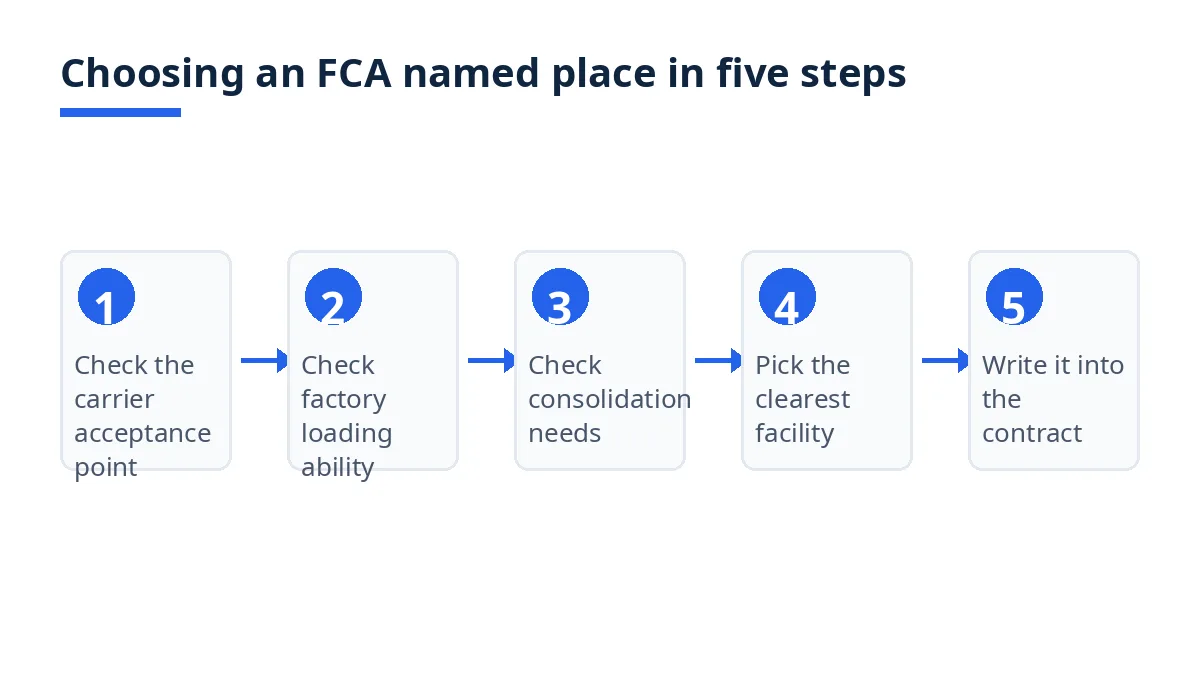
First, where does your carrier accept goods. If it collects from factories, a factory named place is open to you. If it accepts goods only at its terminal or depot, naming the factory creates a gap. Ask the carrier for its acceptance point before you name anything.
Second, can the seller load at its own premises. A factory named place only works if the seller has the equipment and vehicle access to load the buyer's vehicle safely. If factory loading is impractical, a terminal or depot named place fits better.3
Third, does the shipment need consolidation. If you are combining goods from several Bangladeshi suppliers into one container or booking, a single shared named place, such as an inland container depot, gives every seller the same handover point and your carrier one collection point.
Fourth, which place is clearest on the day. The named place should be a facility with a gate and a receiving process, not a district or a city.
Fifth, write the chosen place into the contract with the wording described in the next section, and make sure the carrier booking, the invoice and the transport instructions all carry the same place.
Writing a named place that cannot be misread
A named place fails when it could mean two different locations. Test every draft against that standard: could a driver, a gate officer or a carrier clerk take this wording to the wrong place. If the answer is yes, add precision until the answer is no. DHL states the rule plainly: specify the named place as precisely as possible in the sales contract, because a vague or wrong named place leads to disputes over loading costs, confusion about when risk passes, and delays when the carrier arrives at the wrong location.2
Use a precision ladder.
Weak: "FCA Bangladesh". This names a country, not a place, and says nothing about where delivery happens.
Weak: "FCA Chattogram". This names a city with several terminals, depots and warehouses. A carrier cannot collect from a city.
Better: "FCA New Mooring Container Terminal, Chattogram, Bangladesh". This names a facility, and for many shipments it is enough.
Strong: "FCA New Mooring Container Terminal, Chattogram, Bangladesh, goods to be delivered to the carrier's receiving point at that terminal". This names the facility and the handover point inside it, which matters at a large terminal with more than one gate or yard.
Strong for a factory: "FCA [seller's full factory address], Bangladesh, goods to be loaded onto the buyer's nominated carrier's vehicle at the seller's premises". This names the exact premises and states the loading duty that follows.2
Always include the Incoterms version in the term itself, written as "FCA (Incoterms 2020)" followed by the named place. A bare "FCA" without a version and without a place is an incomplete term. Exportain's FCA clause article covers the full clause structure; this guide covers only the place inside it.
Worked examples show the difference. "FCA Dhaka" could mean a factory, a depot or an airport facility, and no carrier can act on it. "FCA Kamalapur Inland Container Depot, Dhaka, Bangladesh" can be acted on, because it names one facility. "FCA seller's factory" without an address fails the same test: the carrier and the gate staff need the address in the booking.
One more check before signing: confirm that the named facility will accept the goods in the form you are shipping. A named place that cannot receive your consignment is a wrong named place even if the spelling is perfect.
Bangladesh named places in practice
A factory named place is common for a single-supplier order where the buyer's carrier runs factory collections. The wording must carry the full factory address, because industrial areas around Dhaka and Gazipur hold many factories on similar roads, and an address without a factory name and plot detail can still misdirect a driver.
An inland container depot named place, such as Kamalapur Inland Container Depot in Dhaka, suits consolidated or containerized cargo received inland before moving to the port. It gives the buyer one inland handover point and the seller a defined delivery destination short of the port.
A port terminal named place at Chattogram suits sea freight where the carrier's acceptance point is the terminal itself. Name the terminal, not just the port, because Chattogram port holds more than one terminal and yard, and a carrier booked to one terminal will not collect from another. An airport cargo facility named place at Dhaka suits air freight on the same rule: name the facility, not the city.
Export clearance sits with the seller under FCA, and the two connect at the gate. Bangladesh Customs requires an export declaration, known as a Bill of Export or shipping bill, to be submitted and approved before goods are loaded or stuffed for export, and the declaration records the exporter, the foreign buyer and the transport operator.4 When the named place is a terminal or depot, the seller must be able to present the goods and the approved declaration there.
What goes wrong when the named place is vague or wrong
Named-place failures follow a small set of patterns. Each one below is a failure of the place itself, and each one is fixed by changing the wording or the choice of place.
The carrier goes to the wrong gate. A contract that says "FCA Chattogram" and a booking that says a specific terminal send the driver to two different interpretations. The collection fails and the delivery window closes. The fix is a facility-level name in both the contract and the booking.
The loading cost is disputed. A seller that named its own premises and then refuses to load, or a buyer that named a terminal and then expects the seller to unload, has misunderstood the family rule.2 The fix is to name the place with its family in mind and to state the loading duty in the contract.
Risk falls into a gap between factory and terminal. If the contract names a terminal but the seller's plan assumed delivery at the factory gate, the leg between the two places has no agreed owner, and damage on that leg becomes a dispute. The fix is one named place that both sides and the carrier accept, with no second assumed handover point.
The collection window is missed. When the buyer's carrier fails to collect at the agreed time and place, the buyer bears the risk from the end of the agreed delivery period, even though the goods have not moved.2 A named place never confirmed with the carrier turns a scheduling slip into a risk transfer. The fix is to confirm the place and the window with the carrier before signing.
The named place cannot receive the goods. A terminal named for a consignment it does not handle produces a refused delivery. The fix is a short confirmation with the facility or the carrier that the place accepts the cargo in the form shipped.
Named-place checklist before you sign
Run through this checklist with the seller and the carrier before signing.
The term reads "FCA (Incoterms 2020)" followed by one named place, not a city, a country or a list of alternatives.
The named place names a facility with a full address, and for a large terminal it names the receiving point inside the facility.
The family is deliberate: seller's premises means the seller loads, and any other place means the seller delivers ready for unloading.3
The buyer's carrier has confirmed it collects or accepts goods at that exact place.
The seller has confirmed it can load at named premises or deliver to the named facility.
The carrier booking, the commercial invoice and the transport instructions carry the same named place as the contract.
The collection date window and a gate contact are agreed, so a missed collection does not become a risk dispute.
The seller's export clearance plan works at the named place, with the approved export declaration available where the goods are presented.4
How Exportain helps
On Exportain, a buyer can state the intended FCA named place in the enquiry itself, so quotations arrive against the same handover point. A quotation that assumes a factory collection and one that assumes a terminal handover are not comparable until the named place matches. The Exportain overview of the 11 Incoterms rules gives the wider context for buyers still choosing between terms.5
Post a free RFQ on Exportain and get quotes from Bangladeshi suppliers: https://exportain.com/rfqs
FAQs
What is the FCA named place, in plain terms?
It is the exact location where the seller hands the goods to the buyer's carrier, and where risk passes from seller to buyer. Under FCA, the seller delivers the goods, cleared for export, to that place, and the buyer's responsibility starts there.2 It must be a place a carrier can find and act on: a factory address, a depot, a terminal or a cargo facility, never just a city or a country.
Should I name the seller's factory or a terminal?
Name the factory when your carrier collects from factories and the seller can load the buyer's vehicle there, because at the seller's premises loading is the seller's job.2 Name a terminal, depot or forwarder's warehouse when your carrier accepts goods only there, when the shipment is consolidated, or when factory loading is impractical.
What happens if the named place is vague or wrong?
Three problems follow: the carrier may arrive at the wrong location, the loading duty may be disputed, and risk may be unclear for the leg between the assumed place and the real place. DHL warns that a vague or wrong named place leads to disputes over loading costs, confusion about when risk passes, and delays when the carrier arrives at the wrong location.2 Correct the wording to a facility-level name, confirm it with the carrier, and make sure every shipping document carries the same place.
Can the named place be changed after the contract is signed?
Only by agreement. The buyer and seller should agree the change in writing, confirm the new place with the carrier, and update the booking, the invoice and the transport instructions so that all of them carry the same place. Changing the contract wording alone, while the carrier still holds the old place, leaves the collection pointed at the wrong location. If goods have already been delivered to the original named place, delivery has already happened under the original term, and a new arrangement is needed.
Next steps on Exportain
Read the Exportain overview of all 11 Incoterms rules: https://exportain.com/blog/incoterms-for-shipments-from-bangladesh
Read how to write the full FCA clause around your chosen named place: https://exportain.com/blog/fca-contract-clause
Learn how buying on Exportain works before you post an enquiry: https://exportain.com/how-to-buy
Sources
- Incoterms® 2020. International Chamber of Commerce (ICC) (accessed )
- FCA Incoterms Explained: Free Carrier Meaning. DHL (accessed )
- FCA (Free Carrier). Flexport (accessed )
- Customs Clearance Procedures for Export. Bangladesh Customs, National Board of Revenue (accessed )
- Incoterms for Shipments From Bangladesh. Exportain (accessed )
About the author
Sourcing from Bangladesh?
Post a request for quotation and suppliers on Exportain can send you their quotes directly.
Post an RFQ