

Shipping FAS From Bangladesh: How It Works, Costs and Pitfalls
FAS shipping from Bangladesh, explained from the factory gate to the ship's side: the alongside-vessel handover at Chittagong and Mongla, who pays for loading, freight and insurance, and the mistakes that strand cargo at the quay.
Short answer
Under FAS, the seller delivers goods alongside the vessel nominated by the buyer at a named Bangladeshi port, cleared for export, and the buyer then pays for loading, ocean freight and insurance and carries the risk from that point onward. FAS covers sea and inland waterway bulk and break-bulk cargo only, not container terminal handovers or air freight.
On this page
Key takeaways
FAS delivery happens alongside the vessel at the named port of shipment, cleared for export: the buyer then pays for loading, ocean freight and insurance and carries the risk from that point onward.
FAS is for sea and inland waterway bulk and break-bulk cargo only: it does not fit container terminal handovers, where FCA usually applies, or air freight out of Dhaka.
The contract must name the port, the exact loading point within the port, and the vessel and delivery window, with buyer notice deadlines and a fallback if the vessel is delayed or closes early.
Budget by the handover point: the seller pays up to the alongside point, the buyer pays loading, freight, insurance, destination charges and import clearance, and export clearance must be approved before loading.
FAS, or Free Alongside Ship, is the Incoterms 2020 rule for a very specific handover: the seller delivers the goods by placing them alongside the vessel nominated by the buyer at the named port of shipment, cleared for export, and from that point the buyer takes over. The buyer contracts the carrier, pays for loading, and carries the cost and risk of the sea leg onward. This guide follows that point from a Bangladeshi factory gate to a vessel at Chittagong or Mongla.
Two limits shape every FAS shipment from Bangladesh. First, FAS is for sea and inland waterway transport only, so a consignment flying out of Dhaka airport needs a different rule. Second, FAS is not recommended for containerised cargo: in container trade the seller typically delivers to a container terminal, and the box may sit there for days before it is moved to the vessel, so the FCA rule usually fits container shipments better.1 FAS fits bulk and break-bulk cargo that can genuinely be placed alongside a vessel, such as bagged or loose bulk goods and cargo loaded by crane or barge at the quay. The Incoterms 2020 rules, published by the International Chamber of Commerce, allocate delivery, cost, risk and obligations between seller and buyer, and under FAS the risk transfers to the buyer when the goods are placed alongside the ship indicated by the buyer.2 3
Why this matters for buyers and sellers
For a buyer, FAS buys control: the buyer chooses the carrier, negotiates the freight, and decides how the goods are loaded and insured from the quayside onward. That suits bulk buyers who already run ocean logistics, consolidate cargo from several suppliers onto one vessel, or hold a freight contract that beats anything a Bangladeshi seller could obtain on a single shipment. The trade-off is that the buyer also owns the loading operation and every problem after the alongside point: a delayed vessel, a closed cargo window, or damage during loading is the buyer's cost and risk.
For a seller, FAS keeps the obligation short and local: move the goods to the port, clear them for export, and place them alongside the vessel, without contracting the carrier, paying freight, or insuring the sea leg. The exposure is the mirror image: if the buyer names the vessel late, or a loading point the seller cannot reach in time, the delivery can fail even though the goods are ready. Both sides therefore need three facts in writing before production finishes: the named port, the exact loading point, and the vessel and delivery window.
What should I know first about FAS?
Know the handover point before you know the price. FAS means alongside the vessel, not on board, not at the terminal gate, and not at the factory. If your cargo will travel in a container handed over at a terminal, FCA is the rule to discuss instead.1 Confirm the mode, cargo form and named port first, then compare FAS quotations.
Step-by-step: how it works
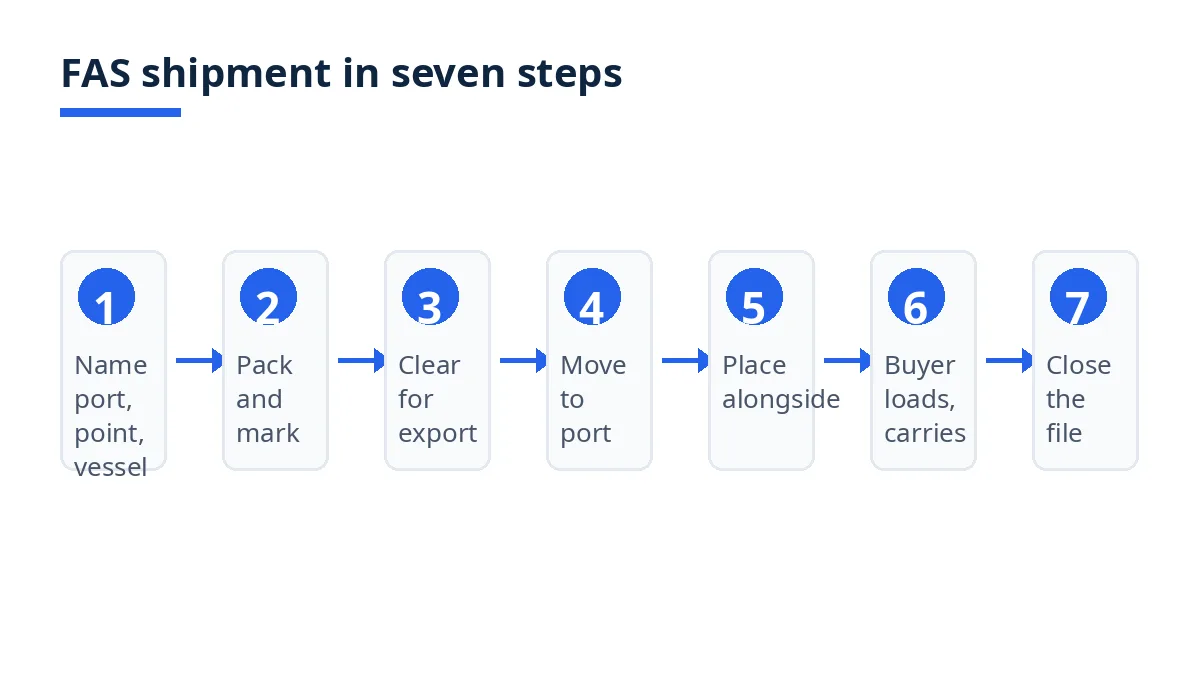
Name the port, the point and the vessel in the contract. Write the rule as FAS, followed by the named port of shipment and the Incoterms 2020 version, for example FAS Chittagong, Incoterms 2020. Then pin down the loading point within the port, quay or barge, because handling charges and movement of goods from quay or barge can vary with port practice.3 The buyer notifies the seller of the vessel name, loading point and delivery date in good time.
Produce, pack and mark for a quayside handover. The seller packs and marks the goods for the sea leg and for handling at the quay, even though the buyer will pay for loading. Packing must survive port storage, transfer to the quayside or barge, and a late vessel.
Clear the goods for export before they move to the vessel. In Bangladesh, goods may not be loaded for export unless an export declaration, the Bill of Export or Shipping Bill, is submitted to Customs and approved, specifying goods, value, exporter, foreign buyer and transport operator.4 The enclosed set includes the export letter of credit or, where there is none, the approved export contract or purchase order, the commercial invoice, the packing list, the EXP form certified by an authorized dealer, the certificate of origin, the VAT registration certificate and the taxpayer identification number, plus product-specific certificates.4
Move the goods to the port and into the controlled area. Inland carriage is the seller's cost up to the alongside point. As one documented Bangladesh export route shows, a consignment from factory premises to Chittagong Port normally takes between eight and ten hours from Dhaka, after which the clearing and forwarding agent requests entry into the port area or a private depot, and the authority or depot records the vehicle and issues an entry pass.5 Allow buffer for traffic, entry queues and inspection.
Place the goods alongside the vessel and prove delivery. The seller delivers by placing the goods alongside the nominated vessel at the agreed point within the agreed period, and informs the buyer in advance of delivery.3 The seller provides, at its own expense, a document confirming delivery, and assists the buyer, at the buyer's request, risk and cost, in obtaining a transport document where one is needed.3 Keep dated photographs of the alongside position and condition with the export declaration set.
The buyer loads, carries and clears onward. From the alongside point, the buyer pays for loading, contracts the carrier and pays freight, arranges insurance for the sea leg, and handles import formalities and any transit customs at destination.1 The seller assists with information the buyer needs for arranging carriage, including transport-related security requirements, at the buyer's risk and cost.1 If the buyer fails to give timely notice of the vessel and loading point, or the vessel closes for cargo before the goods are placed alongside, risk and costs can pass to the buyer from the moment of non-compliance.1
Close the file on both sides. The seller keeps the approved Bill of Export, the delivery proof and the export proceeds paperwork. The buyer keeps the loading records, the bill of lading or sea waybill, and the import file.
Costs, timelines and documents
What are the typical costs and timelines?
There is no reliable standard FAS cost or timeline for Bangladesh, because the split depends on cargo form, port, vessel type and route. Budget by the handover point instead: the seller's side covers goods, inland transport, export clearance and handling up to the alongside point, while the buyer's side covers loading, ocean freight, marine insurance, destination charges, and import duties and clearance. A FAS price compared against an FOB or CIF price without separating these lines will mislead, since the FAS price looks lower precisely because loading, freight and insurance are excluded.
Example figures: take an illustrative bulk consignment quoted FAS Chittagong, with the seller's price covering goods, inland transport and export clearance to the quayside. The buyer must still budget loading, freight and insurance separately, and a delay of a few days at the port can add storage costs assigned by the contract. These figures are illustrative only, not quotations or typical rates.
Timelines follow the same logic: production time depends on the product, the inland leg needs a realistic window plus buffer, export clearance must be approved before loading,4 and the vessel window then governs everything. The most common failure is sequencing: goods at the port before the vessel is named, or a vessel named after the cargo window has closed. Agree four dates in writing: goods ready, port arrival, alongside delivery, and cargo closing time.
Which documents are needed?
The export set is the Bill of Export with the commercial invoice, packing list, EXP form certified by an authorized dealer, certificate of origin, VAT registration certificate and taxpayer identification number, plus product-specific certificates where required.4 The FAS-specific papers are the delivery proof for the alongside handover and the buyer's carriage documents from the loading point onward. A separate FAS documents checklist covers the full set, while the FAS price guide explains what a FAS price includes line by line.
Bangladesh-specific rules and tips
Choose the port on cargo reality, not habit. Chittagong handles the bulk of Bangladesh's seaborne trade, and the documented factory-to-port route runs Dhaka to Chittagong.5 Mongla is Bangladesh's second-largest seaport, supporting exports including jute and jute products, shrimp and frozen food, clay tiles, silk fabrics and ready-made garments, alongside general cargo.6 For a seller in the Khulna region, Mongla can shorten the inland leg, but vessel frequency and handling capacity differ by port, so confirm the named vessel calls at the named port and point before signing.
Name the loading point, not just the port. Under FAS the delivery point within the port matters because quay and barge handling differ, and the buyer must communicate the specific place and point of delivery in time.1 A contract that says only FAS Chittagong leaves the handover open to dispute when the vessel berths at one terminal and the goods arrive at another. Write the berth, quay or barge arrangement into the contract or an attached port plan, and name who pays each handling charge between the gate and the ship's side.
Treat the container question as a gate, not a detail. If the cargo will be stuffed into a container and handed over at a terminal, the seller's delivery under FAS cannot be performed alongside a vessel in the way the rule describes, and FCA is the more appropriate rule.1 Ask at quotation stage whether the goods will be placed alongside the vessel as bulk or break-bulk cargo, or handed over as a container at a terminal. If the answer is the terminal, change the rule before signing.
Mistakes and red flags
What are the most common mistakes?
Using FAS for a container shipment. The seller delivers to a terminal, the container waits, and neither side can point to an alongside delivery. Use FCA instead.1
Using FAS for air freight. FAS has no meaning for a flight out of Dhaka airport: the handover, loading point and vessel notice provisions all assume a ship. Pick a rule that covers air transport.
Naming a port but not a point. FAS Chittagong without a berth, quay or barge point leaves handling charges and the delivery place unresolved. Port practice varies, and the side that assumed the other would pay a handling charge usually discovers the gap after the goods are at the quay.3
Giving late vessel notice. The buyer must notify the seller of the vessel name, loading point and delivery date in time.3 Late notice, or a vessel closing for cargo early, can shift risk and costs to the buyer even though the goods were never loaded.1
Assuming the seller loads or insures. Under FAS the buyer pays for loading onto the vessel and arranges insurance from the alongside point.1 A buyer who budgets only the FAS price and the freight, and forgets loading and insurance, will face an unfunded gap at the port.
Accepting a FAS price without the split. A quotation that does not separate the seller's costs to the alongside point from the buyer's loading, freight and insurance costs cannot be compared with an FOB or CIF quotation. Ask for the split in writing, and read the FAS price guide first.
Red flags on a supplier reply. A reply that will not name the port and loading point, quotes FAS for a container or air shipment without comment, cannot list the export declaration set, or treats loading and insurance as included in a FAS price. Any one of these is a reason to pause before signing.
Checklist
Before you confirm a FAS shipment from Bangladesh, answer every line in writing.
Mode and cargo form confirmed: sea or inland waterway, bulk or break-bulk cargo placed alongside the vessel, not a container handover and not air freight.
Contract reads FAS plus the named port of shipment, the exact loading point within the port, and Incoterms 2020.
Vessel name, loading point and delivery window notified by the buyer in time, with a fallback if the vessel is delayed or closes early.
Seller's cost lines listed: goods, inland transport, export clearance, and handling to the alongside point.
Buyer's cost lines listed: loading, freight, insurance, destination charges, and import duties and clearance.
Export declaration set checked before the goods leave the factory: Bill of Export, invoice, packing list, EXP form, certificate of origin, VAT certificate, taxpayer identification number, and product-specific certificates.
Port plan agreed: inland arrival time, port entry, inspection, and the quay or barge arrangement.
Delivery proof agreed: who issues it, what it shows, and when the buyer receives it. Delay and storage costs assigned in writing, and insurance confirmed by the buyer onward.
How Exportain helps
On Exportain, post the FAS shipment as a request on the RFQ board: product and cargo form, named port and loading point, vessel window, and the cost split you expect, so suppliers quote against the same handover rather than a generic FAS label. Read how to buy before you post, and ask each reply whether the cargo will genuinely be placed alongside the vessel.
FAQs
What should I know first about FAS?
FAS means the seller delivers the goods alongside the vessel nominated by the buyer at the named port of shipment, cleared for export, and risk transfers to the buyer at that point.3 It applies only to sea and inland waterway transport, not container transport, where FCA usually fits better.3
What are the typical costs and timelines?
There are no reliable standard figures: the seller pays up to the alongside point, and the buyer pays loading, freight, insurance, destination charges and import clearance from that point onward. Timelines depend on production, the inland leg, export clearance approval4 and the vessel's cargo window.
Which documents are needed?
The export set is the Bill of Export with the commercial invoice, packing list, EXP form, certificate of origin, VAT certificate and taxpayer identification number, plus product-specific certificates where required.4 The FAS-specific papers are the delivery proof and the buyer's carriage documents from loading onward.
What are the most common mistakes?
The most common mistakes are using FAS for container or air shipments, naming a port without a loading point, giving late vessel notice, assuming the seller loads or insures the goods, and accepting a FAS price without the cost split.1 Each is preventable in writing before the goods leave the factory.
Next steps on Exportain
Post your FAS shipment on the RFQ board with the named port, loading point and vessel window stated, then read the Incoterms guide for shipments from Bangladesh and the CIF cost, insurance and freight guide to compare FAS against a term where the seller carries freight and insurance. Before accepting any headline figure, check the FAS price guide for the line-by-line split.
Sources
- FOB & FAS Incoterms® 2020 explained: Key differences. ICC Academy (accessed )
- Incoterms® 2020. International Chamber of Commerce (ICC) (accessed )
- FAS - Free alongside ship (Named Place) Incoterms 2020. Export Council of Australia (accessed )
- Customs Clearance Procedures for Export. Bangladesh Customs, National Board of Revenue (accessed )
- Load container and transport to port (airport) of departure. UNNExT (UNESCAP) (accessed )
- Mongla Port posts record container throughput and earnings in first half of FY '26. Apparel Resources (accessed )
About the author
Sourcing from Bangladesh?
Post a request for quotation and suppliers on Exportain can send you their quotes directly.
Post an RFQ


