

DAP for Small Importers: Is It the Right Incoterm for Your First Order?
DAP for a first order from Bangladesh, decided by cash and control: the named-place promise, the buyer-side remainder, order size, and when FCA or CPT fits a first order better.
Short answer
DAP can fit a small first order from Bangladesh when the buyer has a broker appointed, funds set aside for import duty and tax, and a precise named place with unloading confirmed. Under DAP the seller delivers the goods to that place, ready for unloading, and bears carriage cost and risk to it, while the buyer clears import customs, pays duty and tax, unloads, and arranges any insurance.
On this page
Key takeaways
DAP delivers goods to a named place ready for unloading; import clearance, duty and tax, unloading, and insurance stay with the buyer, and DAP imposes no insurance obligation on either party.
Price the buyer-side remainder before agreeing DAP: in the worked example the total is 6,435 dollars on a 5,400 dollar DAP price, with duty and tax as an assumed lump sum, not a rate.
Order size decides the fit: fixed clearance effort weighs heaviest on trial orders, while a first container suits DAP best with a broker appointed and duty funds set aside.
FCA gives the buyer control over carriage, CPT pays carriage but moves risk at the first carrier, and DAP moves risk only at the named place; FAS, FOB, CFR and CIF are sea and inland waterway rules only.
Name the full address, appoint the broker, fund duty and tax, agree insurance in writing, and confirm unloading, all before the first order ships.
DAP for small importers looks simple on a quotation: one price, delivery to a named place, and the seller arranges the journey from Bangladesh. It is not complete. Under DAP, the seller delivers the goods to the named place ready for unloading, and the buyer still clears import customs, pays import duty and tax, and unloads the goods.1 This guide tests order size, cash exposure, and control before the term is agreed.
What you are actually buying when you agree DAP
DAP stands for Delivered at Place, one of the eleven Incoterms 2020 rules published by the International Chamber of Commerce (ICC). It can be used for any mode of transport, including shipments that change mode along the way.1 The seller arranges and pays for carriage to the agreed place of destination, handles export clearance and any transit customs formalities, and bears the risk of loss or damage until the goods arrive at that place, ready for unloading and at the buyer's disposal.1 The buyer then unloads at the buyer's own risk and expense, and manages and pays for all import clearance formalities.1
Under the D rules, the place of delivery and the place of destination are the same: delivery, and the transfer of risk, happen at the named place, not at an earlier port or terminal.2 DAP therefore buys delivery to a named place. It does not buy import clearance, duty payment, unloading, or insurance. DAP imposes no insurance obligation on either party: the seller bears the transport risk up to the named place and may insure the seller's own interest, but neither party is obliged to arrange insurance for the buyer.2 If cover matters, agree it in writing, with the journey, the insured value, and the claim route stated.
Write the term in full: "DAP [full delivery address], Incoterms 2020". A city name alone leaves the last leg uncertain; include the receiving address and, where relevant, the gate or dock.3 Incoterms rules do not decide when ownership passes or what the payment terms are, so those points belong in the sales contract alongside the term.3
Control against simplicity: DAP, FCA and CPT on the same first order
A first order forces a trade between simplicity and control. DAP gives the most simplicity: the seller arranges carriage to the destination. FCA gives the most control: the buyer nominates the carrier and arranges main carriage, while the seller delivers the goods, cleared for export, to that carrier at a named place. CPT sits between them on carriage, but not on risk: the seller pays carriage to the named destination, while risk passes to the buyer when the goods are handed to the first carrier.2
Rule | Risk passes to the buyer | Main carriage paid by | Seller must insure | Import clearance by |
|---|---|---|---|---|
FCA | When handed to the buyer's carrier at the named place | Buyer | No | Buyer |
CPT | When handed to the first carrier | Seller, to the named place | No | Buyer |
CIP | When handed to the first carrier | Seller, to the named place | Yes, wide cover | Buyer |
DAP | At the named place, ready for unloading | Seller, to the named place | No | Buyer |
DDP | At the named place, ready for unloading | Seller, to the named place | No | Seller |
FOB | Once goods are on board at the port of shipment | Buyer | No | Buyer |
The table follows the comparison published for all eleven rules, which also records that only CIP and CIF oblige the seller to buy insurance for the buyer.4 Under the C rules, CPT, CIP, CFR and CIF, the seller pays carriage to the destination but delivery and risk transfer happen at origin, so a C price is not a delivered price.2 Under DAP, the seller's delivery obligation is only fulfilled when the goods arrive at the named place.2
Two warnings belong here. FAS, FOB, CFR and CIF are sea and inland waterway rules only, defined by the vessel, and in their current form they are not suitable for container shipments handed over at a terminal.5 For air freight from Dhaka, use only the any-mode rules. And simplicity is priced in: when the seller arranges the logistics, the cost is reflected in the selling price, most likely with a margin for error and a profit margin built in.5 Compare every quotation to the same point, ideally the warehouse. Our Incoterms guide covers all eleven rules, and the CIF guide for small importers shows how the sea-only alternative behaves on a first order.
The cash test: what DAP for small importers leaves you to pay
The decision that matters most is cash, not freight theory. A DAP price is paid on the payment terms in the sales contract, which the Incoterms rule does not set. The buyer-side remainder is then paid at or around arrival, whether or not the goods have been sold on. Price that remainder in writing before agreeing DAP, with the broker's figures where a figure exists and an explicit allowance where it does not.
Example figures only, for illustration:
Cost line | Example figures (USD) |
|---|---|
DAP price, to the named warehouse | 5,400 |
Import duty and taxes, assumed lump sum for illustration | 620 |
Broker and import clearance charges | 180 |
Unloading and onward delivery from the named place | 140 |
Cargo insurance bought by the buyer | 95 |
Total landed cost in this example | 6,435 |
The arithmetic is 5,400 + 620 + 180 + 140 + 95 = 6,435. The duty and taxes line is an assumed lump sum used only to show the shape of the total. No duty rate is stated in this guide; the actual duty and tax must be priced by the broker on the exact classification, value, and origin of the goods. The point is proportion: the remainder is 1,035 on a 5,400 DAP price, close to one fifth of the headline price, and most of it falls due around arrival.
Destination rules decide how much can be deferred. In the United Kingdom, an importer needs an EORI number starting with GB to import into England, Wales or Scotland, and clearance ends with paying VAT and duty; goods may be held at the border if the right amount has not been paid, if licences are missing, or if the goods do not pass inspection.6 In the United States, the importer of record is legally responsible for correct classification, valuation, duty payment, and documentation, under a duty of reasonable care, and hiring a broker does not transfer that responsibility.7 The entry summary is filed within 10 working days of release, and commercial imports valued over 2,500 dollars require an importer of record number and a customs bond.7 A buyer with no broker, no registration, and no funds set aside for duty and tax is not ready for DAP. Clearance must be arranged before the goods move, because it may need to happen before the goods can reach an inland warehouse.3 Price the remainder in the landed cost guide, and agree DAP only when it is funded.
Order size changes the answer
A trial order of a few cartons carries almost the same clearance effort as a larger order: registration, classification, a broker instruction, and a receiving appointment do not shrink because the shipment is small. DAP does not remove that fixed effort; it removes the carriage arrangement only. A buyer who expects DAP to remove the import work will find the same work waiting at the named place, with less time to do it.
A first container order reverses the balance. The carriage work the seller takes on is worth more, the remainder is a smaller share of the total, and a single named place gives one clear point to plan receiving around. DAP fits a first container best when the buyer has a broker appointed, funds set aside, and a receiving point that can take the goods on arrival. The buyer must still fund duty and tax and staff the unloading.
Value at risk is the third factor. Because DAP imposes no insurance obligation, the period before delivery is the seller's risk, and the period from the named place onward, including unloading, is the buyer's.1 On a low-value trial order, a buyer may accept that gap. On a higher-value first order, close it in writing before shipment: who insures the journey, who insures unloading, and what happens if damage is found at the named place.
For Bangladesh-origin shipments, containers are usually handed to the carrier at a yard, depot, or terminal before loading, so FCA, and for seller-paid carriage CPT or CIP, often match the real handover better than FOB, CFR, or CIF.8 That does not rule DAP out. It means the named place must be precise, because the seller's obligation runs to that place wherever the container was handed over. Confirm the Bangladesh-side export file with the seller and the forwarder in writing before the order ships.
Three situations that settle the decision
Situation | DAP fits when | Choose otherwise when |
|---|---|---|
Warehouse buyer with a broker | Full warehouse address named, receiving appointment and unloading confirmed, duty funds set aside | Import clearance is not yet filed before the final leg |
First-time buyer with no broker | A broker is appointed and the duty position is priced before shipment | No broker, no registration, no receiving plan: pause DAP |
Courier-scale buyer | The import work is proportionate to the order value | A parcel flow, where fixed clearance effort outweighs the carriage saving |
The warehouse buyer trades control over carriage for a single delivery point and keeps control over import clearance. Confirm in writing that clearance is filed before the final leg, and that unloading charges are not charged a second time.3 The first-time buyer with no broker should pause: FCA with a forwarder who also handles import clearance, or DDP where the seller can genuinely clear import, may fit better, subject to the limit that some destination rules make it difficult for a foreign seller to handle import formalities, in which case DAP is the appropriate rule and the buyer must clear the goods.1
The named place and the clearance gap
Name the full address and the precise receiving point. A city name alone can leave uncertainty about the last transport leg.3 If the named place is a port or airport terminal, delivery ends there, and the buyer still arranges onward transport, import clearance, and unloading. If it is the buyer's warehouse, the seller's obligation runs to the warehouse, but import clearance may still have to happen first, while the goods sit in customs control.3 The contract, the quotation, and the transport booking must describe the same endpoint.
The clearance gap has a legal edge. Under the Incoterms 2020 rules, the buyer bears all risks of loss or damage during the import clearance process under DAP, under sub-article B3(a). If the buyer is unwilling to assume that risk, the DDP rule should be used instead of DAP, with the warning that foreign sellers may have difficulty carrying out import clearance in the destination country.1 Agree the sequence in writing before shipment: who files the import entry, who supplies the invoice and packing details, who monitors customs release, who can approve a revised delivery appointment, and who pays storage or waiting charges if clearance is delayed. Do not assume every destination charge belongs to the same party merely because the shipment is DAP.3 The transport contract, not the three letters, decides which destination charges the seller's carriage price already includes.
Insurance and unloading: the two lines buyers miss in a DAP price
On insurance, none of the D terms obliges the seller to arrange insurance for the buyer, since the risk up to the destination lies with the seller, and arranging cover for the seller's own interest is the seller's decision.2 Only CIP and CIF oblige the seller to provide insurance for the buyer's risk.5 A DAP buyer needs a separate decision: cover for the journey, cover from the named place, cover during unloading, and a claim route if damage is found at delivery. If the seller offers to add insurance, get the insured journey, the sum insured, the exclusions, and the claims procedure in writing. Our DAP insurance guide explains the gap, and the DAP customs guide explains the clearance split behind it.
On unloading, the buyer is responsible for the costs and risks of unloading, unless the transport contract includes unloading costs for the seller, in which case the buyer assumes only the risks during unloading.1 Unloading charges already included in the seller's transport contract should not be charged again unless agreed otherwise, so the charge and the responsibility must be separated when the quotation is read.3 Confirm who provides labour and equipment, the receiving hours and vehicle restrictions, and whether waiting time is charged if unloading runs late.
Red flags in a DAP quotation for a first order
Treat any of the following as a reason to pause and get the point in writing before agreeing DAP.
"DAP" with no edition and only a city as the named place. Without "Incoterms 2020" and a full address, the delivery point is open to argument.
A delivered, all-in price with no duty, tax, broker, unloading, or insurance anywhere in the quotation. Under DAP, import clearance and import duty and tax are the buyer's.1
A promise to handle import clearance, or a duty-paid quote, under a DAP label. That is DDP work, needing a DDP contract and a seller who can genuinely clear import in the destination country.1
No mention of insurance. DAP imposes no insurance obligation, so silence means no cover has been agreed for the buyer's risk.2
Unloading assumed to be included or free. The transport contract decides the charge, and the buyer bears the unloading risk either way.3
A quotation that cannot be itemised. Ask for pickup, cargo, main transport, destination handling, final delivery, separate services, extra charges, and validity in writing, and identify every exclusion before booking.3
A container handed over at a terminal, quoted on a sea-only rule. FCA, CPT, or CIP usually match the handover better than FOB, CFR, or CIF.8
A quotation that survives these checks is a comparable price, not automatically a good one. Compare it with an FCA quotation from the same supplier, priced to the same warehouse, before deciding.
First-order decision checklist
Answer every item before agreeing DAP on a first order. A "not yet" is a task, not a reason to proceed and hope.
The named place is the full address and receiving point, written identically in the contract, the quotation, and the transport booking.
The term reads "DAP [named place], Incoterms 2020" in the sales contract, not a bare "DAP" on an invoice.
A broker is appointed, or the buyer has confirmed in writing how the import entry will be filed, and the import registration is in place.
Duty and tax are priced by the broker on the exact goods, and the funds are set aside for payment around arrival.
The buyer-side remainder, including broker charges, unloading, onward delivery, and insurance, is priced to the warehouse and funded.
Insurance is agreed in writing: who insures the journey, who insures unloading, and how a claim is made.
Unloading labour, equipment, receiving hours, and waiting-time charges are confirmed with the receiving point.
The seller confirms the export file and the handover point in Bangladesh in writing, and the buyer confirms what happens if import clearance is delayed.
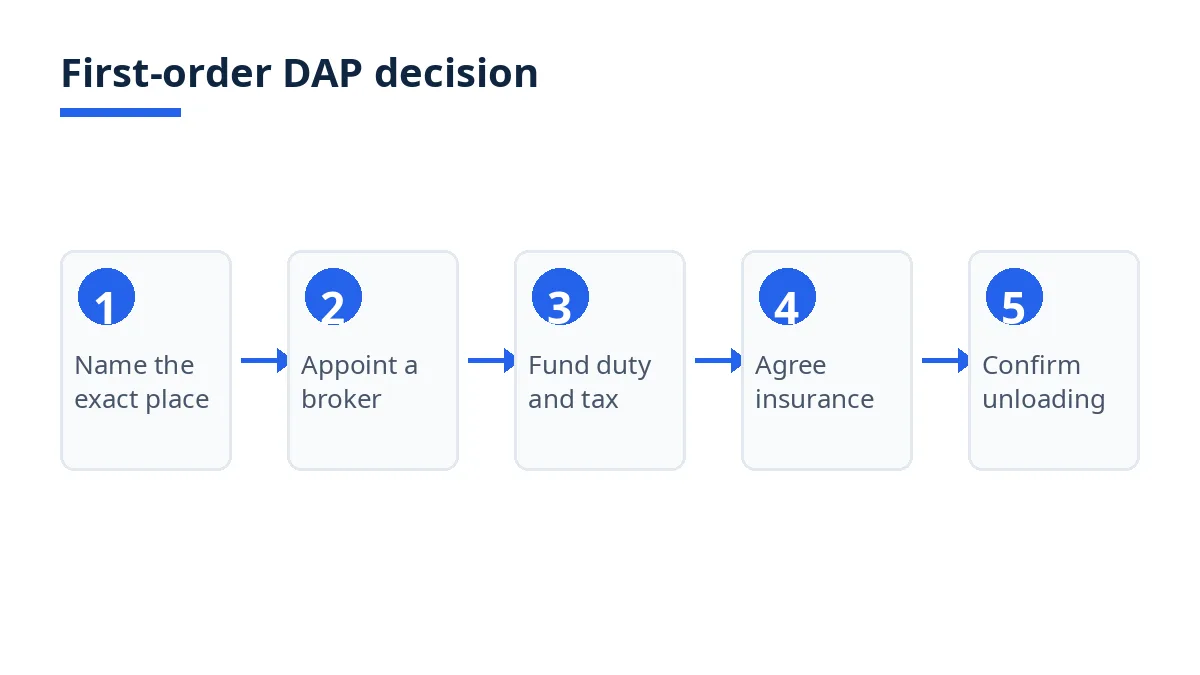
The diagram above summarises the five checks to complete before shipment: name the place, appoint the broker, fund duty and tax, agree insurance, and confirm unloading.
What should I know first about DAP?
DAP means the seller delivers the goods to a named place, ready for unloading, and bears the cost and risk of carriage to that place. The buyer unloads the goods, clears import customs, and pays import duty and tax.1 Delivery and destination are the same place under the D rules, unlike the C rules, where delivery happens at origin and only carriage is paid to the destination.2
What will a DAP first order cost beyond the DAP price?
Import duty and tax, broker and clearance charges, unloading, onward delivery, and any insurance the buyer arranges. In the United Kingdom, clearance ends with paying VAT and duty, and goods can be held at the border if the right amount has not been paid.6 In the United States, duties are calculated from classification, customs value, and country of origin, and the importer of record remains responsible even when a broker files the entry.7 Price every line to the warehouse, using the worked example above as the shape, not the figures.
Which documents do I need for a DAP first order?
The buyer-side papers are the commercial invoice, the packing list, and the transport document, plus the information the broker needs for the import declaration: the goods, their value, quantity, and origin.7 For ocean shipments to the United States, an Importer Security Filing must also be filed before the goods are laden abroad.7 The full seller and buyer document set is set out in the DAP documents checklist. Ask the broker what else the destination country requires for the specific goods.
What are the most common mistakes with DAP on a first order?
Naming only a city as the named place, assuming the DAP price includes duty, tax, and insurance, and leaving the broker appointment until the goods arrive.1 3 The root is the same each time: treating DAP as a delivered price, when it delivers the goods to a place and leaves import clearance, duty, unloading, and insurance with the buyer. Write the full named place, price the buyer-side remainder, and appoint the broker before shipment.
Next steps on Exportain
Compare DAP with the alternatives on the same order: read the Incoterms guide and the DAP decision guide, then post an RFQ stating the quantity, destination, Incoterm, and deadline, so suppliers quote on the term you have chosen.9 Read how to buy for the steps from first search to shipment, and agree the named place, the insurance, and the clearance plan in writing before the first order ships.
Sources
- DAP & DDP Incoterms 2020 explained: Key differences. ICC Academy (accessed )
- Incoterms® 2020 C rules vs D rules: Risk transfer explained. ICC Academy (accessed )
- DAP Incoterms (Delivered at Place): Meaning and Costs. iContainers (accessed )
- Top 11 Incoterms for Exporters & Importers | Complete Guide. Eximintell (accessed )
- Insider thoughts: Bob Ronai on Incoterms 2020 Rules; What are they about?. International Chamber of Commerce (accessed )
- Get UK customs clearance when importing goods into the UK: step by step. GOV.UK (accessed )
- Importing 101: How U.S. Customs Clearance Works. Reidel Law Firm (accessed )
- Incoterms for Shipments From Bangladesh. Exportain (accessed )
- How to source and buy from Bangladesh. Exportain (accessed )
- Incoterms
- landed cost
- cargo insurance
- buyer guide
- importing from Bangladesh
- First-time importers
- delivered at place
About the author
Sourcing from Bangladesh?
Post a request for quotation and suppliers on Exportain can send you their quotes directly.
Post an RFQ


